Struggling with unreliable water access in off-grid areas?
A failing pump can disrupt your entire operation, costing you time and money.
Solar pumps provide a durable, long-term solution, but understanding their true lifespan is key to a wise investment.
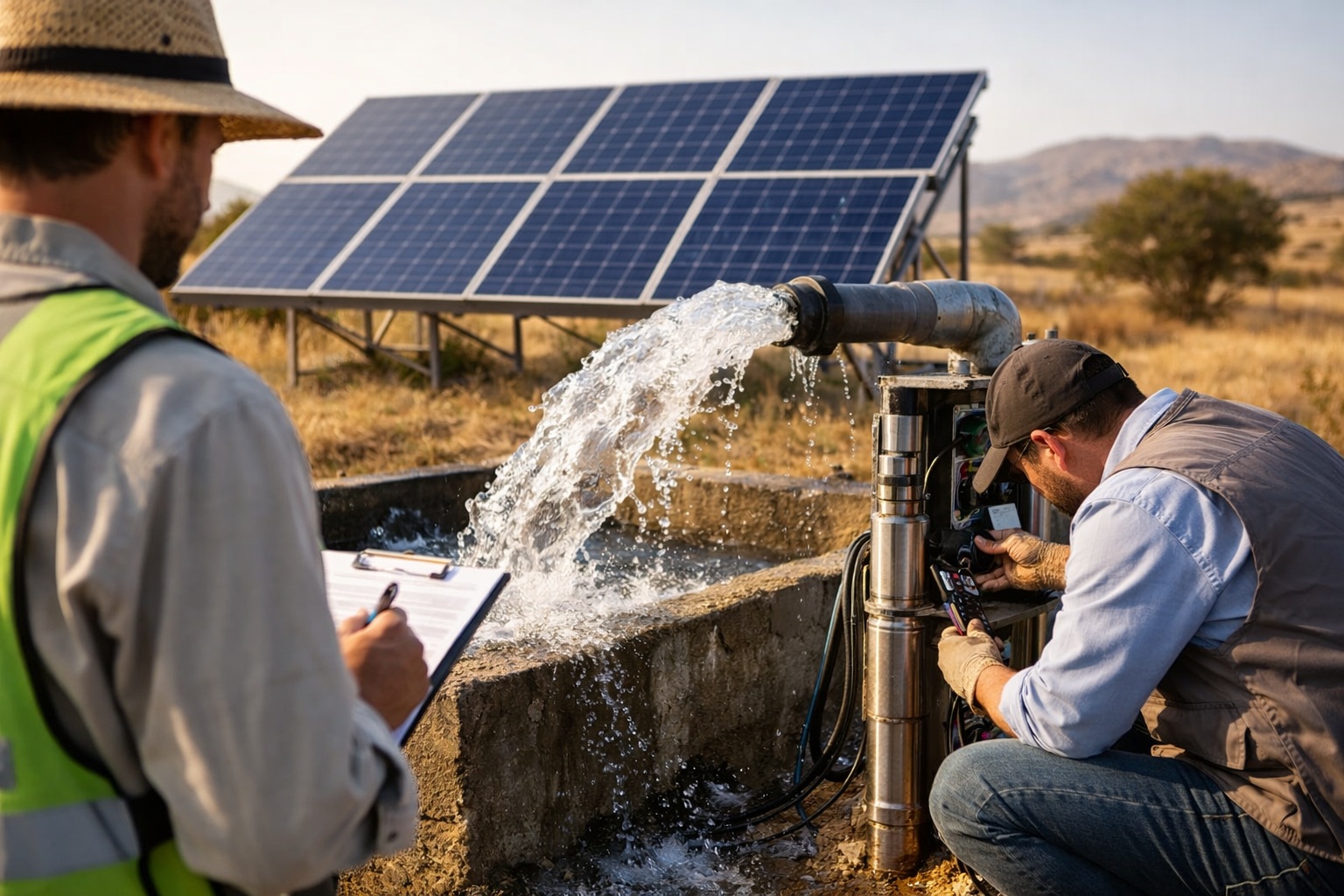
A well-maintained solar water pump system offers a remarkable lifespan.
The solar panels are rated to perform effectively for over 25 years.
The pump and motor assembly can reliably last between 10 and 20 years.
This longevity makes it a sustainable and cost-effective choice for long-term water security.
To truly grasp a pump's lifespan, you have to look beyond a single number.
The system is a collection of distinct components, each with its own durability characteristics and maintenance schedule.
Knowing how these parts work together is crucial for maximizing your return on investment.
Let's delve into the components that determine how long your solar pump will really last.
How long does a solar pump last?
Investing in a solar pump is a significant decision.
You worry about the risk of equipment failure and expensive replacements, especially in a remote location.
Understanding that a pump system is a collection of robust parts, each with a long expected lifespan, brings peace of mind.
The system's core components have varying life expectancies.
Solar panels maintain high efficiency for over 25 years.
The pump motor typically lasts 10-20 years based on usage.
Controllers and other parts are also engineered for long-term service, ensuring your investment is secure for decades.
A solar pump's longevity isn't determined by a single part, but by the durability of its entire ecosystem.
Each component is designed for a specific role and lifespan, and understanding this breakdown provides a clearer picture of long-term performance and maintenance expectations.
The two main components are the solar array and the pump unit itself.
Solar Panels: The 25-Year Powerhouse
Solar panels are the most durable part of the system.
They have no moving parts, making them exceptionally reliable.
Manufacturers typically provide a performance warranty guaranteeing that the panels will produce at least 80-87% of their rated power after 25 years.
Annual degradation is minimal, usually around 0.5%.
This means even after two decades, your power source will still be highly effective.
Their construction is robust, designed to withstand harsh weather conditions like hail, wind, and extreme temperatures, ensuring a consistent energy supply for years.
Pump & Motor Unit: The Heart of the Operation
The pump and motor assembly is the system's workhorse.
Its lifespan generally ranges from 10 to 20 years.
This variation depends heavily on factors like daily run time, water quality, and the specific type of pump mechanism.
A system operating for 6-8 hours daily will naturally last longer than one running 24/7.
Modern systems utilize high-efficiency brushless DC (BLDC) motors, which significantly extend lifespan by eliminating the wear and friction associated with traditional brushed motors.
The pump end, which contains the moving parts that push the water, might require maintenance or replacement sooner, but the motor core is built for longevity.
| Component | Average Lifespan | Key Longevity Factors |
|---|---|---|
| Solar Panels | 25+ Years | Minimal degradation, robust build |
| Pump Motor (BLDC) | 10 - 20 Years | Daily run hours, brushless design |
| Pump End | 5 - 15 Years | Water quality (sand/silt content), material |
| MPPT Controller | 8 - 15 Years | Protection from elements, electrical stability |
What types of solar pumps are there?
Choosing the right solar pump feels overwhelming with so many options.
You might select a pump that doesn't match your well's depth or flow needs, leading to poor performance.
By understanding the main types—screw, plastic impeller, and stainless steel impeller—you can pinpoint the perfect model for your application.
Solar deep well pumps come in three popular designs, each suited for different needs.
A solar screw pump offers high head for deep wells.
A plastic impeller pump provides high flow and wear resistance.
A stainless steel impeller pump delivers premium performance in corrosive water.
The pump end is where the "rubber meets the road" in a water system.
Its design directly impacts the pump's performance, efficiency, and durability under specific conditions.
The three primary types of solar deep well pumps—screw, plastic impeller, and stainless steel impeller—form a comprehensive product portfolio.
Each is engineered to excel in different environments, from deep, sandy wells in Africa to large-scale irrigation in the Americas.
These pumps are all powered by the same highly efficient core technology but are specialized for distinct market needs.
Solar Screw Pump: Low Flow, High Head
This pump type uses a positive displacement mechanism.
A single helical stainless steel screw (rotor) rotates within a rubber stator.
This action creates sealed cavities that move water upward through compression.
This design is brilliant for generating high pressure, making it ideal for lifting water from very deep wells.
Though its flow rate is lower compared to centrifugal pumps, its ability to handle significant head (pressure) is unmatched.
It is particularly effective in water sources with higher concentrations of sand or silt.
The flexible rubber stator can pass small solids without immediate damage, giving it superior sand resistance.
This pump is a go-to solution for domestic water supply, livestock drinking troughs, and small-scale drip irrigation in regions with deep water tables, such as parts of Africa and Latin America.
Its primary advantage is its toughness in harsh water conditions.
Solar Plastic Impeller Pump: High Flow, Wear-Resistant
This is a multi-stage centrifugal pump.
It features a series of impellers made from high-strength, wear-resistant engineering plastics.
As water enters the pump, each impeller stage adds pressure, efficiently moving large volumes of water at a medium head.
This design is optimized for high flow rates, making it perfect for applications that require more water volume than pressure, such as flood irrigation for farms, watering large pastures, and supplying water to residential gardens.
The plastic impellers offer excellent resistance to abrasion from fine sand, outperforming metal impellers in certain sandy conditions.
They are also lightweight and more economical to produce, making the overall pump system more affordable and easier to install.
This balanced performance makes it a popular choice across Africa and the Americas for agricultural and residential use.
Solar Stainless Steel Impeller Pump: Premium Quality, Corrosion Resistance
This model is the premium option in the centrifugal pump category.
It uses impellers, diffusers, and a pump housing all constructed from SS304 or even higher-grade SS316 stainless steel.
This construction is specifically designed to withstand corrosive and abrasive water conditions.
It offers exceptional durability in environments with acidic or alkaline water, high salinity, or other chemical contaminants.
It delivers high flow rates at medium-to-high heads, combining volume with power.
This pump is the ideal choice for demanding applications, such as supplying water in coastal regions, mining operations, or areas with alkaline soils like those found in parts of Australia.
Its long service life and high reliability justify the higher initial cost, making it perfect for high-end residential properties, critical industrial processes, and commercial farms where water quality is a concern.
What is a BLDC motor?
You want an efficient and reliable solar pump system.
Using an inefficient motor wastes precious solar energy, requiring more panels and increasing your initial costs.
A Brushless DC (BLDC) permanent magnet motor is the solution, offering over 90% efficiency and a maintenance-free, long lifespan.
The Brushless DC (BLDC) motor is the core of modern solar pumps.
It uses powerful permanent magnets and an electronic controller instead of traditional brushes.
This design results in over 90% efficiency, reduces wear, and extends the motor's lifespan, making your entire water pump system more powerful and cost-effective.
At the heart of every advanced solar water pump is its motor.
The motor's efficiency and durability are the most critical factors determining the entire system's performance and long-term value.
The shift to Brushless DC (BLDC) permanent magnet motors represents a major technological leap in the solar pumping industry.
This core power source is what enables the screw, plastic impeller, and stainless steel impeller pumps to achieve their impressive performance metrics.
Technical Advantages of BLDC Motors
BLDC motors are fundamentally superior to older motor technologies.
Their efficiency regularly exceeds 90%, whereas traditional AC or brushed DC motors often operate in the 60-75% efficiency range.
This massive efficiency gain comes from two key design features.
First, they use powerful permanent magnets (often neodymium iron boron) on the rotor, which creates a strong magnetic field without consuming electrical power.
Second, they eliminate mechanical brushes, which were a major source of energy loss through friction and electrical arcing.
Instead, an electronic controller precisely manages the flow of electricity to the stator windings, creating a rotating magnetic field that turns the rotor with minimal loss.
This design also results in higher torque, allowing the pump to start reliably even in low-light conditions.
The compact design means these motors can be up to 47% smaller and 39% lighter than conventional motors of the same power rating.
Market Value and Strategic Role
The high efficiency of a BLDC motor has a direct and significant impact on the total cost of a solar pump system.
Because the motor converts more sunlight into pumping power, it requires fewer solar panels to achieve a desired flow rate.
This can reduce the initial system cost by 15-25% or more, a substantial saving.
Furthermore, the brushless design means there are no brushes to wear out and replace, making the motor virtually maintenance-free and dramatically increasing its operational lifespan.
This reliability is crucial for installations in remote, hard-to-reach locations.
Strategically, the BLDC motor is the engine that drives the competitiveness of the entire product line.
It enhances the performance of every pump type, whether it's the high-head screw pump or the high-flow centrifugal models.
By pairing this efficient motor with an intelligent MPPT controller, the system maximizes power generation throughout the day, providing a dependable and energy-efficient water solution.
What is an AC/DC solar pump?
You need water around the clock, not just when the sun is shining.
Standard solar pumps stop working on cloudy days or at night, leaving you without water when you might need it most.
An AC/DC hybrid pump solves this by automatically switching to grid or generator power when solar energy is insufficient.
An AC/DC hybrid solar pump offers the best of both worlds.
It runs primarily on free solar energy during the day.
When sunlight is low, its intelligent controller automatically switches to an alternate AC power source, like the grid or a generator, ensuring you have a reliable water supply 24/7.
While solar power offers incredible autonomy, its primary limitation has always been its dependence on sunlight.
For applications requiring a constant water supply—such as households, critical livestock operations, or irrigation schedules that extend past daylight hours—a standard DC-only solar pump may not be enough.
This is where hybrid AC/DC solar pump systems come in.
They are engineered to provide uninterrupted water access by seamlessly integrating solar power with conventional AC electricity.
This technology addresses the core challenge of solar variability, making solar pumping a viable solution for 24-hour water needs.
Intelligent Power Management
The brain of an AC/DC hybrid system is its advanced controller.
This controller is designed with dual power inputs, allowing it to be connected to a DC solar array and an AC power source (like the utility grid or a backup generator) simultaneously.
The controller's built-in logic constantly monitors the power available from the solar panels.
Its primary goal is to maximize the use of free solar energy.
When there is sufficient sunlight, the system will run 100% on solar power.
The controller automatically identifies the DC input and prioritizes it, ensuring you are using the most cost-effective energy source available.
Hybrid Function and Automatic Switchover
What happens on an overcast day or when the sun starts to set?
This is where the "hybrid" function becomes critical.
If the solar panels are not producing enough power to meet the pump's demands, the controller can blend solar power with AC power.
It draws as much energy as it can from the panels and supplements the rest with AC electricity.
This maximizes the use of every available watt of solar energy, keeping your utility costs to a minimum.
When there is no solar input at all, such as at night, the controller performs an automatic and seamless switchover to the AC power source.
The pump continues to operate without any interruption or manual intervention.
This ensures a consistent and worry-free water supply around the clock, giving users the environmental and financial benefits of solar without sacrificing the reliability of a traditional grid-powered pump.
This dual-power capability makes solar pumping a practical solution for a much wider range of applications.
Conclusion
A solar pump’s lifespan hinges on its components and usage.
With durable panels, efficient motors, and proper pump selection, a system can reliably provide water for over two decades, making it a smart, sustainable investment.
Frequently Asked Questions
Can a solar pump run at night?
Generally, no, as they rely on sunlight.
However, AC/DC hybrid models or systems with battery storage can operate at night by using grid power or stored energy.
How many solar panels are needed to run a well pump?
This depends on the pump's horsepower and your daily water needs.
A small 1/2 HP pump might only need 2-4 panels, while larger pumps require more.
Do solar water pumps work on cloudy days?
Yes, they can operate on cloudy days, but at a reduced flow rate.
The amount of water pumped will be proportional to the level of sunlight available.
Do you need a battery for a solar water pump?
Batteries are not required for most systems.
It is often more cost-effective to pump water into a storage tank during the day for later use.
How deep can a solar pump go?
The depth depends on the pump model.
Solar screw pumps are designed for high head and can lift water from depths exceeding 500 feet (150 meters).
Can I use a solar pump for my house?
Absolutely.
Solar pumps, especially when paired with a pressure tank or a tankless pressure system, are an excellent and sustainable solution for household water supply.
What maintenance does a solar pump require?
Maintenance is minimal.
It mainly involves wiping the solar panels clean a few times a year and periodically checking for any wear on the pump end.