Struggling with a pool that's too cold to use most of the year?
You want a longer swim season without massive energy bills.
A pool heat pump is generally better for guaranteed, year-round heating, while a solar heater offers lower running costs but depends entirely on sunshine.
For consistent temperature control in any weather, day or night, a heat pump is the more reliable investment for extending your swimming season.
Deciding how to heat your pool is a major choice for any homeowner.
You want to maximize your enjoyment without creating a financial or maintenance headache.
This guide will break down the two leading options: solar heaters and heat pumps.
We will compare their costs, performance, and long-term value.
This will help you make an informed decision that fits your climate, budget, and swimming habits.
Let's dive into the details to find the perfect heating solution for your backyard oasis.
Solar Pool Heaters Explained
Tired of your pool's temperature depending entirely on the weather?
Solar heating offers a green solution, but its effectiveness can be inconsistent, leaving your pool cold on cloudy days.
A solar pool heater uses panels, typically mounted on your roof, to directly absorb the sun's thermal energy.
Your pool pump circulates water through these panels, where it heats up before returning to the pool.
It's an eco-friendly method with nearly zero operating costs, perfect for sunny climates.
A solar pool heater is a straightforward and environmentally sound system.
It taps directly into the sun's thermal radiation, making it highly efficient at converting sunlight into heat.
Unlike solar photovoltaic (PV) panels that create electricity, these thermal collectors are purpose-built for heating water.
Let's explore the mechanics, benefits, and drawbacks in more detail.
How it Works
The system is simple yet effective.
Your existing pool pump sends cool water from the pool up to a series of solar collectors.
These collectors are usually long panels containing many small tubes.
As the water flows through these tubes, it absorbs the heat collected by the dark surface of the panels.
The now-warmed water then flows back into your pool, gradually raising its overall temperature.
This cycle continues as long as the pump is running and there's enough solar energy to provide a net heat gain.
A controller automates the process, diverting water to the collectors only when they are warmer than the pool water.
Advantages of Solar Heating
The main appeal of solar heating is its incredibly low operating cost.
- Eco-Friendly: The system produces zero emissions, using 100% renewable energy from the sun.
- Low Running Costs: Once installed, the only cost is the electricity to run your pool pump, which you are likely running anyway for filtration.
There is no additional charge for the heat itself. - Minimal Maintenance: Solar collectors are durable and have few moving parts, requiring little to no maintenance over their long lifespan.
- Long Lifespan: With proper care, solar collector panels can last for 15 to 20 years, significantly longer than most mechanical heaters.
Disadvantages to Consider
Despite its benefits, solar heating is not without its limitations.
- Weather Dependent: This is the most significant drawback.
The system's performance is tied directly to the amount of available sunshine.
On cloudy days or during rainy periods, it will not heat the pool effectively, if at all. - Slower Heating: Solar heaters raise the pool temperature gradually.
They cannot provide the rapid, on-demand heating that a heat pump or gas heater can. - Daytime Operation Only: A solar heater only works when the sun is out.
It cannot operate at night, which is when pools lose the most heat. - Space Requirements: The collector panels require a large, unshaded area, typically on a roof.
This can be a challenge for homes with limited or unsuitable roof space.
The general rule is that the collector area should be 50% to 100% of the pool's surface area. - Higher Initial Cost: While operating costs are low, the upfront investment for a solar heating system can be higher than for a heat pump.
Pool Heat Pumps Demystified
Want your pool warm and ready whenever you are, day or night?
A heat pump offers consistent, on-demand heating but comes with a higher daily running cost than a solar system.
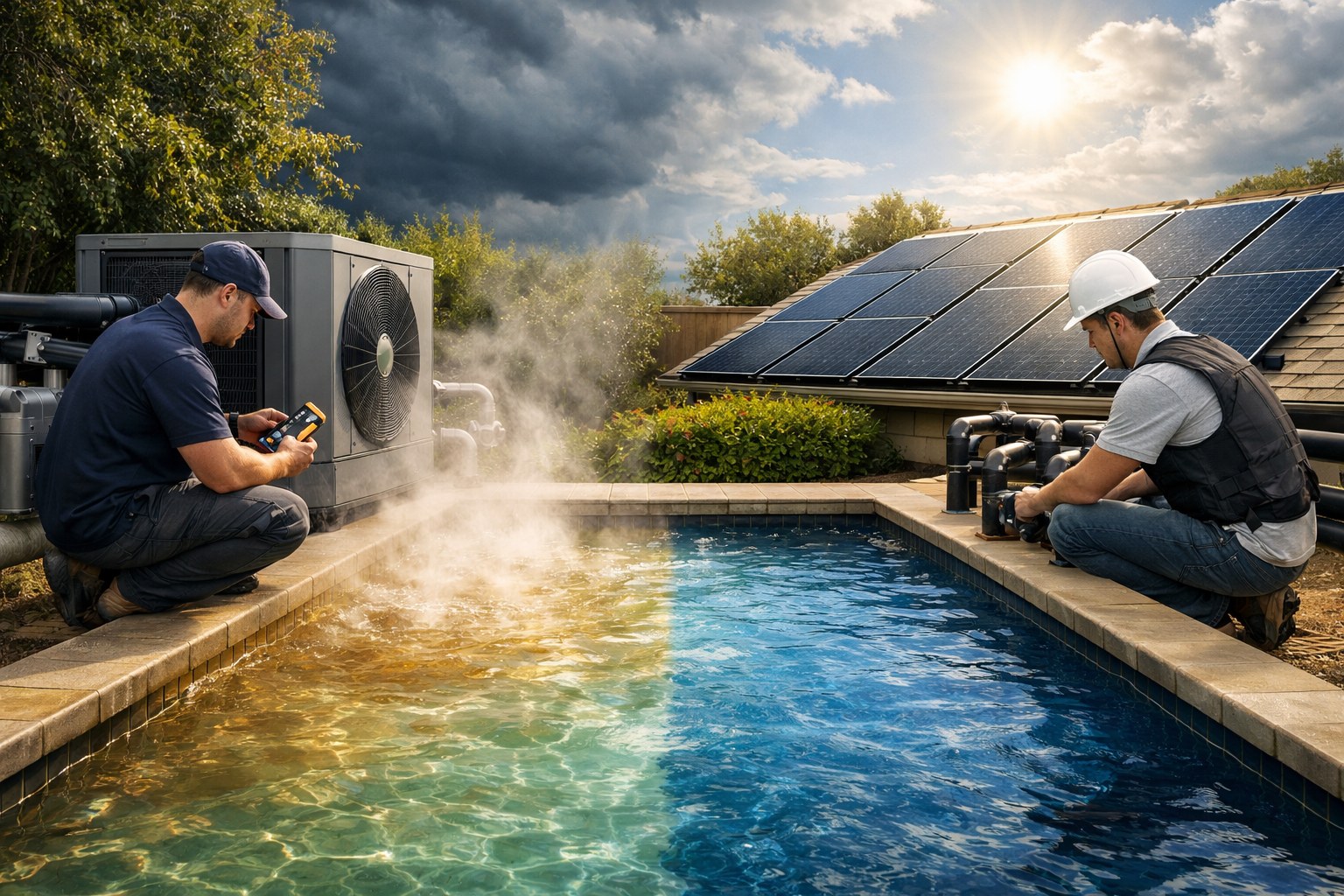
A pool heat pump works like a reverse air conditioner, pulling heat from the ambient air and transferring it to your pool water.
It uses electricity to power a fan and compressor, making it highly efficient but not dependent on direct sunlight, so it can operate 24/7.
The pool heat pump is the go-to choice for reliable and flexible pool heating.
It doesn't create heat from scratch like a gas or electric resistance heater.
Instead, it cleverly moves heat from one place to another.
This heat transfer method is a game-changer for extending the swim season, even into the cooler months.
Let's break down how this technology provides consistent warmth for your pool.
How Heat Pumps Function
The process is a marvel of thermodynamics.
- Air Intake: A fan draws in outside air and directs it over an evaporator coil.
- Heat Absorption: A liquid refrigerant within the evaporator coil absorbs heat from the air, turning the liquid into a gas.
- Compression: The gas is then passed through a compressor, which dramatically increases its temperature and pressure.
- Heat Transfer: This superheated gas travels to a condenser, also known as a heat exchanger.
Pool water is simultaneously pumped through the heat exchanger, where it absorbs the heat from the hot gas. - Cycle Repeat: The refrigerant cools, turns back into a liquid, and the cycle begins again.
Because it only uses electricity to run the components (fan and compressor) to move existing heat, it's incredibly efficient.
The Measure of Efficiency: COP
The efficiency of a heat pump is measured by its Coefficient of Performance (COP).
The COP is the ratio of heat energy output to the electrical energy input.
A COP of 6 means that for every 1 kilowatt (kW) of electricity consumed, the heat pump produces 6 kW of heat.
| Heating Method | Typical COP | Energy Source |
|---|---|---|
| Pool Heat Pump | 5-10 | Air (Heat) + Electricity |
| Gas Heater | < 1.0 | Natural Gas or Propane |
| Electric Resistance | 1.0 | Electricity |
| Solar Heater | N/A | Direct Sunlight |
As the table shows, heat pumps are 500% to 1000% more efficient than traditional electric resistance heaters.
Modern inverter heat pumps can achieve even higher COPs by adjusting their speed to match the heating demand.
Heat Pump Advantages
The benefits of a heat pump center on performance and convenience.
- Consistent Performance: Heat pumps work regardless of direct sunlight.
They operate effectively in cloudy weather and even at night, as long as the ambient air temperature is above roughly 7-10°C (45-50°F). - Heats Faster: Compared to a solar heater, a heat pump can raise the pool temperature much more quickly.
- Total Temperature Control: You can set your desired temperature, and the heat pump will work to maintain it automatically.
- Cooling Capability: Many heat pumps have a reverse cycle, allowing them to cool your pool water during peak summer heat—a feature solar heaters cannot offer.
- Small Footprint: They require only about 6 square feet of ground space, making installation flexible.
Heat Pump Disadvantages
The primary drawbacks are related to cost and mechanics.
- Operating Cost: While efficient, they still consume electricity, leading to higher monthly utility bills compared to a solar heater's near-zero running cost.
- Slower than Gas: They heat faster than solar but slower than a gas heater, taking anywhere from 8 to 24 hours for the initial temperature rise.
- Air Temperature Dependent: Their efficiency drops as the air gets colder, and most standard units will not operate effectively in near-freezing temperatures.
- Mechanical Complexity: With more moving parts like compressors and fans, they have a shorter lifespan (typically 10-15 years) and repair costs can be significant.
Cost Comparison: Upfront vs. Long-Term
Worried about the financial impact of heating your pool?
Both systems have significant costs, but they are weighted differently between upfront investment and long-term operating expenses.
Solar heaters have a high initial cost but almost no running costs, making them cheaper over their 15-20 year lifespan.
Heat pumps have a lower upfront cost but ongoing electricity expenses, which can add up significantly over time, especially if not paired with a pool cover.
Choosing between a solar heater and a heat pump often comes down to budget.
It's crucial to look beyond the initial price tag and consider the total cost of ownership over the lifetime of the system.
This includes the purchase price, installation, ongoing energy costs, and maintenance.
Let's examine how these two options stack up financially.
Initial Investment
The upfront cost is the first financial hurdle.
It includes the equipment itself and professional installation.
-
Solar Pool Heater: The initial outlay for a solar system is generally higher.
Costs can range from $3,000 to $7,000 or more, depending on the size of your pool and the complexity of the installation.
Factors influencing the price include roof type, panel brand, and the need for a booster pump. -
Pool Heat Pump: Heat pumps typically have a lower upfront cost, with prices for quality residential units starting around $2,500 and going up to $6,000.
The size (kW output) required for your pool is the biggest price driver.
Installation is usually simpler and less expensive than for a solar system.
Long-Term Operating Costs
This is where the two systems dramatically diverge.
-
Solar Pool Heater: The cost to operate a solar heater is virtually zero.
The heat energy from the sun is free.
The only associated cost is the small amount of electricity your pool pump uses to circulate water through the collectors, which it would be doing anyway for filtration.
This can amount to less than $100 per year. -
Pool Heat Pump: A heat pump's running cost depends on several factors:
- Your local electricity rate.
- The size and efficiency (COP) of your unit.
- The desired pool temperature.
- The ambient air temperature.
- Whether or not you use a pool cover.
Annual running costs can range from $250 to $850 per season.
However, without a pool cover, heat loss can cause these costs to double or even triple, as the heater must work much harder.
Payback Period & Return on Investment
Let's consider a simple cost-benefit analysis.
| Feature | Solar Pool Heater | Pool Heat Pump |
|---|---|---|
| Upfront Cost | High | Medium |
| Running Cost | Very Low | Moderate |
| Lifespan | 15-20+ years | 10-15 years |
| Payback Period | 5-8 years (vs gas) | 2-5 years (vs gas) |
While the solar heater's payback period against "free" heating is infinite, its real return comes from its longevity and minimal running costs.
Over a 20-year period, a solar system is almost always the cheaper option overall.
A heat pump provides a faster return when compared to very expensive gas heating but will always have a recurring energy cost.
The financially optimal choice depends on how long you plan to stay in your home.
For long-term homeowners in sunny areas, solar is a sound investment.
For those who prioritize immediate heating power and may have a shorter time horizon, a heat pump might be more appealing despite the ongoing costs.
The Hybrid Solution: Best of Both Worlds?
Can't decide between free solar energy and reliable on-demand heat?
Combining systems can be expensive, but it offers unparalleled performance and efficiency, giving you the ultimate control over your pool.
A hybrid system uses a solar heater as the primary, low-cost heat source, with a heat pump acting as a backup.
The heat pump only kicks in when needed—on cloudy days, at night, or for a quick temperature boost—saving up to 90% on heating costs compared to using a heat pump alone.
For the pool owner who wants it all—maximum energy savings, a near-year-round swim season, and the flexibility to heat the pool on demand—a hybrid system is the ultimate solution.
This approach combines the strengths of both solar heaters and heat pumps while minimizing their individual weaknesses.
It represents a significant upfront investment but delivers the most efficient, flexible, and cost-effective heating over the long term.
How a Hybrid System Works
In a hybrid setup, both a solar heater and a heat pump are installed and integrated into your pool's plumbing.
-
Primary Heating: The solar system serves as the primary heater.
Whenever the sun is shining and the collectors are warm enough, it does the heavy lifting, heating the pool with free, renewable energy.
This covers the bulk of your heating needs during sunny weather, drastically reducing your reliance on paid electricity. -
Secondary/Backup Heating: The heat pump acts as the secondary or backup heater.
It is set to a minimum desired temperature.
The heat pump's controller monitors the pool water and will only activate if the solar system is unable to maintain that setpoint.
This typically happens:- During several consecutive cloudy or rainy days.
- At night, to offset heat loss.
- At the beginning or end of the season when more heating power is needed.
- When you want to heat the pool quickly for an impromptu swim.
The Synergy of a Hybrid System
The real magic of a hybrid system lies in how the two technologies complement each other.
| Scenario | Primary System | Backup System | Outcome |
|---|---|---|---|
| Sunny Day | Solar | Off | Pool is heated for free. |
| Cloudy Day | Solar (low) | Heat Pump (on) | Heat pump assists to maintain temperature. |
| Nighttime | Off | Heat Pump (on) | Heat pump offsets heat loss to keep the pool ready for the next day. |
| Quick Heat-Up | Solar (if on) | Heat Pump (on) | Both systems can work together for the fastest possible heating. |
This intelligent application means you are always using the cheapest available energy source.
The expensive-to-run heat pump is only used when absolutely necessary, leading to massive energy savings.
Is a Hybrid System Right for You?
While it sounds ideal, a hybrid system isn't for everyone.
Consider a Hybrid System If:
- You want to extend your swimming season as long as possible, even into the cooler months.
- You live in an area with variable weather (e.g., sunny periods mixed with cloudy spells).
- Energy efficiency and long-term cost savings are your top priorities.
- You are willing to make a larger upfront investment for superior performance and flexibility.
A Hybrid System May Be Overkill If:
- You live in a consistently hot and sunny climate where a solar heater alone is sufficient.
- Your budget for the initial installation is limited.
- You only need to take the chill off the water for a few months a year, where a heat pump alone would suffice.
Ultimately, a hybrid system is an investment in lifestyle.
It guarantees a warm pool whenever you want it, with the lowest possible environmental and financial impact over its lifetime.
Conclusion
A heat pump offers reliable, all-weather heating, while solar provides eco-friendly, low-cost warmth.
The best choice depends on your climate, budget, and desire for on-demand versus passive heating.
FAQs
How much does it cost to run a pool heat pump?
On average, running a pool heat pump costs between $250 and $850 per season.
This varies based on electricity rates, climate, and use of a pool cover.
How long does it take for a heat pump to heat a pool?
The initial heating can take 8 to 24 hours to raise the temperature significantly.
After that, it maintains the temperature with shorter, more frequent cycles.
Are pool heat pumps worth the money?
Yes, if you want to reliably extend your swim season.
They are much more efficient than gas or electric resistance heaters, making them a cost-effective way to guarantee a warm pool.
What is the best temperature for a pool?
Most people find a temperature between 26°C and 28°C (78°F to 82°F) comfortable for recreational swimming.
Therapy or exercise pools are often kept warmer.
Should I run my pool pump at night with a solar heater?
No, running a solar heater at night will cool your pool.
The system should only operate during the day when the solar collectors are warmer than the pool water.
Can you use a heat pump and solar heater together?
Yes, this is called a hybrid system.
It uses solar as the primary heater and the heat pump as a backup, offering the best combination of low cost and reliable performance.
Do you need a pool cover with a heater?
Yes, a pool cover is essential.
It can reduce heating costs by 50-70% by preventing heat loss through evaporation, especially at night.
Your heater will run less and last longer.
Can a pool heat pump work in winter?
Standard heat pumps lose efficiency in cold air and stop working around 7°C (45°F).
Specialized cold-climate models can operate in freezing temperatures, but are more expensive.