Struggling with high electricity bills or no grid access for your pond pump?
You feel the constant drain on your wallet and the limitations of traditional power sources.
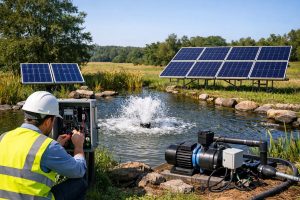
Solar power offers a cost-effective, eco-friendly solution to keep your pond vibrant.
The number of solar panels needed depends on your pump's horsepower (HP) and type.
A small 1/2 HP DC pond pump can run on as few as two 100-watt panels, while a larger 1 HP AC pump might need eight 100-watt panels or more.
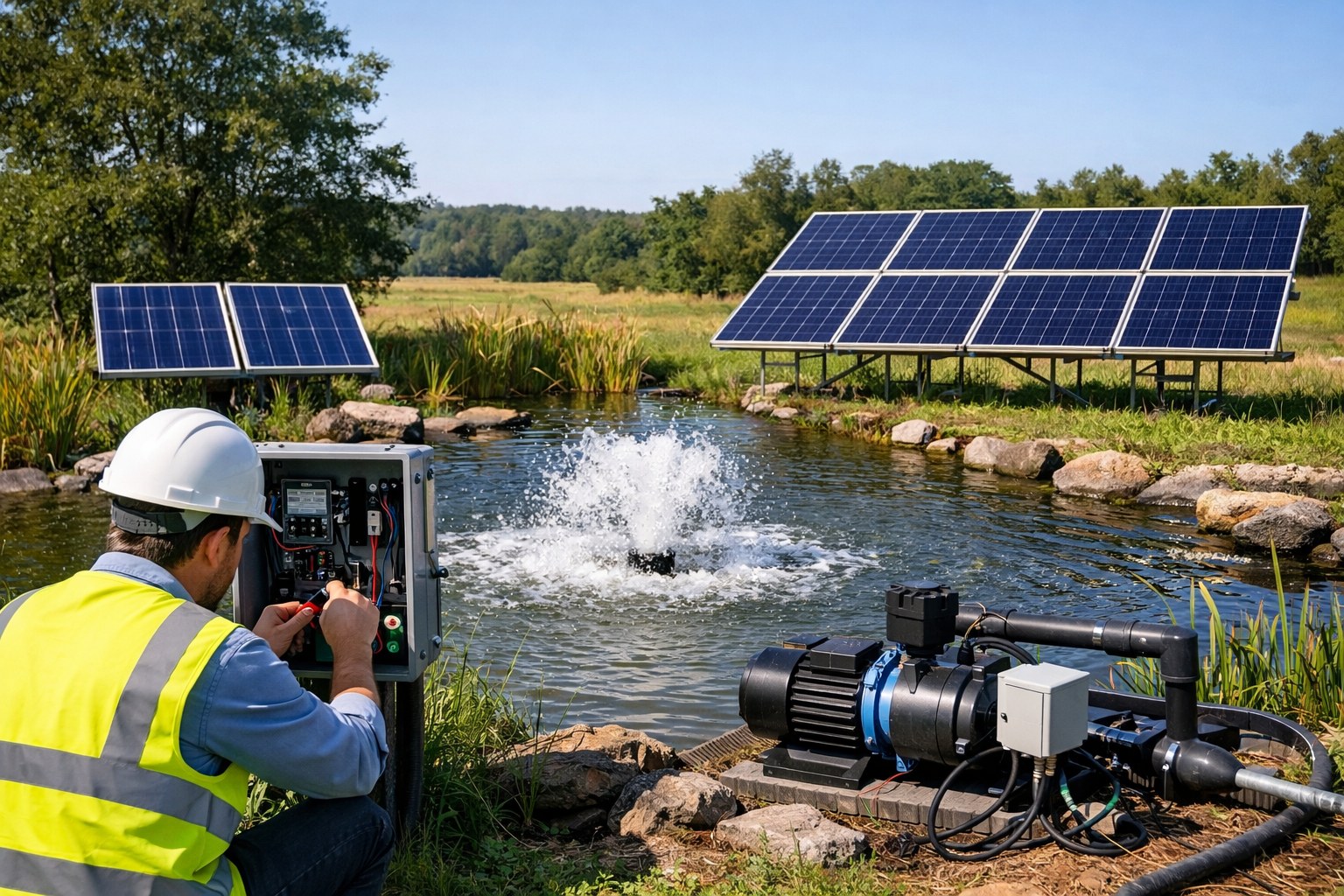
Understanding your pump's specific power needs is the first step toward energy independence.
Factors like daily sunlight hours, pump efficiency, and whether you need battery backup will influence your final panel count.
Let's explore the details to ensure you build the perfect solar setup for your pond.
Understanding the Two Main Classes of Pumps
Are you trying to figure out if your existing pump can go solar or if you need a new one?
This uncertainty can be frustrating and might delay your project.
The answer lies in understanding the two main pump categories: pumps designed for solar and classic AC pumps.
The number of solar panels you need is directly tied to your pump's design.
Pumps built specifically for solar (DC pumps) are highly efficient and require fewer panels.
Conversely, standard AC pumps can be adapted but typically demand a larger, more powerful solar array to operate effectively.
The choice between these two pump types is the most critical factor in determining the size and cost of your solar panel system.
A pump specifically designed for solar power is built with efficiency as a top priority.
These are typically Direct Current (DC) pumps that can run directly off the power generated by solar panels, minimizing energy loss.
Their internal mechanics, often featuring high-efficiency BLDC permanent magnet brushless motors, are optimized for variable solar power input.
This efficiency means they can start up and operate even in lower light conditions.
For pond applications, this could mean circulation starts earlier in the morning and continues later into the evening.
Pumps Designed for Solar
These pumps are the most energy-efficient option.
Because they run on DC power, they connect to solar panels with minimal conversion losses.
A DC pump system is streamlined, usually consisting of just the panels, a controller, and the pump itself.
The controller, often using Maximum Power Point Tracking (MPPT) technology, constantly adjusts the electrical load to extract the maximum available power from the solar panels, boosting efficiency by up to 30%.
This setup reduces the total number of panels required, lowering upfront costs and simplifying installation.
| Pump Size (HP) | Typical Panel Wattage | Number of 100W Panels |
|---|---|---|
| 1/4 HP | 200W | 2 |
| 1/2 HP | 400W | 4 |
| 1 HP | 800W - 1200W | 8 - 12 |
Classic AC Pumps
Most standard pond pumps are Alternating Current (AC) pumps, designed to plug into a household electrical outlet.
Making an AC pump run on solar power is possible, but it requires an extra component: an inverter.
Solar panels produce DC power, so an inverter is needed to convert it to AC power for the pump.
This conversion process is not 100% efficient; some energy is always lost as heat.
Due to this inefficiency, an AC pump will require more solar panel wattage to perform the same amount of work as an equivalent DC pump.
For example, a 1 HP AC pump might need 1,500 watts of solar panels, whereas a 1 HP DC pump might only need 1,200 watts.
While using an existing AC pump can save on the initial cost of the pump itself, the need for a larger solar array and a high-quality inverter can sometimes make the total system cost higher.
How Many Panels Do I Need for a 1HP Motor?
You have a 1 HP pump for your pond but are unsure how to power it with the sun.
This confusion can lead to buying too few panels, resulting in poor performance, or too many, wasting money.
Getting the panel count right from the start is crucial for a reliable system.
A new, highly efficient 1 HP three-phase DC pump may only require 1200 watts, or twelve 100W solar panels.
However, an older, single-phase AC pump of the same size could demand more panels due to lower efficiency and the power needed for an inverter.
Several factors beyond just horsepower will dictate the final number of panels.
The age of your pump, its phase type, and the type of motor it uses all play a significant role.
A deeper dive into these specifics will help you build a system that is both effective and economical, ensuring your pond gets the water circulation it needs without interruption.
Single-Phase vs. Three-Phase Motors
The electrical phase of your pump motor is a major determinant of its efficiency.
-
Single-Phase Motors: These are common in smaller, residential pumps.
They are simpler in construction but are less efficient than their three-phase counterparts.
When running a single-phase AC pump on solar, the inverter has to work harder, and the motor itself draws more power upon startup.
This inefficiency means you'll need to oversize your solar array by 20-30% to ensure reliable operation. -
Three-Phase Motors: Often found in higher-quality or larger pumps, these motors are inherently more efficient.
They provide a smoother, more consistent power delivery, which translates to less energy waste.
Many modern solar pump systems use a specialized controller that takes DC power from the panels and outputs three-phase AC power directly to the pump, combining high efficiency with robust performance.
Pump Age and Condition
A pump's efficiency naturally decreases over time.
Seals wear out, impellers erode, and internal friction increases.
A 10-year-old 1 HP pump will not perform the same as a brand-new one.
It will require more energy to start up and to move the same volume of water.
When sizing a solar array for an older pump, it's wise to add an extra 10-25% panel capacity to compensate for this age-related efficiency loss.
This ensures the pump receives enough power to run reliably, especially on days that are not perfectly sunny.
The Power of the BLDC Motor
The heart of every modern, efficient solar pump is a Brushless DC (BLDC) permanent magnet motor.
These motors are a game-changer for solar applications.
With efficiencies often exceeding 90%, they convert significantly more electrical energy into mechanical work compared to traditional motors.
This high efficiency has a direct impact on your solar array.
A pump with a BLDC motor requires fewer solar panels to operate, which reduces the system's overall cost and physical footprint.
Their design also allows for a wider operating range, meaning the pump can function effectively even when solar radiation is low.
| Factor | Impact on Panel Count | Recommendation |
|---|---|---|
| Motor Phase | Single-phase is less efficient; requires more panels. | Choose a three-phase pump system for optimal efficiency. |
| Pump Age | Older pumps lose efficiency; require more power. | Add 10-25% more panel capacity for pumps over 5-10 years old. |
| Motor Type | BLDC motors are over 90% efficient; need fewer panels. | Prioritize pump kits that use BLDC permanent magnet motors. |
Choosing the Right Pump for Your Pond
You need a pump, but the choices seem overwhelming.
From screw pumps to impeller pumps, how do you know which is best for your pond's depth and water quality?
Making the wrong choice can lead to inadequate water flow, frequent clogs, or premature failure.
The key is to match the pump type to your specific needs.
For ponds needing to move water to a high waterfall, a high-head pump like a solar screw pump is ideal.
For general circulation in dirty water, a wear-resistant plastic impeller pump excels.
For pristine water features, a durable stainless steel impeller pump offers longevity.
Understanding the distinct advantages of each pump technology allows you to select a model that not only performs reliably but also optimizes your solar panel investment.
Let's break down the three most popular solar pump designs to help you make an informed decision and ensure your pond thrives for years to come.
Solar Screw Pump: High Head Specialist
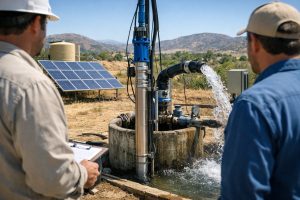
If your pond design includes a tall waterfall or a stream that starts far above the pond's surface, you need a pump that can push water vertically with force.
This is where the solar screw pump, also known as a progressing cavity pump, shines.
It uses a rotating stainless steel screw within a rubber stator to create pressurized pockets of water, effectively pushing it to great heights.
- Best For: High-head applications like waterfalls, fountains, and long-distance water transfer.
- Advantages: Excellent at handling deep or high-lift situations.
They are also highly resistant to sand and sediment, making them a durable choice for natural-bottom ponds. - Limitations: They provide a lower flow rate (Gallons Per Minute) compared to impeller pumps of the same HP.
This makes them less suitable for applications requiring rapid, high-volume circulation.
Solar Plastic Impeller Pump: The High-Flow Workhorse
For most standard pond circulation and filtration needs, moving a large volume of water is the top priority.
The solar plastic impeller pump is a multi-stage centrifugal pump designed for exactly this purpose.
It uses a series of durable, engineered plastic impellers to accelerate water, delivering high flow rates at low to medium head.
- Best For: General pond circulation, filtration systems, and supplying water to gentle streams.
- Advantages: Delivers the highest water output for its power class.
It's lightweight, economical, and offers excellent resistance to abrasion from fine sand or silt. - Limitations: Not ideal for very high waterfalls or in highly corrosive water environments.
The plastic components may wear faster than stainless steel in harsh conditions.
Solar Stainless Steel Impeller Pump: Premium Durability
When longevity and resistance to corrosion are paramount, the solar stainless steel impeller pump is the premium choice.
Both the impellers and the pump housing are constructed from SS304 stainless steel, making it incredibly durable.
This model is designed for challenging water conditions and provides reliable high flow for decades.
- Best For: Ponds with acidic or alkaline water, high-end water features, and any application where maximum reliability is required.
- Advantages: Superior corrosion resistance and a very long service life.
It can handle demanding conditions without degrading. - Limitations: This is the most expensive and heaviest option.
Its premium cost is justified for niche applications or for users who prioritize long-term, maintenance-free operation.
Extending Pumping for All Conditions
Worried that solar power means no water on cloudy days or at night?
This is a common concern that can make people hesitant to switch to solar.
You need a reliable water supply for your pond's ecosystem, regardless of the weather.
The solution is a hybrid system or adding extra panels.
AC/DC hybrid controllers automatically switch to grid power when sunlight is insufficient.
Alternatively, adding extra panels to your array can extend pumping into the low-light hours of the morning and evening, ensuring more consistent operation.
With the right system design, you don't have to compromise on reliability.
Modern solar pumping technology offers flexible solutions to guarantee your pond has the water it needs, 24/7.
Whether for household use or critical livestock watering, you can achieve worry-free water security powered by the sun.
The Power of AC/DC Hybrid Systems
For applications where a constant water supply is non-negotiable, an AC/DC hybrid controller provides the ultimate peace of mind.
This intelligent device is connected to both your solar panel array and a standard AC power source, like the grid or a generator.
- Automatic Switching: The controller prioritizes solar power.
As long as the sun is providing enough energy, the pump runs entirely on free solar electricity.
When clouds roll in or night falls and solar input drops, the controller instantly and automatically switches to the AC backup power. - Maximized Solar Use: Advanced hybrid controllers can even blend power sources.
If the panels are producing some power but not quite enough, the controller will supplement it with just enough AC power to keep the pump running, maximizing your use of solar energy and minimizing your electricity bill. - 24/7 Operation: This technology ensures your pond aerator, fountain, or filtration system can run around the clock without interruption, protecting fish and maintaining water quality.
Adding Panels for Longer Pumping Days
If a full hybrid system isn't necessary, but you'd like to get more out of your solar pump, a simple solution is to expand your solar array.
By adding a few extra panels in parallel to your existing setup, you increase the system's ability to capture energy in non-ideal conditions.
- Earlier Mornings & Later Evenings: A larger solar array will meet the pump's minimum power requirement earlier in the morning and later in the evening when the sun is low in the sky.
This can add several hours of valuable pumping time to your day. - Better Cloudy Day Performance: On overcast days, the sun's energy is scattered.
A larger array provides a bigger "net" to capture this diffuse light, often providing enough power to keep the pump running at a reduced speed when a smaller array would have shut down completely.
This strategy is particularly effective for off-grid pond management where maximizing daily water volume is the primary goal, and running at night is not a requirement.
Conclusion
The number of panels depends on your pump's type, horsepower, and efficiency.
An efficient DC pump requires fewer panels than an AC pump, ensuring a cost-effective and reliable solar solution for your pond.
Frequently Asked Questions
Can a solar panel run a water pump directly?
Yes, a DC water pump can be run directly from a solar panel, typically through a controller which optimizes the power from the panel to the pump.
How many watts does it take to run a pond pump?
A small pond pump might use 200-400 watts, while larger pumps for waterfalls can require 1000 watts or more, depending on the required flow and lift.
How do I choose a solar pond pump?
Choose based on your pond's volume, desired flow rate (GPH), and the vertical height (head) the water needs to be lifted. Higher head requires a more powerful pump.
Do solar powered pond pumps work at night?
Not without a battery backup system.
Standard systems only operate when there is sufficient sunlight to power the panels.
What size solar panel and battery do I need for a water pump?
This depends on the pump's wattage and how many hours you need it to run at night.
Calculate your daily energy need (watts x hours) to size the battery and panels.
Are solar pond aerators effective?
Yes, they are very effective for oxygenating water in off-grid or remote ponds, which is crucial for fish health and preventing algae buildup.
How long do solar water pumps last?
A quality solar pump system can last for decades.
Solar panels are often warrantied for 25 years, and well-built BLDC pump motors can operate for over 10 years.
What is the main disadvantage of a solar water pump?
The primary disadvantage is the high initial investment cost.
Additionally, their performance is dependent on weather and sunlight availability, unless a battery backup is included.
About My Role
About me:
My Name: Seven
My Email: Info@rafsun.com
My Website Link: https://www.rafsun.com/ Brand Name: RAFSUN
Country: China.
Main Products:
DC Solar Well Pump, AC/DC Submersible Pump, Solar Booster pump, Solar Pool Pump,Solar Sump Pumps, Solar Pump Inverter
Business Model: B2B, wholesale only
Rafsun (Taizhou) Technology Co., Ltd Founded in Taizhou City, Zhejiang Province over a decade ago,
The facility operates 10 production lines with 200+ workers and includes an R&D department of 30+ engineers.
Technical Capabilities
The company has developed 100+ technical patents in Intelligent permanent magnet variable frequency pump technology.
Quality control follows a structured system with IQC, LQC, PQC, and OQA protocols. Products undergo 144+ hours salt spray testing and 1000+ hours UV resistance testing, meeting CE, IEC, and RoHS certifications.
Global Distribution
Main Export Countries:Australia, South Africa, Chile, the United States, Mexico, Turkey, Saudi Arabia, Dubai, Panama, etc.
With annual production of 300,000+ units, Rafsun supplies products to 150+ countries across Europe, Asia, Africa, and other regions. The company has accumulated 50,000+ customer reviews from international markets.
Potential Customers: Medium to large local water pump importers and distributors.
Product Features:
Promotion Channels: Alibaba, trade shows
About My Typical Customer
●Name: Andrew ●Country: Australia ●Age: 54 years old
● Personality traits: Confident, good at taking the lead in conversations
● Main products purchased: Household VSD variable frequency booster pumps, solar water pumps, deep well pumps, vertical centrifugal pumps, and other water pumps
● Purchasing preferences: Focus on quality, but also seek price competitiveness and owning their own brand
● Position: Company owner
● Main sourcing location: China