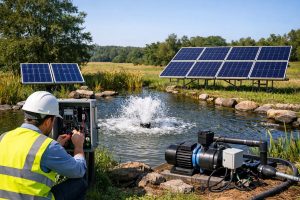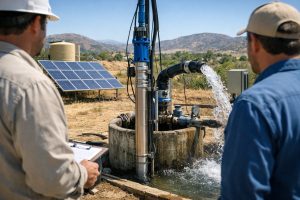
Struggling to get water in a remote location where the power grid can't reach?
A solar pump system could be your answer.
High-quality solar pumps can handle depths up to 1,000 feet of total head.
However, the pump type and your well's specific conditions are crucial.
These factors, like static water level and required flow rate, determine the exact operational depth and efficiency.
Understanding the depth a solar pump can handle is key.
But it's not just about a single number.
The real answer depends on several interconnected factors, from geology to technology.
Deeper wells require more than just power; they demand specialized engineering and the right pump design to work efficiently.
Let's explore the concepts that determine a solar pump's true deep-well capability.
Understanding Total Pump Head vs. Submersion Depth
Confused by pump specifications that list different depths?
It's a common issue.
The terms can be misleading if you don't know the difference.
Total Pump Head (TPH) is the total vertical distance the pump can move water, reaching up to 1,000 feet.
Submersion depth is how deep the pump unit can be placed underwater, typically around 400 feet.
They are not the same thing.
Understanding these two metrics is the first step in correctly sizing a pump system.
TPH is about the work the pump has to do, while submersion depth is about the physical limits of the pump's construction.
A pump might only be rated for 400 feet of submersion but can easily service a well with a TPH of 700 feet if the static water level is high enough.
This distinction prevents costly mistakes and ensures you select a pump that performs reliably for years.
The engineering behind these limits involves balancing hydraulic power with material resilience against immense water pressure.
How to Calculate Your Total Pump Head (TPH)
Total Pump Head is the total workload placed on your pump.
It is the sum of all the vertical and horizontal distances the water must travel, plus any pressure requirements.
It's calculated by adding three main components.
- Static Water Level: This is the distance from the ground level down to the top of the water in your well before pumping begins. It represents the initial lift required.
- Elevation Change: If you are pumping water uphill to a storage tank, you must add the vertical height difference from the wellhead to the tank's inlet.
- Pressure Head: If you are pumping into a pressure tank, you need to convert the tank's pressure setting into an equivalent head. A standard rule is to add 2.31 feet of head for every 1 pound per square inch (PSI) of pressure. For a typical 40/60 PSI pressure system, you would calculate based on the highest setting, so 60 PSI adds approximately 138.6 feet to your TPH.
Why Is Submersion Depth Limited?
Submersion depth is a structural limitation, not a performance one.
It tells you the maximum depth the pump can be placed below the water level without being damaged.
The deeper the pump goes, the greater the external water pressure on its housing, seals, and electrical connections.
Manufacturers specify a maximum submersion depth, often around 400 feet, to ensure the pump's integrity.
Exceeding this depth can cause seals to fail, allowing water to enter the motor housing and leading to catastrophic failure.
It's a critical safety and longevity specification that must be respected during installation.
| Parameter | Total Pump Head (TPH) | Max Submersion Depth |
|---|---|---|
| What it Measures | The total work required to lift and move water | The physical depth the pump can be submerged |
| Typical Max Value | Up to 1,000 feet or more | Around 400 feet |
| Main Factor | Pumping distance, elevation, and pressure | Water pressure on pump seals and housing |
| Purpose | Used for pump performance selection | Used for safe pump placement and installation |
The Core Trio: Matching The Right Pump to Your Well's Depth
Choosing the wrong pump for your well's depth means wasted energy and poor performance.
A pump designed for shallow wells will fail in a deep one.
A high-head pump in a shallow well is an inefficient use of resources.
Selecting the right pump depends on your well's depth and your water needs.
For low flow and very deep wells, a solar screw pump is ideal.
For high flow in medium-depth wells, a plastic impeller pump works best.
For corrosive water, a stainless steel impeller pump is necessary.
The global demand for sustainable water solutions has led to the development of specialized solar pumps.
These systems are vital in off-grid areas across Africa, the Americas, Australia, and Asia.
Each pump type is engineered to solve a specific problem, creating a complete product portfolio for diverse applications.
Understanding their unique strengths and limitations is key for any distributor aiming to meet diverse market needs.
Let's break down the three most popular solar deep well pump designs to see how they fit into different scenarios.
Solar Screw Pump: The Deep Well Specialist
Solar screw pumps, also known as progressive cavity pumps, are engineered for high-head, low-flow applications.
This design uses a stainless steel screw-shaped rotor that turns inside a rubber stator.
As the screw rotates, it creates sealed cavities of water that are progressively pushed upwards.
This mechanism operates on positive displacement, allowing the pump to generate very high pressure and lift water from extreme depths.
They are the go-to solution for domestic water supply, livestock watering, and small-scale drip irrigation in regions with deep water tables, such as parts of Africa and Latin America.
Their main advantage is an exceptional ability to handle sandy or silty water without damage, as the rubber stator can flex to pass small particles.
They can offer a consistent water flow even as the solar energy input fluctuates.
However, their flow rate is inherently limited, making them unsuitable for large-scale agricultural irrigation that demands high volumes of water.
Solar Plastic Impeller Pump: The High-Volume Workhorse
For applications requiring high flow rates at medium head, the solar plastic impeller pump is the most economical and effective solution.
This is a multi-stage centrifugal pump.
It uses a series of stacked, durable plastic impellers.
Each impeller stage adds pressure, efficiently moving large volumes of water.
These pumps are ideal for farm irrigation, pasture water systems, and filling large storage tanks where water demand is high.
They are widely used across the Americas and Africa for their excellent performance and value.
One of their key advantages is high resistance to abrasion from fine sand, as the engineered plastic is both tough and slightly flexible.
They are also lightweight, which simplifies installation and reduces shipping costs.
The main limitation is their durability in very deep wells or highly corrosive water, where the plastic components may degrade over time compared to stainless steel.
Solar Stainless Steel Impeller Pump: The Premium Durability Option
When water quality is harsh or longevity is the top priority, the solar stainless steel impeller pump is the premium choice.
This model features impellers and a pump body constructed from SS304 stainless steel.
This material provides superior resistance to corrosion and abrasion.
It is designed for demanding environments, such as areas with acidic or alkaline water, or regions with saline soil conditions found in Australia and parts of the Americas.
These pumps offer high flow rates at medium-to-high head, making them suitable for high-end homes, commercial applications, and ranches where reliability is non-negotiable.
The primary benefit is a long service life, even in aggressive water.
They maintain high efficiency over their lifespan because the stainless steel impellers do not wear down easily.
The trade-offs are a higher initial cost and increased weight, which can make installation more challenging.
This positions them as a solution for niche, high-end markets where performance and durability justify the investment.
The Unseen Engine: Why the BLDC Motor is a Game-Changer
Are you focusing only on the pump itself?
The motor that drives it is equally, if not more, important.
An inefficient motor will waste precious solar energy and require a larger, more expensive solar array.
Modern solar pumps use a Brushless DC (BLDC) permanent magnet motor with efficiency exceeding 90%.
This core technology is the key to a powerful, reliable, and cost-effective water pumping system.
It directly reduces operational costs and enhances overall performance.
All three pump types—screw, plastic impeller, and stainless steel impeller—are powered by the same advanced motor technology.
The BLDC permanent magnet brushless motor is the heart of the system.
Its incredible efficiency is what makes solar pumping practical and economically viable.
The rotor is constructed from high-grade 40SH neodymium iron boron magnets, which provide strong and stable magnetic fields.
This advanced design delivers more power in a smaller package, fundamentally changing the economics of solar water pumping.
Let's explore the technical and market advantages this motor brings.
Technical Advantages of BLDC Motors
The superiority of BLDC motors stems from their advanced design.
Unlike traditional brushed motors, they have no brushes that wear out, eliminating a common point of failure and the need for maintenance.
Here are the key technical benefits:
- High Efficiency: With efficiencies over 90%, these motors convert more solar electricity into pumping power. This is a significant improvement over AC motors (60-75% efficiency) or brushed DC motors (75-80% efficiency).
- Strong Power and High Torque: The permanent magnet design delivers high torque even at low speeds. This allows the pump to start reliably under load, even in early morning or cloudy conditions when solar power is limited.
- Compact and Lightweight Design: Advanced engineering has resulted in motors that are up to 47% smaller and 39% lighter than their conventional counterparts. This crucial advantage simplifies transportation and installation, especially in remote areas where heavy equipment is not available.
- Long Service Life: The absence of brushes and the use of high-quality components mean these motors are designed for a service life exceeding 10 years with zero maintenance.
Market Value and Strategic Importance
The technical benefits of the BLDC motor translate directly into significant market value for both distributors and end-users.
For distributors, offering products with this core technology creates a strong competitive advantage.
It allows you to sell a system that is more efficient, reliable, and easier to install.
For the end-user, the value is even more direct.
The high efficiency means a smaller and less expensive solar panel array is needed to achieve the same pumping performance.
This can reduce the total system cost by 15-25%.
Over the long term, the maintenance-free design and extended lifespan result in the lowest total cost of ownership.
Strategically, the BLDC motor is the engine that drives the entire system's competitiveness.
When paired with an intelligent MPPT (Maximum Power Point Tracking) controller, it maximizes the energy harvested from the solar panels throughout the day.
This combination of a highly efficient motor and smart controls ensures that the pump delivers reliable water whenever the sun shines.
Beyond Sunlight: The Power of Hybrid AC/DC Systems
What happens when the sun doesn't shine?
For many critical applications, waiting for a sunny day is not an option.
Traditional solar pump systems shut down on cloudy days or at night, creating water insecurity.
Hybrid AC/DC solar pumps solve this problem by allowing dual power inputs.
The system automatically uses solar power when available and seamlessly switches to an AC source like the grid or a generator when it's not.
This ensures a reliable, 24/7 water supply.
Innovation in the solar pumping industry now focuses on reliability and convenience.
Leading manufacturers have developed intelligent controllers that manage both DC power from solar panels and AC power from an external source.
This hybrid approach offers the best of both worlds: the cost-free, clean energy of solar and the all-weather reliability of conventional power.
The controller is the brain of the system, designed with two power inputs that can be connected simultaneously.
It's an automated, worry-free solution that prioritizes solar energy to minimize costs but guarantees water is always available when needed.
How AC/DC Hybrid Controllers Work
The intelligence of a hybrid system lies in its controller.
This sophisticated electronic device continuously monitors the power available from the solar panels.
The operating logic is simple yet effective.
- Prioritizing Solar (DC) Power: When there is sufficient sunlight, the controller directs the DC power from the solar panels to the pump motor. The system operates entirely off-grid, costing nothing to run.
- Hybrid Functionality: During periods of intermittent clouds, when solar power is reduced but still present, the controller's hybrid function kicks in. It blends the available solar power with just enough AC power to keep the pump running at the desired speed. This maximizes the use of free solar energy and only supplements with AC power as needed.
- Automatic AC Switchover: When there is no solar input, such as at night or during heavy overcast days, the controller automatically switches over to the AC power source. This transition is seamless and ensures the pump continues to operate without any manual intervention.
Benefits for Critical Water Applications
The ability to guarantee a 24/7 water supply makes hybrid solar pumps invaluable for a wide range of applications.
For households, it means consistent water pressure for showers, laundry, and drinking water, regardless of the weather.
For livestock farming, it ensures animals have constant access to drinking water, which is critical for their health and productivity.
In agriculture, it allows for irrigation schedules to be maintained overnight or during rainy seasons, protecting crop yields.
This technology provides peace of mind.
It removes the primary limitation of solar-only systems—their intermittency.
End-users get the environmental and financial benefits of solar power without sacrificing the reliability they depend on.
For distributors, offering hybrid systems opens up new markets and provides a powerful solution for customers with critical water needs.
Conclusion
A solar pump’s depth is defined by its Total Pump Head, not just submersion.
Choosing the right pump and motor technology ensures efficient, reliable water access for any application.
Frequently Asked Questions
Can a solar water pump work at night?
No, a standard solar-only pump requires sunlight to operate. However, hybrid AC/DC systems can switch to grid or generator power to pump water 24/7, even at night.
How many solar panels are needed for a 2 HP water pump?
Typically, a 2 HP (1500W) pump requires approximately 1800W to 2000W of solar panels. The exact number depends on the panel wattage and local solar irradiance levels.
What is the life of a solar water pump?
A well-maintained solar water pump system can last for over 15-20 years. The brushless DC motors often have a service life of over 10 years, and solar panels are typically warrantied for 25 years.
Do solar pumps require batteries?
No, most solar water pumps do not require batteries. They pump water when the sun is shining and store the water in a tank for use when it's cloudy or dark.
How do I choose a solar water pump?
Choose a pump based on your Total Pump Head (TPH) and daily water volume requirements (Gallons Per Day). TPH includes vertical lift, elevation, and pressure needs.
What maintenance does a solar pump need?
Solar pumps require very little maintenance. The main tasks are periodically cleaning the solar panels and checking the pump inlet for any debris, especially in sandy wells.
Can a solar pump fill a pressure tank?
Yes, solar pumps can be used to fill a pressure tank. You must add the pressure requirement to your Total Pump Head calculation (add 2.31 feet of head for every PSI).
What is the difference between a submersible and a surface solar pump?
A submersible pump is placed down inside the well, underwater. A surface pump is located on the ground and is used to pull water from shallow sources like ponds, rivers, or cisterns.