Worried about your pond's health or rising energy bills?
You might think shutting off your pump saves money.
However, the truth is that continuous circulation is vital for your pond's ecosystem, especially if it contains fish.
Running a pump 24/7 ensures filtration, oxygenation, and prevents harmful toxin buildup.
Deciding whether to run your pond pump constantly can feel like a choice between your wallet and your fish.
It's a common dilemma for pond owners.
You want a thriving aquatic environment but are mindful of the operational costs.
This guide will break down the essential reasons for continuous operation.
We will also explore the real costs involved and look at modern, energy-efficient solutions.
Let's dive into why that constant hum from your pump is the sound of a healthy pond.
Why is Continuous Pumping Essential for Pond Life?
Are you concerned that turning off your pump might harm your fish?
This is a valid worry.
Stagnant water quickly becomes dangerous for aquatic life, creating a toxic environment.
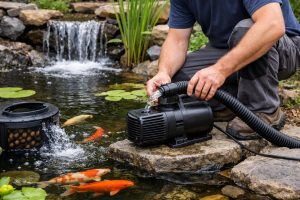
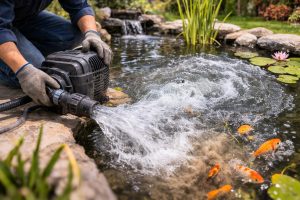
A continuously running pump is the heart of your pond's life support system. It drives critical filtration, circulates oxygen, and prevents the buildup of lethal toxins like ammonia. Shutting it off, even for a few hours, can quickly endanger your fish and the entire ecosystem.
To truly understand the pump's role, we need to look closer at what happens when the water stops moving.
It’s not just about a pretty waterfall.
It's about a complex biological machine that needs to run nonstop to function correctly.
A silent pump can signal the start of a rapid decline in water quality, triggering a chain reaction that is difficult and costly to reverse.
Let's examine the three pillars of pond health that rely entirely on your pump.
The Critical Role of Filtration
Filtration is your pond's primary defense against pollution.
Your pump pushes water through filter media, which houses colonies of beneficial bacteria.
These microscopic allies are essential for breaking down harmful substances.
They convert toxic ammonia from fish waste into less harmful nitrates in a process called the nitrogen cycle.
When you turn off the pump, this entire process halts.
If the filter media dries out, the beneficial bacteria can die off in a matter of hours.
Losing this bacterial colony is a major setback.
It's like firing your pond's entire cleaning crew.
The pond must then go through a risky "re-cycling" period, where ammonia levels can spike to lethal levels, posing a severe threat to your fish.
| Pump Status | Filtration Effect | Consequence for Pond Health |
|---|---|---|
| Running 24/7 | Consistent biological and mechanical filtration. | Stable water quality, low ammonia levels, healthy fish. |
| Turned Off Nightly | Filtration stops, bacteria may die. | Ammonia spikes, risk of fish death, algae blooms. |
Preventing Deadly Oxygen Depletion
Moving water is essential for gas exchange at the pond's surface.
This is the primary way your pond gets life-sustaining oxygen and releases harmful gases like carbon dioxide.
A running pump creates surface agitation through waterfalls, fountains, or simple circulation.
This constant movement churns the water, ensuring that oxygen-poor water from the bottom is brought to the top to be replenished.
When the pump stops, this exchange ceases.
The oxygen levels in the water begin to drop immediately.
Fish, plants, and beneficial bacteria all consume oxygen.
In a stagnant pond, especially overnight when plants also consume oxygen, levels can plummet to dangerously low points.
This lack of oxygen, known as hypoxia, is a leading cause of fish death.
Fish will often be seen gasping at the surface, a clear sign of severe distress.
Managing Debris and Sludge Buildup
Your pump also plays a vital role in mechanical cleaning.
Water circulation keeps fine debris like fallen leaves, fish waste, and uneaten food suspended in the water column.
This allows the particles to be pulled into the pond's skimmer and filtration system for removal.
Without circulation, all this organic matter settles to the bottom of the pond.
It decomposes into a thick layer of organic sludge or "muck."
This muck is not just unsightly; it's a breeding ground for harmful anaerobic bacteria.
These bacteria release toxic gases, such as hydrogen sulfide, which smells like rotten eggs and is poisonous to fish.
Furthermore, the decomposition of sludge consumes a massive amount of oxygen and releases nutrients that fuel aggressive algae blooms.
A pump that runs 24/7 is your best tool for preventing sludge from ever accumulating.
Are Pond Pumps Expensive to Run?
Do you fear that a constantly running pump will send your electricity bill soaring?
This is a common misconception based on outdated pump technology.
Modern pumps are surprisingly efficient.
The cost of running a modern, energy-efficient pond pump 24/7 is often negligible, costing just a few cents per hour. The potential cost of replacing fish and fixing water quality issues from shutting it off far outweighs the small savings on your utility bill.
The financial argument for turning off your pump simply doesn't hold up when you look at the numbers.
Manufacturers understand that operating cost is a major concern for pond owners.
As a result, there has been a significant push in the industry towards creating powerful pumps that consume very little electricity.
Let's break down the actual costs and compare them to the financial risks of an unhealthy pond, while also exploring solutions that can reduce or even eliminate these costs entirely.
Calculating the Real Cost
The cost to run your pump depends on two main factors: its wattage and your local electricity rate.
You can easily calculate this.
Most pumps have their wattage listed on the unit or in the manual.
Let’s use an example.
A medium-sized, 100-watt pump running 24 hours a day uses 2.4 kilowatt-hours (kWh) per day (100W x 24h / 1000).
If your electricity costs $0.15 per kWh, the daily cost is just $0.36.
That's less than $11 per month.
Even very large pumps for waterfalls rarely exceed a few dollars per day.
When you compare this small, predictable expense to the potential costs of an emergency, the choice is clear.
- Cost of new fish: Koi and other prized pond fish can cost hundreds or even thousands of dollars.
- Cost of chemicals: Algaecides, ammonia binders, and bacterial additives to fix a crashed ecosystem can add up quickly.
- Cost of your time: Frequent water testing and large water changes are labor-intensive.
The Rise of High-Efficiency Technology
Modern pumps leverage advanced motor technology to maximize performance while minimizing power consumption.
One of the most significant innovations is the use of brushless DC (BLDC) permanent magnet motors.
These motors are fundamentally more efficient than traditional AC motors.
They can achieve efficiencies exceeding 90% in some cases.
This means more of the electricity consumed is converted into water movement, and less is wasted as heat.
This core technology provides several benefits:
- Lower Power Draw: A BLDC pump can often perform the same job as an older pump while using 30-50% less energy.
- Greater Control: Many high-efficiency pumps are controllable, allowing you to dial back the flow when maximum power isn't needed, saving even more electricity.
- Longer Lifespan: These motors often run cooler and have fewer wearing parts, contributing to increased reliability and longevity.
Solar and Hybrid Pumps: The Ultimate Solution
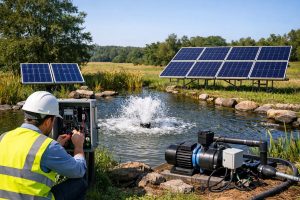
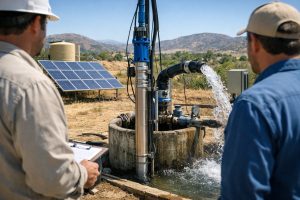
For the ultimate in energy savings and reliability, solar and hybrid pump systems are the answer.
These systems operate independently of the power grid, offering a green and cost-effective solution.
Solar Screw Pumps: These are ideal for deep ponds or high-head applications, providing reliable flow even from significant depths. They are exceptionally durable.
Solar Impeller Pumps: These deliver high flow rates, perfect for large ponds, circulation, and impressive waterfall features. They are available with wear-resistant plastic or corrosion-resistant stainless steel impellers for different water conditions.
The core of these systems is the high-efficiency BLDC motor, which maximizes water output from every watt of solar power.
What if the sun isn't shining?
This is where hybrid AC/DC controllers come in.
These smart devices can be connected to both solar panels and your home's AC power grid simultaneously.
The controller prioritizes solar power whenever it is available.
If cloud cover reduces solar input, it can supplement with AC power.
At night or during extended bad weather, it will switch over to AC power automatically.
This ensures your pond receives uninterrupted 24/7 circulation, worry-free, while maximizing your use of free solar energy.
This technology provides the best of both worlds: environmental sustainability, cost savings, and the absolute reliability your pond ecosystem demands.
When Can You Turn a Pond Pump Off?
Perhaps your pond is just a decorative water feature.
Does it still need constant circulation?
In some specific cases, turning off the pump is acceptable.
If your pond contains no fish or other aquatic animals and is purely for ornamental purposes, you can turn the pump off. In this scenario, the pump's function is aesthetic, such as running a waterfall or fountain, and is not critical for life support.
The decision to run a pump continuously is almost entirely based on the presence of living creatures.
Without fish, the urgent concerns of oxygen depletion and ammonia toxicity disappear.
However, there are still some downsides to consider, even in a fishless pond.
Let's explore the conditions under which it's safe to switch it off, and the potential issues you might still encounter.
Ponds Without Fish or Wildlife
A pond that is simply a reflecting pool or a base for a fountain does not have the same biological demands as one teeming with life.
There is no fish waste producing ammonia.
There are no gills competing for dissolved oxygen.
In this context, the pump serves two main purposes:
- Aesthetics: To create the sound and visual appeal of moving water.
- Clarity: To circulate water through a filter to remove pollen, dust, and other debris that can make the water cloudy.
It is perfectly reasonable to run the pump only when you are outside to enjoy it.
Using a simple plug-in timer is an excellent way to automate this.
You can set it to run during daylight hours or for a few hours in the evening when you are entertaining.
Potential Downsides of Intermittent Use
Even without fish, stopping and starting a pump can have some negative consequences.
You should be aware of these before deciding on an intermittent schedule.
Stagnation and Algae: Stagnant water, even without the nutrient load from fish, is more prone to algae growth. The lack of circulation and filtration allows single-celled algae to multiply, which can turn the water green. String algae may also gain a foothold on the pond's surfaces.
Clogging and Startup Issues: When a pump is turned off, debris in the plumbing can settle. This can sometimes create a clog in the pipe or jam the pump's impeller. This may require you to prime the pump or manually clear the obstruction upon restarting, which can be an inconvenience.
Increased Wear and Tear: The initial power surge on startup is one of the most stressful moments for an electric motor. Frequent starting and stopping can, over the long term, cause more wear on the pump's components compared to running it continuously.
In summary, while you absolutely can turn off the pump in a fishless, ornamental pond, you may trade a small savings in electricity for increased maintenance tasks like cleaning algae and dealing with pump startup issues.
Conclusion
For any pond with fish, a pump running 24/7 is not a luxury, but a necessity.
It maintains water quality and oxygen levels, ensuring a healthy, stable ecosystem for its inhabitants.
FAQs
What happens if I turn my pond pump off at night?
Oxygen levels will drop significantly, and toxic ammonia from fish waste will accumulate. This creates a stressful and potentially lethal environment for your fish by morning.
How do I know if my pond pump is big enough?
A general rule is the pump should circulate the entire volume of your pond at least once every hour. Ponds with high fish loads may require more.
Can a pond pump run in the winter?
Yes, a running pump can help keep a hole open in the ice. This is crucial for allowing toxic gases to escape from under the ice sheet.
How much does it cost to run a pond pump 24/7?
Modern energy-efficient pumps are inexpensive to run. Many cost less than a dollar a day, depending on their size and your local electricity rates.
Do I need a backup for my pond pump?
For ponds with valuable fish like koi, a backup power source like a generator or a battery backup system with an aerator is highly recommended for power outages.
Can I use a timer on my pond pump?
Using a timer is only advisable for purely ornamental water features that do not contain any fish or other aquatic animals. It's not safe for ponds with life.
Should I turn off my waterfall at night?
Your waterfall is a primary source of aeration for the pond. Turning it off will reduce oxygen levels, which is most dangerous overnight, so it should be left on.
What is more important, a pump or an aerator?
A pump is more important as it drives filtration, which removes toxins. An aerator primarily adds oxygen, but a pump does both circulation for oxygen and filtration.