Struggling with high electricity bills from your water pump?
You worry about the cost and inefficiency, seeking a more sustainable and affordable solution for your water needs.
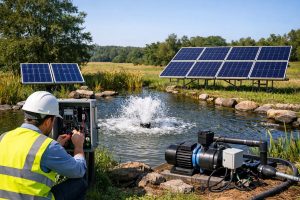
Yes, you can run a water pump straight from a solar panel, especially if it's a DC pump designed for this purpose. This direct connection is simple and efficient, eliminating the need for complex inverters or batteries for daytime operation, making it a cost-effective choice for many applications.
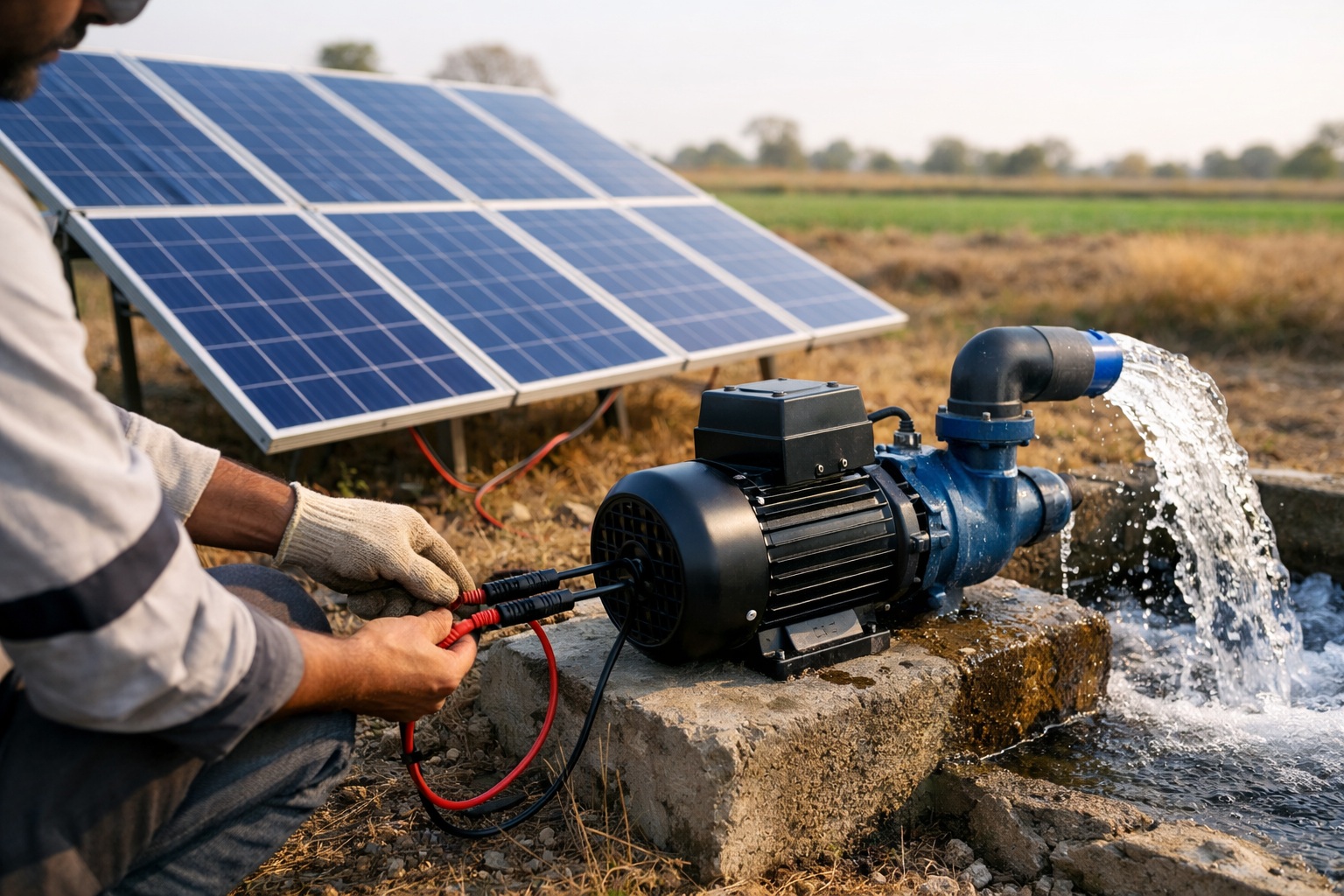
Connecting a solar panel directly to a water pump sounds like the ultimate plug-and-play solution for energy independence.
It promises simplicity and harnesses free energy from the sun.
However, while this setup is indeed possible and often practical, its success hinges on several critical factors.
The compatibility between the panel's output and the pump's requirements is paramount.
An incorrect match can lead to poor performance or even damage your equipment.
This guide will walk you through the nuances of direct solar pumping, exploring when it's the perfect solution and when alternative configurations are necessary to ensure a reliable and long-lasting water supply.
Let's dive into the specifics to determine the best approach for your situation.
The Pros and Cons of a Direct Connection
Tired of complex wiring and endless maintenance for your pump system?
You want a straightforward setup that just works when the sun is out, without extra components and costs.
Connecting a pump directly to a solar panel is the simplest and most affordable setup. It minimizes components, leading to lower upfront costs and fewer points of failure. This configuration is ideal for applications where water is only needed during daylight hours, such as agricultural irrigation or filling a stock tank.
A direct connection is the most fundamental form of a solar-powered pumping system.
Its main appeal lies in its sheer simplicity and cost-effectiveness.
By eliminating batteries, charge controllers, and inverters, you significantly reduce the initial investment by up to 40-50% and simplify the installation process.
This makes it an accessible entry point into solar water pumping.
However, this simplicity comes with trade-offs that are crucial to understand.
The system's performance is entirely dependent on real-time solar irradiation.
This means the pump will run at variable speeds throughout the day and will not operate at all during cloudy periods or at night.
Understanding the Limitations
The most significant drawback is the lack of power regulation and storage.
Without a controller or battery, the pump is exposed to fluctuating voltages from the solar panel.
During peak sun, the panel's open-circuit voltage (Voc) can be 20-25% higher than its operating voltage (Vmp).
This surge can potentially over-volt and damage a pump that is not designed to handle such variations.
Conversely, during low-light conditions, the voltage may be insufficient to start the pump's motor, leading to stalling or stuttering, which can cause premature wear.
| Feature | Direct Connection (Pros) | Direct Connection (Cons) |
|---|---|---|
| Cost | Lowest upfront cost. No batteries or controllers needed. | Potential for pump damage, leading to replacement costs. |
| Simplicity | Easiest to install and maintain. Fewer components. | System is inflexible and operates only in direct sun. |
| Efficiency | No energy loss from charging batteries or inverting power. | Inefficient use of solar power in non-ideal light. |
| Reliability | Fewer points of failure (no electronics to break). | Inconsistent water supply; no water on cloudy days or at night. |
When is Direct Connection a Good Idea?
A direct connection works best when the pump and solar panel are perfectly matched and the application can tolerate an intermittent water supply.
This is common in agricultural settings for daytime irrigation or for filling a large storage tank.
The tank acts as a buffer, storing water pumped during sunny hours for use at any time.
For this setup to be reliable, it is essential to choose a DC pump specifically rated to handle the voltage range of your solar panel array.
Manufacturers of high-quality DC pumps often specify a maximum input voltage to prevent damage.
Why DC Pumps are More Efficient for Solar
Are you trying to power a standard AC pump with solar panels?
You're facing high costs for large inverters and extra panels, making the project less financially viable than you hoped.
Direct Current (DC) pumps are inherently more efficient for solar applications because they use power directly from the panels without conversion losses. AC pumps require an inverter, which can waste 10-20% of the precious solar energy during the DC to AC power conversion process.
When designing a solar pumping system, one of the first decisions is whether to use a Direct Current (DC) or Alternating Current (AC) pump.
While you may be tempted to use an existing AC pump to save on upfront costs, it's often a less efficient and more expensive solution in the long run.
The native power produced by solar panels is DC.
Using a DC pump allows for the most direct and efficient use of this power.
This synergy between DC panels and DC pumps forms the foundation of modern, high-performance solar water systems.
Let's explore the technical advantages that make DC pumps the superior choice for most solar-powered applications.
The Problem with Power Conversion
Powering a standard AC pump requires an inverter to convert the DC electricity from the solar panels into AC electricity.
This conversion process is never 100% efficient.
A significant portion of energy, typically ranging from 10% to 20%, is lost as heat within the inverter.
This means you need to purchase a larger, more expensive solar array—with 10-20% more panels—just to compensate for this energy loss.
This not only increases the initial system cost but also the physical footprint of the solar array.
The Advantages of a Native DC System
DC pumps, especially those with high-efficiency brushless motors, are designed to run directly off solar panel voltage.
This eliminates the need for a costly, power-wasting inverter.
A modern Brushless DC (BLDC) motor can achieve efficiencies exceeding 90%.
This is a stark contrast to the combined efficiency of an AC pump and inverter system, which often falls below 75%.
This superior efficiency means a DC pump can deliver the same amount of water with a smaller, less expensive solar array.
| Pump System | System Efficiency | Components Required | Best Use Case |
|---|---|---|---|
| DC Pump | High (~90%) | Solar Panels, Pump, (Optional Controller) | Off-grid locations, new installations, maximizing water per watt. |
| AC Pump | Lower (~75%) | Solar Panels, Inverter, Pump | Powering an existing AC pump where replacement is not feasible. |
Introducing the Role of the MPPT Controller
Even in a DC system, a controller is highly recommended.
A Maximum Power Point Tracking (MPPT) controller acts as a smart DC-to-DC converter.
It constantly monitors the solar panel's output and adjusts the electrical load to "trick" the panel into producing its maximum possible power, regardless of sunlight conditions.
This process can boost the system's overall water output by as much as 30% compared to a direct connection.
The controller also provides vital protective functions, such as soft starting the motor, and preventing damage from over-voltage or running dry.
It ensures you get the most water possible from every sunbeam while safeguarding your investment.
Matching a Pump to Your Water Needs
Unsure which solar pump is right for your well?
The variety of options is confusing, and choosing the wrong one could mean insufficient water flow or a pump that can't handle your well's depth.
To choose the right pump, you must match its specifications to your needs. Low-flow, high-head pumps are for deep wells and domestic use. High-flow, medium-head pumps are for irrigation. The pump material, like plastic or stainless steel, depends on your water quality.
The heart of any solar water system is the pump itself.
Choosing the correct type of pump is just as critical as sizing the solar array.
A pump that is perfectly suited for lifting small amounts of water from a very deep well will be entirely inappropriate for irrigating a large field.
The global solar pump market offers a diverse portfolio to meet these varied demands.
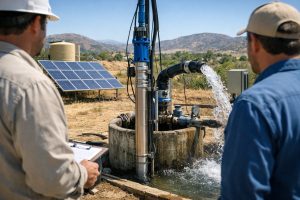
The three most popular types of solar deep well pumps are the solar screw (or helical rotor) pump, the solar plastic impeller pump, and the solar stainless steel impeller pump.
Each is designed for a specific application, and understanding their differences is key to building a successful system.
Low Flow, High Head: The Solar Screw Pump
This type of pump uses a stainless steel screw rotating inside a rubber stator.
This mechanism acts like an Archimedes' screw, pushing "packets" of water upwards with significant force.
This design excels at creating high pressure, making it ideal for applications with a very high "total dynamic head" (the total height the water must be lifted).
- Best For: Deep wells (over 100 meters / 330 feet), domestic water supply, livestock watering where flow rate is less critical.
- Advantages: Excellent sand handling capability (up to 5% sand content), can operate efficiently in challenging water conditions, and provides consistent pressure for deep wells.
- Limitations: The flow rate is inherently limited by the design, making it unsuitable for large-scale irrigation that demands high volumes of water.
High Flow, High Value: The Solar Plastic Impeller Pump
This is a multi-stage centrifugal pump that uses a series of rotating plastic impellers to accelerate water.
Each stage adds pressure, allowing the pump to achieve a balance of good flow and moderate head.
The use of engineered, wear-resistant plastic makes these pumps a lightweight and economical choice.
- Best For: Farm irrigation, pasture water supply, garden watering, and applications where high water output is the priority.
- Advantages: Delivers a high volume of water, offers excellent resistance to fine sand and abrasion, and is a cost-effective solution for many agricultural needs. Its lightweight nature simplifies installation.
- Limitations: Not ideal for highly corrosive or alkaline water conditions. Durability may be reduced in extremely deep wells where pressure is immense.
Premium Durability: The Solar Stainless Steel Impeller Pump
For the most demanding environments, the stainless steel impeller pump is the premium option.
Both the impellers and the pump body are constructed from high-grade stainless steel (typically SS304 or SS316).
This design provides the ultimate protection against corrosion and abrasion.
- Best For: Corrosive water with acidic or alkaline properties, regions with brackish water, and high-end residential or commercial applications where longevity and reliability are paramount.
- Advantages: Exceptional corrosion resistance leads to a very long service life. It maintains high reliability even in harsh water conditions.
- Limitations: This premium construction comes at a higher cost. The pump is also heavier, which can make installation more challenging.
The Power Behind the Pump: High-Efficiency Motors
Do you worry that your solar pump won't be powerful enough on cloudy days?
You need a system that maximizes every bit of available sunlight to ensure a consistent water supply, reducing the need for an oversized solar array.
Modern solar pumps use high-efficiency Brushless DC (BLDC) permanent magnet motors. These motors convert over 90% of electrical energy into mechanical power, ensuring strong performance even in low-light conditions and reducing the number of solar panels needed by up to 25%.
While the pump end (screw vs. impeller) determines the flow and head characteristics, the motor is the engine that drives its performance.
The single most important technological advancement in solar pumping has been the widespread adoption of the Brushless DC (BLDC) permanent magnet motor.
This core technology is what makes modern solar pumps so efficient and reliable.
It's the critical component that dictates the overall efficiency of the entire system, directly impacting both performance and cost.
Understanding the value of a high-quality motor is essential for anyone investing in a solar water pump.
Why BLDC Motors are a Game-Changer
Traditional DC motors use "brushes" to transmit power to the rotor, which wear out over time, create friction, and generate heat—all of which represent wasted energy.
BLDC motors, by contrast, use an electronic controller to switch the power, eliminating physical brushes entirely.
This design provides several key advantages:
- Superior Efficiency: With no energy lost to friction from brushes, BLDC motors can achieve efficiencies of 90% or more. This means more of the sun's energy is converted into water pumping and less is wasted as heat.
- Longer Lifespan: The absence of wearing parts like brushes means the motor can operate for tens of thousands of hours without maintenance, drastically increasing the pump's service life.
- Higher Power Density: These motors can produce more power and torque from a smaller and lighter package. A modern BLDC motor can be up to 47% smaller and 39% lighter than a traditional motor of equivalent power, which simplifies pump design and installation.
The Financial Impact of Motor Efficiency
The high efficiency of a BLDC motor has a direct and significant financial benefit.
Because the motor wastes less power, the entire system requires fewer solar panels to achieve the same water output.
A pump system with a 90% efficient BLDC motor may require 25% fewer solar panels than a system with a less efficient motor.
Given that solar panels can account for a large portion of the total system cost, this reduction translates into substantial upfront savings.
Over the lifetime of the pump, these savings continue to grow through reduced maintenance and a longer operational lifespan.
The strategic role of the motor cannot be overstated; it is the core driver of both performance and long-term value.
What If I Need Water at Night or on Cloudy Days?
Worried that a solar-only system won't provide water when you need it most?
Solar power is great, but the lack of sun at night or on rainy days presents a major challenge for critical water needs.
For 24/7 water access, a hybrid AC/DC solar pumping system is the ideal solution. These systems automatically switch between solar power and a grid or generator backup, ensuring a continuous water supply. They prioritize free solar energy and use AC power only when necessary.
The primary limitation of a standard solar pump is its dependence on the sun.
While this is acceptable for many applications, it's a non-starter for households or critical livestock operations that require a constant, reliable water supply.
Fortunately, technology has evolved to solve this exact problem.
The solution is not to build a massive and expensive battery bank, but to use a hybrid or "blended" power system.
Specialized controllers can seamlessly manage multiple power sources, giving you the best of both worlds: the free, clean energy of solar and the unwavering reliability of AC power.
How Hybrid AC/DC Controllers Work
A hybrid AC/DC controller is the brain of a versatile water pumping system.
It's designed with inputs for both DC power from solar panels and AC power from the electrical grid or a backup generator.
The controller's sophisticated logic is programmed to always prioritize the solar input.
- Full Sun Operation: During sunny periods, the system runs entirely on 100% solar power, costing you nothing to operate. The controller's MPPT function ensures maximum water output.
- Low Sun Operation: When clouds appear and solar power is reduced, the controller's "hybrid" or "blending" function is activated. It supplements the available solar power with just enough AC power to keep the pump running at the desired speed. This maximizes the use of free solar energy before drawing on the grid.
- No Sun Operation: At night or during heavy, prolonged storms with no solar input, the controller automatically switches over to run the pump entirely on AC power.
This intelligent, automatic switching ensures your water pressure never falters and your tanks stay full, 24 hours a day, 7 days a week, without any manual intervention.
The Battery-Free Backup Solution
This hybrid approach provides a reliable backup without the significant drawbacks of a large battery bank.
Batteries are expensive, have a limited lifespan of only 3-5 years, require regular maintenance, and introduce another potential point of failure.
A hybrid AC/DC system leverages the reliability of the grid you already have, making it a more cost-effective and lower-maintenance solution for ensuring an uninterrupted water supply.
It's the smartest way to achieve true water security while still reaping the financial and environmental benefits of solar power.
Conclusion
In summary, connecting a pump directly to a solar panel is viable, but a complete system with a matched DC pump and smart controller offers far superior efficiency, reliability, and longevity.
FAQs
What happens to a solar water pump on cloudy days?
On cloudy days, the pump's output will decrease.
A system with an MPPT controller will still function at a reduced rate, while a hybrid system can supplement with AC power.
How deep can a solar water pump go?
Solar pumps can service a wide range of depths.
Screw pumps are designed for very deep wells, often exceeding 200 meters (650 feet), while impeller pumps handle shallower to medium depths.
Do solar water pumps need batteries?
No, most solar water pumps do not need batteries.
They are designed to operate during the day, often filling a storage tank.
Hybrid systems use the grid for backup instead of batteries.
How long do solar water pumps last?
A quality solar water pump with a brushless motor can last for 10+ years.
The solar panels themselves often have a power-output warranty of 25 years, making it a long-term investment.
Can a solar panel run a 220V pump?
Yes, but it requires more equipment.
You need a large solar array and a powerful inverter to convert the panel's DC power to 220V AC, which is less efficient than using a native DC pump.
What size solar panel do I need for a 1HP water pump?
A 1HP pump (approx. 746 watts) typically requires at least 1,000 to 1,200 watts of solar panels to ensure it runs effectively, accounting for real-world conditions and system inefficiencies.
How do I protect my solar pump from running dry?
Most modern solar pump controllers include dry-run protection.
They use sensors in the well or monitor the motor's load to automatically shut off the pump if the water level drops too low.
Is it difficult to install a solar water pump?
No, installation is often simpler than you might think.
Many kits are designed for DIY installation with detailed manuals and support, saving you significant labor costs compared to traditional pump systems.