Your remote farm needs water, but the sky is always gray.
You worry a solar pump won't work, leaving your crops and livestock thirsty.
This guide shows how they can.
Yes, solar pumps absolutely work on cloudy days, though at a reduced capacity.
They can still generate 10% to 40% of their peak power by capturing diffuse sunlight.
For consistent water flow, hybrid systems and proper pump selection are key to overcoming overcast conditions.
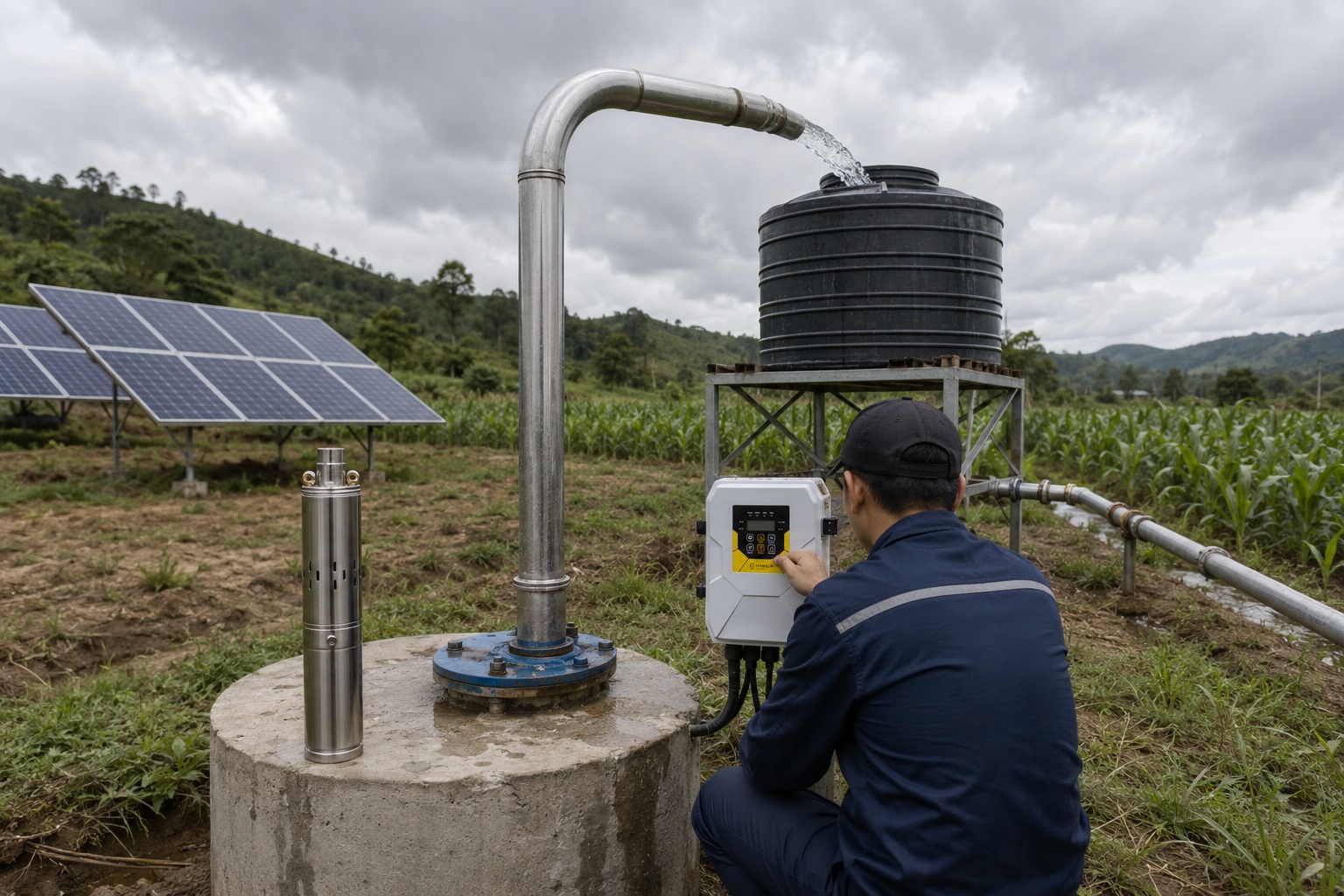
You see that solar pumps can function when it's overcast.
But how much water can you really expect, and are there ways to improve performance?
The technology behind these systems is more resilient than you might think.
Let's explore how solar pumps convert weak sunlight into the power you need, ensuring your water supply remains dependable even when the sun is hiding.
How do solar pumps generate power?
You might wonder how a simple panel turns sunlight into pumping power.
It seems complex, but the process is straightforward and highly effective.
Let's demystify the science behind solar energy generation.
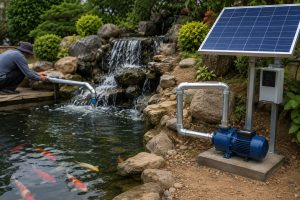
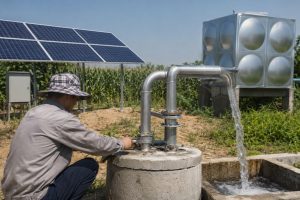
Solar panels use photovoltaic (PV) cells to convert sunlight into DC electricity.
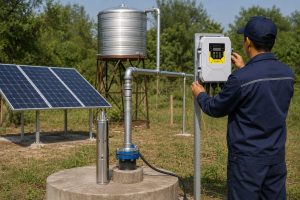
This power flows to a controller, which manages the energy and runs the pump's motor.
This direct process efficiently uses available light to move water without needing a grid connection.
The basic concept is simple, but the technology that makes it work efficiently is quite advanced.
From the moment a photon of light hits the panel to the instant water flows from the pump, several critical steps occur.
Understanding these components, especially the motor at the heart of the pump, reveals why modern solar pumping systems are so reliable and powerful, even when conditions aren't perfect.
Let's break down this process further.
The Photovoltaic (PV) Effect Explained
The magic begins with the photovoltaic effect.
Sunlight is made of tiny energy packets called photons.
When these photons strike a solar panel's silicon cells, they transfer their energy to electrons within the silicon.
This energy jolt knocks the electrons loose from their atoms.
The freed electrons are then directed by an internal electric field within the cell.
This flow of electrons creates a direct current (DC) of electricity.
The more intense the sunlight, the more photons strike the panel, and the more electricity is generated.
From DC Electricity to Pumping Power
The raw DC electricity from the panels is not yet ready to power the pump directly.
It first travels to an intelligent pump controller.
This controller is the brain of the system.
Its most important function is Maximum Power Point Tracking (MPPT).
MPPT technology constantly adjusts the electrical load to find the perfect balance of voltage and current.
This ensures the pump receives the maximum possible power from the panels at any given moment, whether in bright sun or under cloud cover.
This optimization can boost output by up to 30% compared to systems without it.
The controller then delivers this refined power to the pump's motor.
The Powerhouse: BLDC Motors
At the core of every modern, high-performance solar pump is a Brushless Direct Current (BLDC) motor.
These motors are a major leap forward from older motor types.
They use powerful permanent magnets on the rotor, eliminating the need for carbon brushes that wear out.
This design results in exceptional efficiency, often exceeding 90%.
In contrast, traditional AC motors might only be 60-75% efficient.
This means more of the precious solar energy is converted into actual water pumping.
These motors are also significantly smaller and lighter.
A BLDC motor can be up to 47% smaller and 39% lighter than a conventional motor with similar power.
This not only makes installation easier but also reduces the number of solar panels needed, lowering the overall system cost.
| Feature | BLDC Motor | Traditional Brushed Motor |
|---|---|---|
| Efficiency | >90% | 60-75% |
| Lifespan | Very Long (no brushes to wear out) | Shorter (brushes require replacement) |
| Maintenance | Virtually maintenance-free | Regular maintenance needed |
| Torque | High torque at all speeds | Good starting torque, but less consistent |
| Size & Weight | Compact and lightweight | Bulkier and heavier |
The high efficiency, reliability, and long life of BLDC motors are what make solar pumping a truly viable and competitive solution for off-grid water needs.
What is the effect of clouds on solar pump performance?
You've invested in a solar pump, but now a thick bank of clouds is rolling in.
You're worried your water supply will grind to a halt.
Understanding how different clouds affect your system helps manage expectations and plan accordingly.
Cloud cover significantly reduces a solar pump's output, typically dropping performance to between 10% and 40% of its maximum potential.
The density and type of cloud are the biggest factors; thin, high clouds have far less impact than thick, low-lying storm clouds.
It's not as simple as "cloudy means no power."
The atmosphere is a dynamic place, and the way light interacts with it changes constantly.
Some cloud conditions can surprisingly boost performance, while others can bring it to a near standstill.
By understanding the difference between direct and diffuse light and how various cloud layers affect solar irradiance, you can gain a much clearer picture of what your solar pump can achieve on any given day.
Direct vs. Diffuse Sunlight
Solar panels use two types of sunlight to generate power.
Direct sunlight is the light that travels in a straight line from the sun to the panel.
This provides the highest energy output and is what you get on a perfectly clear, sunny day.
Diffuse sunlight is light that has been scattered by particles in the atmosphere, like water droplets in clouds.
On an overcast day, nearly 100% of the light reaching the ground is diffuse.
While weaker than direct light, modern high-efficiency monocrystalline solar panels are very good at capturing this scattered light from all angles.
This ability is why panels continue to produce a meaningful amount of power even when the sky is completely gray.
Cloud Types and Their Impact
Not all clouds are created equal.
Their altitude, thickness, and composition determine how much light they block.
- High, Thin Clouds (Cirrus): These wispy, ice-crystal clouds allow a large portion of sunlight to pass through. They might reduce output by only 10-20%, allowing for significant water pumping to continue.
- Mid-Level Clouds (Altostratus): These gray, uniform sheets can cover the entire sky. They have a more moderate impact, often reducing output to 30-50% of maximum.
- Low, Thick Clouds (Stratus, Cumulus): Dense, dark clouds like stratus layers or the base of cumulus clouds are the most impactful. They can block a large amount of light, cutting production down to 10-25% of its potential.
- Thunderstorm Clouds (Cumulonimbus): These are the most extreme, blocking almost all light and reducing output to near zero.
Quantifying the Output Drop with Cloud Optical Thickness (COT)
For a more scientific measure, experts use Cloud Optical Thickness (COT).
This value quantifies how much light a cloud can block.
| Cloud Condition | Cloud Optical Thickness (COT) | Expected Output Retention |
|---|---|---|
| Thin Clouds | < 3 | 20% to 40% |
| Moderate Clouds | 3 - 6 | 10% to 25% |
| Thick Overcast | > 10 | Under 10% |
This data shows that while any cloud has an effect, only the thickest, darkest clouds will cause a near-total shutdown of production.
The Surprising "Cloud Lensing" Effect
Interestingly, some cloudy days can be more productive than perfectly clear days.
This phenomenon is known as the "cloud lensing" or "edge of cloud" effect.
It happens when the sun is out, but broken clouds are passing by.
As the sun passes the edge of a bright, puffy cloud, the cloud can reflect and concentrate sunlight onto your panels.
For a brief period, the panels receive both direct sunlight and reflected sunlight, causing a power surge that can exceed 120% of their rated output.
This can result in more total energy produced on a partly cloudy day than on a completely clear, but hotter, day.
Can rain or cool temperatures help solar panels?
You see rain and cool weather on the forecast and assume it's bad news.
You picture lower output and a struggling pump.
But surprisingly, these conditions can offer some distinct advantages for your solar system.
Yes, rain and cool temperatures can improve solar panel performance.
Rain washes away light-blocking dust and grime.
Cooler temperatures allow the panels to operate more efficiently, partially offsetting the power loss from reduced sunlight on an overcast day.
Heat is the hidden enemy of solar panel efficiency.
While we associate sun with heat, it's actually the light (irradiance) that panels need, not the temperature.
When panels get too hot, their voltage drops, and they produce less power.
Cloudy, cool, and rainy days create an environment where your panels can perform at their peak electrical efficiency, converting a higher percentage of the available light into usable energy.
The Cleaning Power of Rain
Over time, solar panels accumulate a layer of dust, pollen, bird droppings, and other grime.
This film can block a surprising amount of sunlight.
Studies have shown that dirty panels can lose anywhere from 5% to over 20% of their efficiency, depending on the location.
A steady rainfall provides a free and effective cleaning service.
It washes away this accumulated debris, restoring the panel's ability to absorb the maximum amount of light possible.
On a cloudy day, where every photon counts, a clean panel will perform significantly better than a dirty one.
This natural cleaning helps your system capture more of the limited diffuse light available.
Temperature's Critical Role in Efficiency
Every solar panel has a "temperature coefficient."
This rating tells you how much efficiency the panel loses for every degree Celsius its temperature rises above the standard test condition of 25°C (77°F).
A typical temperature coefficient is around -0.35% per degree Celsius.
This means that on a hot, sunny day, a panel's surface can easily reach 65°C (149°F).
At this temperature, the panel's output could be reduced by as much as 14%.
(65°C - 25°C) * -0.35% = -14%
| Panel Temperature | Approximate Efficiency Loss |
|---|---|
| 25°C (77°F) | 0% (Baseline) |
| 45°C (113°F) | -7% |
| 65°C (149°F) | -14% |
| 75°C (167°F) | -17.5% |
Cloudy days are almost always cooler.
This lower ambient temperature keeps the panels operating much closer to their ideal 25°C.
This higher electrical efficiency helps to compensate for the lower amount of sunlight.
For example, a panel on a 20°C cloudy day might only receive 25% of the sunlight, but it will convert that light with nearly 100% of its rated efficiency.
A panel on a 45°C sunny day might receive 100% of the sunlight, but it will only convert it with 93% efficiency.
The Combined Effect for Better-Than-Expected Performance
When you combine the cleaning effect of rain with the efficiency boost from cooler temperatures, the performance on an overcast day is often better than simple calculations would suggest.
The panel is clean, allowing it to absorb more of the available diffuse light.
The cool temperature allows it to convert that light into electricity with maximum efficiency.
While the total output will still be lower than on a bright, cool, sunny day, these two factors work together to mitigate the losses from cloud cover.
How can you maximize solar pump output on cloudy days?
Your solar pump's flow is dropping on overcast days.
You need a reliable water supply, no matter the weather.
Fortunately, several strategies can significantly boost your system's performance and ensure you have water when you need it most.
To maximize output, use high-efficiency panels and choose the right pump for your well.
Optimize panel orientation for diffuse light and consider a hybrid AC/DC controller.
This controller automatically supplements solar power with grid or generator power, guaranteeing 24/7 operation.
A robust solar water system isn't just about having good panels; it's about designing a complete, integrated solution.
From the specific type of pump you install in the well to the controller that manages the power, every component plays a role in cloudy-day performance.
By making smart choices upfront, you can build a system that is resilient, efficient, and perfectly matched to your environment and water needs.
Choosing the Right Pump System
The pump itself is the most critical choice.
Different pump designs are optimized for different conditions.
-
Solar Screw Pump (Progressive Cavity): This type excels in deep wells where high pressure (head) is needed but a large volume of water (flow) is not. Its design, featuring a stainless steel screw rotating within a rubber stator, is highly resistant to sand and silt, making it durable in harsh water conditions. It's an ideal solution for domestic water supply or livestock watering from very deep boreholes.
-
Solar Plastic Impeller Pump (Centrifugal): For applications needing high flow rates at a medium head, like farm irrigation or filling large tanks, this is often the best choice. It uses multiple stages of durable plastic impellers. These pumps offer excellent resistance to fine sand, are lightweight, and provide a very cost-effective way to move a lot of water.
-
Solar Stainless Steel Impeller Pump (Centrifugal): When dealing with corrosive water (acidic or alkaline) or when maximum durability is required, this premium option is the answer. The entire pump body and impellers are made from SS304 stainless steel, offering superior corrosion resistance and a very long service life. It’s perfect for high-end homes or regions with known water quality issues.
| Pump Type | Best For | Flow Rate | Head (Pressure) | Sand Resistance |
|---|---|---|---|---|
| Screw Pump | Deep wells, domestic use | Low | Very High | Excellent |
| Plastic Impeller | Irrigation, high volume | High | Medium | Good (fine sand) |
| Stainless Steel Impeller | Corrosive water, longevity | High | Medium-High | Good |
The Ultimate Solution: A Hybrid AC/DC System
For absolute peace of mind, nothing beats a hybrid AC/DC controller.
This advanced device provides the ultimate solution for cloudy days and nighttime water needs.
It is designed with two power inputs: a DC input for your solar panels and an AC input for the utility grid or a backup generator.
The controller's intelligent logic always prioritizes solar power.
When sunlight is strong, the pump runs 100% on free solar energy.
As clouds reduce the solar input, the controller can automatically blend in just enough AC power to maintain the desired water flow.
When there is no solar input at all, like at night or during a heavy storm, it seamlessly switches to 100% AC power.
This ensures you have a reliable, worry-free water supply 24 hours a day, 7 days a week, while still maximizing your use of clean, free solar energy.
Does electricity cost matter more than clouds?
You live in a cloudy, rainy region like Portland or Seattle.
You've likely dismissed solar as impractical for your area.
However, the financial viability of a solar pump often depends more on your local electricity price than on the number of sunny days.
Absolutely.
High electricity rates dramatically increase the value of every kilowatt-hour your solar system generates.
This means a solar pump in a cloudy area with expensive power can have a faster payback period than one in a sunny area with cheap power.
The decision to go solar is a financial one as much as it is an environmental one.
Focusing only on the weather misses half of the equation.
The real measure of a solar investment's success is its payback period—the time it takes for the system to pay for itself through electricity savings.
When you analyze the numbers, you'll find that high utility costs can make solar an incredibly smart investment, even under gray skies.
Calculating Your Payback Period
The payback period is a simple but powerful calculation.
Payback Period = (Total System Cost) / (Annual Financial Savings)
The key here is "Annual Financial Savings," not just "Annual Kilowatt-hours (kWh) Produced."
Annual Savings = (Annual kWh Produced) x (Your Electricity Rate per kWh)
Let's look at a comparison to see why the electricity rate is so crucial.
We'll imagine a solar pump system that costs $5,000.
The Value Proposition in High-Cost Areas
Consider two different locations:
-
Location A (Sunny, Low-Cost Power):
- Annual Production: 2,000 kWh
- Electricity Rate: $0.12 per kWh
- Annual Savings: 2,000 kWh * $0.12/kWh = $240
- Payback Period: $5,000 / $240 = 20.8 years
-
Location B (Cloudy, High-Cost Power):
- Annual Production: 1,400 kWh (30% less than Location A)
- Electricity Rate: $0.35 per kWh
- Annual Savings: 1,400 kWh * $0.35/kWh = $490
- Payback Period: $5,000 / $490 = 10.2 years
As you can see, even though the system in the cloudy location produces 30% less energy, it pays for itself in less than half the time.
The high cost of grid power makes every bit of solar energy generated incredibly valuable.
The Role of Net Metering and Incentives
For grid-connected systems, utility policies add another layer to the financial calculation.
Net Metering is a billing mechanism that allows you to send excess solar power you generate on sunny days to the grid.
In return, you receive credits on your utility bill.
On cloudy days, when your system isn't producing enough power, you can draw electricity from the grid and use these credits to offset the cost.
It's like using the grid as a giant, free battery.
Many regions also offer tax credits, rebates, and other incentives that can reduce the upfront cost of your system, further shortening the payback period and making the investment even more attractive, regardless of the local weather.
Conclusion
Solar pumps reliably operate on cloudy days, though with reduced output.
System design, pump choice, and hybrid AC/DC options ensure dependable water flow.
Ultimately, high local electricity costs often make solar a smart financial investment, even in less sunny climates.
Frequently Asked Questions
How efficient are solar panels on a cloudy day?
On a cloudy day, solar panels typically operate at 10% to 25% of their maximum efficiency, depending on the thickness and type of the cloud cover.
Do solar panels work with moonlight?
No. Moonlight is reflected sunlight and is thousands of times weaker than direct sunlight. It is not strong enough to generate any usable power for a pump.
How much water will a solar pump move on a cloudy day?
Flow will be reduced, often in line with the power drop of 23% to 67% or more. The exact amount depends on the pump, panels, and cloud density.
Do solar panels work if it's not sunny?
Yes. They use diffuse, scattered light to generate power on overcast days. However, they do not produce any power at night without an external energy source.
What happens to a solar pump when it snows?
A thick layer of snow will block all sunlight and stop production. The system will resume working once the snow melts or is cleared off the panels.
Do I need a battery for my solar pump?
Not always. A common solution is to pump water into a storage tank during the day. A battery or hybrid controller is only needed for on-demand water 24/7.
Can a solar pump run directly from the panels?
Yes. Most modern solar pump systems are designed this way. A special DC controller manages the DC power from the panels and runs the DC pump motor directly.