Struggling to select the right solar pump?
An improperly sized system can lead to poor performance, increased costs, and ultimately, failure to meet your water needs.
To correctly size a solar water pump, you must first calculate your Total Dynamic Head (TDH) and daily water volume requirement.
Next, choose a pump type and motor that match these needs.
Finally, size the solar panel array to reliably power the entire system.
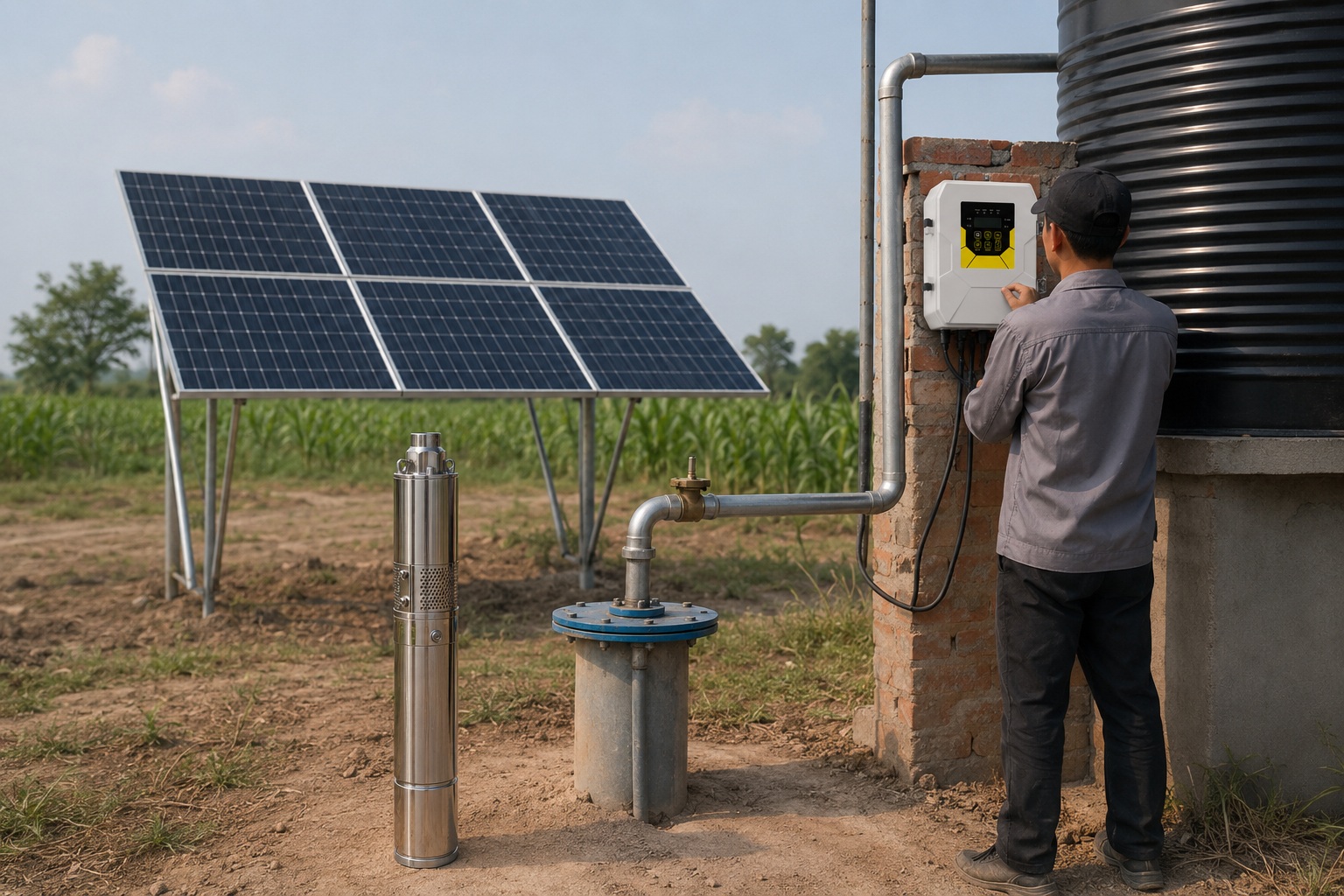
Selecting the right pump is more than just picking a model from a catalog.
It requires a systematic approach.
This ensures the pump you choose delivers water reliably and efficiently for years to come.
This guide will walk you through the essential steps.
Following this process ensures you get the sizing right the first time, avoiding costly mistakes and ensuring a dependable water supply.
First Step: Calculating Your Total Water Needs
Unsure how much water your project actually requires?
Guessing your flow rate and pressure can lead to an inefficient system that fails to meet your demands from day one.
To calculate your water needs, you must first determine the daily volume of water required for your specific application, such as for livestock or irrigation.
Then, you must calculate the Total Dynamic Head (TDH), which represents the total pressure the pump must overcome.
Understanding these two numbers—flow rate and TDH—is the non-negotiable first step in sizing any water pump system, especially a solar-powered one.
These metrics form the foundation for all subsequent decisions about the pump, motor, and solar array.
Without accurate calculations here, the entire system is built on guesswork.
Let's break down how to determine these critical figures accurately.
Determining Your Required Flow Rate
Your required flow rate is the volume of water you need over a specific period.
It is typically measured in gallons per minute (GPM) or liters per minute (LPM).
This figure depends entirely on your application.
A system for a single home has very different needs than one for a large agricultural field.
You should calculate your total daily water requirement first.
Then, divide that by the number of hours you expect the pump to run each day, which is determined by your location's peak sun hours.
For example, if you need 2,400 gallons per day and have 6 peak sun hours, you need a pump that can deliver 400 gallons per hour, or about 6.7 GPM.
It is always wise to add a 10-15% buffer to your calculation to account for unforeseen needs.
| Application | Average Daily Water Requirement |
|---|---|
| Single Family Home (4 people) | 300-400 Gallons |
| Beef Cattle (per head) | 10-15 Gallons |
| Dairy Cow (per head) | 20-35 Gallons |
| Drip Irrigation (per acre) | Varies greatly, approx. 5,000-10,000 Gallons |
| Center Pivot Irrigation | Can exceed 500 GPM during operation |
Understanding Total Dynamic Head (TDH)
Total Dynamic Head (TDH) is the total equivalent height that water must be pumped, considering all sources of pressure loss in the system.
It is the most critical factor in pump selection.
TDH is the sum of three separate components.
-
Static Head: This is the vertical distance from the water level in your well or source to the highest point of delivery, such as the inlet of a storage tank. It is a simple vertical measurement in feet or meters.
-
Friction Loss: As water moves through pipes and fittings, it encounters resistance, which causes pressure loss. This loss is known as friction loss. It increases with the length of the pipe, the flow rate, and the number of bends and valves. A smaller pipe diameter dramatically increases friction loss. For instance, pumping 10 GPM through 100 feet of 1-inch pipe results in about 14 feet of head loss, while a 2-inch pipe has only 1 foot of head loss.
-
Pressure Head: This is the amount of pressure you need at the final outlet. If you are simply filling a non-pressurized tank, this value is zero. However, if you are feeding a pressure tank or a sprinkler system that requires 30 PSI, you must convert that pressure to head. Every 1 PSI of pressure is equivalent to 2.31 feet of head. Therefore, a 30 PSI requirement adds 69.3 feet to your TDH.
Choosing the Right Pump Type for the Job
The perfect pump for a deep, narrow well might be entirely useless for shallow irrigation.
Choosing the wrong pump type means poor performance, frequent maintenance, and a significantly shorter lifespan for your investment.
You must match the pump type to your specific needs.
Progressive cavity (screw) pumps are ideal for deep wells with low flow requirements.
Centrifugal pumps offer much higher flow rates, with plastic impellers suited for sandy water and stainless steel impellers for corrosive conditions.
The pump's internal mechanism dictates its performance characteristics.
A pump designed for high flow cannot efficiently generate high pressure, and vice versa.
The water quality of your source is also a major determining factor.
Water with high sand content will quickly destroy a pump not designed to handle abrasives, while corrosive water will eat away at incompatible materials.
Making the right choice here ensures durability and efficiency.
The Progressive Cavity (Screw) Pump
This pump type is the specialist for deep wells.
It uses a single helical rotor (a stainless steel screw) rotating inside a double helical stator (a rubber housing).
This action creates sealed cavities that move water upward with each rotation.
Key Characteristics:
- Performance: It excels at providing very high head (pressure) from great depths, often exceeding 500 feet (150 meters). However, its flow rate is comparatively low, typically under 20 GPM.
- Sand Handling: This is its greatest advantage. The screw design can handle water with a significant amount of sand and sediment, often up to 3% concentration, without rapid wear. This makes it ideal for newly drilled or unstable wells.
- Applications: It is perfectly suited for domestic water supply from deep wells, livestock watering in arid regions, and small-scale, high-head irrigation.
The Centrifugal Pump (Plastic Impeller)
This is the workhorse for high-volume applications.
It uses a series of rotating impellers to build pressure and move water.
The plastic impeller variant is a cost-effective and lightweight option.
Key Characteristics:
- Performance: It delivers high flow rates at a medium head. This makes it ideal for moving large quantities of water for applications like farm irrigation and filling large reservoirs.
- Wear Resistance: Modern engineered plastics offer excellent resistance to abrasion from fine sand. This makes them a durable choice for many groundwater sources. A plastic impeller pump can often be 30-40% more economical than its stainless steel counterpart.
- Applications: It is widely used for farm and pasture irrigation, home garden watering systems, and general water transfer where well depths are moderate and flow requirements are high.
The Centrifugal Pump (Stainless Steel Impeller)
This is the premium option for quality and longevity.
This model uses high-grade SS304 or SS316 stainless steel for the impellers, diffusers, and pump housing.
This construction is designed for durability in challenging environments.
Key Characteristics:
- Corrosion Resistance: Its primary advantage is superior resistance to corrosion. This is essential for applications with acidic or alkaline water, or high salinity. It can extend the pump's lifespan by over 50% in such conditions.
- Performance: It offers high flow rates and can be engineered for medium-to-high head applications. The rigidity of stainless steel allows for tighter tolerances, often resulting in higher efficiency than plastic models.
- Applications: It is the go-to choice for water supply in regions with known water quality issues, such as alkaline soil regions. It is also used for high-end homes, ranches, and industrial processes where reliability is paramount.
| Pump Type | Best For | Max Head | Max Flow | Sand Tolerance | Cost Factor |
|---|---|---|---|---|---|
| Progressive Cavity | Deep Wells, High Sand | Very High | Low | Excellent | Medium |
| Centrifugal (Plastic) | High Volume, Moderate Depth | Medium | Very High | Good | Low |
| Centrifugal (SS) | Corrosive Water, Durability | High | Very High | Fair | High |
Powering Your Pump: The Motor and Controller
Your pump is only as good as the motor that drives it.
An inefficient motor wastes precious solar energy, forcing you to buy more panels and increasing your overall system cost significantly.
Modern solar pumps utilize high-efficiency Brushless DC (BLDC) permanent magnet motors, which often exceed 90% efficiency.
These advanced motors are paired with intelligent Maximum Power Point Tracking (MPPT) controllers to maximize power generation from your solar panels, even in less-than-ideal conditions.
The combination of a high-efficiency motor and an intelligent controller is the core of a modern solar pumping system.
This synergy determines not just the pump's performance, but the economic viability of the entire project.
An efficient system requires fewer solar panels, which reduces the initial investment, simplifies installation, and lowers the overall footprint.
Understanding this technology is key to appreciating the value of a well-engineered system.
The Advantage of Brushless DC (BLDC) Motors
BLDC motors represent a major leap in motor technology.
Unlike traditional brushed motors, they have no brushes that wear out, creating friction and requiring replacement.
They use powerful permanent magnets on the rotor and electronic commutation.
Key Advantages:
- High Efficiency: BLDC motors can convert over 90% of electrical energy into mechanical energy. This is a dramatic improvement over traditional AC or brushed DC motors, which often operate in the 60-75% efficiency range. This 25% reduction in energy waste is substantial.
- Durability and Lifespan: With no brushes to wear down, the motor is virtually maintenance-free and has a significantly longer operational lifespan.
- Compact and Lightweight: The high power density of BLDC motors means they can be made smaller and lighter than conventional motors of the same power output. They can be up to 40% lighter and 50% smaller, which simplifies installation, especially in deep wells.
- Cost Savings: The high efficiency directly translates to cost savings. A more efficient motor requires less power, meaning you can use a smaller, less expensive solar array to achieve the same pumping performance, potentially reducing panel costs by 20% or more.
The Role of the MPPT Controller
The controller is the brain of the solar pumping system.
An MPPT (Maximum Power Point Tracking) controller is an intelligent electronic device that sits between the solar panels and the pump motor.
Its job is to optimize the power transfer from the panels to the motor.
The voltage and current output of a solar panel changes constantly with sunlight intensity and temperature.
The MPPT controller continuously monitors the panel's output and adjusts the electrical load to ensure the panel is always operating at its peak power output point.
This can boost the energy harvested from the panels by up to 30% compared to a system without an MPPT controller, especially on cloudy days or during the early morning and late afternoon.
Ensuring 24/7 Operation: Hybrid AC/DC Systems
For critical applications, relying solely on sunlight is not always an option.
This is where hybrid AC/DC controllers provide a solution.
These advanced controllers are designed with two power inputs.
They can accept DC power from the solar panels and AC power from the grid or a generator simultaneously.
The controller's logic is programmed to prioritize solar power.
It will always use available free energy from the sun first.
When sunlight fades and the solar power is insufficient to run the pump, the controller automatically blends in or switches completely to the AC power source.
This ensures an uninterrupted water supply 24 hours a day, providing peace of mind and ultimate reliability.
Final Step: Sizing Your Solar Panel Array
You have selected the perfect pump, but you power it with an undersized solar array.
This common mistake means your pump will fail to run at full capacity and may not run at all on overcast days when you might need it most.
To size your solar array correctly, you need the pump motor's power rating in watts and the average number of peak sun hours for your specific geographic location.
As a general rule, multiply the pump's wattage by a safety factor of 1.25 to 1.3 to determine the total solar panel wattage you need.
Sizing the solar array is the final piece of the puzzle.
This step bridges the gap between the water demand (head and flow) and the power source (the sun).
An accurately sized array ensures that the pump receives enough power to operate efficiently throughout the day and across different seasons.
Under-sizing the array is a false economy, as it cripples the performance of the entire system.
Let's look at the simple but critical calculation involved.
Finding Your Pump's Power Requirement
Every pump motor has a power rating, which is measured in watts (W) or horsepower (HP).
This information is always listed on the motor's specification sheet or nameplate.
For sizing a solar array, you must use the wattage rating.
If the power is given in horsepower, you need to convert it.
One horsepower is approximately equal to 746 watts.
For example, a 1.5 HP motor has a power requirement of about 1.5 * 746 = 1119 watts.
This wattage figure is the foundation of your solar array calculation.
Determining Peak Sun Hours
"Peak sun hours" is a critical but often misunderstood concept.
It does not refer to the number of daylight hours.
Instead, it is a standardized value that represents how much solar energy is available in a specific location.
One peak sun hour is equivalent to one hour of sunshine at an intensity of 1000 watts per square meter.
A location with 5 peak sun hours receives the energy equivalent of 5 hours of full, direct, peak-intensity sun over the course of a day.
This value varies greatly by geography and season.
| Region | Average Peak Sun Hours (Annual) |
|---|---|
| Northern Europe | 2.5 - 3.5 |
| Southern USA (e.g., Arizona) | 5.5 - 6.5 |
| Central Australia | 6.0 - 7.0 |
| North Africa / Middle East | 5.5 - 7.5 |
| Southeast Asia | 4.0 - 5.0 |
You must use the peak sun hour value for your specific location to size your array correctly.
The Sizing Calculation
The calculation to determine the required solar array wattage is straightforward.
You need to provide enough panel wattage to cover the pump's power needs, plus a buffer for system inefficiencies and poor weather.
The Formula: Required Array (W) = Pump Power (W) x Safety Factor
A typical safety factor is 1.25 to 1.3.
This 25-30% oversize accounts for factors like panel temperature, dust, wiring losses, and lower light conditions.
Example Calculation:
- You have a pump with a 1000W motor.
- You choose a safety factor of 1.3.
- Required Array Wattage =
1000W * 1.3 = 1300W.
This means you would need a solar array with a total rated output of 1300 watts.
You could achieve this with four 330W panels (1320W total) or three 450W panels (1350W total).
Using this safety factor ensures your pump will perform reliably even on days that are not perfectly bright and sunny.
Conclusion
Properly sizing a solar water pump involves a systematic evaluation of head, flow, pump type, and the solar array.
Following these steps ensures a reliable and cost-effective system.
FAQs
How many solar panels does it take to run a water pump?
It depends on the pump's wattage. A 750W pump in a location with good sun might need three 330W panels.
Can a solar pump run without a battery?
Yes, most modern solar pump systems are direct-drive and do not require batteries, pumping water whenever there is sufficient sunlight.
What is the lifespan of a solar water pump?
A well-maintained system can last for many years. The BLDC motor can last over 10 years, while solar panels have a lifespan of 25 years.
How deep can a solar pump work?
This depends on the pump type. Progressive cavity screw pumps are designed for deep wells and can work at depths exceeding 500 feet (150 meters).
Can solar pumps work on cloudy days?
Yes, they can, but at a reduced flow rate. The MPPT controller helps maximize performance in low-light conditions.
What size solar pump do I need for a 1 hp motor?
A 1 HP motor is about 746 watts. You would need a pump and controller designed for that power, and a solar array of roughly 1000 watts.
Is an MPPT controller necessary for a solar pump?
While not strictly necessary, an MPPT controller is highly recommended. It can boost your system's output by up to 30%, maximizing your investment.
How does water temperature affect pump performance?
Water temperature primarily affects the viscosity and density of the water, but for most applications, the impact is negligible. However, very hot water can affect some pump seals over time.