Struggling with cloudy water or stressed fish despite having a new pump?
Your pump might be too powerful.
Choosing a pump that's too big can harm your pond's ecosystem.
Yes, a pump can absolutely be too big for a pond.
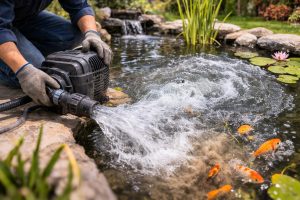
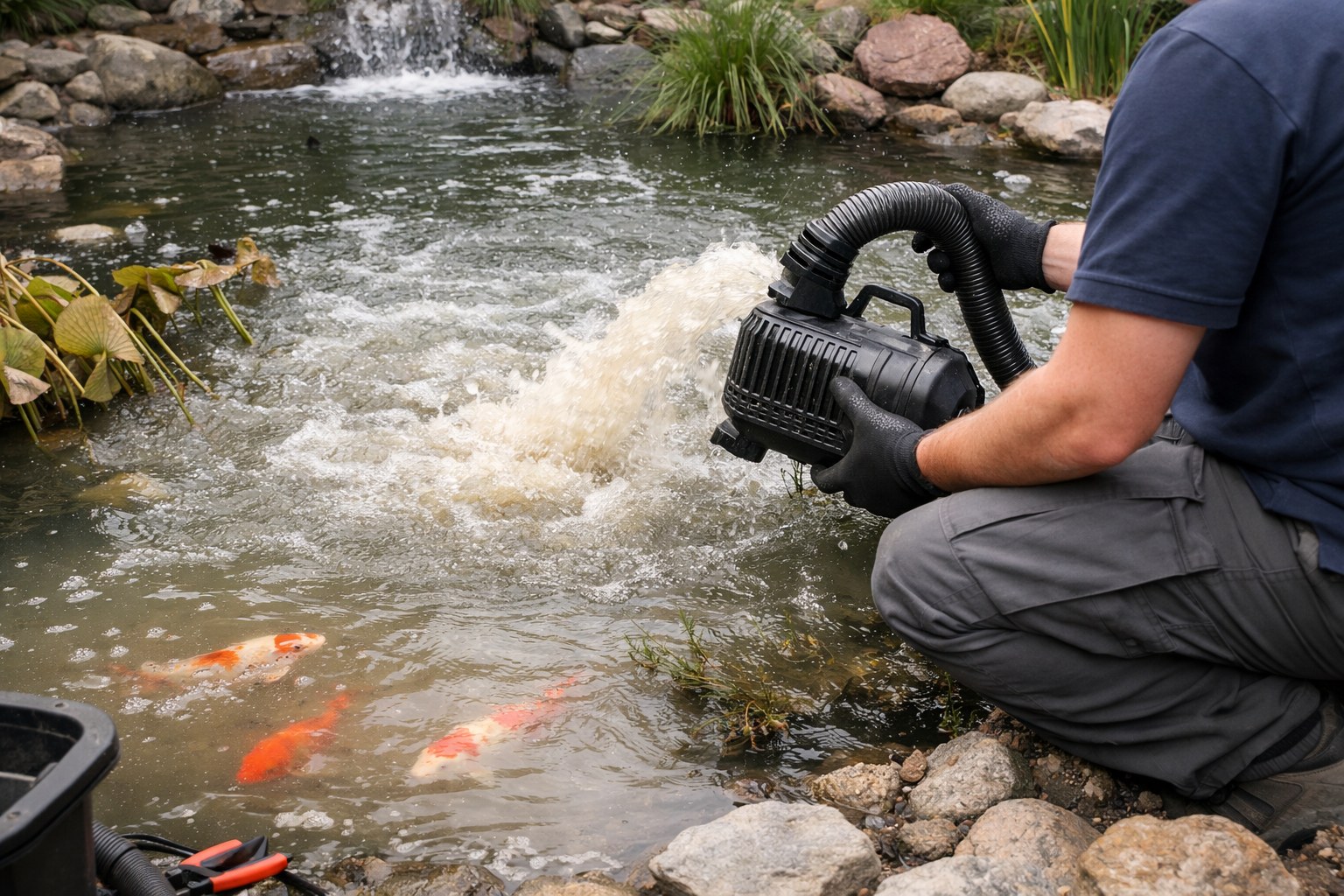
An oversized pump creates excessive water turbulence, which can stress fish, damage plants, and stir up sediment.
This disrupts the delicate natural balance, leading to poor water clarity and an unhealthy aquatic environment.
Selecting the right pump is a balancing act.
It’s not just about moving water; it's about creating a healthy, stable habitat.
An overpowered pump works against this goal, turning your tranquil oasis into a turbulent mess.
Understanding the key factors in pump selection will save you from making a costly and harmful mistake.
This guide will walk you through everything you need to know to find that perfect balance for a thriving pond.
Factors to Consider When Choosing a Fish Pond Pump
Is your pond water murky or are your fish acting lethargic?
An incorrectly sized pump could be the culprit, silently disrupting the harmony of your aquatic ecosystem.
The most critical factors are pond volume, fish and plant load, desired water features, and your local climate.
These elements collectively determine the required flow rate, measured in Gallons Per Hour (GPH), ensuring adequate circulation and oxygenation without creating excessive force.
Choosing a pond pump involves more than just picking one off the shelf.
It requires a calculated approach to ensure the heart of your pond's circulation system is perfectly tuned to its needs.
A pump that is too small will fail to circulate water effectively, leading to stagnant zones where harmful bacteria can thrive and oxygen levels plummet.
Conversely, a pump that is too powerful, as we've noted, creates a stressful, unnatural environment.
By carefully evaluating each key factor, you can select a pump that delivers optimal performance, promoting a crystal-clear and healthy pond that supports all its inhabitants.
Let's break down these critical components to help you make an informed decision and avoid common pitfalls.
Pond Size: The First Calculation
The volume of your pond is the foundational metric for pump selection.
An accurate measurement is non-negotiable.
To calculate the volume in gallons, use this formula:
(Average Length in feet) x (Average Width in feet) x (Average Depth in feet) x 7.48 = Total Gallons.
For example, a pond that is 10 ft long, 8 ft wide, and has an average depth of 2 ft holds approximately 1,200 gallons (10 x 8 x 2 x 7.48 = 1196.8).
This number is the starting point for determining the necessary flow rate.
Stocking Levels: Fish and Plants Matter
The biological load of your pond significantly impacts your pump requirements.
Fish and plants add to the ecosystem's need for oxygen and filtration.
More fish produce more waste, which requires faster circulation to process through the filter.
A heavily stocked koi pond, for instance, demands a much more robust circulation system than a simple water garden with a few goldfish.
A general guideline is to increase your calculated flow rate by 25-50% for ponds with a moderate to heavy fish load.
This ensures ammonia and nitrites are efficiently removed, keeping the water safe for your aquatic pets.
Head Height and Water Features
"Head height" is the vertical distance from the pump's location to the highest point the water needs to reach.
This is crucial if you have a waterfall, fountain, or stream.
Every foot of vertical lift reduces a pump's actual flow rate.
Pump manufacturers provide a chart showing the flow rate at different head heights.
For example, a pump rated at 3,000 GPH might only produce 2,000 GPH at a 5-foot head height.
Always choose a pump that provides your target flow rate after accounting for head height and friction loss from tubing.
| Feature | Additional Pump Power Consideration | Why it Matters |
|---|---|---|
| Small Fountain | Increase required GPH by 10-20% | Must overcome gravity to create the desired spray height. |
| Waterfall | Add 100 GPH for every inch of waterfall width | Ensures a visually appealing, consistent sheet of water. |
| Stream | Calculate stream volume and add to pond volume | The pump must circulate water through the entire system. |
| External Filter | Check filter's max flow rate | Pushing too much water can damage the filter. |
How to Calculate Pond Pump Size
Worried about complex math and technical charts?
Sizing your pond pump is simpler than you think.
Getting it right prevents future headaches and ensures a healthy pond from day one.
A reliable rule of thumb is to choose a pump with a flow rate that circulates your pond's entire volume at least once every two hours.
Therefore, the pump's GPH should be at least 50% of your pond's total gallonage.
For ponds with fish, aim for once per hour.
Calculating the perfect pump size is the single most important step in establishing a healthy pond ecosystem.
This calculation ensures that your pump and filter work in harmony to keep the water clean and oxygenated.
An underpowered pump leads to stagnation, algae blooms, and unhealthy fish.
An overpowered pump overwhelms the filtration system and creates a stressful environment.
By following a straightforward calculation method, you can confidently select a pump that meets the specific demands of your pond, whether it's a small water feature or a large koi habitat.
Step-by-Step Calculation Guide
-
Calculate Pond Volume: First, determine the total volume of your pond in gallons.
Use the formula:Length (ft) x Width (ft) x Depth (ft) x 7.48.
If your pond is irregularly shaped, estimate the average length and width. -
Determine Base Flow Rate (GPH): The goal is to circulate the water effectively.
- For general ponds/water gardens: Divide the total volume by 2.
This provides a circulation rate of once every two hours.
Example: A 1,000-gallon pond needs a base flow rate of 500 GPH. - For koi or fish ponds: Use the total volume as your base GPH.
This provides a more robust circulation rate of once per hour, which is essential for managing fish waste.
Example: A 1,000-gallon koi pond needs a base flow rate of 1,000 GPH.
- For general ponds/water gardens: Divide the total volume by 2.
-
Account for Head Height: Determine the vertical distance from the pump outlet to the water's highest point (e.g., the top of a waterfall).
Check the pump's performance chart.
Find a pump that delivers your required GPH at that specific head height.
Remember, flow rate decreases as head height increases.
For every 10 feet of horizontal tubing, add 1 foot of head height to account for friction loss. -
Adjust for Water Features and Filtration:
- Waterfalls: For a pleasing aesthetic, you generally want about 1,500 GPH for every 1 foot of waterfall width.
If this number is higher than your base GPH, use the waterfall requirement as your new target. - Filtration: Ensure your chosen pump's GPH does not exceed the maximum flow rate of your filter.
An overpowered pump can force water through the filter too quickly, reducing its effectiveness, or even damage the filter unit itself.
Your pump's GPH should be about 75-90% of the filter's maximum GPH rating.
- Waterfalls: For a pleasing aesthetic, you generally want about 1,500 GPH for every 1 foot of waterfall width.
Real-World Examples
Let's apply this to a couple of scenarios to see how it works.
Scenario 1: Small Decorative Pond
- Volume: 500 gallons
- Fish: A few small goldfish
- Features: None, just circulation
- Calculation: 500 gallons / 2 hours = 250 GPH.
A pump rated for 250-400 GPH would be sufficient.
Scenario 2: Medium Koi Pond with Waterfall
- Volume: 2,000 gallons
- Fish: Moderately stocked with koi
- Features: A 1.5-foot wide waterfall with a 4-foot head height.
- Calculation:
- Fish Circulation Needs: 2,000 gallons / 1 hour = 2,000 GPH.
- Waterfall Needs: 1.5 ft width x 1,500 GPH/ft = 2,250 GPH.
- Decision: The waterfall requires a higher flow rate, so we target 2,250 GPH.
- Final Selection: You need a pump that can deliver at least 2,250 GPH at a 4-foot head height.
How to Choose the Right Pump for Your Specific Pond Needs
Feeling overwhelmed by the sheer number of pumps available?
From submersible to external and low voltage to high flow, making the right choice determines the long-term health of your pond.
To choose the right pump, match its specifications to your calculated needs.
Consider pump type (submersible vs. external), energy efficiency, filtration compatibility, and durability.
This ensures your pump is not just effective, but also cost-efficient and long-lasting.
With your required GPH and head height calculated, you're ready to navigate the market.
But the numbers are only half the story.
The type of pump you choose will impact maintenance, operating cost, and even safety.
For example, a submersible pump is easy to install and quieter, but an external pump is often more powerful and easier to access for repairs.
Thinking about these practical aspects will lead you to a pump that not only performs well but also fits your lifestyle and budget, guaranteeing years of enjoyment from your pond.
Submersible vs. External Pumps
This is the first major decision you'll face.
Each type has distinct advantages and is suited for different applications.
-
Submersible Pumps:
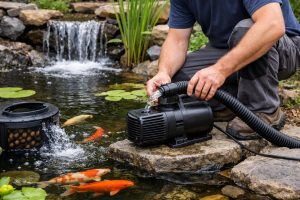
- How they work: Placed directly in the pond, often in the skimmer box or at the deepest point.
- Pros: Easy to install, generally quieter as the water muffles the sound, and often more affordable for smaller ponds.
- Cons: Can be difficult to access for maintenance, and their lifespan can be shorter if they become clogged with debris.
- Best for: Small to medium-sized ponds (under 3,000 gallons), decorative features, and beginners.
-
External Pumps:
- How they work: Located outside the pond in a dry, protected housing.
They pull water from the pond through plumbing. - Pros: Easier to access for maintenance, typically more energy-efficient for high-flow applications, and have a longer lifespan.
- Cons: More complex and expensive initial installation, can be noisier if not housed properly.
- Best for: Large ponds (over 3,000 gallons), high-flow waterfalls, and serious koi hobbyists who prioritize performance and easy maintenance.
- How they work: Located outside the pond in a dry, protected housing.
Energy Efficiency and Operating Costs
A pond pump runs 24/7, making its energy consumption a significant factor in your electricity bill.
A difference of just 50 watts can add up to over $50 per year in operating costs.
- Direct Drive Pumps: These are powerful and great for high head heights but tend to use more electricity.
They are common in pumps needed for large waterfalls. - Magnetic Drive Pumps: Highly energy-efficient for low to medium head heights.
They are a popular choice for general circulation and filtration in most backyard ponds. - Low Voltage Pumps: These are increasingly popular for their safety and efficiency.
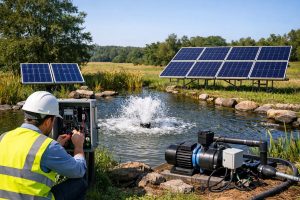
Operating on 12V or 24V, they reduce the risk of electric shock and can sometimes be powered by solar panels, further lowering costs.
Durability and Maintenance
A pump is a long-term investment.
Look for features that indicate durability and ease of maintenance.
- Materials: Pumps with ceramic shafts and stainless steel components resist wear and corrosion better than those with all-plastic parts.
- Solids-Handling Capability: If your pond has a lot of debris or is a dedicated fish pond, a "solids-handling" pump is essential.
These pumps can pass small leaves, fish waste, and algae without clogging, significantly reducing maintenance.
They are typically measured by the maximum particle size they can handle (e.g., up to 1.25 inches). - Pre-Filter/Cage: A good submersible pump will have a robust pre-filter cage to prevent large debris from entering and damaging the impeller.
Look for a cage that is easy to remove and clean.
Conclusion
Yes, a pump can be too big.
An oversized pump disrupts your pond's balance, stresses fish, and wastes energy.
Proper calculation based on volume, stock, and features is essential.
Frequently Asked Questions
What happens if my pond pump is too strong?
A pump that is too strong creates excessive turbulence. This can stress fish, uproot plants, and constantly stir up debris from the bottom, leading to cloudy water and an unhealthy ecosystem.
Can a pump be too strong for a filter?
Yes. If the pump's flow rate (GPH) exceeds the filter's maximum capacity, it forces water through too quickly. This reduces the filter's effectiveness and can potentially damage the filter media or housing.
How often should a pond pump run?
A pond pump should run 24 hours a day, 7 days a week. Continuous circulation is crucial for maintaining oxygen levels and filtering out waste, which is essential for the health of your fish and plants.
How do I reduce the flow of my pond pump?
You can reduce the flow by installing a diverter or ball valve on the outlet tubing. This allows you to bleed off excess pressure or restrict the flow to achieve the desired rate.
Should my pond pump be on the bottom of the pond?
Placing the pump at the bottom is common for maximum circulation. However, it's often better to slightly elevate it on a brick or shelf to prevent it from sucking up bottom sludge and debris.
How many times should pond water be circulated per day?
For a fish pond, the water should be circulated at least once every hour (24 times a day). For a water garden without fish, circulating the total volume once every two hours is sufficient.
Does a bigger pump use more electricity?
Generally, yes. A pump with a higher GPH or one designed for higher head pressure will have a more powerful motor that consumes more watts, leading to higher electricity costs.