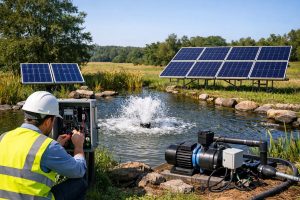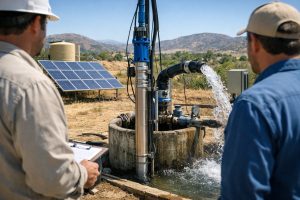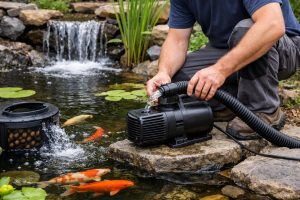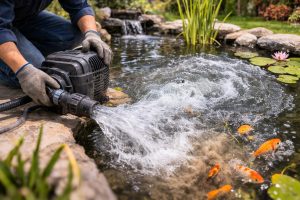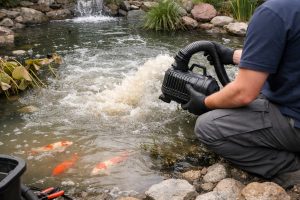
Struggling with a turbulent, unhealthy pond despite having a pump?
Your pump might be too strong, causing stress to fish and wasting energy.
This common issue highlights the importance of matching pump power to your specific needs.
Yes, a pond pump can definitely be too powerful.
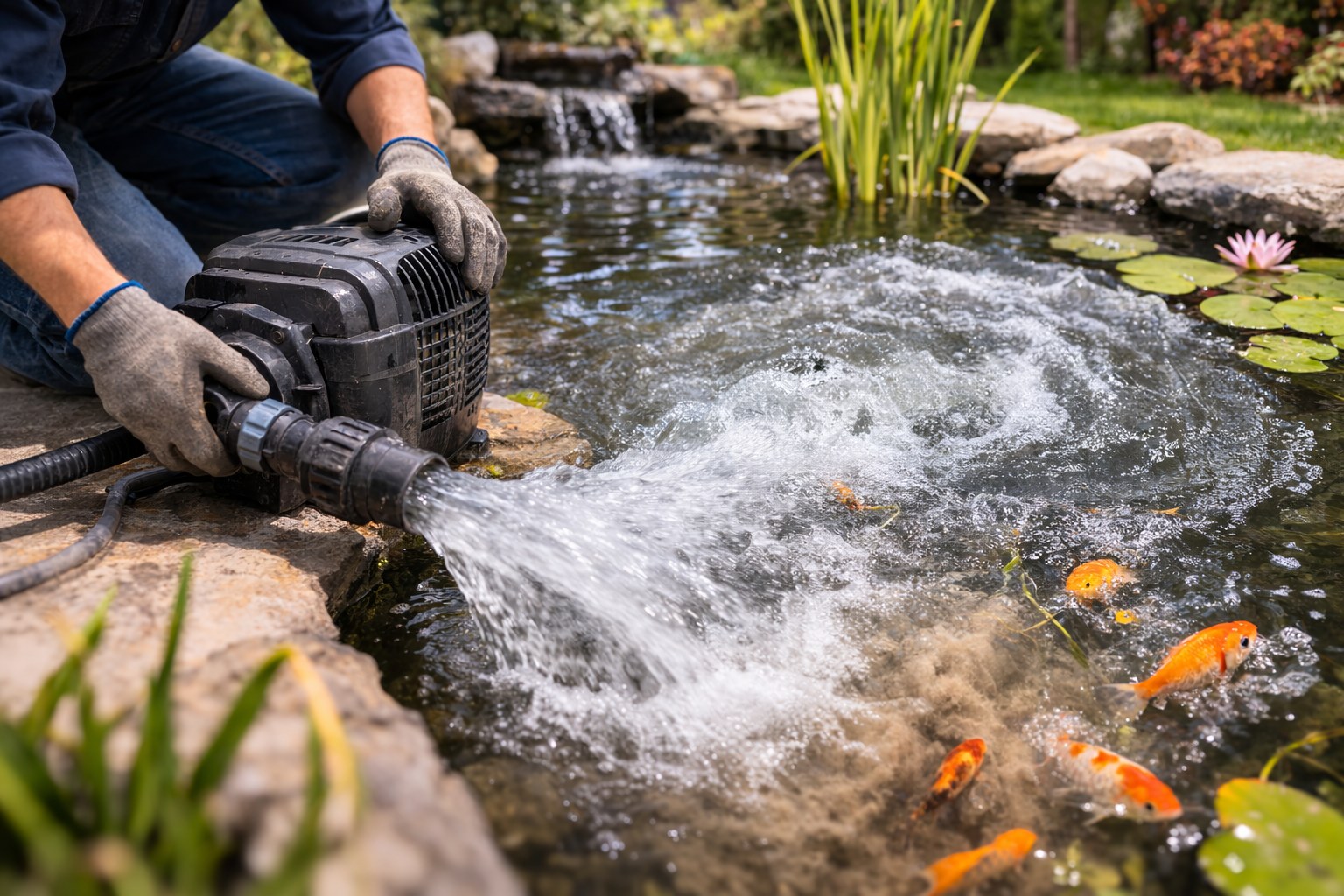
An oversized pump creates excessive water flow, which can stress or even harm fish and aquatic plants.
It can also stir up bottom sediment, leading to cloudy water, and will consume more electricity than necessary, increasing your operating costs.
Choosing the right pump is a balancing act.
You need enough power for proper circulation and filtration, but not so much that it disrupts the delicate ecosystem you've created.
This principle of matching equipment to the specific environment doesn't just apply to garden ponds.
It's even more critical in demanding applications like agriculture, livestock watering, and domestic water supply from deep wells, where efficiency and reliability are paramount.
Let's explore how to select the perfect pump for any situation, from a small water feature to a large-scale irrigation project.
How to Choose the Right Pump for Your Specific Needs
Choosing a pump can feel overwhelming with so many options available.
Making the wrong choice leads to inefficiency, high costs, and system failure.
It's a common problem for distributors and end-users alike.
To choose the right pump, you must first define your needs.
Consider the required flow rate (how much water you need), the total head (the vertical distance the water must be lifted), and the water quality (e.g., sandy or corrosive).
These factors determine the ideal pump type and size.
Selecting the perfect pump is a science.
It involves a careful analysis of your specific application to ensure optimal performance, longevity, and cost-effectiveness.
For professionals sourcing pumps for large projects or resale, understanding the technical nuances is key to providing value and building a reputation for expertise.
The decision goes beyond simple power ratings; it involves matching the pump's core design to the job at hand.
Let's break down the most popular and efficient solar deep well pump technologies available today.
The Three Pillars of Solar Pumping Technology
The global demand for off-grid water solutions has spurred innovation, leading to specialized pump designs.
Each is engineered to excel under different conditions.
-
Solar Screw Pump: The High-Head Specialist
This pump utilizes a stainless steel screw (rotor) rotating within a rubber stator.
This action creates sealed cavities that move water upward.
It's designed for low-flow, high-head applications.
It is ideal for deep wells where water needs to be lifted from significant depths for domestic use or livestock.
A key advantage is its exceptional resistance to sand, with some models handling up to 5% sand content without damage. -
Solar Plastic Impeller Pump: The High-Flow Workhorse
This is a multi-stage centrifugal pump.
It uses a series of durable, wear-resistant plastic impellers to move large volumes of water.
It's the go-to choice for applications requiring high flow rates at medium head, such as farm irrigation and pasture water supply.
Its lightweight and economical design makes it a popular choice, particularly in regions like Africa and the Americas. -
Solar Stainless Steel Impeller Pump: The Durability Champion
When water quality is a concern, this pump shines.
Built with SS304 stainless steel impellers and a matching pump body, it offers superior resistance to corrosion.
It is engineered for environments with acidic or alkaline water, found in parts of Australia and the Americas.
This pump delivers high flow at medium-to-high head, ensuring a long service life in harsh conditions.
Matching the Pump to the Application
To simplify the selection process, here is a guide to help you match the right pump technology to the right job.
| Pump Type | Best For | Key Advantages | Limitations |
|---|---|---|---|
| Solar Screw Pump | Deep wells, domestic water, livestock | High head (lifts water from great depths), sand resistant | Lower flow rate, not for large-scale irrigation |
| Solar Plastic Impeller | Farm irrigation, garden water supply | High flow rate, economical, lightweight, wear-resistant | Less durable in corrosive water or very deep wells |
| Solar Stainless Steel | Corrosive water, premium homes, ranches | High corrosion resistance, long service life, reliable | Higher initial cost, heavier |
Ultimately, choosing the right pump is the first step.
The true engine behind its performance is the motor.
What else should I look for in a pump?
Focusing only on the pump itself is a common mistake.
If the motor driving it is inefficient, you'll waste energy and money, regardless of how good the pump is.
This oversight can cripple an otherwise well-designed water system.
Look beyond the pump and focus on the motor efficiency.
A high-efficiency motor, like a Brushless DC (BLDC) permanent magnet motor, is crucial.
It directly impacts the number of solar panels needed, reduces operating costs, and ensures long-term reliability and performance.
When evaluating a water pump system, the motor is the heart of the operation.
An advanced motor not only delivers power but does so with maximum efficiency, translating solar energy into water movement with minimal loss.
This is where cutting-edge technology separates standard pumps from high-performance systems.
For distributors, offering products with superior motor technology provides a significant competitive advantage.
For end-users, it means a more robust, cost-effective, and sustainable water solution.
The Power of the BLDC Permanent Magnet Motor
All three pump types—screw, plastic impeller, and stainless steel—can be powered by the same core technology: a BLDC permanent magnet brushless motor.
This is not just an incremental improvement; it's a revolutionary leap in pump efficiency.
-
Unmatched Efficiency: These motors consistently achieve efficiencies exceeding 90%.
In contrast, traditional AC motors or brushed DC motors can have efficiencies as low as 60-70%.
This 20-30% improvement means more water is pumped using the same amount of solar power. -
Advanced Materials: The rotor is constructed from high-grade 40SH neodymium iron boron magnets.
This material ensures a strong and stable magnetic field, which is essential for maintaining high torque and efficiency over the motor's lifespan. -
Compact and Lightweight Design: Modern BLDC motors are significantly smaller and lighter than their predecessors.
On average, they are 47% smaller in volume and 39% lighter in weight.
This simplifies transportation and installation, especially in remote locations.
The Market Value of Superior Motor Technology
The strategic role of the BLDC motor cannot be overstated.
Its technical advantages translate directly into tangible market value.
| Feature | Technical Advantage | Market Value for Customers |
|---|---|---|
| High Efficiency (>90%) | Less energy wasted as heat | Reduces solar panel requirements by up to 30%, lowering initial system cost. |
| High Torque | Strong starting power | Ensures reliable operation, even in challenging conditions. |
| Brushless Design | No brushes to wear out | Maintenance-free operation, eliminating a common point of failure. |
| Compact & Lightweight | Smaller physical footprint | Easier and cheaper to install, reducing labor costs. |
| Long Service Life | Fewer moving/wearing parts | Provides a reliable water source for years, delivering a better return on investment. |
The integration of a BLDC motor transforms a good pump into a great one.
When combined with an intelligent MPPT (Maximum Power Point Tracking) controller, the system maximizes every watt of available solar energy, delivering reliable water from sunrise to sunset.
What if I need water 24/7?
Solar power is fantastic, but what happens on cloudy days or at night?
For many critical applications, relying solely on sunlight is not an option.
This limitation can be a major barrier to adopting solar pumping solutions.
This is solved with an AC/DC hybrid pump system.
These systems automatically switch between solar power and a grid or generator source.
They prioritize solar energy when available and seamlessly switch to AC power when needed, ensuring an uninterrupted water supply.
The future of reliable water access, especially in off-grid or semi-grid areas, lies in hybrid technology.
A well-designed AC/DC water pump system offers the best of both worlds: the cost-saving, eco-friendly benefits of solar energy and the 24/7 reliability of a conventional power source.
This dual-power capability removes the main drawback of solar-only systems, making them a practical and worry-free solution for any water need, day or night.
Understanding the AC/DC Hybrid Controller
The brain of the hybrid system is the intelligent controller.
It's designed with dual power inputs, allowing you to connect solar panels and an AC source (like the grid or a generator) simultaneously.
-
Automatic Power Prioritization: The controller is smart.
It constantly monitors the solar input.
As long as the sun provides enough power, the pump runs 100% on free solar energy. -
Energy Blending Function: When solar energy decreases, for example on a cloudy day, the controller doesn't just switch off.
It has a hybrid function that blends power, drawing the maximum possible energy from the solar panels and supplementing the rest with AC power.
This maximizes the use of free solar energy and minimizes reliance on the grid. -
Seamless AC Switchover: When there is no solar input at all (e.g., at night), the controller automatically switches over to the AC power supply.
The entire process is automatic, requiring no manual intervention.
Benefits of a Hybrid Water Pumping System
This technology provides unmatched flexibility and peace of mind for both residential and commercial users.
-
Uninterrupted Water Supply: Guarantees water is available 24 hours a day, 7 days a week, regardless of weather conditions or time of day.
This is critical for households, livestock, and commercial operations. -
Maximized Cost Savings: By prioritizing and maximizing the use of free solar energy, the system significantly reduces electricity bills.
It only draws from the grid when absolutely necessary. -
Increased System Versatility: A hybrid system can be installed anywhere.
It's perfect for locations with an unreliable grid connection, or for users who want to be grid-independent but require a backup. -
Simplified Operation: The fully automatic switching means the system is "set it and forget it."
It provides a hassle-free user experience, ensuring that water is always there when needed without any complex management.
By embracing hybrid technology, you are not just buying a pump; you are investing in a complete, reliable, and intelligent water management solution.
Conclusion
Choosing the right pump involves matching its type to your flow, head, and water needs, while ensuring it's powered by an efficient motor and a smart controller for ultimate reliability.
FAQs
What happens if my pond pump is too weak?
A pump that is too weak will not circulate water effectively. This can lead to stagnant areas, low oxygen levels, and the buildup of algae and harmful bacteria.
What is the ideal pond circulation rate?
A good rule of thumb is to circulate the entire volume of your pond at least once every hour. For ponds with a high fish load, circulating the water twice per hour is better.
Can I use a single pump for a filter and a waterfall?
Yes, you can use a single pump for both. However, you must ensure the pump has enough flow rate and head pressure to operate the filter and lift water to the top of the waterfall effectively.
How do I know if my pump flow rate is too high?
Signs of an overpowered pump include visibly stressed fish struggling against the current, plants being uprooted, and constantly murky water from stirred-up sediment.
Are bigger pumps always more expensive to run?
Generally, yes. A larger, more powerful pump will consume more electricity. This is why it's crucial to select the right size to avoid unnecessary energy costs.
How does head height affect a pump's performance?
Head height is the vertical distance the pump must push water. The higher the head, the lower the actual flow rate will be. Always check a pump's performance chart to see its flow at your required head height.
Should I run my pond pump 24/7?
Yes, for the health of your pond, especially if it contains fish. Continuous operation ensures constant filtration and oxygenation, which is vital for a stable aquatic ecosystem.
What is the difference between a fountain pump and a filter pump?
Fountain pumps are designed to create high pressure to produce decorative spray patterns but typically can't handle solid debris. Filter pumps are designed to move larger volumes of water and can handle solids without clogging.