Struggling with water access in an off-grid location?
Traditional pumps mean high fuel costs and unreliability.
A solar water pump is the sustainable solution you need.
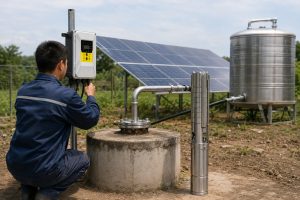
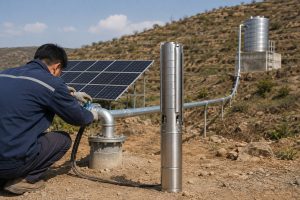
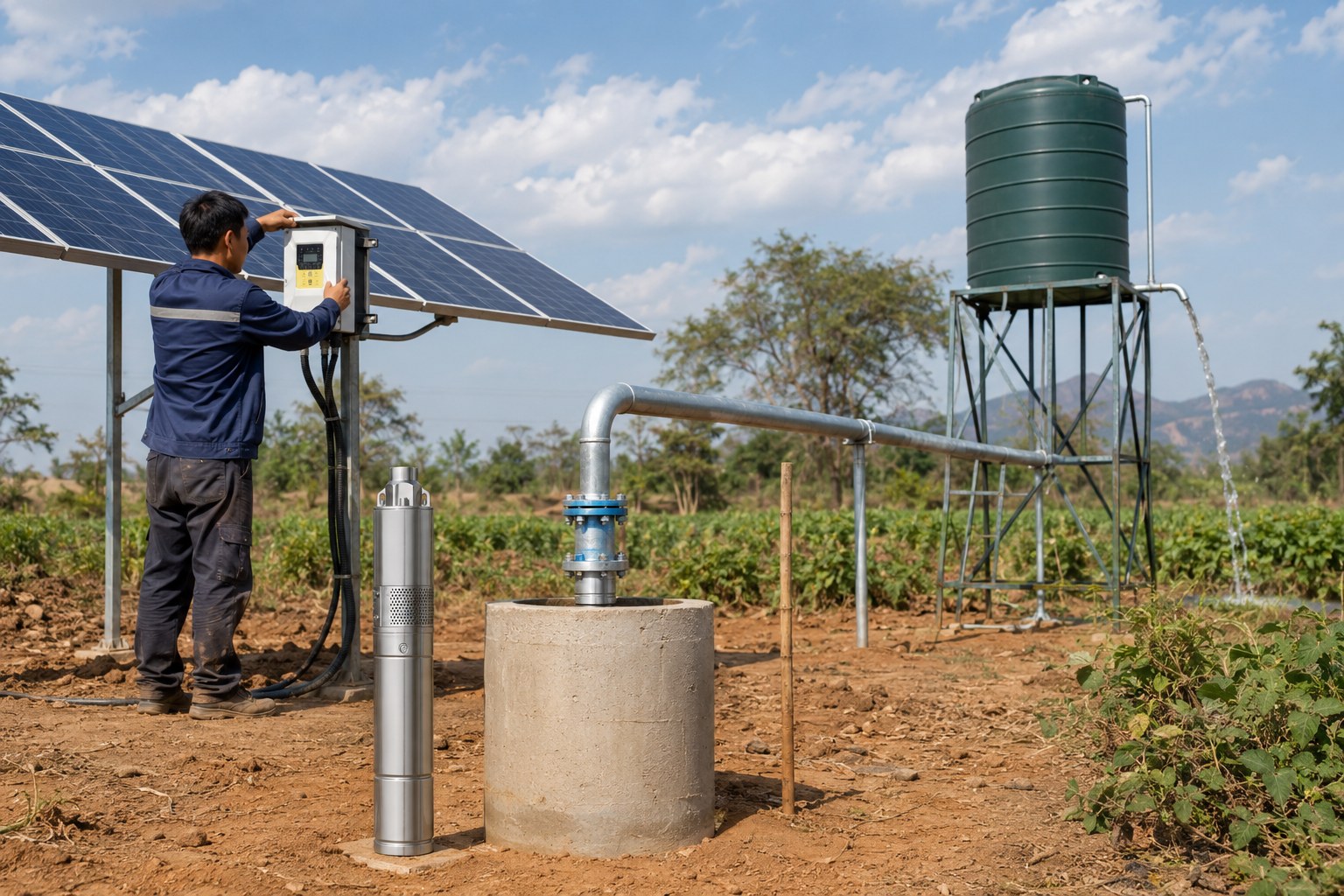
A solar water pump works by using solar panels to capture sunlight and convert it into DC electricity. This electricity powers a motor, which drives a pump to move water from a source like a well or river. For AC pumps, an inverter is used to change the DC to AC power.
Understanding this simple yet powerful technology is the first step toward achieving water independence.
Solar pumps are transforming agriculture and daily life in regions across Africa, Asia, and the Americas.
They provide a reliable water supply without depending on a fluctuating power grid or expensive fossil fuels.
Let's explore the components that make up these life-changing systems and how they come together to deliver water wherever the sun shines.
The Basics of a Solar Water Pump
A solar pump system might seem complicated at first.
You worry about choosing the wrong parts and ending up with an inefficient setup.
Let's break down the essential components for a clear understanding.
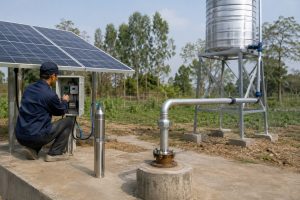
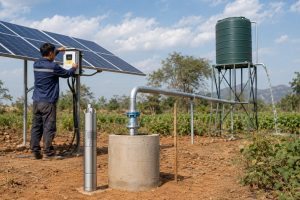
The core components of a solar water pumping system are the solar panels, a pump controller, and the water pump itself. The panels generate power, the controller manages it efficiently, and the pump moves the water. Some systems also include a water tank for storage.
A solar water pump system is an elegant integration of several key parts, each playing a critical role.
Knowing how these parts function together demystifies the entire operation and empowers you to make informed decisions for your specific water needs.
From the panel that catches the sun to the pipe that delivers the water, every component is designed for efficiency and durability.
The Main Components of a Solar Pump System
A complete solar pumping system is more than just a pump and a panel.
It's a carefully balanced ecosystem of technology.
- Solar Panels: Also known as a photovoltaic (PV) array, these are the system's power plant. They are made up of solar cells that absorb photons from sunlight. This process generates direct current (DC) electricity. The cost of PV panels has fallen by over 80% in the last decade, making these systems more affordable than ever.
- Water Pump Motor: This is the heart of the system that does the physical work. It uses the electricity generated by the panels to draw water from a source, which can be a deep well, borehole, river, or lake.
- Pump Controller: This is the brain of the operation. It regulates the electrical power from the panels to the motor. It also provides vital protection against over-voltage, under-voltage, or motor damage if the water source runs dry. Advanced controllers feature Maximum Power Point Tracking (MPPT), which can boost water output by up to 30% by optimizing the power from the panels.
- Inverter: Standard water pumps often run on alternating current (AC). If an AC pump is used, an inverter is required to convert the DC electricity from the solar panels into usable AC power. This conversion process has a small efficiency loss, typically around 5-10%.
- Pipes: A simple but crucial component, pipes transport the water from the pump to its final destination, whether it's an irrigation system, a livestock trough, or a storage tank.
- Water Tank: Many systems include a water storage tank. This allows water to be pumped and stored during peak sunlight hours for use at night or on cloudy days, often eliminating the need for a battery bank.
The Solar Water Pump Working Principle
The process is a straightforward conversion of light into motion.
- Sunlight, composed of photons, strikes the solar panels.
- The photovoltaic cells within the panels absorb these photons, creating a flow of DC electricity.
- This DC electricity is sent to the pump controller.
- The controller manages the power, adjusts it for maximum efficiency, and sends it to the pump's motor.
- The motor activates, driving the pump mechanism.
- The pump draws water from the source and pushes it through the pipes to the desired location.
This entire process happens automatically and silently, powered only by the sun.
What are the Different Types of Solar Water Pumps?
There are so many different types of solar pumps available.
Choosing the wrong one can lead to poor performance and wasted investment.
Let's clarify the main categories to help you select the right pump for your needs.
Solar water pumps are primarily categorized by their placement (submersible vs. surface) and the type of electrical current they use (DC vs. AC). Submersible pumps are placed underwater in deep wells, while surface pumps are used for shallow water sources like rivers or ponds.
Understanding the fundamental differences between pump types is crucial for designing an effective water system.
Whether you need to lift water from a 150-meter deep borehole or transfer it from a nearby stream to your farm, there is a specific pump designed for that job.
The choice depends on your water source, depth, required flow rate, and budget.
Let's dive deeper into these classifications.
Differentiating by Function: Where the Pump Sits
The physical location of the pump is the first major distinction.
-
Submersible Solar Pumps: As the name suggests, these pumps are designed to be fully submerged in water. They are the go-to solution for deep wells and boreholes. Because they push water up from below rather than pulling it from above, they are far more efficient for lifting water from significant depths, often exceeding 200 meters. They are sealed units, built to withstand underwater conditions for years.
-
Surface Solar Pumps: These pumps are installed on dry land near the water source. They work by pulling or sucking water from shallow sources like rivers, lakes, ponds, or storage tanks. They are generally limited to a suction depth of about 7-8 meters. Their main advantages are lower initial cost and easier access for installation and maintenance.
| Pump Type | Best Use Case | Pumping Depth | Cost | Maintenance |
|---|---|---|---|---|
| Submersible | Deep wells, boreholes | 10m - 300m+ | Higher | More complex |
| Surface | Rivers, ponds, tanks | Up to 8m | Lower | Easier |
Differentiating by Current: The Power It Uses
The type of electricity the motor uses is another key factor.
-
DC Solar Pumps: These pumps use a direct current (DC) motor. They can be connected directly to the solar panels (via a controller), which naturally produce DC power. This makes them highly efficient, as there is no energy lost in converting the power from DC to AC. DC pumps are the ideal choice for purely off-grid applications where simplicity and maximum efficiency are paramount.
-
AC Solar Pumps: These pumps use an alternating current (AC) motor, the same type used in most grid-powered appliances. They require an inverter to function with solar panels. While this adds a component and a small efficiency loss, AC pumps are very versatile. They can be powered by solar panels during the day and by grid electricity or a generator at other times, offering greater flexibility. This makes them suitable for larger-scale irrigation or commercial uses where high flow rates are needed.
A Closer Look at High-Performance Solar Deep Well Pumps
Generic pump categories don't tell the whole story.
You need the right tool for a specific job, whether it's a deep well, sandy water, or a corrosive environment.
Let's explore three specialized pump models for targeted performance.
Three leading solar deep well pump types are the solar screw pump for high head, the solar plastic impeller pump for high flow, and the solar stainless steel impeller pump for corrosion resistance. Each is engineered to excel in a different application.
For distributors and end-users, having a portfolio of specialized pumps is a significant competitive advantage.
It allows you to provide the perfect water solution for any environment, from a family home in rural Africa to a large-scale farm in the Americas.
These pumps are not just different in name; their internal design directly impacts their performance, durability, and ideal use case.
Let's break down the unique strengths of each.
The Solar Screw Pump: Low Flow, High Head
This pump is a specialist in lifting water from extreme depths.
It uses a simple, effective mechanism: a single stainless steel helical screw (rotor) rotates within a rubber housing (stator).
This action creates sealed cavities of water that are pushed progressively up the pump, generating very high pressure, or "head."
It is the perfect choice for domestic water supply, livestock drinking water, and small-scale drip irrigation where the well is deep but the water volume requirement is not massive.
Its ability to handle water with some sand content makes it highly durable in harsh well conditions common in parts of Africa and Latin America.
The Solar Plastic Impeller Pump: High Flow, High Wear-Resistance
This pump is a workhorse designed for moving large volumes of water.
It is a multi-stage centrifugal pump.
This means it has a series of impellers, or spinning disks, stacked on top of each other.
As water passes through each stage, its pressure and speed increase.
Using durable, engineered plastic for the impellers provides excellent resistance to abrasion from fine sand.
This design delivers a high flow rate at a medium head, making it ideal for farm irrigation, pasture watering, and filling large tanks quickly.
It is lightweight and more economical than its stainless steel counterpart, making it a popular choice across Africa and the Americas for agricultural applications.
The Solar Stainless Steel Impeller Pump: Premium Quality, Corrosion Resistance
This is the premium option for challenging water conditions.
This pump features impellers, a pump body, and other key components made from SS304 or even higher-grade SS316 stainless steel.
This construction provides superior resistance to corrosion from acidic or alkaline water.
It is the only viable choice for regions with aggressive groundwater, such as in certain alkaline soil areas in Australia or industrial zones.
It offers high flow and medium-to-high head capabilities similar to the plastic impeller model but with a much longer service life in corrosive environments.
Its durability and reliability make it the top choice for high-end homes, critical commercial applications, and ranches where water quality is a concern.
| Pump Model | Key Feature | Best For | Flow Rate | Head (Pressure) |
|---|---|---|---|---|
| Screw Pump | High-Pressure Screw | Deep wells (>100m) | Low | Very High |
| Plastic Impeller | High-Volume Impellers | Farm irrigation, Sandy Water | High | Medium |
| Stainless Steel Impeller | Corrosion-Resistant | Acidic/Alkaline Water | High | Medium-High |
The Core of Efficiency: The Brushless DC Motor
The pump itself is only half of the performance equation.
An inefficient motor wastes precious solar energy, requiring more panels and increasing costs.
Let's focus on the engine that drives modern, high-performance solar pumps.
High-efficiency Brushless DC (BLDC) permanent magnet motors are the technological core of modern solar pumps. With efficiencies exceeding 90%, they significantly reduce the number of solar panels needed, which can lower the system's initial cost by 20-30%.
The motor is the single most important factor determining the overall efficiency and competitiveness of a solar water pump system.
A superior motor translates directly into lower initial investment and better long-term performance for the end-user.
This is where leading manufacturers differentiate their products, moving beyond standard components to advanced engineering.
The adoption of BLDC motor technology has been a game-changer for the solar pumping industry.
What is a BLDC Permanent Magnet Motor?
A Brushless DC (BLDC) motor is an advanced electric motor that operates without the mechanical brushes and commutator of a traditional DC motor.
Instead, it uses an electronic controller to switch the current in the motor windings.
High-performance BLDC motors used in solar pumps feature a rotor made of powerful permanent magnets, such as 40SH grade neodymium iron boron.
This design eliminates friction and energy loss associated with brushes, leading to dramatically higher efficiency, a longer lifespan, and quieter operation.
Technical and Market Advantages
The benefits of using a BLDC motor are substantial and impact everyone from the manufacturer to the end-user.
- Extreme Efficiency: BLDC motors can achieve efficiencies of over 90%, compared to 60-75% for conventional brushed motors. This means more of the sun's energy is converted into water pumping power.
- Reduced System Cost: Because the motor is so efficient, it requires less power to do the same amount of work. This allows the system to run with fewer solar panels, directly reducing the total initial investment by as much as 30%.
- Compact and Lightweight Design: These motors are significantly more compact and lighter. A modern BLDC motor can be up to 47% smaller and 39% lighter than a traditional motor with the same power output. This makes installation easier and cheaper, especially for deep well pumps.
- High Torque and Reliability: BLDC motors provide high starting torque, which is essential for getting water moving from a deep source. With no brushes to wear out, they are virtually maintenance-free and offer a much longer operational life, often exceeding 10 years without service.
In essence, the BLDC motor acts as a force multiplier for the entire solar pump system, making it more powerful, affordable, and reliable.
Advantages and Disadvantages of Solar Powered Water Pumps
Solar pumps sound like an ideal solution, but are they perfect for every situation?
Believing they have no downsides can lead to mismatched expectations and buyer's remorse.
Let's weigh the pros and cons to form a complete picture.
The primary advantages of solar pumps are no ongoing fuel costs, extremely low maintenance, and environmental friendliness. The main disadvantages are a higher initial investment and the inability to pump water at night or on heavily overcast days without a backup system.
Like any technology, solar water pumps have a distinct set of strengths and weaknesses.
Fortunately, the biggest drawback—their dependence on sunlight—has been effectively solved with modern technology.
By understanding both sides, you can accurately assess if a solar pump is the right choice and what type of system will best meet your need for a 24/7 water supply.
The Major Advantages
The benefits of going solar for your water needs are compelling, especially in the long term.
- Economical to Operate: Once installed, the energy is free. A diesel pump used for irrigation might cost over $500 annually in fuel and maintenance. A solar pump has zero fuel costs, meaning the higher initial investment can often be paid back in just 2-3 years.
- Eco-Friendly: Solar pumps produce zero carbon emissions during operation. This reduces reliance on fossil fuels and helps protect the environment.
- Ideal for Remote Areas: They are the perfect solution for locations without access to a reliable electrical grid. They can be installed anywhere the sun shines.
- Low Maintenance and High Reliability: With fewer moving parts than diesel pumps and no brushes to replace in BLDC motors, solar pumps can operate for many years with minimal maintenance. This reliability is critical for communities and farms that depend on a constant water source.
- Increases Productivity: Solar pumps free people from the grueling and time-consuming task of manually collecting water. Farmers can irrigate more land and harvest multiple times a year, boosting food security and income.
The Disadvantages and Modern Solutions
The historical drawbacks of solar pumps are being overcome by technological advancements.
- High Up-front Costs: The initial purchase and installation cost is higher than for a conventional electric or diesel pump. However, the price of solar panels has plummeted, and the long-term savings on fuel and maintenance make it a financially sound investment over the system's life.
- Unable to Work When It's Dark: A standard solar pump only operates during daylight hours. This can be a significant limitation. The solution is twofold:
- Water Storage: Pumping water into a large storage tank during the day provides a gravity-fed water supply that is available 24/7.
- AC/DC Hybrid Systems: This is the ultimate solution for uninterrupted water access. Advanced hybrid controllers can accept both DC power from solar panels and AC power from the grid or a generator. The controller automatically prioritizes solar power. When sunlight is insufficient, it can blend in AC power or switch over completely, ensuring you have water whenever you need it, day or night. This technology effectively eliminates the main drawback of solar pumping.
Conclusion
Solar water pumps offer a reliable, cost-effective, and green solution for water needs.
Their success hinges on matching the right pump type and a high-efficiency motor to the specific application.
FAQs
Can a solar pump work without a battery?
Yes.
Most systems pump water directly into a storage tank during the day.
This stored water can then be used anytime, eliminating the need for batteries.
How deep can a solar pump go?
This varies by model.
Solar screw pumps are designed for high-head applications and can effectively pump water from depths exceeding 200 meters (650 feet).
How long do solar water pumps last?
A well-maintained system has a long lifespan.
Solar panels are often warrantied for 20-25 years, and a quality BLDC pump motor can last for over 10 years.
What is the difference between a solar pump and an electric pump?
The main difference is the power source.
A solar pump uses free energy from the sun, while a standard electric pump relies on paid electricity from the power grid.
What size solar pump do I need?
The right size depends on your daily water requirement, the depth of your water source (total dynamic head), and the amount of solar irradiation in your location.
Can solar pumps run at night?
Not on their own.
To get water at night, you need a system with a water storage tank, a battery bank, or a hybrid AC/DC controller connected to a secondary power source.
What is a solar pump controller?
The controller is the system's brain.
It manages the power from the solar panels to the pump, maximizing efficiency and protecting the motor from damage.