Struggling with high electricity bills or no grid access for your water needs?
You're searching for a sustainable, cost-effective solution but feel overwhelmed by the options and price points.
**A simple solar-powered water pump can cost between $90 and $700.
A complete solar well pump system for more demanding applications, like deep wells or large-scale irrigation, typically starts around $2,000 and can exceed $3,000 for high-performance models.
The final price depends on the pump's size, type, and system components.**
This wide price range can be confusing.
You might wonder why one system costs as much as a used car while another is less than a dinner for two.
The answer lies in the components, the technology driving them, and the specific job you need the pump to do.
Understanding these factors is crucial for making a wise investment that delivers reliable water for years.
Let's break down what truly determines the cost and performance of a solar water pump system.
How Do Solar Pumps Work?
Need to move water but find traditional pumps too expensive or impractical for off-grid locations?
You want a reliable system but don't understand the mechanics behind solar-powered options.
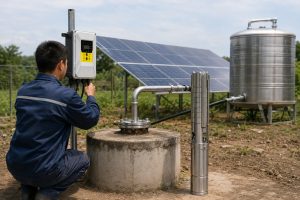
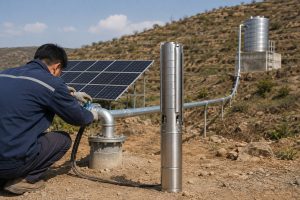
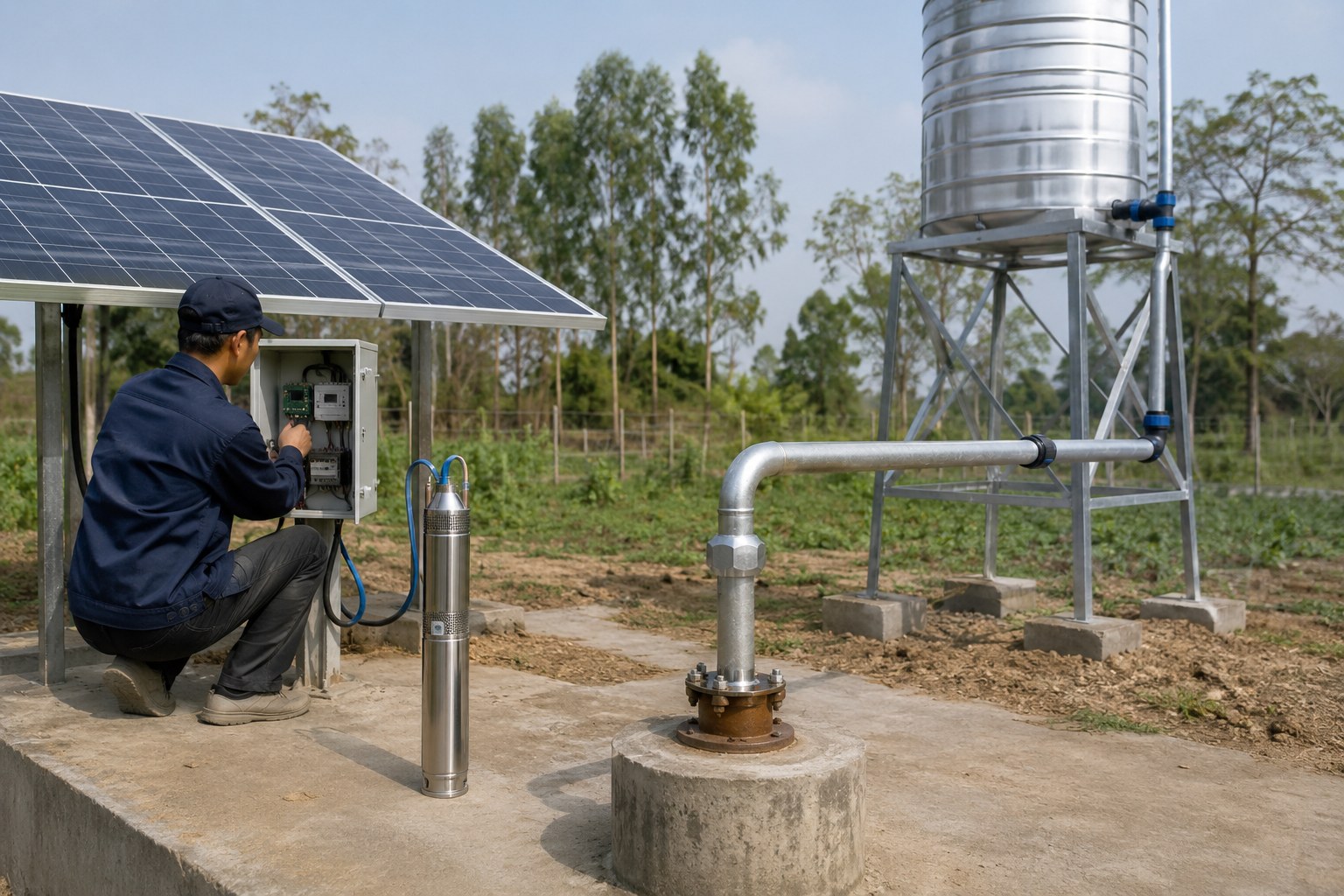
**A solar water pump system uses photovoltaic (PV) panels to convert sunlight into DC electricity.
This electricity powers a motor, which drives the pump to move water from a source like a well, stream, or tank.
An intelligent controller manages the power to maximize efficiency.**
To truly grasp the system's value, we need to look closer at its core components.
The setup is more than just a panel and a pump.
It's an integrated system where each part plays a vital role in efficiency, durability, and overall cost.
The three main components are the solar panels, the pump controller, and the pump unit itself.
However, the real heart of the system is the motor inside the pump.
The Core Components of a Solar Pumping System
A solar water pump system is elegantly simple in its design.
-
Solar Photovoltaic (PV) Panels: These panels are the system's power plant.
They capture photons from sunlight and convert them into direct current (DC) electricity.
The number and wattage of panels needed depend directly on the pump motor's power requirements and the amount of daily sunlight available at the installation site.
-
Solar Pump Controller: This is the brain of the operation.
Its primary job is to regulate the power from the panels to the motor.
Modern systems use Maximum Power Point Tracking (MPPT) controllers, which are essential for maximizing water output.
An MPPT controller adjusts the electrical load to find the "sweet spot" where the solar panels produce the most power, increasing efficiency by up to 30% compared to direct connections.
It also provides crucial protection against over-voltage, under-voltage, and dry-running.
-
The Pump Unit (Motor and Wet End): This is the part that does the physical work.
It consists of the motor, which converts electrical energy into mechanical motion, and the "wet end" (e.g., impellers or a screw), which uses that motion to move water.
The Engine of Efficiency: The BLDC Motor
The single most critical factor in a solar pump's performance and long-term value is its motor.
High-efficiency systems utilize a Brushless DC (BLDC) permanent magnet motor.
Unlike older brushed motors, BLDC motors have no brushes to wear out, drastically increasing their lifespan to over 30,000 hours and eliminating maintenance.
Their efficiency is remarkable.
A high-quality BLDC motor can achieve an electrical-to-mechanical conversion efficiency of over 90%.
This high efficiency means the motor requires less power to do the same amount of work.
Consequently, you need fewer solar panels to run the pump, which significantly reduces the initial system cost.
These motors are also engineered to be compact and lightweight.
For instance, an advanced BLDC motor can be up to 47% smaller and 39% lighter than a traditional motor of equivalent power output.
This simplifies transportation and installation, especially in remote areas.
| Motor Type | Efficiency | Lifespan | Maintenance | Key Feature |
|---|---|---|---|---|
| BLDC Permanent Magnet | >90% | >30,000 Hours | None | High torque, compact |
| Brushed DC Motor | 60-75% | 3,000-5,000 Hours | Regular brush replacement | Lower initial cost |
| AC Motor (with inverter) | 80-85% | 20,000 Hours | Minimal | Requires DC-to-AC inverter |
This table clearly shows why the BLDC motor is the superior choice for solar pumping applications.
Its unparalleled efficiency is the key that unlocks the entire system's potential, providing more water for less power and a lower overall investment.
What Are The Advantages Of Solar Water Pumps?
Are you facing unreliable water access due to remote location or unstable power grids?
The ongoing costs of fuel for diesel generators and frequent maintenance are draining your resources.
**Solar water pumps offer a major advantage by operating independently of the power grid with zero fuel costs.
They are environmentally friendly, require very little maintenance, and provide a reliable long-term water source, making them highly cost-effective over their lifespan.**
The benefits of switching to solar-powered water solutions extend far beyond simply "going green."
They represent a strategic shift towards energy independence, operational stability, and long-term financial savings.
For agriculture, households, and livestock management in areas with abundant sunshine, the case for solar pumps is compelling.
Let's explore these advantages in greater detail.
A Deeper Look at the Benefits
The decision to invest in a solar pump system is often driven by a combination of economic, practical, and environmental factors.
Understanding each benefit helps clarify the return on investment.
Significant Long-Term Cost Savings
While the initial setup cost can be higher than for a conventional pump, a solar pump system pays for itself over time.
The primary saving comes from eliminating the need for electricity or fuel.
Consider the comparison with a diesel-powered pump.
| Cost Factor | Solar Pump System | Diesel Pump System |
|---|---|---|
| Initial Investment | Medium to High | Low to Medium |
| Fuel Costs | $0 | Continuous & Fluctuating |
| Maintenance | Minimal (panel cleaning) | Frequent (oil, filters, repairs) |
| Operational Labor | Automatic (runs on its own) | Requires refueling & monitoring |
| Lifespan | 20+ years (panels), 10+ years (pump) | 5-10 years (engine) |
The sun's energy is free.
Once the system is installed, the operational cost is nearly zero.
This predictability is a massive advantage over the volatile and ever-increasing prices of diesel fuel and grid electricity.
Over a 10-year period, a solar pump can save a user thousands, or even tens of thousands, of dollars in fuel and maintenance costs.
Unmatched Reliability and Energy Independence
Solar pumps are a perfect solution for remote locations where power lines are non-existent or unreliable.
They provide complete energy independence.
Farmers no longer have to worry about power outages disrupting irrigation schedules or livestock watering.
Households in rural areas can enjoy a consistent water supply without being tethered to a fragile grid.
This reliability is further enhanced by the simplicity of the system.
With few moving parts, especially in models with BLDC motors, there is very little that can break down.
They can operate for years without needing any service beyond a simple cleaning of the solar panels.
Environmental and Health Benefits
Solar pumps produce clean energy.
They emit no greenhouse gases or other pollutants during operation.
This contrasts sharply with diesel pumps, which release harmful fumes like carbon monoxide and nitrogen oxides, contributing to air pollution and health problems for those nearby.
By choosing solar, you are not only securing your water supply but also contributing to a healthier environment for your community.
Furthermore, it eliminates the risks associated with storing and handling flammable fuels on your property.
What Are The Disadvantages Of Solar Water Pumps?
Worried that a solar pump won't work when you need it most, like on cloudy days or at night?
The idea of an inconsistent water flow or the high cost of battery backups is holding you back.
**The main disadvantages of basic solar pumps are their reliance on direct sunlight, leading to inconsistent flow on cloudy days and no operation at night.
High-performance systems that overcome this often require expensive battery banks, increasing the initial cost and complexity.**
These limitations are valid concerns, particularly for basic, entry-level systems.
The performance of a solar pump is directly tied to the sun's intensity, a factor you can't control.
For applications requiring a 24/7 water supply, such as domestic use or critical irrigation, these drawbacks have traditionally been a significant barrier.
However, modern technology offers powerful solutions to mitigate these issues entirely.
Overcoming the Limitations of Solar Power
While the challenges are real, advanced solar pump systems have evolved to address them head-on.
Understanding these solutions is key to selecting a system that provides unwavering reliability.
The Problem of Intermittency
A standard solar pump's output fluctuates throughout the day.
It starts slowly in the morning, peaks at midday, and fades in the evening.
On heavily overcast or rainy days, its performance can drop significantly, sometimes by as much as 50-80%, or it may not run at all.
This inconsistent flow is a major issue for applications that need a steady water supply.
For a long time, the only solution was to add a large battery bank to the system.
While batteries store excess energy for use at night or during cloudy periods, they come with their own set of drawbacks:
- High Cost: A battery bank can add 30-50% to the total system cost.
- Maintenance: Batteries require regular monitoring and maintenance.
- Limited Lifespan: Most solar batteries need to be replaced every 5-10 years, representing a significant future expense.
- Reduced Efficiency: The process of charging and discharging a battery results in energy loss.
The Modern Solution: AC/DC Hybrid Technology
Recognizing these challenges, leading manufacturers have developed a more elegant and cost-effective solution: the AC/DC hybrid solar pump controller.
This innovation provides the best of both worlds, ensuring you have water whenever you need it, without the expense and hassle of batteries.
An AC/DC hybrid controller is designed with two power inputs: one for the solar panels (DC) and one for a backup power source (AC), such as the main electrical grid or a generator.
The controller's intelligent software automatically prioritizes solar power.
How it works:
-
Full Sun: The system runs 100% on free solar energy from the PV panels.
-
Partial Clouds: The controller's hybrid function intelligently blends the available solar power with just enough AC power to maintain the required pump speed and water flow.
It maximizes the use of every bit of solar energy before drawing from the grid.
-
Night or Heavy Clouds: When solar input is zero or insufficient, the controller automatically and seamlessly switches over to the AC power source, ensuring uninterrupted pump operation.
This technology offers 24-hour water security.
You get the cost-saving benefits of solar during the day and the reliability of the grid at night or on rainy days.
It completely eliminates the need for a costly battery bank for most applications, providing a more reliable, lower-maintenance, and more financially sound solution for worry-free water access.
What Size Solar Pump Do I Need?
Choosing the wrong pump size could mean wasting money on an overpowered system or being left with a weak trickle of water.
You need to match the pump to your specific needs, but the calculations seem complex.
To size a solar pump, you must first calculate two key factors: the total daily water volume you need (in gallons or liters) and the Total Dynamic Head (TDH), which is the total vertical distance the water must be lifted plus any friction loss in the pipes.
Sizing a pump isn't just about picking the one with the highest flow rate.
It's a balancing act between flow, pressure, and the unique demands of your application.
A pump designed for a deep well is fundamentally different from one meant for shallow-water irrigation.
Understanding the main types of solar pumps and their ideal applications is the first step to making the right choice and ensuring your investment is both efficient and effective.
Let's explore the three most popular types of solar deep well pumps.
Matching the Pump Type to Your Water Needs
The global market for solar deep well pumps is dominated by three distinct designs, each engineered for specific conditions.
All are powered by high-efficiency BLDC motors, but their "wet ends" are built for different tasks.
1. Solar Screw Pump: The Deep Well Specialist
This pump is built for high-head, low-flow applications.
It uses a rotating stainless steel screw within a rubber stator.
As the screw turns, it creates sealed cavities that move water upward through compression, almost like a screw pushing the water up.
-
Best For: Deep wells, domestic water supply, and livestock drinking water in arid regions.
It's ideal for situations where you need to lift water from great depths (high head).
-
Advantages: Excellent for lifting water from depths of 100 meters or more.
It is highly resistant to sand and can operate reliably in harsh water conditions.
- Limitations: Its flow rate is limited, making it unsuitable for applications requiring large volumes of water quickly, such as large-scale farm irrigation.
2. Solar Plastic Impeller Pump: The High-Volume Workhorse
This is a multi-stage centrifugal pump.
It uses a series of durable plastic impellers that spin at high speed.
Each impeller adds pressure to the water, pushing it to the next stage and ultimately out of the pump.
- Best For: Farm irrigation, pasture water supply, and filling large tanks or reservoirs where high flow is more important than extreme head.
-
Advantages: Delivers a high volume of water (high flow rate).
It is lightweight, economical, and offers good resistance to fine sand and abrasives.
-
Limitations: Less durable than stainless steel in highly corrosive water.
It is not the best choice for extremely deep wells where very high pressure is required.
3. Solar Stainless Steel Impeller Pump: The Premium Durability Option
This model is structurally similar to the plastic impeller pump but uses impellers and a pump body made from SS304 or SS316 stainless steel.
It's designed for longevity in challenging water conditions.
-
Best For: Water sources with acidic or alkaline properties, such as in alkaline soil regions or certain industrial applications.
Also used for high-end homes and ranches where maximum reliability and service life are paramount.
-
Advantages: Exceptional corrosion resistance ensures a very long service life.
Highly reliable even in aggressive water environments.
-
Limitations: This is the most expensive of the three types.
It is also heavier, which can slightly complicate installation.
| Pump Type | Primary Application | Key Strength | Ideal Water Condition | Relative Cost |
|---|---|---|---|---|
| Screw Pump | Deep Well / Domestic | Very High Head | Sandy / Abrasive | $$ |
| Plastic Impeller | Farm Irrigation / High Volume | High Flow / Economical | General / Fine Sand | $ |
| Stainless Steel Impeller | Corrosive Water / Premium Use | Corrosion Resistance | Acidic / Alkaline | $$$ |
By understanding this product portfolio, distributors can cater to diverse market needs, while end-users can select the perfect pump that balances performance, durability, and cost for their specific application.
What Is The Most Powerful Solar Water Pump?
You're looking for the "most powerful" pump, thinking that means the highest performance.
But you're worried that just chasing a high flow rate number might lead you to buy the wrong pump for your actual needs.
**The "most powerful" solar water pump isn't simply the one with the highest flow rate (LPH).
True power is a combination of the pump's flow, the head it can overcome, and most importantly, the efficiency of the motor and controller that drive the entire system.**
Focusing solely on a pump's maximum Liters Per Hour (LPH) rating is a common mistake.
A pump that boasts 20,000 LPH might be completely useless if it can only lift water one meter, and your well is 50 meters deep.
Conversely, a pump with a modest 2,500 LPH rating could be incredibly powerful if it can efficiently deliver that water to a height of 100 meters.
The true competitive advantage and power of a modern solar pump system lie in the synergy between its components, driven by a high-efficiency motor and an intelligent control system.
Redefining "Power" in Solar Pumping
To make an informed decision, we must move beyond simple metrics and look at what creates a genuinely powerful and effective system.
Power is about doing the required work with the least amount of energy.
The Engine of Power: High-Efficiency BLDC Motors
As we've discussed, the BLDC permanent magnet motor is the core of a high-performance system.
Its efficiency, often exceeding 90%, is the primary determinant of the system's power-to-consumption ratio.
-
Higher Torque: These motors deliver high torque even at low speeds.
This means they can start pumping earlier in the day and continue later in the evening, maximizing the daily water output.
-
Less Power Needed: A 90% efficient motor requires significantly less energy from the solar panels compared to a 70% efficient motor to pump the same amount of water.
This can reduce the required solar array size by over 20%, directly cutting down the system's cost and footprint.
- Reliability Under Load: The robust design ensures they can handle the continuous 24-hour workloads possible with AC/DC hybrid systems without overheating or failing.
The Brains of Power: Intelligent MPPT Controllers
The motor provides the muscle, but the MPPT controller provides the intelligence.
It ensures the motor always receives the optimal voltage and current from the solar panels, regardless of changing sunlight conditions.
Without an MPPT controller, a system can lose up to 30% of its potential power.
A powerful system isn't just about raw output; it's about smart energy utilization.
The controller maximizes every watt generated by the panels, effectively making the entire system more powerful and efficient.
The Right Tool for the Job
Ultimately, the most powerful pump is the one that is perfectly matched to its task.
- For a 150-meter deep borehole supplying a home, a solar screw pump is the most powerful choice, even with its lower flow rate.
- For irrigating a 5-hectare farm from a shallow river, a plastic impeller pump delivering high volumes of water is the most powerful solution.
- For providing water in an area with corrosive water chemistry, a stainless steel impeller pump is the most powerful because it will outlast all others, ensuring long-term reliability.
Therefore, the question shouldn't be "What is the most powerful pump?" but rather, "What is the most powerfully effective pump system for my specific needs?" The answer lies in a flexible product portfolio that combines high-efficiency BLDC motors and intelligent controllers with the right pump type for the job.
Conclusion
Choosing the right solar pump depends on understanding your specific needs for flow and head.
The true value lies not just in the pump, but in a high-efficiency motor and smart controller.
FAQs
Are solar water pumps worth it?
Yes, for off-grid locations or areas with high electricity costs, they are very worthwhile.
The initial investment is paid back over time through zero fuel costs and minimal maintenance requirements.
How long do solar water pumps last?
A well-maintained system has a long lifespan.
Solar panels are often warrantied for 20-25 years, while high-quality BLDC pumps can operate for over 10 years before requiring major service.
Can a solar pump run without a battery?
Yes, most modern solar pumps run directly from the solar panels during the day.
AC/DC hybrid systems can also use grid power at night, eliminating the need for batteries entirely.
What is the main disadvantage of a solar water pump?
The main disadvantage of a basic system is its dependence on sunlight.
Performance decreases on cloudy days, and it does not operate at night without a backup like batteries or an AC/DC hybrid controller.
How many solar panels does it take to run a water pump?
This depends entirely on the pump's wattage.
A small 100-watt pump might only need one or two panels, while a large 1500-watt irrigation pump could require a much larger array.
Do solar pumps work on cloudy days?
Yes, but at a reduced capacity.
The pump's flow rate will decrease as cloud cover lessens the sun's intensity.
An MPPT controller helps maximize performance in low-light conditions.
Can a solar pump fill a tank?
Absolutely.
This is one of their most common applications.
Pumping water to an elevated storage tank during the day provides a pressurized water supply that can be used 24/7 via gravity.
How high can a solar pump lift water?
This varies widely by model.
Small pumps might lift water 5-10 meters.
Specialized deep well screw pumps, however, are designed to lift water from depths exceeding 200 meters.