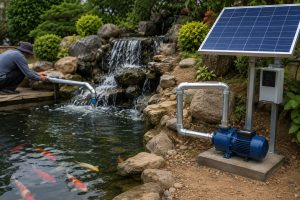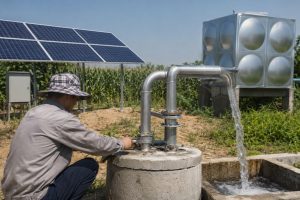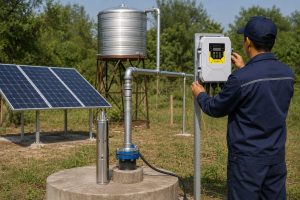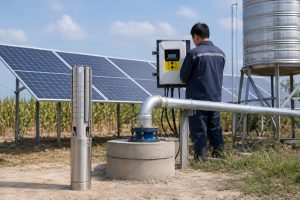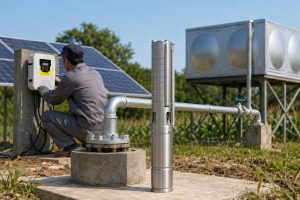
Struggling with unreliable grid power for your water needs?
Solar energy offers a clean, independent solution.
But can it power a demanding submersible pump?
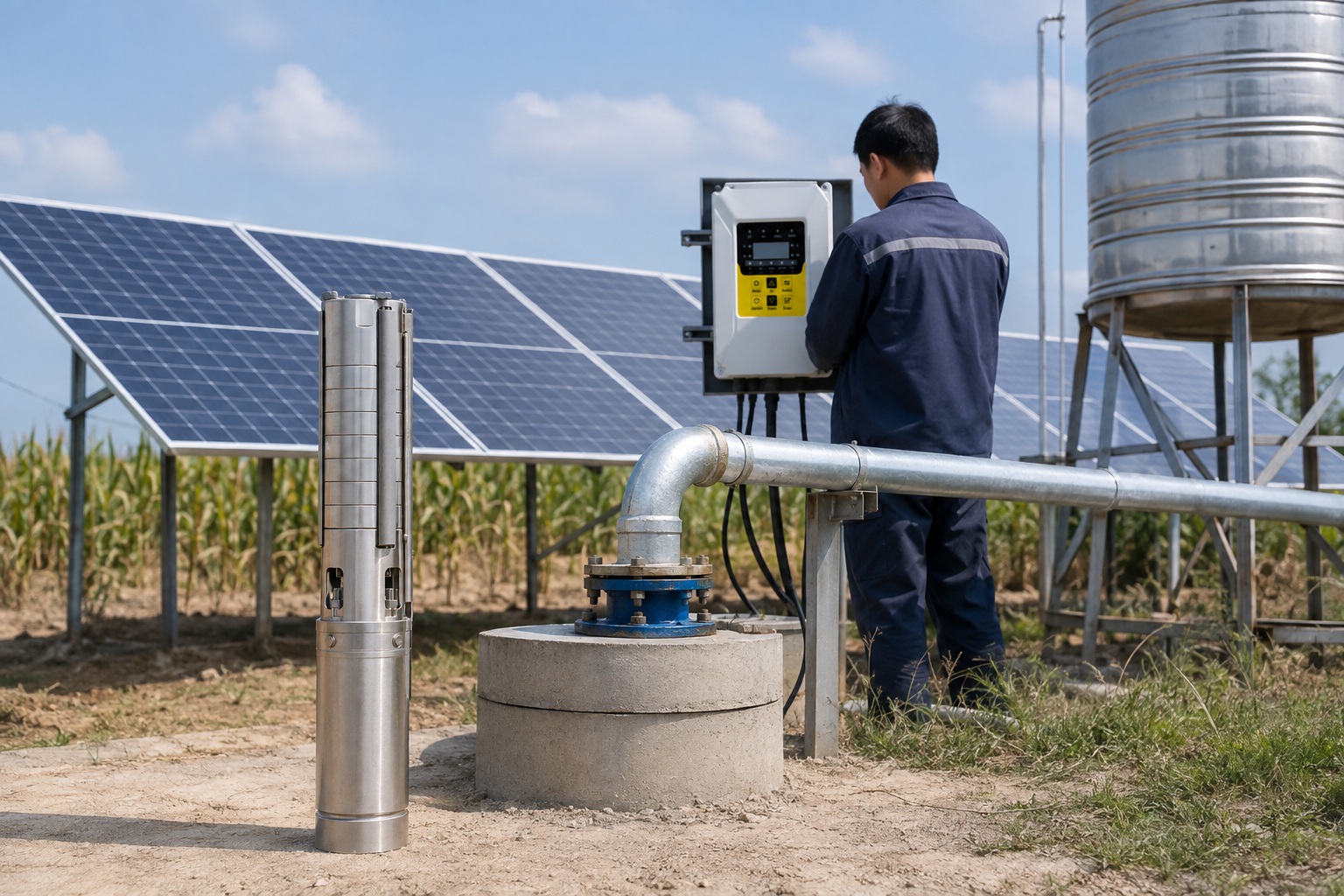
Yes, you absolutely can run a submersible pump on solar power.
Solar-powered systems are a sustainable and cost-effective solution, especially for remote areas.
They use solar panels to generate electricity, offering reliable water access without depending on the grid.
Now that you know it's possible, you might be wondering how it all works.
Let's dive into the components, the different types of pumps, and how to set up your own system for maximum efficiency.
This guide will walk you through everything you need to know to make an informed decision.
How Solar Power Drives Submersible Pumps
Confused by how sunlight turns into water flow?
The process seems complex.
It’s actually a straightforward system with a few key components working together seamlessly.
A solar-powered pump system uses solar panels to convert sunlight into DC electricity.
This power is managed by a controller, which then runs the pump.
Some systems use an inverter for AC pumps or batteries for nighttime operation, creating a reliable water supply.
A solar water pumping system is a model of efficiency.
It harnesses the sun's energy and transforms it into the mechanical power needed to move water.
Understanding each part of this process helps clarify how reliable and effective these systems are.
At its core, the system is designed to be simple, robust, and require minimal maintenance.
The Main Components of the System
The entire setup consists of a few primary parts that work in harmony.
Each component has a specific job, contributing to the overall function of pumping water using only sunlight.
-
Solar Panels: These are the power generators. They are made of photovoltaic (PV) cells that capture sunlight and convert it directly into Direct Current (DC) electricity. The amount of power they generate depends on their size, efficiency, and the intensity of the sunlight.
-
Pump Controller: This is the brain of the operation. It manages the DC power coming from the panels. Its most critical function is Maximum Power Point Tracking (MPPT), which optimizes the power output from the panels to the pump, increasing efficiency by up to 30%. It also protects the pump from voltage fluctuations, overloads, and running dry.
-
Water Pump: This is the heart of the system. It is typically a submersible DC pump specifically designed for solar applications. It takes the electrical energy from the controller and uses it to draw water from a source like a well, borehole, or river.
-
Inverter (for AC pumps): If you choose an AC pump, an inverter is necessary. It converts the DC power from the solar panels into Alternating Current (AC) power that the pump can use. This conversion process, however, results in a small energy loss, typically between 5-15%.
-
Batteries (Optional): For water access on cloudy days or at night, batteries can be added. They store excess energy generated by the panels during peak sun hours. This stored power can then be used whenever needed, ensuring a 24/7 water supply.
How it All Works Together
The process is elegantly simple.
Sunlight strikes the solar panels, which generate DC electricity.
This electricity flows to the pump controller.
The controller intelligently regulates this power, ensuring the pump receives the optimal voltage and current to operate at maximum efficiency.
It then sends this refined power to the submersible pump.
The pump motor activates, drawing water from the source and pushing it to a storage tank or an irrigation system.
If the system includes batteries, any surplus energy from the panels recharges them for later use.
This seamless flow of energy makes solar pumping a highly reliable solution for off-grid water needs.
| Component | Function | Key Benefit |
|---|---|---|
| Solar Panels | Convert sunlight to DC electricity | Provides free, renewable energy |
| Pump Controller | Regulates power and protects the pump | Maximizes efficiency (MPPT) and system lifespan |
| Water Pump | Moves water from source to destination | Delivers water where it's needed |
| Inverter (Optional) | Converts DC to AC for AC pumps | Allows use of widely available AC pumps |
| Batteries (Optional) | Store excess energy for later use | Ensures 24/7 water supply |
DC vs. AC Submersible Pumps: Which One is Better?
Choosing between an AC and DC pump can be paralyzing.
The wrong choice could lead to inefficiency or unnecessary costs.
Understanding the key differences is crucial.
For most off-grid solar setups, DC pumps are better due to higher efficiency.
They connect directly to solar panels without an inverter, reducing energy loss.
AC pumps are more common and can switch to grid power, making them flexible for larger, hybrid systems.
When planning a solar submersible pump installation, one of the first questions you'll face is whether to use a DC or an AC pump.
Each type has distinct advantages and is suited for different scenarios.
The decision impacts your system's efficiency, cost, and flexibility.
A clear understanding of their differences will help you select the right pump for your specific requirements.
A Head-to-Head Comparison
Let's break down the primary characteristics of DC and AC pumps when used in a solar-powered system.
The main distinction lies in how they use the power generated by the solar panels.
DC pumps are designed to run directly on the DC power produced by solar panels.
This makes the system simpler and more efficient.
There is no need for an inverter, which means you avoid the 5-15% energy loss that occurs during the DC-to-AC conversion.
This efficiency gain is significant, especially in smaller setups where every watt counts.
AC pumps, on the other hand, require an inverter to function with solar panels.
While this adds a component and introduces a slight efficiency loss, it also brings flexibility.
AC pumps are more widely available and can be designed for larger, more powerful applications.
Crucially, they can be connected to the electrical grid or a generator as a backup power source, a feature that is vital for many large-scale agricultural or residential systems.
| Feature | DC Pumps | AC Pumps |
|---|---|---|
| Power Source | Powered directly by solar panels | Needs an inverter to convert solar DC to AC |
| Energy Efficiency | Higher (no conversion loss) | Lower (5-15% energy loss in inverter) |
| System Simplicity | Simpler (fewer components) | More complex (requires an inverter) |
| Best For | Small to medium off-grid setups | Larger installations, hybrid systems |
| Availability | Less common, but growing in popularity | More widely available and diverse |
| Usage Flexibility | Primarily for dedicated solar setups | Can switch between solar and grid/generator power |
| Initial Cost | Often lower for a complete system | Can be higher due to the cost of the inverter |
Which One Should You Choose?
The choice ultimately depends on your application.
Choose a DC pump if:
- Your primary goal is maximum energy efficiency.
- You are setting up a small-to-medium system in a completely off-grid location.
- Simplicity and lower maintenance are your top priorities.
- Typical applications include livestock watering, domestic water for a remote cabin, or small-scale drip irrigation.
Choose an AC pump if:
- You need to power a larger, high-capacity pump for extensive irrigation or a large household.
- You have access to the electrical grid and want the flexibility of a hybrid system.
- You need the ability to run the pump 24/7, using the grid or a generator as a backup for cloudy days or nighttime operation.
- The specific pump size or type you need is only available in an AC model.
In short, DC pumps offer superior efficiency for pure solar applications, while AC pumps provide greater flexibility and power for larger, hybrid systems.
How to Determine the Number of Solar Panels?
Worried about buying too many or too few solar panels?
Miscalculating your power needs can be a costly mistake.
Follow this simple, step-by-step guide to get it right.
To find the number of panels, first calculate your pump's daily energy need (pump wattage x run hours).
Then, divide this by your location's peak sun hours.
This gives you the total solar panel wattage required.
Finally, divide by a single panel's wattage.
Sizing your solar array correctly is perhaps the most critical step in designing your system.
An undersized array won't provide enough power to run your pump effectively, especially on less sunny days.
An oversized array means you've spent more money than necessary.
This calculation ensures your investment is both effective and economical.
Step-by-Step Calculation Guide
Let's walk through a practical example to make this clear.
We'll use a common scenario: powering a 1 horsepower (HP) submersible pump.
Step 1: Find Your Pump's Power Consumption
First, determine the power your pump uses in watts (W).
This information is usually on the pump's specification sheet.
A 1 HP pump is equivalent to approximately 746 watts.
Step 2: Calculate Your Daily Energy Needs
Next, figure out how many hours per day you plan to run the pump.
Multiply the pump's wattage by the daily run time to get the total daily energy needed in watt-hours (Wh).
If the pump runs for 6 hours per day:
- 746 W × 6 hours = 4,476 Wh
Step 3: Determine the Required Solar Power
Now, you need to know the "peak sun hours" for your location.
This is not the same as total daylight hours.
It represents the average number of hours per day when the sun's intensity is strong enough for peak panel output.
This value varies by location and season.
Let's assume your area gets 5 peak sun hours per day.
Divide your daily energy need by the peak sun hours.
- 4,476 Wh / 5 hours = 895.2 W
This means you need a solar array that can produce at least 895.2 watts.
Step 4: Calculate the Number of Panels
Finally, divide the required solar power by the wattage of the individual solar panels you plan to use.
Let's say you are using 400 W panels.
- 895.2 W / 400 W per panel = 2.24 panels
Since you can't buy a fraction of a panel, you must round up.
In this case, you would need 3 solar panels of 400 W each.
Factors That Affect Your Calculation
This calculation provides a good baseline, but it's wise to consider other factors for a robust system.
-
System Inefficiencies: No system is 100% efficient. There are minor power losses from wiring, the controller, and dirt on the panels. It's a standard practice to add a safety margin of 20-25% to your required solar power. In our example, 895.2 W * 1.25 = 1,119 W. This would mean you actually need three 400W panels (1200W total) to be safe.
-
Geographic Location and Season: Peak sun hours change throughout the year. Always use the value for the season with the least sunlight (usually winter) if you need the pump to run year-round.
-
Total Dynamic Head (TDH): The total height the pump must lift the water affects its power consumption. A higher TDH requires more energy, so you may need to adjust your run time or solar array size accordingly.
The Three Most Popular Types of Solar Deep Well Pumps
Not all deep well pumps are the same.
Choosing the wrong type for your well depth and water needs can lead to poor performance and premature failure.
The three main types are screw pumps for high head, plastic impeller pumps for high flow, and stainless steel impeller pumps for corrosive water.
Each is designed for specific applications, from domestic use in deep wells to large-scale farm irrigation.
Once you've decided on solar power, the next step is selecting the right type of deep well pump.
The technology inside the pump determines its performance characteristics, such as its flow rate and the depth from which it can pull water.
The three most common types—screw, plastic impeller, and stainless steel impeller—each serve a distinct purpose.
Matching the pump type to your specific water conditions and demands is key to building a long-lasting and efficient system.
Solar Screw Pump: Low Flow, High Head
This pump, also known as a progressive cavity pump, is an expert at lifting water from great depths.
It uses a helical stainless steel rotor (the screw) that spins inside a rubber stator.
This action creates sealed cavities that "push" water upwards with significant force.
This design results in a lower flow rate but an exceptionally high head (lifting capability).
- Applications: Ideal for domestic water supply from very deep wells, livestock drinking troughs in remote areas, and small-scale, high-pressure irrigation. It is particularly popular in regions like Africa and Latin America where deep boreholes are common.
- Advantages: Its main strengths are its ability to handle deep wells and its high resistance to sand and silt. The simple design can operate effectively even in less-than-perfect water conditions.
- Limitations: The flow rate is limited, making it unsuitable for applications requiring large volumes of water, such as large-scale farm irrigation.
Solar Plastic Impeller Pump: High Flow, Wear-Resistant
This is a multi-stage centrifugal pump.
It features a series of impellers made from durable, engineered plastic.
As water enters the pump, each impeller spins at high speed, adding pressure and pushing the water to the next stage.
This stacking of stages allows the pump to achieve high flow rates at a medium head.
- Applications: The go-to choice for farm irrigation, filling large livestock tanks, supplying water to pastures, and residential garden systems. It's widely used in Africa and the Americas for agricultural purposes.
- Advantages: Delivers a high volume of water, offers excellent resistance to fine sand, is lightweight, and is generally more economical than its stainless steel counterpart.
- Limitations: The plastic components may not have the same longevity as stainless steel in highly corrosive water or under the extreme pressures of very deep wells.
Solar Stainless Steel Impeller Pump: Premium Quality, Corrosion Resistance
This pump is the premium option, built for durability and harsh environments.
It functions similarly to the plastic impeller pump but uses impellers and a pump body made from high-grade SS304 stainless steel.
This material choice makes it exceptionally resistant to corrosion from acidic or alkaline water.
- Applications: Specifically designed for challenging water conditions, such as areas with acidic water, alkaline soil regions in Australia, and parts of the Americas. It is also a top choice for high-end homes and ranches where reliability and long service life are paramount.
- Advantages: Superior corrosion resistance, a very long operational lifespan, and high reliability even in aggressive water.
- Limitations: It comes with a higher initial cost and is heavier than plastic models, positioning it for more niche, high-end, or demanding market segments.
| Pump Type | Key Feature | Best For | Main Advantage |
|---|---|---|---|
| Screw Pump | Low Flow, High Head | Deep wells, domestic use | High sand resistance |
| Plastic Impeller | High Flow, Medium Head | Farm irrigation, high volume | Economical and wear-resistant |
| Stainless Steel Impeller | High Flow, High Head | Corrosive water conditions | Maximum durability & corrosion resistance |
The Core Power: Why BLDC Motors Are a Game-Changer
A pump is only as good as its motor.
An inefficient motor wastes precious solar power, increasing your costs and reducing water output.
Brushless DC (BLDC) motors are the core of modern solar pumps, with efficiencies over 90%.
Their permanent magnet design delivers high torque and power in a compact, maintenance-free package, reducing the number of solar panels needed and lowering overall system cost.
While the pump type is important, the motor that drives it is the true heart of the system.
The efficiency of the motor directly impacts the overall performance and cost-effectiveness of your solar water pump.
The adoption of Brushless DC (BLDC) permanent magnet motors has revolutionized the industry.
This technology is the driving force behind the high performance of today's best solar pumps.
What is a BLDC Motor?
A Brushless DC motor is an advanced electric motor that operates without the mechanical brushes and commutator found in traditional brushed motors.
Instead, it uses an electronic controller to switch the direction of the current in the motor windings.
This design eliminates the friction and wear associated with brushes, leading to significant improvements in efficiency, reliability, and lifespan.
The rotor of these motors is made with powerful permanent magnets, often from high-grade 40SH neodymium iron boron, which provides strong and consistent torque.
The Technical Advantages
The design of a BLDC motor offers several clear technical benefits over older motor technologies.
-
High Efficiency: BLDC motors regularly achieve efficiencies exceeding 90%. Traditional AC or brushed DC motors often operate in the 60-75% efficiency range. This 15-30% improvement means more of the sun's energy is converted into water flow, not wasted as heat.
-
High Torque and Power: The permanent magnet design provides high torque even at low speeds. This allows the pump to start easily, even in low-light conditions, and to handle the heavy load of lifting water from deep wells.
-
Compact and Lightweight: Without the bulky components of brushed motors, BLDC motors are significantly smaller and lighter. They can be up to 47% smaller and 39% lighter than a conventional motor of the same power output.
-
Maintenance-Free and Long Lifespan: The absence of brushes means there are no parts to wear out and replace. This results in a maintenance-free design with a much longer operational life, which is a critical advantage for pumps installed in remote or hard-to-reach locations.
The Market Value for You
These technical advantages translate directly into tangible benefits for both distributors and end-users.
For an importer or distributor like Andrew from Australia, who values quality and cost-effectiveness, these benefits are key selling points.
-
Reduced System Cost: A more efficient motor requires less power to do the same amount of work. This means you can use a smaller solar array—fewer panels—to run the pump, significantly lowering the initial investment cost of the entire system.
-
Simplified Installation: The lighter weight and smaller size of the pump and motor assembly make it easier and cheaper to transport and install.
-
Lower Operating Costs: With no maintenance required and a longer lifespan, the total cost of ownership over the life of the system is dramatically reduced.
The BLDC motor is not just a component; it is the core technology that makes modern solar water pumps so competitive and effective.
The Brains of the System: Smart Pump Controllers
Your solar pump system is vulnerable to damage from power fluctuations and can't work without sun.
This limits your water access and risks your investment.
Modern controllers use MPPT to maximize solar energy by over 30% and protect the pump.
Advanced hybrid AC/DC controllers automatically switch to grid or generator power when sunlight is low, ensuring a reliable 24/7 water supply.
If the motor is the heart of the solar pump, the controller is its brain.
This sophisticated electronic device does much more than just turn the pump on and off.
It optimizes performance, protects your investment from damage, and, in advanced models, provides unparalleled flexibility by integrating backup power sources.
A high-quality controller is essential for a reliable, efficient, and long-lasting solar water pumping system.
The Core Functions of a Pump Controller
A modern solar pump controller has two primary responsibilities: maximizing power and providing protection.
-
Power Optimization with MPPT: The most important feature is Maximum Power Point Tracking (MPPT). The power output from a solar panel varies constantly with changes in sunlight intensity and temperature. An MPPT controller continuously monitors the panel's output and adjusts the electrical load to ensure the motor is always receiving the maximum possible power. This process can boost the system's overall efficiency by 20-30% compared to a system without MPPT.
-
System Protection: The controller acts as a vigilant guard for your pump motor. It provides critical protection against:
- Over-voltage and Under-voltage: Protects the motor from damage caused by spikes or drops in power.
- Overload: Shuts the pump off if it is working too hard, preventing the motor from burning out.
- Dry-Running: Uses sensors to detect if the water source has run dry and stops the pump to prevent damage from running without water.
The Rise of Hybrid AC/DC Systems
For applications where a constant water supply is non-negotiable, a standard solar-only system has a limitation: it doesn't work well on cloudy days or at all at night.
This is where hybrid AC/DC controllers provide a revolutionary solution.
These advanced controllers are designed with two power inputs: one for the DC power from the solar panels (PV) and another for AC power from the electrical grid or a generator.
The controller's internal logic is programmed to prioritize solar power.
When the sun is shining, the system runs entirely on free solar energy.
If clouds reduce the solar input, the controller can intelligently blend in just enough AC power to keep the pump running at the desired speed.
When there is no solar input at all, such as at night, it automatically switches over to the AC power source.
Benefits of a Hybrid System
This hybrid capability offers the best of both worlds and ensures complete peace of mind.
- 24/7 Water Reliability: Guarantees that you have water whenever you need it, regardless of the weather or time of day.
- Maximum Energy Savings: The system always uses available solar power first, only drawing from the more expensive AC source when absolutely necessary. This maximizes your use of free energy and minimizes electricity bills.
- System Versatility: It makes solar pumps a viable solution even for critical applications like large-scale irrigation or primary household water supply, where interruptions are not an option.
By pairing a high-efficiency BLDC motor with an intelligent hybrid AC/DC controller, you create a truly robust, cost-effective, and worry-free water solution.
Conclusion
Solar pumps are a viable, efficient solution for modern water needs.
The true competitive advantage comes from combining the right pump type with a high-efficiency BLDC motor and a smart controller.
FAQs
How many solar panels does it take to run a 1 hp pump?
Typically, you will need about 900-1200 watts of solar panels. This usually translates to three or four modern panels, depending on their individual wattage and your location.
Can a solar pump work at night?
Yes, if the system includes a battery bank to store energy or a hybrid AC/DC controller that can automatically switch to grid power or a generator.
How deep can a solar pump go?
This depends on the pump type. Solar screw pumps are designed for high head and can lift water from depths exceeding 200 meters (650 feet).
Do solar water pumps require batteries?
Batteries are optional. They are needed for off-grid systems that must operate at night or on cloudy days. Hybrid controllers offer an alternative without needing batteries.
What is the lifespan of a solar water pump?
Solar panels can last over 25 years. The pump and high-quality BLDC motor typically have a lifespan of 10+ years with minimal maintenance.
Can solar pumps handle sandy water?
Yes, certain types are designed for it. Solar screw pumps, with their progressive cavity design, are particularly effective and highly resistant to damage from sand and silt.
How much does a solar water pump system cost?
Costs vary widely based on pump size, depth, and solar array requirements. A small system might cost a few thousand dollars, while large agricultural systems can be much more.
Is it difficult to maintain a solar pump?
No, they are very low-maintenance. Systems with BLDC motors have no brushes to replace, and the primary task is simply keeping the solar panels clean.