Struggling with high electricity bills from your pond aerator?
Worried that a power outage could harm your valuable koi collection?
There's a sustainable, off-grid solution that keeps your water clear and your fish healthy.
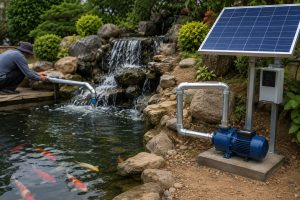
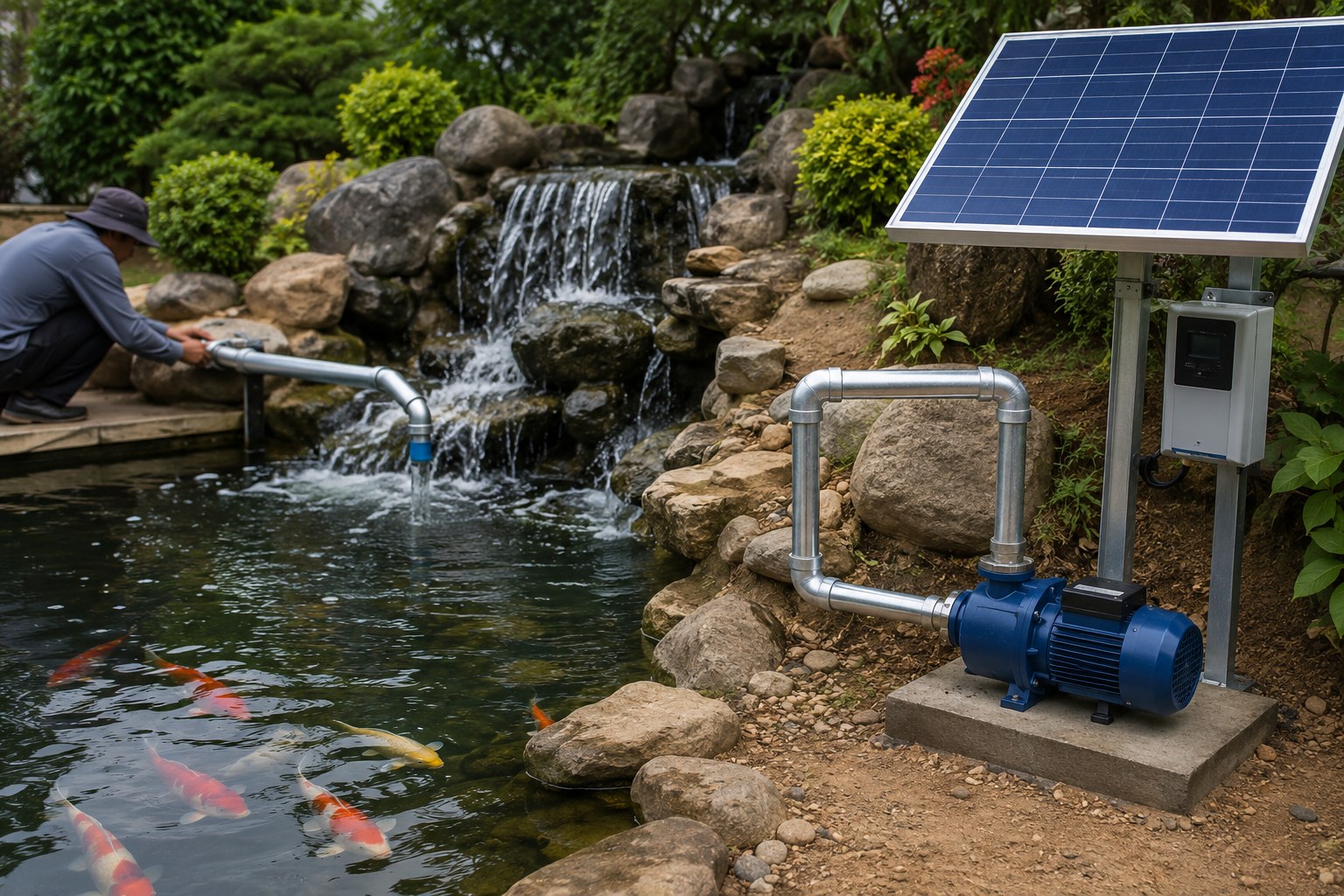
Yes, koi absolutely require a well-oxygenated pond to thrive, especially in warmer weather or crowded conditions. However, a dedicated air pump isn't your only option. A solar-powered water pump provides powerful aeration by circulating water and creating features like waterfalls, making it an efficient, all-in-one solution.
But how exactly can a water pump, designed to move water, replace an air pump that blows bubbles?
It all comes down to a simple principle: surface agitation.
The larger the surface area of water that is exposed to the air, the more oxygen can dissolve into it.
A water pump creates constant movement, breaking the still surface of the pond.
When used to power a fountain or a waterfall, it dramatically increases this effect, infusing the water with life-giving oxygen.
This means the right pump not only circulates and cleans your pond but also serves as its primary aeration system.
Let's explore the different types of solar pumps and how their unique features can be tailored to create the perfect, energy-efficient ecosystem for your koi.
The Deep-Well Specialist: Can a Solar Screw Pump Work?
Are you dealing with a uniquely deep pond or want to create a very tall, dramatic waterfall feature?
You might assume a standard pond pump won't have the required power.
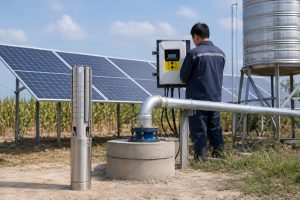
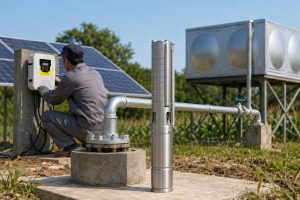
A specialized solar screw pump could be the unexpected answer to your problem.
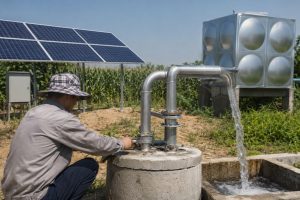
While not a conventional choice for pond circulation due to its lower flow rate, a solar screw pump excels at pushing water to great heights (high head). This makes it a niche but powerful option for creating tall, oxygenating waterfalls that other pumps cannot achieve.
A solar screw pump is a type of positive displacement pump.
Instead of spinning an impeller, it uses a rotating stainless steel screw within a rubber stator.
As the screw turns, it traps "pockets" of water and forces them upwards through the pump.
This mechanism is incredibly effective at creating high pressure, allowing it to pump water to extreme heights.
How a Screw Pump Contributes to Aeration
The primary way a screw pump would aerate a pond is indirectly, by powering a water feature.
Its strength lies in overcoming vertical distance.
If you want to create a waterfall that starts several meters above the pond's surface, a screw pump has the necessary "head" pressure to deliver the water.
The tumbling action of water falling from a significant height is one of the most effective ways to force oxygen into the water.
Key Specifications for Niche Pond Use
While its flow rate might be 60-70% lower than a centrifugal pump of similar power, its head can be over 200% higher.
Consider this when designing your water feature.
| Feature | Impact on Koi Pond Aeration | Ideal Scenario |
|---|---|---|
| Very High Head | Can create tall, dramatic waterfalls, which are excellent for oxygenation. | Ponds where the waterfall source is located many feet above the water surface. |
| Low Flow Rate | Not suitable for general pond circulation; may need to be paired with another pump. | Supplemental use for a specific high-pressure water feature, not as the primary circulator. |
| High Sand Resistance | Very durable if the pond has a sandy or silty bottom that gets stirred up. | Natural-bottom ponds or ponds in dusty, arid environments. |
The Verdict for Koi Ponds
A solar screw pump is a specialist tool.
For the average koi pond owner, its low flow rate makes it less suitable as a primary circulation and aeration pump.
However, for landscapers and hobbyists designing ambitious, multi-level water features or needing to draw water from a very deep source into the pond, its high-head capability is unmatched.
It provides a powerful, solar-powered solution for creating a visually stunning and highly effective aeration source through a tall waterfall.
Think of it less as a pond circulator and more as a dedicated feature pump.
The High-Flow Workhorse: Solar Plastic Impeller Pumps
Are you looking for the most efficient way to circulate your entire pond volume and ensure maximum oxygenation?
The constant hum of a large, grid-powered pump can be a drain on both your wallet and the peace of your garden.
A solar-powered plastic impeller pump offers a quiet, cost-effective, and powerful solution.
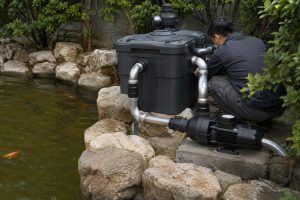
This is the go-to choice for most koi ponds. Its multi-stage centrifugal design is built for high flow rates, ensuring the entire pond volume is turned over rapidly. This constant circulation and surface agitation provide excellent, consistent aeration for your fish.
This type of pump is a multi-stage centrifugal pump.
It works by using a series of durable, wear-resistant plastic impellers, each housed in its own stage.
As water enters the pump, the first impeller spins, flinging the water outward and into the next stage.
Each subsequent impeller adds more pressure and velocity to the water.
This design is brilliant for moving large volumes of water efficiently, which is exactly what a healthy koi pond needs.
How High Flow Equals High Oxygen
The health of a koi pond is directly related to its "turnover rate"—the time it takes for the entire volume of water to pass through the filtration and aeration system.
A higher turnover rate means more effective cleaning and, crucially, more oxygenation.
A high-flow plastic impeller pump is the engine for this process.
A good rule of thumb is to aim for a turnover rate of at least once per hour.
For a 10,000-gallon pond, you would want a pump capable of moving 10,000 gallons per hour (GPH).
This powerful flow creates significant surface agitation, which is where the majority of gas exchange (oxygen in, carbon dioxide out) happens.
Key Advantages for Koi Ponds
These pumps are not only powerful but also designed for the realities of a pond environment.
Their impellers are made from engineering-grade plastics that are highly resistant to abrasion from fine sand or small bits of organic debris.
This makes them more durable and reliable than pumps with less-resistant components.
| Feature | Impact on Koi Pond Aeration | Why It Matters |
|---|---|---|
| High Flow Rate | Maximizes pond turnover, leading to superior surface agitation and oxygenation. | Keeps the entire water column healthy, not just the surface. |
| Medium Head | Perfectly suited for running filters, UV clarifiers, and medium-sized waterfalls. | Provides enough power for most standard pond features that aid in aeration. |
| Wear-Resistant | Handles small particles and debris without premature wear and tear on the impellers. | Ensures a longer pump life in a typical, non-sterile pond environment. |
| Lightweight & Economical | Easier to install and more affordable than all-metal counterparts. | Makes powerful solar aeration accessible to more pond owners. |
The Ideal Choice for Most Ponds
For over 90% of residential and commercial koi ponds, the solar plastic impeller pump is the optimal choice.
Its ability to move large volumes of water efficiently translates directly into a healthier, more stable, and better-oxygenated environment for your koi.
It provides the power needed for robust circulation and beautiful water features without the high cost and complexity of other pump types.
It represents the perfect balance of performance, durability, and value.
The Premium Choice: Solar Stainless Steel Impeller Pumps
Do you live in an area with unusual water chemistry, or are you simply unwilling to compromise on the quality and longevity of your pond equipment?
While standard pumps work well for most, certain conditions can cause premature failure.
Investing in a premium, corrosion-resistant pump from the start can save you money and headaches down the line.
For the discerning pond owner in a challenging environment, the solar stainless steel impeller pump is the ultimate solution. Its SS304 construction offers unmatched resistance to corrosion and wear, ensuring maximum reliability and an incredibly long service life, even in acidic or alkaline water.
This pump operates on the same high-flow centrifugal principle as the plastic impeller model.
The critical difference lies in the materials.
Both the impellers and the pump housing itself are constructed from SS304-grade stainless steel.
This material is renowned for its superior resistance to rust and corrosion from a wide range of chemical compounds.
This robust build quality makes it the definitive choice for applications where water quality could compromise lesser materials.
When is Stainless Steel Necessary for a Pond?
Most municipal water sources are relatively neutral and pose little threat to a quality plastic pump.
However, certain situations call for the resilience of stainless steel.
If your pond is filled with well water that is naturally acidic or alkaline, these conditions can slowly degrade plastics and lower-grade metals.
Regions prone to acid rain can also see their pond pH levels drop, creating a more corrosive environment.
Furthermore, some aggressive algaecides or water treatments can have a corrosive effect over time.
A stainless steel pump is effectively immune to these threats, offering what can be a 300% to 500% longer lifespan in such conditions.
A Comparison for the Conscientious Owner
Choosing between plastic and stainless steel often comes down to balancing initial cost against long-term value and peace of mind.
| Feature | Plastic Impeller Pump | Stainless Steel Impeller Pump |
|---|---|---|
| Corrosion Resistance | Good | Exceptional |
| Best For | Neutral pH water, standard ponds | Acidic/alkaline water, coastal areas, high-end ponds |
| Initial Cost | Lower | Higher (approx. 30-50% more) |
| Weight | Lightweight | Heavier, more robust |
| Long-Term Value | Excellent | Unmatched in harsh environments |
The "Buy It for Life" Aeration Solution
While a solar stainless steel impeller pump comes at a higher initial price point, it should be viewed as a long-term investment in your pond's health and your own peace of mind.
It offers the same fantastic high-flow aeration and circulation benefits as its plastic counterpart but with an added layer of near-indestructible durability.
For those building a high-end koi pond, living in areas with challenging water, or simply wanting the absolute best, this pump ensures your solar aeration system will run reliably for many, many years to come.
The Heart of the System: The High-Efficiency BLDC Motor
What truly makes a modern solar pump so much better than an old grid-powered one?
The secret isn't just the solar panels.
It's the incredibly advanced motor at the heart of the pump.
This core technology is what dictates the system's efficiency, power, and overall cost-effectiveness.
All three of these advanced solar pumps are powered by a BLDC (Brushless DC) permanent magnet motor. With efficiency ratings often exceeding 90%, this motor is the key to unlocking maximum water flow from a minimal number of solar panels, drastically reducing both initial and operating costs.
A BLDC motor is a marvel of modern engineering.
Unlike traditional AC motors or older brushed DC motors that use physical "brushes" to transfer power, a BLDC motor uses an electronic controller.
This eliminates friction, wear, and energy loss associated with brushes.
The rotor is made from powerful rare-earth magnets (like neodymium iron boron).
This results in a motor that is more powerful, more efficient, and significantly smaller and lighter than its traditional counterparts.
Why Motor Efficiency is Everything
For a solar-powered system, efficiency is the most critical factor.
An inefficient motor would require a larger, more expensive solar panel array to do the same amount of work.
Let's compare the numbers.
A typical grid-powered AC pond pump might have an efficiency of 50-60%.
This means 40-50% of the electricity it consumes is wasted as heat and noise.
A BLDC motor, with over 90% efficiency, wastes less than 10% of its energy.
This means for every 100 watts of solar power provided, a BLDC motor can convert 90+ watts into pumping power, while an older style motor might only provide 50-60 watts of useful work.
This is a performance increase of over 47%.
The Tangible Benefits for Pond Owners
This massive leap in efficiency translates into real-world advantages.
| Advantage | Technical Reason | Benefit to You |
|---|---|---|
| Lower Cost | Requires fewer solar panels for the same water flow. | A smaller solar array is cheaper to buy and easier to install. |
| More Power | Higher torque and power output from a smaller size. | A compact pump can deliver powerful flow for big waterfalls and strong circulation. |
| Longer Lifespan | No brushes to wear out; runs cooler. | A maintenance-free motor that can last for over a decade. |
| Quiet Operation | No friction from brushes and less vibration. | Preserves the peace and tranquility of your garden sanctuary. |
The Engine of Sustainable Aeration
The BLDC motor is the unsung hero of your solar aeration system.
It is the technology that makes solar-powered pond pumping not just possible, but practical and economically superior to traditional methods.
By choosing a pump with a high-efficiency BLDC motor, you are ensuring that you get the most aeration power for your investment, lower system costs, and enjoy a quiet, reliable, and maintenance-free solution for years.
24/7 Peace of Mind: Hybrid AC/DC Systems
What's the biggest concern with a solar-powered life support system for your koi?
The answer is obvious: what happens at night, or on a series of dark, cloudy days?
Your fish need oxygen 24/7, and a standard solar system only works when the sun is out.
This is where a hybrid controller changes everything.
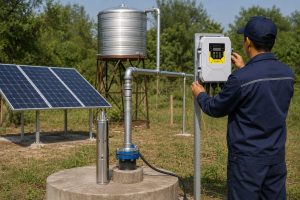
To guarantee uninterrupted pond aeration, advanced systems offer an AC/DC hybrid controller. This intelligent device automatically switches between free solar power and your home's AC grid power, ensuring your pump runs 24/7 and your fish are always safe, no matter the weather or time of day.
A hybrid AC/DC system provides the ultimate "best of both worlds" solution.
The controller is designed with two power inputs: one for the DC electricity from your solar panels and one for the AC electricity from your home.
An internal microprocessor constantly monitors the power coming from the solar panels.
Smart Power Management in Action
The system's logic is designed for maximum efficiency and reliability.
During a bright, sunny day, the controller will power the pump exclusively with 100% free solar energy.
Your pond is being aerated and circulated at zero running cost.
As a cloud passes over or as evening approaches, the solar power input will drop.
The controller detects this and seamlessly supplements the solar power with just enough AC power to maintain the pump's speed.
This is the "hybrid" function, which maximizes the use of every available watt of solar energy before drawing from the grid.
When the sun sets completely, the controller automatically switches over to 100% AC power, ensuring the pump continues to run through the night.
The next morning, as the sun rises, it automatically switches back to solar.
You don't have to do a thing.
Why This is Critical for Koi
Oxygen levels in a pond are at their lowest just before dawn.
This is because, at night, both your fish and all the aquatic plants consume oxygen, while none is being produced through photosynthesis.
A pump that shuts off at night is a pump that fails during the most critical period for oxygen depletion.
This can lead to stressed, gasping fish, and in a worst-case scenario, a catastrophic loss.
A hybrid system completely eliminates this risk.
It provides absolute peace of mind that your pond's life support system is always running, protecting your valuable investment in your koi.
It combines the environmental and cost benefits of solar with the 24/7 reliability of the grid.
Conclusion
A dedicated oxygen pump is not always necessary for a healthy koi pond.
A correctly sized solar water pump provides a superior, all-in-one solution for circulation and aeration.
By choosing the right pump and motor technology, you create a sustainable, cost-effective, and reliable ecosystem for your koi to thrive in.
Frequently Asked Questions
How can I oxygenate my pond without a pump?
You can add oxygenating plants and create a waterfall. However, for a pond with koi, mechanical circulation from a pump is highly recommended for consistent oxygen levels.
Do koi need an air pump at night?
Yes, oxygen is most critical at night when plants and fish both consume it. A pump, especially a hybrid model, should run 24/7 to prevent oxygen depletion.
How do I know if my pond has enough oxygen?
The most obvious sign of low oxygen is fish gasping for air at the surface. For accurate readings, you can use a digital oxygen meter or a chemical test kit.
Can a pond be over-oxygenated?
This is extremely rare in an outdoor pond setting and is not a practical concern for hobbyists. High oxygen levels are beneficial for fish health and water clarity.
Does a waterfall add enough oxygen to a pond?
Yes, a waterfall is one of the best ways to aerate a pond. The splashing and tumbling action as water falls through the air is highly effective at dissolving oxygen.
What is the difference between an air pump and a water pump for a pond?
An air pump injects air bubbles directly into the water. A water pump circulates water, creating aeration at the surface and by powering features like fountains and waterfalls.
How deep should a koi pond be?
A minimum depth of 3 to 4 feet is recommended. This provides protection from predators and helps maintain a more stable water temperature throughout the year for the fish.
Can I use tap water for my koi pond?
You can, but it must be treated with a dechlorinator first. The chlorine and chloramine in tap water are toxic to fish and beneficial bacteria in your pond's filter.