Struggling to get water where you need it?
Many pumps are inefficient or fail in harsh conditions.
Understanding the two main pump types is key to finding a reliable, cost-effective solution.
The two main types of water pumps are centrifugal pumps and positive displacement pumps.
Centrifugal pumps use a spinning impeller to move large volumes of water at lower pressures.
Positive displacement pumps trap and force fluid, delivering a consistent flow at high pressures, perfect for specific tasks.
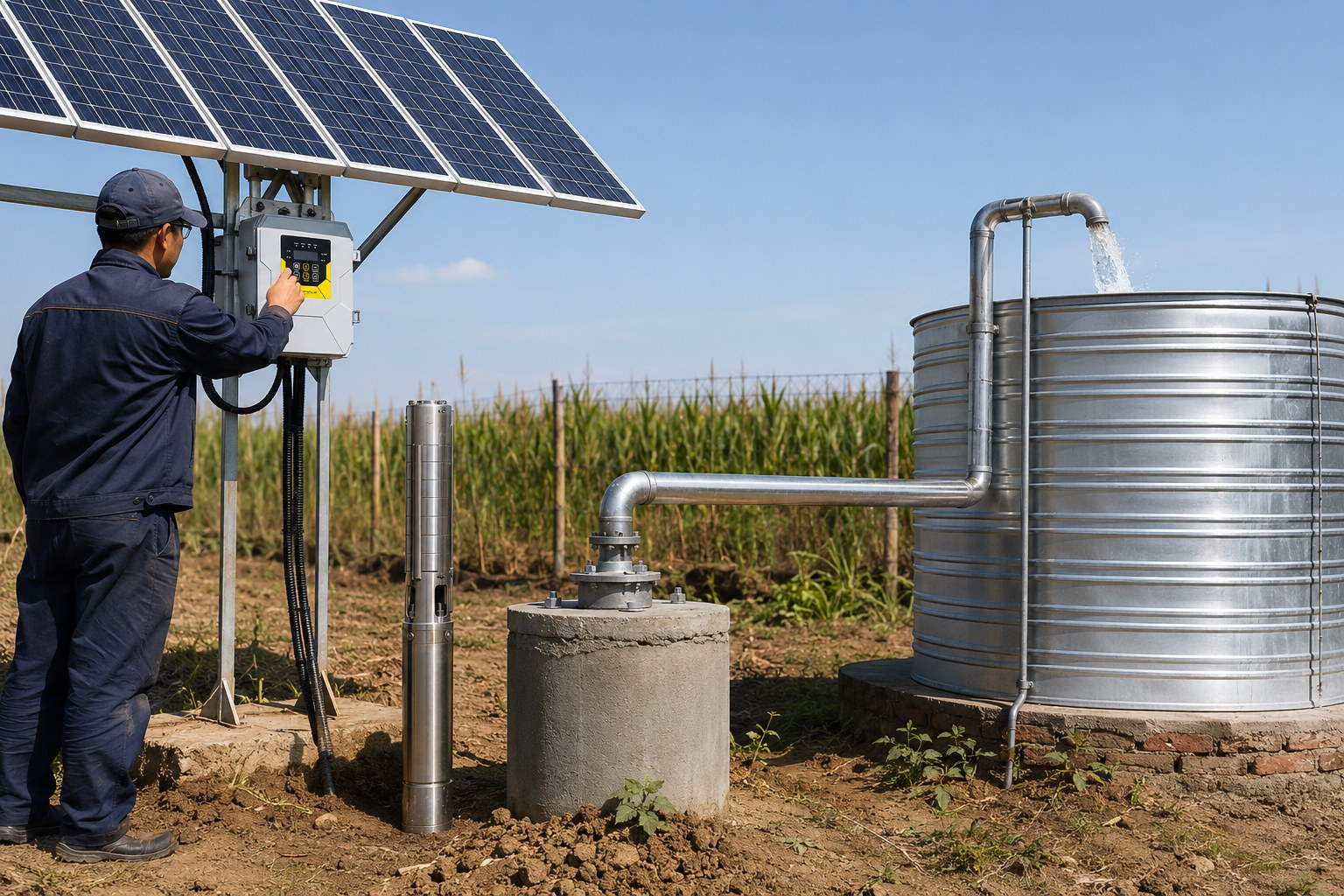
Choosing between them can feel complex, especially with modern variations like solar-powered models.
However, each type is designed for very different jobs.
Knowing this difference is the first step toward selecting a pump that will perform efficiently and last for years.
This guide will break down these two categories, explore their most popular sub-types, and show you how to choose the perfect pump for your home, farm, or business.
Let's dive in.
Centrifugal Pumps: The Volume Movers
Need to move a lot of water for irrigation or your home supply?
Standard pumps can struggle with sandy water or wear out quickly.
Modern centrifugal pumps use specialized impellers to handle large volumes efficiently, even in challenging conditions.
Centrifugal pumps are the most common type, using a rotating impeller to generate force and push water.
They are ideal for high-flow applications like agricultural irrigation, municipal water systems, and residential water supply, offering an excellent balance of cost and performance.
Centrifugal pumps are the workhorses of the water-moving world.
Their simple design and effectiveness in moving large fluid volumes make them a go-to choice for countless applications.
How Centrifugal Pumps Work
The core principle is simple but powerful.
An electric motor or engine spins a component called an impeller at high speed.
As the impeller rotates, it creates a low-pressure area at its center, drawing water into the pump.
Centrifugal force then flings the water outwards to the edge of the impeller at high velocity.
This action converts rotational energy into kinetic energy, increasing the water's pressure and pushing it out through the pump's discharge outlet.
This mechanism is incredibly effective for moving low-viscosity fluids like water.
It allows for a continuous, smooth flow, which is why these pumps are so prevalent in systems that require moving thousands of gallons per hour.
Modern Variations for Off-Grid Success
The basic centrifugal design has been adapted for specific challenges, especially in off-grid areas where water quality and power sources are unpredictable.
Two key variations dominate the solar pump market:
-
Solar Plastic Impeller Pumps: These pumps are engineered for high flow and medium head applications.
Equipped with durable, wear-resistant plastic impellers, they are a lightweight and economical solution.
They excel at moving water with fine sand, with a sand resistance of up to 0.1%, making them perfect for farm irrigation, pasture water supply, and residential gardens in regions across Africa and the Americas. -
Solar Stainless Steel Impeller Pumps: For environments with corrosive water, this is the premium choice.
The impeller and pump body are made from SS304 or SS316 stainless steel, offering superior resistance to acidic or alkaline conditions.
This durability ensures a long service life and high reliability, making them ideal for alkaline soil regions in Australia, parts of the Americas, and high-end residential water systems.
Performance Comparison: Plastic vs. Stainless Steel Impellers
| Feature | Solar Plastic Impeller Pump | Solar Stainless Steel Impeller Pump |
|---|---|---|
| Primary Use | High-flow irrigation, general use | Corrosive water, high-end applications |
| Flow Rate | High | High |
| Head Range | Medium (e.g., up to 80 meters) | Medium to High (e.g., up to 120 meters) |
| Sand Resistance | Excellent (up to 0.1% fine sand) | Good (less emphasis than corrosion) |
| Corrosion Resistance | Low to Moderate | Excellent (SS304/SS316) |
| Cost | Economical | Premium (20-40% higher) |
| Weight | Lightweight | Heavier |
Positive Displacement Pumps: The Precision Movers
Do you need to pump thick fluids or achieve very high pressure?
Centrifugal pumps lose efficiency and can fail in these demanding situations.
Positive displacement pumps provide a reliable, consistent flow, making them the perfect tool for specialized, high-pressure tasks.
Positive displacement (PD) pumps work by trapping a fixed volume of fluid and mechanically forcing it into the discharge pipe.
This mechanism ensures a constant flow rate regardless of pressure, making them ideal for pumping viscous fluids, dosing chemicals, or applications requiring extremely high heads.
Unlike centrifugal pumps that generate pressure through velocity, positive displacement pumps move fluid with precision and power.
This fundamental difference makes them indispensable in specific industrial, agricultural, and domestic scenarios where pressure and consistency are more important than sheer volume.
The Mechanism of Positive Displacement
The operation of a PD pump involves a cycle of filling and emptying a fixed-volume cavity.
An expanding cavity on the suction side draws fluid in.
Then, as the cavity shrinks, the fluid is displaced and forced out the discharge side.
This cycle delivers a steady, pulsed flow.
There are several types, each with a unique mechanism:
- Reciprocating Pumps: Use a back-and-forth motion of pistons, plungers, or diaphragms to move fluid.
- Rotary Pumps: Use rotating components like gears, lobes, or screws to trap and move fluid.
This design makes them self-priming and capable of handling a wide range of fluid viscosities, from thin water to thick oils and slurries.
The High-Head Specialist: Solar Screw Pumps
Within the positive displacement category, the screw pump is a standout for deep-well applications, especially in solar-powered systems.
It uses a single helical screw (the rotor) that rotates inside a rubber double-helix cavity (the stator).
As the rotor turns, it creates a series of sealed cavities that progress along the pump, pushing the water upwards.
This design excels at producing a very high head (vertical lift) with a lower flow rate.
It's exceptionally well-suited for drawing water from deep boreholes for domestic use and livestock watering.
A key advantage is its outstanding sand resistance—it can handle water with a sand content of up to 2%, far more than most centrifugal pumps.
Comparison: Positive Displacement vs. Centrifugal Pumps
| Feature | Positive Displacement Pump (e.g., Screw Pump) | Centrifugal Pump (e.g., Impeller Pump) |
|---|---|---|
| Operating Principle | Traps and displaces fluid | Creates velocity and centrifugal force |
| Flow Rate | Low to Medium, Constant | Medium to High, Variable with pressure |
| Pressure/Head | High, up to 200+ meters | Lower, pressure drops as flow increases |
| Viscosity Handling | Excellent (handles thick fluids) | Poor (efficiency drops with viscosity) |
| Sand Resistance | Excellent (up to 2% for screw pumps) | Poor to Good (depends on impeller design) |
| Best For | Deep wells, high-pressure tasks, viscous fluids | High-volume transfer, irrigation, general supply |
| Self-Priming | Yes | No (typically requires priming) |
The Power Source: Why the Motor Matters
A great pump is useless without an efficient and reliable motor.
Traditional motors can be bulky, energy-hungry, and prone to wear.
Modern motor and controller technology dramatically boosts performance, cuts energy costs, and extends the pump's lifespan.
The motor is the heart of any water pump system.
For solar pumps, high-efficiency brushless DC (BLDC) motors are now the industry standard.
They convert electrical energy into motion with over 90% efficiency, maximizing water output from every watt of solar power.
The true revolution in water pumping isn't just in the pump head—it's in the engine driving it.
The shift from older, less efficient motors to advanced drive systems has unlocked new levels of performance and reliability, particularly for off-grid solar applications where every watt counts.
The Rise of High-Efficiency BLDC Motors
The core of a modern, high-performance solar pump is its Brushless DC (BLDC) permanent magnet motor.
Unlike older brushed motors, BLDC motors have no brushes to wear out, making them virtually maintenance-free and significantly more durable.
Their technical advantages are immense:
- Exceptional Efficiency: With efficiencies exceeding 90% (compared to 60-75% for traditional AC or brushed DC motors), they convert more solar energy directly into pumping power.
This means you can pump more water with fewer solar panels, reducing the system's initial cost by up to 25%. - Powerful Performance: The rotor is constructed from high-strength permanent magnets, such as Neodymium iron boron (40SH).
This provides high torque, allowing the pump to start and run effectively even in lower light conditions. - Compact and Lightweight Design: Advanced BLDC motors are significantly smaller and lighter than their traditional counterparts—often up to 47% smaller and 39% lighter.
This makes transportation and installation far easier, especially in remote locations.
The Role of Intelligent Controllers
A smart motor needs a smart brain.
Maximum Power Point Tracking (MPPT) controllers are essential for solar pump systems.
These intelligent devices continuously monitor the output of the solar panels and adjust the electrical load to extract the maximum possible power at any given moment.
An MPPT controller can boost the daily water output by up to 30% compared to a system without one, ensuring the pump runs optimally from sunrise to sunset.
Hybrid Power Systems for 24/7 Operation
The biggest limitation of solar power is its dependence on the sun.
To overcome this, advanced hybrid AC/DC controllers have been developed.
These systems offer unparalleled flexibility and ensure a reliable water supply around the clock.
The controller is designed with dual power inputs, allowing you to connect both solar panels and an AC power source (grid or generator) simultaneously.
The system's logic prioritizes solar power automatically.
When sunlight is strong, the pump runs entirely on free solar energy.
If clouds reduce the solar input, the controller seamlessly blends in AC power to maintain pump performance.
When there is no solar input at night, it automatically switches to the AC source.
This ensures worry-free, uninterrupted water access 24/7.
How to Choose the Right Water Pump
Faced with so many options, choosing a pump can be overwhelming.
Making the wrong choice leads to poor performance, high running costs, and premature failure.
A simple evaluation of four key factors—application, flow, head, and water quality—will guide you to the perfect pump.
To choose the right pump, you must first define your needs.
Consider your primary application (home, farm, industry), the required flow rate, the total pumping height (head), and the quality of your water source.
This ensures you select a pump that is both efficient and durable.
Selecting a water pump shouldn't be a guessing game.
A methodical approach will save you time, money, and frustration.
By breaking down your requirements, you can confidently match a pump's capabilities to your specific needs, ensuring optimal performance for years to come.
Step 1: Define Your Application
The first question to ask is: what will you use the water for?
Different applications have vastly different requirements.
- Domestic Use: For supplying water to a home or boosting low city water pressure, you'll need reliability and consistent pressure.
A submersible pump in a well or a booster pump is common.
Flow rates of 10-20 GPM (Gallons Per Minute) are typical. - Agricultural Use: Irrigation demands high flow rates to cover large areas.
A centrifugal pump with a plastic impeller might be perfect, delivering 50+ GPM.
For livestock watering from a deep well, a high-head screw pump is a better fit. - Industrial Use: Applications can range from moving corrosive chemicals (requiring a stainless steel positive displacement pump) to circulating water in cooling systems (requiring a high-volume centrifugal pump).
Step 2: Calculate Flow Rate and Head
These two metrics are the most critical technical specifications.
- Flow Rate (GPM or m³/h): This is the volume of water the pump can move in a given amount of time.
Estimate your peak demand.
A small garden may only need 5 GPM, while irrigating an acre of crops could require over 30 GPM. - Total Dynamic Head (TDH): This is the total pressure the pump must overcome.
It's calculated by adding the Static Head (the vertical distance from the water source to the highest point of delivery) and Friction Loss (the pressure lost due to friction as water moves through pipes, fittings, and valves).
Failing to account for friction loss is a common mistake that leads to under-pumping.
As a rule of thumb, for every 100 feet of pipe, you can add 5-10 feet of head for friction, depending on pipe diameter and flow rate.
Step 3: Analyze Your Water Quality
The type of water you're pumping will determine the pump's required materials and design.
- Clean Water: Most standard pumps are suitable.
- Water with Sand or Silt: A pump designed for abrasives is essential to prevent rapid wear.
A solar screw pump (handling up to 2% sand) or a centrifugal pump with a durable plastic impeller (handling fine sand) are excellent choices. - Corrosive Water (acidic or alkaline): If your water has a high or low pH, a pump made from inert materials is non-negotiable.
A pump with SS304 or SS316 stainless steel components is required to prevent corrosion and premature failure.
Pump Selection Decision Matrix
| Application | Recommended Pump Type | Key Feature | Example Requirement |
|---|---|---|---|
| Deep Well Home Supply | Solar Screw Pump | High Head, Sand Resistance | 120m Head, 5 GPM |
| Small Farm Irrigation | Solar Plastic Impeller Pump | High Flow, Wear Resistance | 40m Head, 50 GPM |
| Livestock Watering | Solar Screw Pump | High Reliability, Deep Lift | 150m Head, 3 GPM |
| Corrosive Water Source | Solar Stainless Steel Pump | Corrosion Resistance | 60m Head, 40 GPM |
| Boosting City Pressure | Electric Booster Pump | Pressure Sensing | Increase pressure by 30 PSI |
Conclusion
The two main pump types, centrifugal and positive displacement, serve different needs.
Understanding their strengths, combined with efficient motors and smart controllers, empowers you to choose a truly effective water solution.
FAQs
What is the difference between a centrifugal and positive displacement pump?
Centrifugal pumps use an impeller to create flow, ideal for large volumes.
Positive displacement pumps trap and force fluid, providing constant flow at high pressure.
Which type of water pump is best for home use?
For well water, a submersible pump is best.
For boosting city pressure, a centrifugal booster pump is the standard choice for its efficiency and reliability.
What pump is best for high pressure?
Positive displacement pumps, such as piston or screw pumps, are designed to deliver a consistent flow at very high pressures, far exceeding most centrifugal pumps.
Can a water pump run dry?
No, most water pumps should never run dry.
Running without water causes overheating and can quickly damage the seals and motor, leading to pump failure.
How do I know what size water pump I need?
Calculate your required flow rate (GPM) and total dynamic head (vertical lift plus friction loss).
Match these numbers to the pump's performance chart.
Are solar water pumps a good investment?
Yes, for off-grid or remote areas, they are an excellent investment.
They have zero fuel costs, low maintenance, and a long lifespan, offering significant long-term savings.
What is a jet pump vs. a submersible pump?
A jet pump sits above ground and pulls water up, making it good for shallow wells.
A submersible pump is placed inside the well and pushes water up, making it more efficient for deep wells.
What is the most efficient type of water pump?
Submersible centrifugal pumps are generally the most efficient for moving large volumes of water from wells because they push water instead of pulling it.