Struggling with weak water pressure or a flooded basement?
These common household problems can cause daily frustration and expensive damage.
The right water pump is the permanent solution you need.
Choosing the best water pump for your home means matching the pump to the job. You need to assess your specific application—like boosting pressure or draining a well—and understand key metrics like flow rate (GPM) and total lift. Selecting the correct pump type and power source is essential for efficiency.
Choosing a water pump can feel overwhelming with so many options available.
However, breaking down the decision into a few key steps makes the process simple.
This guide will walk you through everything from sizing your pump correctly to understanding the different types and power sources available.
You will learn how to evaluate your needs and select a pump that delivers reliable performance for years to come.
Let’s ensure you make an informed choice that solves your water management challenges effectively.
What size water pump do I need?
Buying the wrong size pump is a common and costly mistake.
An undersized pump won't do the job, while an oversized one wastes energy and can burn out prematurely.
Understanding a few key factors will ensure you select the perfect size for your needs.
To size a pump correctly, you must calculate your required Gallons Per Minute (GPM), the total vertical distance the water must travel (Total Head Lift), and any additional pressure from tanks. Using a pump sizing chart or an online calculator can simplify this process significantly.
Choosing the right size well pump is not as simple as matching a horsepower rating to a well depth.
The ideal pump depends on a combination of factors that are unique to your setup.
A deeper understanding of these variables is crucial to prevent pump failure and ensure an efficient water system.
Understanding Key Sizing Metrics
To properly size a pump, you must first calculate three critical ratings.
-
Gallons Per Minute (GPM): This measures the volume of water the pump can move in one minute. A typical home requires 6-12 GPM for daily use.
-
Suction Head (SH): This is the vertical distance from the water source up to the pump itself. This is most relevant for pumps located above the water, like jet pumps.
-
Total Head Lift (THL): This is the single most important measurement. It is the total vertical height from the water source to the final discharge point. A pump's power is defined by its ability to push water against gravity over this distance.
The relationship between these factors is critical.
For example, let's consider a 200-foot deep well.
If you only need 5 GPM (enough for a small cabin), a 0.5 HP pump would likely be sufficient.
However, if you need 25 GPM for a larger home or small-scale irrigation, you would need to upgrade to a 1.5 HP pump.
When you demand a higher flow rate (GPM), you sacrifice vertical lift capability if the motor's horsepower remains the same.
Therefore, to get more water from the same depth, you must increase the motor's horsepower.
The Critical Role of Pressure Tanks
Many homeowners make the mistake of not accounting for their pressure tank.
Pumping into a pressurized tank adds a significant load, or "lift," onto the pump.
The pump must work against the back pressure inside the tank.
The conversion is simple: every 1 Pound per Square Inch (PSI) of pressure is equivalent to 2.31 feet of vertical lift.
So, if you are pumping into a standard 40/60 PSI pressure tank, you must calculate for the highest pressure setting, which is 60 PSI.
60 PSI x 2.31 ft/PSI = 138.6 feet of additional lift.
Let's revisit our 200-foot well example.
If you pump into a storage tank with no pressure, the total lift is 200 feet.
But if you connect it to that 60 PSI pressure tank, the total lift becomes:
200 ft (from well) + 138.6 ft (from tank) = 338.6 feet.
A pump rated for 200 feet of lift will fail quickly if forced to handle nearly 340 feet of lift.
This is a primary cause of premature pump burnout.
Sizing Chart Example
This table illustrates how horsepower, depth, and desired flow rate are interconnected.
Note that these are estimates, and a pump's specific performance curve should always be consulted.
| Horsepower (HP) | Max Flow (GPM) | Max Head (Feet) | Example Application (at 200 ft lift) |
|---|---|---|---|
| 0.5 HP | 10 GPM | 250 ft | ~5-7 GPM (Good for a small home) |
| 1.0 HP | 15 GPM | 400 ft | ~10-12 GPM (Good for a standard home) |
| 1.5 HP | 28 GPM | 450 ft | ~20-25 GPM (Good for a large home/irrigation) |
Always factor in a safety margin of about 10-20% on your Total Head Lift calculation to ensure your pump operates comfortably within its limits.
What are the different types of water pumps for home use?
Faced with a wall of pumps at the hardware store, it's easy to get confused.
Choosing the wrong one means it won't work correctly, leading to wasted time and money.
By learning the main categories, you can quickly narrow down the perfect pump for your task.
The most common home water pumps are submersible pumps for wells, booster pumps to increase water pressure, and sump pumps for basement drainage. Each type is engineered for a specific job, so matching the pump to your application is the key to success.
Water pumps are essential devices designed to move water efficiently.
They serve a wide range of functions in residential settings, from providing your daily water supply to protecting your home from flooding.
Understanding the fundamental differences between pump types is the first step toward selecting the right tool for your specific needs.
Pumps can be classified based on their application, mechanism, and power source, but for homeowners, it's most helpful to think about them in terms of their primary use.
Pumps for Water Supply
These pumps are designed to bring water into your home for drinking, bathing, and other daily needs.
-
Submersible Pumps: As the name suggests, these pumps are fully submerged in the water they are pumping, typically inside a well or borehole. Because they push water up rather than pulling it, they are highly efficient and are the standard choice for deep wells (over 25 feet deep). They are quiet and reliable.
-
Jet Pumps: These pumps are located above ground and pull water up from a well through a suction pipe. They are suitable for shallow wells (less than 25 feet deep) or deep wells when equipped with a two-pipe jet assembly. They are easier to access for maintenance than submersible pumps.
-
Booster Pumps: These are not used to draw water from a source but to increase the pressure within your home's plumbing system. If you suffer from weak showers and slow-filling appliances, a booster pump installed on your main water line can provide a significant and immediate improvement.
Pumps for Drainage and Transfer
These pumps are designed to move unwanted water away from your property.
-
Sump Pumps: A sump pump is your first line of defense against a flooded basement. It sits in a basin (sump pit) at the lowest point of your basement or crawlspace. When groundwater levels rise and fill the pit, a float switch automatically activates the pump, which discharges the water safely away from your home's foundation.
-
Utility Pumps: These are portable, general-purpose pumps used for various dewatering tasks. You might use one to drain a water heater, empty a hot tub, or remove standing water from your yard after a heavy rain. They are not designed for permanent installation.
Comparison of Common Home Pump Types
This table provides a quick overview to help you distinguish between the most common pump types found in residential settings.
| Pump Type | Primary Application | Typical Placement | Key Advantage |
|---|---|---|---|
| Submersible Pump | Drawing water from a deep well | Inside the well casing, below the water level | Highly efficient for deep applications, quiet operation. |
| Booster Pump | Increasing household water pressure | In-line with the main water supply pipe (e.g., in basement) | Solves low-pressure problems throughout the house. |
| Sump Pump | Preventing basement flooding | In a sump pit in the basement or crawlspace | Automatic operation protects against water damage. |
| Jet Pump | Drawing water from a shallow well | Above ground, near the wellhead | Easy to access for service and maintenance. |
What power source is best: Electric, Gas, or Solar?
You have a job to do, but how will you power your pump?
Relying on the grid can be a problem during outages, while gas engines are noisy and require fuel.
Let's compare the options to find the most reliable and cost-effective solution for you.
Electric pumps are the standard for most homes with grid access. Gas pumps offer powerful portability for remote or emergency use. Solar pumps are the ultimate off-grid solution, offering energy independence and zero running costs, making them increasingly popular worldwide.
The first major decision in choosing a pump is determining its power source.
This choice often dictates where and how you can use the pump, and it has long-term implications for cost, reliability, and environmental impact.
While traditional electric and gas pumps have their place, modern solar technology has emerged as a powerful and competitive alternative.
Conventional Power Sources
-
Electric Pumps: These are the most common pumps for residential use. They are generally efficient, quiet, and reliable, as long as you have a consistent electricity supply. They are ideal for permanent installations like well pumps and booster pumps where grid power is readily available. Their main drawback is their complete dependence on the power grid.
-
Gas/Diesel Pumps: Powered by an internal combustion engine, these pumps are valued for their portability and high power output. They are the go-to choice for dewatering construction sites, remote agricultural applications, or as an emergency backup during power outages. However, they are noisy, produce emissions, require regular refueling and maintenance, and have high operational costs.
The Rise of Solar-Powered Pumps
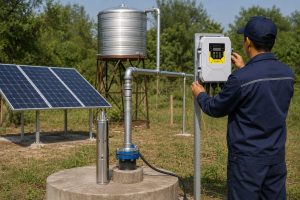
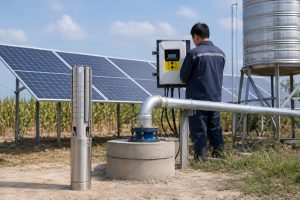
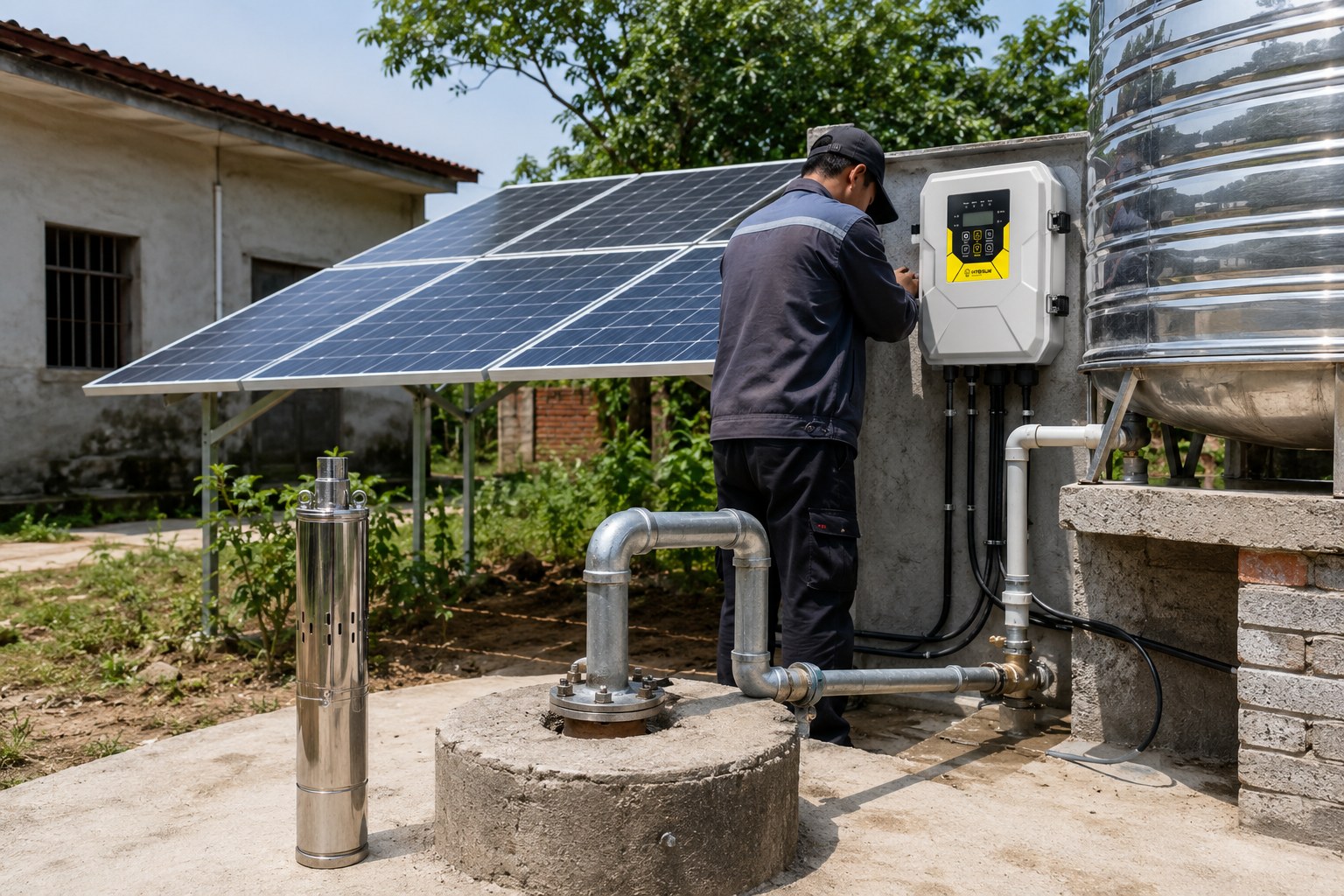
Solar water pumps have become a transformative technology, especially in regions with abundant sunlight and unreliable or non-existent power grids.
They are now essential equipment in parts of Africa, the Americas, Australia, and Asia.
The core of a modern solar pump system is a high-efficiency Brushless DC (BLDC) permanent magnet motor.
These motors can achieve efficiencies exceeding 90%, a significant improvement over traditional AC or brushed DC motors.
This high efficiency is a game-changer.
It means the pump can do more work with less power.
This directly reduces the number of expensive solar panels required to run the system, lowering the initial investment by 20-30% and making solar a more financially viable option than ever before.
The system is environmentally friendly, operates silently, and once installed, has virtually zero running costs.
Power Source Comparison
This table helps compare the three main power options across several key metrics.
| Feature | Electric Pump | Gas Pump | Solar Pump |
|---|---|---|---|
| Operating Cost | Moderate (depends on electricity rates) | High (fuel and maintenance) | Zero |
| Portability | Limited by cord length | High | High (for the pump system itself) |
| Environmental Impact | Low (at point of use) | High (emissions, noise) | Zero |
| Reliability | Dependent on power grid | Dependent on fuel and maintenance | Highly reliable, dependent only on sunlight |
| Ideal Use Case | Permanent home installations with grid power | Remote job sites, emergency dewatering | Off-grid homes, remote livestock and irrigation |
How do different solar pump designs affect performance?
You've decided on a solar pump, but now you see different types like "screw" and "impeller."
Choosing the wrong internal design can lead to poor performance or a pump that clogs easily in your specific well.
Understanding how each design works ensures you get the right performance for your water conditions.
Solar pump performance is defined by its internal mechanism. Screw pumps are best for high-lift, low-flow needs in deep, sandy wells. Plastic impeller pumps provide high flow for irrigation. Stainless steel impeller pumps offer the best durability for corrosive water.
Not all solar deep well pumps are created equal.
The internal pumping mechanism, or "pump end," is specifically engineered for different conditions.
These designs are typically driven by the same high-efficiency BLDC motors, but their performance characteristics vary dramatically based on the water source.
The three most popular designs form a competitive portfolio that can meet nearly any water need: the screw pump, the plastic impeller pump, and the stainless steel impeller pump.
Choosing the right one is critical for efficiency and long-term durability.
Solar Screw Pumps: For Deep Wells and High Lift
A solar screw pump uses a simple but effective mechanism.
It consists of a single helical rotor (the screw) that rotates inside a rubber stator.
This action creates sealed cavities that move water upward through compression.
- Performance: This design generates very high pressure, which translates to a high head or lift capability. However, the volume of water it can move (flow rate) is relatively low.
- Best For: Deep domestic wells, livestock drinking troughs, and applications where water needs to be pushed a long way up. It is ideal for regions with deep water tables.
- Advantages: Its key advantage is an exceptional resistance to sand and grit, which would quickly destroy other pump types. It can operate reliably in harsh water conditions.
- Limitations: Its low flow rate makes it unsuitable for large-scale irrigation or applications requiring high volumes of water quickly.
Solar Plastic Impeller Pumps: For High Flow and General Use
This is a multi-stage centrifugal pump.
It uses a series of stacked impellers that spin at high speed.
Each impeller adds pressure to the water, pushing it up to the next stage.
- Performance: This design is built for volume, delivering a high flow rate at a medium head.
- Best For: General-purpose applications like farm irrigation, supplying water to pastures, and large home gardens where moving a lot of water is the priority.
- Advantages: It provides excellent water output for the energy consumed. Modern plastic compounds offer good wear resistance against fine sand. These pumps are also lightweight and more economical.
- Limitations: The plastic components are less durable in highly corrosive (acidic or alkaline) water or in very deep wells where high pressures can cause wear over time.
Solar Stainless Steel Impeller Pumps: For Premium Durability
This pump operates on the same centrifugal principle as the plastic impeller model but is constructed from superior materials.
It utilizes SS304 stainless steel for both the impellers and the pump housing.
- Performance: It offers high flow rates and medium-to-high head capabilities, similar to the plastic version but with far greater resilience.
- Best For: Environments with corrosive water, such as areas with acidic water or high-alkalinity soil. It is the premium choice for high-end homes, ranches, or critical applications where reliability is paramount.
- Advantages: It boasts superior corrosion resistance and a significantly longer service life, especially in aggressive water.
- Limitations: The high-grade materials make it heavier and result in a higher initial purchase price, positioning it as a more specialized, high-end solution.
Solar Pump Design Comparison
| Feature | Solar Screw Pump | Solar Plastic Impeller Pump | Solar Stainless Steel Impeller Pump |
|---|---|---|---|
| Flow Rate | Low | High | High |
| Head (Lift) | Very High | Medium | Medium-to-High |
| Sand Resistance | Excellent | Good (fine sand) | Good |
| Corrosion Resistance | Good | Poor | Excellent |
| Initial Cost | Moderate | Low | High |
| Best Application | Deep, sandy wells | General irrigation | Corrosive water, long-term durability |
What advanced features should I look for?
Is a pump just a motor and some pipes?
Thinking that way can lead to an inefficient system that fails when you need it most.
Modern water pump systems are intelligent, and ignoring advanced features means missing out on major gains in efficiency and reliability.
For maximum performance, look for pumps powered by a high-efficiency BLDC motor (over 90% efficient). Pair this with an intelligent MPPT controller to maximize solar power usage and a hybrid AC/DC controller for an uninterrupted, 24/7 water supply.
The true competitive advantage of a modern water pump system extends beyond the pump itself.
It lies in the synergy between a highly efficient motor and an intelligent control system.
These components determine the overall efficiency, reliability, and cost-effectiveness of your entire water solution.
For any user, from a homeowner to a large-scale agricultural operator, understanding these features is key to unlocking the full potential of their investment.
The Core of Efficiency: The BLDC Motor
The driving force behind the best solar pumps is the Brushless DC (BLDC) permanent magnet motor.
Unlike older motor designs, BLDC motors have no brushes to wear out, making them virtually maintenance-free.
Their key advantage is staggering efficiency.
-
Technical Superiority: These motors consistently achieve electrical-to-mechanical efficiencies exceeding 90%. They are built with high-grade materials like neodymium iron boron magnets, allowing them to deliver high torque and strong power from a compact design. A modern BLDC motor can be up to 47% smaller and 39% lighter than a traditional motor of equivalent power.
-
Market Value: This high efficiency has a direct financial benefit. A more efficient motor requires less power, which means you can run the entire system with fewer solar panels. This reduces the initial system cost, simplifies installation, and lowers the overall footprint. The long, maintenance-free service life further enhances its value proposition.
Intelligent Control Systems (MPPT)
A solar pump is only as good as the power it receives.
An intelligent controller with Maximum Power Point Tracking (MPPT) technology is essential.
Solar panels have a specific voltage and current at which they produce the most power, and this "maximum power point" changes throughout the day with the sun's intensity.
An MPPT controller constantly tracks this point and adjusts the electrical load of the pump motor to maximize the energy harvest.
A system with an MPPT controller can increase the total volume of water pumped per day by as much as 30% compared to a system without one, ensuring you get the most out of every bit of sunlight.
Hybrid Power for 24/7 Operation
The ultimate feature for reliability is a hybrid AC/DC controller.
This technology provides a seamless, uninterrupted water supply, eliminating the primary drawback of a solar-only system.
The controller is designed with dual power inputs, allowing you to connect both solar panels and an AC power source (grid power or a generator) simultaneously.
- Automatic Switching: The controller's logic prioritizes solar power. When the sun is shining, the pump runs entirely on free solar energy.
- Hybrid Function: If clouds reduce the solar input, the controller can blend AC power with the available solar power to maintain pump operation, maximizing the use of free energy.
- AC Takeover: When there is no solar input at night or during heavy overcast weather, the controller automatically switches to the AC power source.
This ensures you have a worry-free water supply 24 hours a day, providing both the cost savings of solar and the reliability of the grid.
Conclusion
Choosing the right home water pump means matching the pump’s size, type, and power source to your unique needs.
Consider well depth, water quality, and required flow for a reliable, efficient solution.
FAQs About Water Pumps
What is the best type of water pump for home use?
It depends on the task. Use a submersible pump for wells, a booster pump for low pressure, and a sump pump for basement drainage.
How many GPM do I need for a house?
A typical home requires 6-12 GPM. You should account for all fixtures that might run at the same time to determine your peak demand.
How long do home water pumps last?
A quality, well-maintained pump can last 8 to 15 years. Longevity depends on the pump type, frequency of use, and water quality.
Can a pump be too big for a well?
Yes. An oversized pump can draw water faster than the well can recharge, which can damage both the pump and the well itself.
What is the difference between a jet pump and a submersible pump?
A jet pump sits above ground and pulls water up. A submersible pump sits inside the well and pushes water up, making it more efficient for deep wells.
Do solar water pumps work on cloudy days?
Yes, but at a reduced output. Systems with hybrid AC/DC controllers or battery storage can ensure a consistent water supply regardless of weather.
How do I calculate total head lift?
Add the vertical lift from the water to the outlet, plus any friction loss from pipes, and the pressure equivalent from a tank (1 PSI = 2.31 ft).
Is a 3/4 HP well pump big enough for a house?
For many average-depth wells and standard-sized homes, a 3/4 HP pump is often sufficient, but you must calculate your specific GPM and total head requirements.