Struggling with water access after sunset in off-grid areas?
A solar pump seems useless at night.
But what if you could have water 24/7, sustainably and affordably?
Yes, a solar pump can work at night, but not directly from solar panels alone.
It requires a system to store energy, like batteries, or a hybrid setup that can switch to an alternate AC power source like the grid or a generator to ensure uninterrupted water flow.
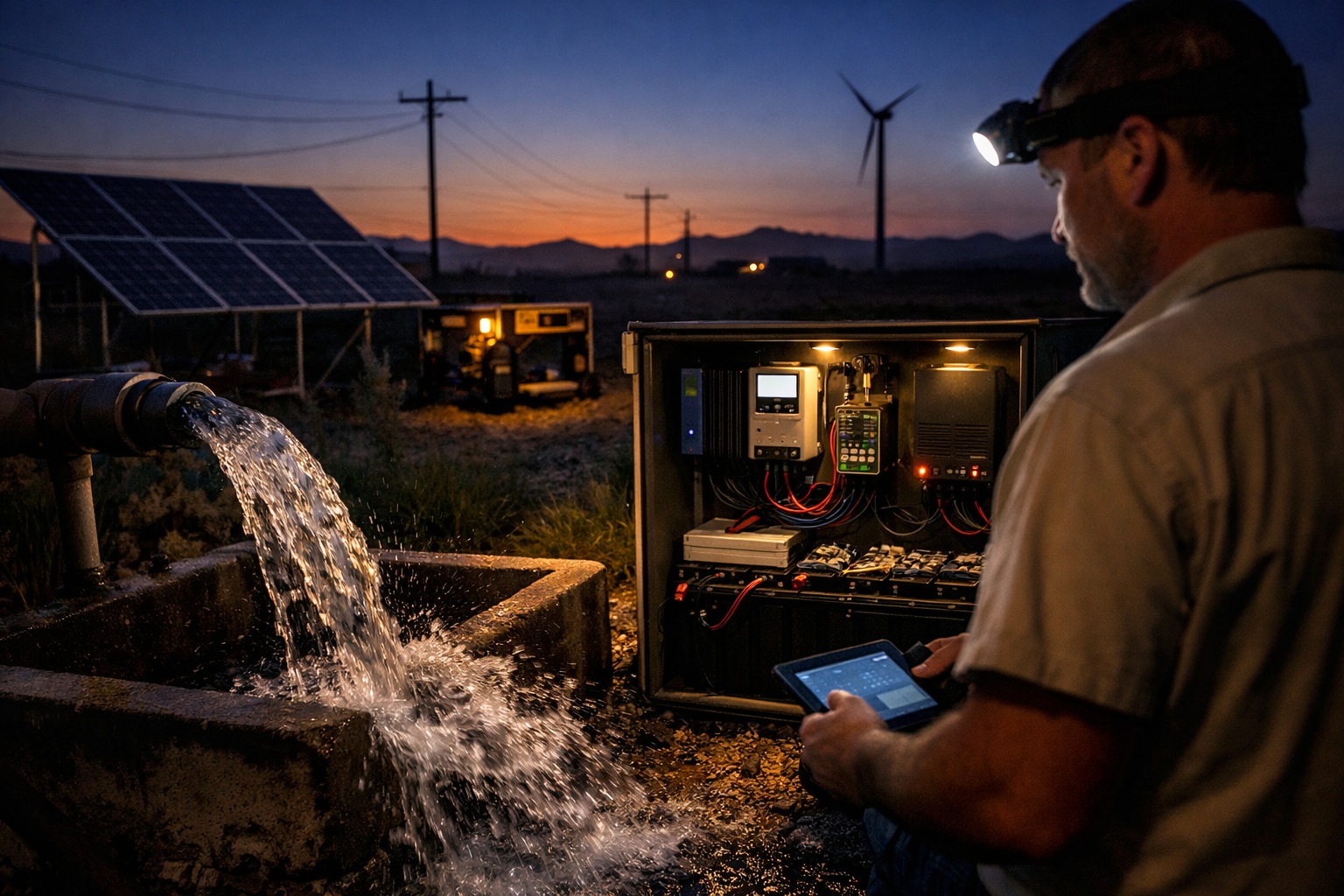
Understanding this is key to building a reliable, around-the-clock water supply.
While solar panels themselves are inactive in the dark, the right system design ensures you are never left without water.
Let's dive into the practical solutions that make nighttime and low-light operation a reality.
By exploring these methods, you can select the most effective and cost-efficient configuration for any application, from a small home to a large farm.
Understanding the Basics: How Solar Panels Generate Power
You invested in solar, but cloudy days and nights leave your water supply uncertain.
Relying solely on sunlight feels risky and limits your pump's use.
Solar panels work using the photovoltaic effect, converting photons from sunlight into DC electricity.
They cannot produce energy at night without a light source, and their output is significantly reduced on cloudy days, typically to 10-25% of their rated power.
Solar panels are the engine of your water system, but they don't work in a vacuum.
Their performance is directly tied to the availability of sunlight.
To understand how to get water at night, we first must understand how the power is generated during the day.
This process, known as the photovoltaic effect, is a marvel of material science.
The Photovoltaic Effect
Each solar panel contains multiple photovoltaic (PV) cells.
These cells are typically made from silicon wafers treated to create an electric field.
When photons from sunlight strike the cell, they energize and dislodge electrons from their atoms.
This flow of electrons creates a direct current (DC).
The amount of DC electricity generated is proportional to the intensity of the sunlight hitting the panel.
More intense, direct sunlight means higher power output.
Conversely, diffuse light on a cloudy day results in a fraction of the power.
At night, with no photons, this process stops completely.
The Role of High-Efficiency Components
The efficiency of this conversion process is a critical factor.
It measures how much of the available sunlight is converted into usable electricity.
Modern high-efficiency solar panels can achieve conversion rates of over 23%.
This is especially important for water pumping systems, where maximizing power output from a limited number of panels is crucial for reducing upfront costs and system footprint.
The core of a modern solar pump system is a high-efficiency motor, which uses this DC power to drive the pump.
A Brushless DC (BLDC) permanent magnet motor is the industry standard for this application.
These motors can achieve efficiencies exceeding 90%.
The high efficiency of both the panels and the motor means that more water is pumped for every watt of solar energy captured.
This synergy becomes vital when planning for periods of low light or no light.
A more efficient system can do more work during peak sun hours, which is essential for the strategies we will discuss next.
Solution 1: Storing Energy with a Battery Backup System
Relying on sunlight means no water when clouds roll in or after sunset.
This unpredictability is a major problem for critical applications like livestock watering or household use.
A battery backup system solves this by storing excess solar energy generated during sunny days.
This stored power is then used to run the pump at night or during overcast weather, providing a truly independent, 24/7 off-grid water supply.
A battery bank transforms an intermittent solar-powered system into a constant, reliable utility.
It decouples water availability from immediate weather conditions.
However, designing a battery-based system requires careful calculation of energy needs and storage capacity to ensure it meets demand without failing.
How a Battery System Works
During peak sun hours, your solar panels often generate more electricity than the pump needs to operate at full capacity.
An intelligent solar pump controller, specifically one with Maximum Power Point Tracking (MPPT), diverts this surplus energy to charge a connected battery bank.
The controller manages the charging process to protect the batteries from overcharging.
When the sun goes down or cloud cover becomes too thick, the controller automatically switches the power source.
It begins drawing DC electricity from the batteries to power the pump motor.
This transition is seamless, ensuring the water flow is not interrupted.
The system continues to run on battery power until the batteries are depleted or until the sun rises and the solar panels begin producing power again, at which point they will power the pump and recharge the batteries simultaneously.
Sizing Your Battery Bank
The most critical aspect of a battery system is proper sizing.
An undersized bank will run out of power too quickly, failing to meet nighttime demands.
An oversized bank is unnecessarily expensive and may never be fully utilized.
To size a battery bank correctly, you need to consider:
- Daily Water Requirement: How many gallons or liters do you need per day?
- Pump Power Consumption: What is the wattage of your pump motor?
- Desired Autonomy: How many consecutive cloudy days or nights do you want the system to run without any sun? A standard goal is 2-3 days of autonomy.
The calculation involves determining the total watt-hours (Wh) needed per day (Pump Watts x Daily Run Hours) and multiplying it by the desired days of autonomy.
| System Component | Role in Battery Backup | Key Consideration |
|---|---|---|
| Solar Panels | Generate DC power for the pump and to charge batteries. | Must be sized to meet daily demand and recharge batteries. |
| MPPT Controller | Manages power flow from panels to pump and batteries. | Select a controller that supports battery charging protocols. |
| Battery Bank | Stores surplus energy for later use. | Capacity (Ah) and voltage must match the system's needs. |
| BLDC Pump Motor | Consumes stored energy to pump water. | High-efficiency motors (90%+) extend battery runtime significantly. |
Once the batteries are drained, they will require several hours of adequate sunlight to recharge.
This is why, for continuous all-day pumping needs, the water storage method discussed next is often a more robust and cost-effective alternative.
Solution 2: Storing Water in Tanks or Cisterns
Batteries are effective but add cost, complexity, and maintenance to a solar pump system.
They also have a limited lifespan and can be sensitive to extreme temperatures.
A simpler, more durable solution is to store water, not energy.
By using the pump during peak sun hours to fill a large storage tank, you ensure a gravity-fed water supply is available 24/7, regardless of the weather or time of day.
This strategy leverages what solar does best: producing abundant power when the sun is shining brightest.
It's a low-tech, highly reliable approach that has been used for centuries.
For many agricultural and domestic applications, storing water is the most practical and economical way to achieve water security.
The Principle of Water Storage
The concept is straightforward.
Instead of powering the pump on demand, you run it at maximum capacity whenever there is sufficient sunlight.
The goal is to pump more water than you need for immediate use and store the excess.
This stored water acts as your buffer.
The pump fills an elevated tank, a cistern, or a reservoir.
When you need water at night or on a cloudy day, you simply open a valve.
Gravity then provides the pressure to deliver the water to your home, garden, or livestock troughs.
There are no batteries to maintain, no complex electronics, and no ongoing energy costs for water delivery once it's in the tank.
Designing a Water Storage System
Effective system design hinges on accurately calculating your water needs and storage capacity.
Just like with batteries, you need to plan for autonomy.
- Calculate Daily Water Usage: Determine the total volume of water your household, farm, or livestock consumes in a 24-hour period.
- Plan for "No-Sun" Days: Decide how many consecutive cloudy days you need to be prepared for. A common target is 3 to 5 days.
- Determine Tank Size: Multiply your daily water usage by the number of desired autonomy days. This gives you the minimum required tank volume. For example, if you use 1,000 gallons per day and want 3 days of autonomy, you need a 3,000-gallon tank.
Pump Selection for Water Storage
When your primary strategy is filling a tank, the pump's characteristics are very important.
You need a pump that can efficiently move a large volume of water during the 6-8 peak sun hours available each day.
Here’s where different pump types come into play:
- Solar Plastic Impeller Pumps: These are excellent for this role. They are designed for high flow rates at medium head, making them perfect for filling tanks from shallow to moderately deep wells. Their sand-resistant design ensures longevity, and their lower cost makes them economical for farm and ranch applications.
- Solar Stainless Steel Impeller Pumps: For scenarios with slightly corrosive water or where maximum durability is desired, these are the premium choice. They also offer high flow rates and are built to last, ensuring the tank is filled reliably day after day.
- Solar Screw Pumps: While these are high-head, low-flow pumps, they are ideal for filling tanks from very deep wells (over 100 meters). Their ability to overcome immense vertical distances makes water storage possible even in challenging geological locations.
By matching the pump type to your well depth and daily volume needs, you create a highly efficient system that maximizes water production during sunny periods, securing your supply for any eventuality.
Solution 3: Using a Hybrid AC/DC Power System
What if you need unlimited water on demand, 24/7, but don't have space for a large tank and find batteries too costly or high-maintenance?
This is a common dilemma for businesses or homes with high, unpredictable water usage.
A hybrid AC/DC solar pump system offers the ultimate flexibility.
It prioritizes free solar energy when available but can automatically switch to a secondary AC power source—like the public grid or a generator—at night or on cloudy days, guaranteeing uninterrupted water flow.
This dual-power approach provides total peace of mind.
You get the cost savings and environmental benefits of solar without ever compromising on water availability.
It is the best-of-both-worlds solution for critical water supply needs.
The Technology Behind Hybrid Controllers
The heart of this system is the intelligent hybrid pump controller.
This advanced controller has two separate power inputs: one for the DC power from the solar panels and one for an AC power source (110V/220V).
The controller's internal logic is programmed to prioritize solar power.
- Solar Priority Mode: When there is sufficient sunlight, the controller draws 100% of its power from the solar panels to run the pump. The AC input remains on standby.
- Solar Blending Function: As clouds reduce solar power, the controller doesn't just shut off. It intelligently supplements the decreased solar input by drawing just enough AC power to maintain the pump's desired speed and flow rate. This maximizes the use of every available watt of free solar energy.
- Automatic AC Switchover: When the sun sets or cloud cover is too heavy for solar production, the controller seamlessly and automatically switches over completely to the AC power source. The pump continues to operate without interruption.
- Automatic Solar Resumption: The next morning, as the sun rises, the controller detects the incoming solar power and automatically switches back, shutting off the AC input to resume cost-free operation.
Key Advantages of a Hybrid System
This setup is ideal for a wide range of users, from homeowners who want to reduce their utility bills to large-scale agricultural operations that cannot afford any downtime.
The benefits are compelling:
- Uninterrupted Water Supply: Guarantees 24/7 water access, eliminating weather-related uncertainties.
- Maximized Cost Savings: Uses free solar energy whenever possible, only resorting to paid grid electricity or fuel-based generators when absolutely necessary. Some hybrid systems can reduce water pumping electricity costs by up to 80%.
- System Simplicity: Eliminates the need for batteries or large water tanks, reducing initial investment, maintenance, and space requirements.
- Pump Longevity: The soft-start function within the controller gradually brings the motor up to speed, reducing mechanical stress on the pump and motor, thereby extending their service life.
This approach is especially valuable for distributors serving diverse markets.
It allows them to offer a single, highly adaptable product that meets the needs of both off-grid customers (paired with a generator) and grid-tied customers looking to lower their energy bills.
| Power Solution | Best For | Pros | Cons |
|---|---|---|---|
| Battery Storage | Complete off-grid autonomy and nighttime use. | Energy independence; works anywhere. | High initial cost; battery lifespan (3-7 years); maintenance. |
| Water Storage | Low-tech reliability, agriculture, livestock. | Very durable; low maintenance; gravity-fed pressure. | Requires space for a large tank; upfront tank cost. |
| Hybrid AC/DC | Uninterrupted 24/7 demand; grid-tied homes; critical operations. | Ultimate reliability; maximises solar savings; no batteries needed. | Requires access to an AC power source (grid or generator). |
Conclusion
A solar pump can reliably work at night.
Success depends on choosing the right system—battery storage, water tanks, or a hybrid AC/DC controller—to match your specific budget and water needs.
FAQs
1. Do solar pumps work on cloudy days?
Yes, they operate at a reduced speed. On an overcast day, a pump may produce 10-25% of its normal output, so water flow will be slower but not stopped.
2. Can I run a solar pump directly from a generator at night?
Yes, if you have a hybrid AC/DC controller. This device allows you to connect a generator as a backup power source for nighttime or emergency use.
3. Is it better to store water or store energy in batteries?
For agricultural use, storing water in a tank is often cheaper and more durable. For homes needing pressurized water at night, batteries are more practical.
4. How many solar panels do I need for a solar pump?
This depends on the pump's wattage, well depth, and your daily water needs. An expert sizing calculation is required for an efficient system.
5. Can a solar pump run an irrigation system?
Absolutely. High-flow solar pumps, like plastic or stainless steel impeller models, are specifically designed for farm irrigation and pasture watering applications.
6. Do solar panels work in freezing weather?
Yes, solar panels actually work more efficiently in cold temperatures. However, you must ensure the pump and water lines are protected from freezing.
7. How long do solar water pumps last?
A high-quality brushless DC motor can last over 10 years with minimal maintenance. The pump's lifespan depends on the model and water quality.
8. What maintenance does a solar pump system require?
The system is virtually maintenance-free. It's recommended to periodically wipe the solar panels clean and check wiring connections annually for any corrosion or damage.