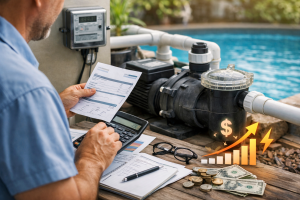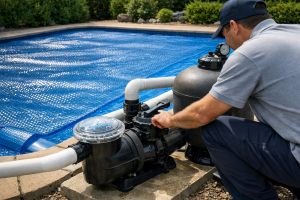
Worried about your pool pump's non-stop energy use driving up your bills?
You're seeing a huge spike in your electricity costs and can't figure out why.
This guide will break down the true cost.
Running a typical 1.5 HP single-speed pool pump 24 hours a day can cost between $150 and $550 per month, or even more.
This depends heavily on your local electricity rates and the pump's efficiency.
However, using modern variable-speed pumps can drop this cost to as low as $30-$90 per month.
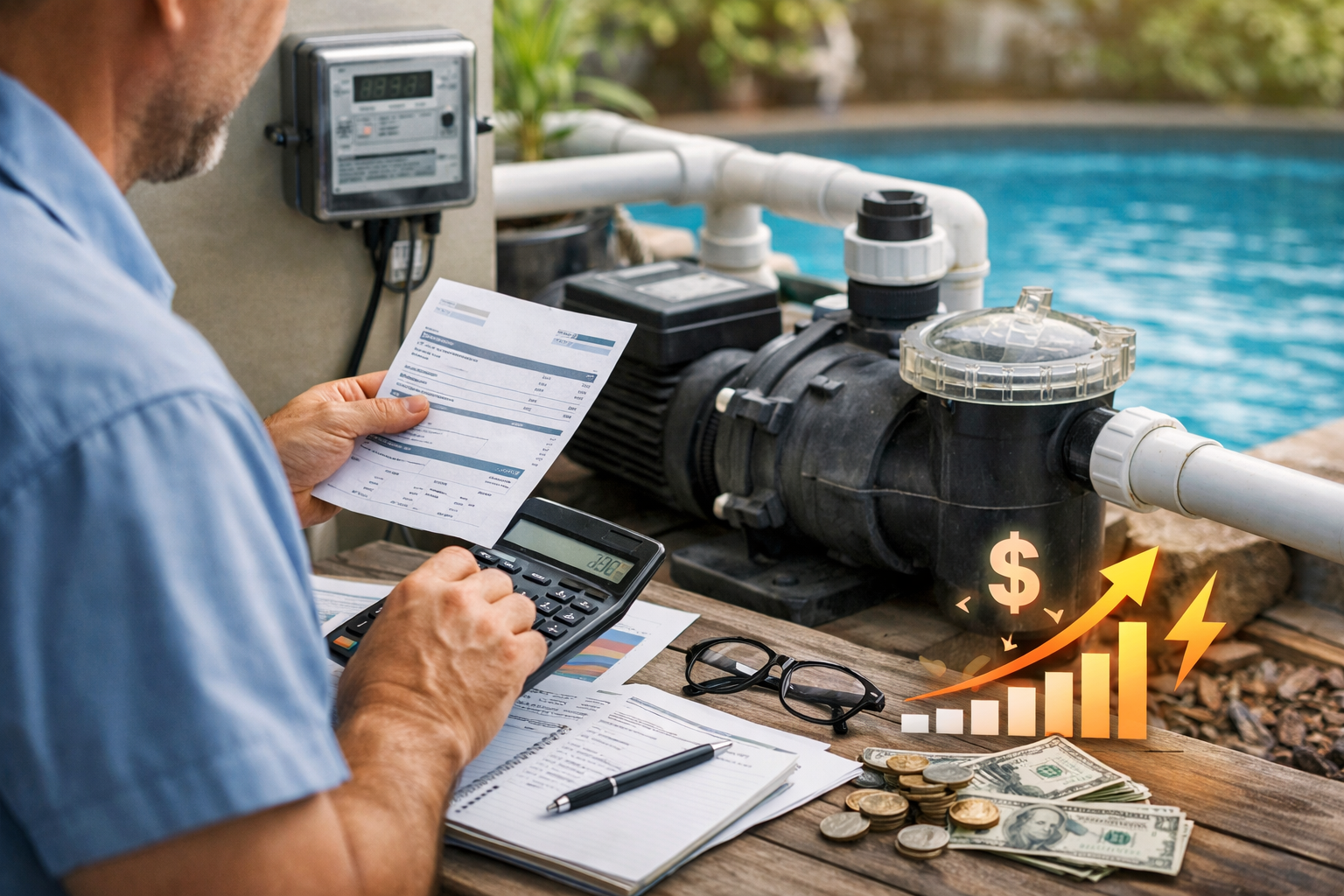
Understanding the exact cost of running your pool pump around the clock is the first step toward slashing your energy expenses.
This figure can be alarming, but it's not a fixed sentence for your wallet.
The good news is that technology and smart strategies offer powerful ways to manage, and even drastically cut, these costs without sacrificing water quality.
In this comprehensive guide, we will dive deep into the key factors that determine your pump's running cost.
We will explore the different types of pumps available, from outdated energy hogs to ultra-efficient modern marvels.
You will also learn how to precisely calculate your own expenses and discover powerful optimization techniques.
By the end, you'll have a clear roadmap to achieving a clean pool that doesn't drain your bank account.
Let's begin by understanding the fundamentals of how these essential devices consume power.
Understanding Pool Pump Electricity Usage
Your pool pump is a powerful appliance, often leading to surprisingly high electricity bills if left unchecked.
It's one of the biggest energy consumers in many homes.
Understanding its power draw is key to control.
A standard pool pump uses 1,500 to 2,500 watts, making it a top energy user in your home.
This accounts for 20-30% of your electricity bill during swim season.
Understanding this consumption is crucial for managing costs and making smart equipment choices.
To truly grasp your pump's impact on your energy bill, we need to look beyond the average numbers.
The actual electricity consumption of a pool pump is a complex interplay of its design, the specifics of your pool, and how you operate it.
It's not just about turning it on and off; it's about how hard the pump's motor has to work.
Motor and System Factors
The heart of the pump is its electric motor.
The motor's horsepower (HP) rating gives a general idea of its potential power draw, but it's not the whole story.
-
Motor Horsepower: A larger motor, like a 2.0 HP model, will naturally draw more electricity than a 1.0 HP model to perform the same work. However, many pools are equipped with oversized pumps, leading to unnecessary energy waste. An oversized pump can use up to 35% more energy than a correctly sized one.
-
Motor Efficiency: Modern motors, especially high-efficiency permanent magnet brushless DC (BLDC) motors, convert more electricity into pumping power and less into wasted heat. A high-efficiency 1.0 HP motor can outperform a standard 1.5 HP motor while using significantly less electricity—often with an efficiency rating over 90%.
-
Operating Voltage: Pumps can run on 115V or 230V. While the total power consumption (watts) remains the same, running a pump at 230V cuts the amperage (amps) in half. This reduces electrical resistance and heat in the wiring, leading to slightly better efficiency and a longer lifespan for the motor.
-
System Resistance (Total Dynamic Head): This is one of the most critical but often overlooked factors. It's the total amount of resistance the pump must overcome to circulate water. High resistance forces the motor to work much harder, dramatically increasing energy use. Key contributors include:
- Pipe Diameter: Smaller pipes, like 1.5-inch, create significantly more friction than larger 2-inch pipes. Upgrading can reduce head loss by up to 40%.
- Plumbing Layout: Every sharp 90-degree turn adds resistance equivalent to several feet of straight pipe. Using smoother, sweeping elbows reduces this friction.
- Equipment: Filters, heaters, and chlorinators all add to the total resistance. A dirty, clogged filter can easily double the pump's energy consumption.
By understanding these fundamentals, you can begin to see that managing pump electricity usage is about optimizing the entire system, not just the pump itself.
Cost Breakdown by Pump Type
Sticker shock from a high upfront cost can be misleading.
The real expense of a pool pump is its lifetime operating cost, which can vary by thousands of dollars.
Choosing the right type is your most important decision.
Variable-speed pumps offer a massive return on investment, with annual savings of over $800.
While costing more initially ($800-$1,500), they pay for themselves in 12-24 months compared to inefficient, single-speed models ($300-$600) that run at one high speed.
The type of pump you have is the single biggest determinant of your electricity bill.
The technology inside these pumps has evolved dramatically, and understanding the differences is essential for any pool owner.
Let's break down the three main types and their associated costs, assuming a 24-hour run time to see the maximum potential cost and savings.
Single-Speed Pumps
This is the oldest and least efficient technology.
These pumps have a simple induction motor that operates at only one high speed, typically around 3,450 RPM.
- Power Consumption: A common 1.5 HP single-speed pump continuously draws around 1,700 - 2,000 watts.
- 24-Hour Cost Calculation:
- Daily kWh = 2.0 kW * 24 hours = 48 kWh
- Monthly Cost (at $0.164/kWh) = 48 kWh 30 days $0.164 = $236 per month
- In high-cost states like California ($0.30/kWh), this balloons to over $430 per month.
This is the equivalent of running more than 30 modern refrigerators at the same time.
They are cheap to buy but incredibly expensive to own, which is why they are being phased out by regulations in many regions.
Dual-Speed Pumps
A step up from single-speed, these pumps offer two settings: a high speed (around 3,450 RPM) for tasks like vacuuming and a low speed (around 1,725 RPM) for general filtration.
The low-speed setting uses significantly less energy.
- Power Consumption: High speed is similar to a single-speed (1,700+ watts), but low speed can drop to around 800 - 1,200 watts.
- 24-Hour Cost (Low Speed):
- Daily kWh = 1.0 kW * 24 hours = 24 kWh
- Monthly Cost (at $0.164/kWh) = 24 kWh 30 days $0.164 = $118 per month
While better, it's still a compromise.
Dual-speed pumps are an older technology that has been largely superseded.
Variable-Speed Pumps (VSPs)
This is the modern, most efficient option.
VSPs use a sophisticated permanent magnet motor (similar to those in electric cars) and an intelligent controller.
They can be programmed to run at the precise speed needed for any task, from a very low RPM for daily filtration to a high RPM for short periods.
The key is the "Pump Affinity Law": reducing the pump's speed by half reduces its energy consumption by nearly 87%.
- Power Consumption: For 24/7 filtration, a VSP can be set to run at a very low speed, consuming just 200 - 400 watts.
- 24-Hour Cost Calculation (Low Speed):
- Daily kWh = 0.3 kW * 24 hours = 7.2 kWh
- Monthly Cost (at $0.164/kWh) = 7.2 kWh 30 days $0.164 = $35 per month
This demonstrates a staggering 85% reduction in running costs compared to a single-speed pump.
The higher initial investment is quickly recovered through massive energy savings.
| Pump Type | Average Power (Watts) | Monthly Cost (24/7) | Payback Period |
|---|---|---|---|
| Single-Speed | 2,000 W | $236 | N/A (Baseline) |
| Dual-Speed (Low) | 1,000 W | $118 | ~2 years |
| Variable-Speed (Low) | 300 W | $35 | 1 - 2 years |
How to Calculate Your Pool Pump's Electricity Usage
Feeling overwhelmed by estimates?
You don't have to guess how much your pump is costing you.
You can calculate the exact cost with simple math.
Getting a precise number empowers you to make informed decisions.
To find your cost, multiply your pump's Volts by its Amps to get Watts.
Then, convert Watts to kilowatts (kW) by dividing by 1,000.
Multiply this by your runtime and your local electricity rate per kilowatt-hour (kWh) for your total expense.
Calculating your pump's specific energy usage and cost is a straightforward process that puts you in control.
All the information you need is typically found on the pump motor's nameplate and your utility bill.
Let's walk through the exact steps with a real-world example, assuming you want to know the cost for 24-hour operation.
Step-by-Step Calculation Guide
Follow these five simple steps to pinpoint your pump's daily and monthly cost.
-
Find the Nameplate Data: Locate the metal label on your pump's motor. You are looking for two key numbers: Voltage (V) and Amperage (A). A pump might show dual ratings like "115/230V" and "16/8A". Use the numbers corresponding to how your pump is actually wired. If it's wired for 230V, you'd use 230V and 8A.
-
Calculate Power in Watts: Power is the rate of energy consumption. The formula is simple:
- Watts = Volts × Amps
- Example: For a pump running at 230V and drawing 8.5 amps:
- Watts = 230 V × 8.5 A = 1,955 Watts. This is the instantaneous power the pump uses.
-
Convert to Kilowatts (kW): Your utility company bills you in kilowatt-hours, so we need to convert watts to kilowatts.
- Kilowatts (kW) = Watts / 1,000
- Example: 1,955 Watts / 1,000 = 1.955 kW.
-
Calculate Daily Energy Use (kWh): Now, multiply the kilowatts by the number of hours you run the pump each day. For this guide's purpose, we'll use 24 hours.
- Daily kWh = kW × Hours of Operation
- Example: 1.955 kW × 24 hours = 46.92 kWh per day.
-
Determine the Final Cost: Find your electricity rate on your utility bill, listed as cost per kWh (e.g., $0.164/kWh).
- Daily Cost = Daily kWh × Your Rate
- Monthly Cost = Daily Cost × 30 days
- Example:
- Daily Cost = 46.92 kWh × $0.164/kWh = $7.69 per day.
- Monthly Cost = $7.69 × 30 = $230.70 per month.
For Ultimate Accuracy: Use a Meter
While nameplate calculations are very good estimates, they represent the maximum load.
Actual power draw can vary.
For the most precise measurement, you can use a Kill-A-Watt meter for plug-in pumps (115V) or have an electrician install an energy monitoring device for hardwired pumps (230V).
These devices measure the exact, real-time power consumption, accounting for factors like motor efficiency and system pressure.
This gives you a true picture of your operating costs.
Energy-Saving Strategies & Optimization
Knowing the cost is one thing; lowering it is another.
High pump running costs are not inevitable.
You can take several powerful steps to reduce energy use by 50-80%.
Strategic changes to your system and schedule make all the difference.
The best strategies are upgrading to a variable-speed pump, optimizing runtime to the minimum needed for clarity, and improving plumbing to reduce resistance.
Regular filter cleaning and using a pool cover are also highly effective, low-cost methods to significantly cut energy consumption.
Simply accepting high energy bills from your pool pump is no longer necessary.
A combination of modern technology, intelligent scheduling, and proper maintenance can lead to dramatic and sustained savings.
Even small adjustments can yield significant results over a swimming season.
Here, we'll explore the most effective strategies for optimizing your pool’s energy efficiency.
Core Strategy: Pump selection and Operation
The foundation of an energy-efficient pool lies in how you circulate the water.
-
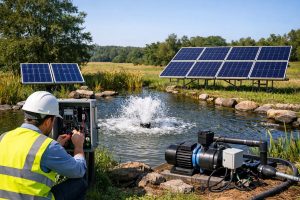
Upgrade to a Variable-Speed Pump (VSP): As shown earlier, this is the single most impactful change you can make, capable of cutting pump-related energy costs by up to 90%. The high-efficiency permanent magnet motors are the key. Look for models with an integrated controller that can automatically adjust speed. For example, a system with both AC grid and DC solar inputs allows for seamless, 24-hour operation using free solar energy during the day and switching to the grid (or battery storage) at night, maximizing savings.
-
Optimize Runtime and Speed: Do you really need to run your pump 24/7? Many pool owners find that running a VSP for 12-18 hours at a very low speed (e.g., 1,000-1,500 RPM) provides superior filtration and chemical distribution at a fraction of the cost of running a single-speed pump for only 8 hours. The goal is "turnover," getting all the water through the filter. With a VSP, you can achieve this turnover goal more efficiently over a longer period at a lower speed.
Supporting Strategies: System and Maintenance
These improvements reduce the workload on your pump, allowing it to operate more efficiently.
-
Plumbing Improvements:
- Increase Pipe Diameter: If renovating or building, insist on 2-inch or even 2.5-inch plumbing instead of the old 1.5-inch standard. The wider pipes drastically reduce friction.
- Use Sweep Elbows: Replace sharp 90-degree fittings with gentler, curved "sweep" elbows to maintain water momentum.
- Minimize Equipment: Each piece of equipment adds resistance. Use bypass loops to direct water around heaters or chlorinators when they aren't actively needed.
-
Filter Optimization:
- Keep it Clean: A dirty filter is like a clogged artery for your pool. The pump has to work much harder to force water through. Clean cartridge filters and backwash sand/DE filters regularly, based on the pressure gauge reading (clean when pressure is 8-10 PSI above the clean starting pressure).
- Go Bigger: An oversized filter has more surface area, creating less resistance and allowing for longer intervals between cleanings.
-
Use a Pool Cover: A pool cover is a multi-purpose energy saver. It reduces water evaporation by up to 95%, which means the pump runs less to replace water. It also keeps debris out, reducing filter load, and retains heat, cutting down on heating costs. This simple addition can reduce a pool's total energy needs by 30-50%.
By combining these strategies, you create a synergistic effect where each improvement enhances the others, leading to a highly efficient and cost-effective pool system.
Future-Proofing Your Pool’s Energy Efficiency
Are you just looking to save money now, or do you want a long-term solution?
The technology for pool systems is advancing rapidly, focusing on total energy independence.
Thinking ahead can save you thousands in the future.
The future is smart, automated, and solar-powered.
Integrating a variable-speed pump with solar panels and a smart automation system creates a nearly zero-cost operating solution.
This setup offers energy independence, environmental benefits, and protection from rising utility rates.
The trend in pool technology is moving decisively towards smart, interconnected, and sustainable systems.
Future-proofing your pool means adopting technologies that not only save you money today but also insulate you from rising energy costs and prepare you for a more automated, off-grid future.
This involves looking at the pool not as a standalone item, but as an integrated part of your home's energy ecosystem.
The Power of Solar Integration
The ultimate way to cut your pump's running cost is to get your electricity for free from the sun.
This is no longer a niche concept but a practical and highly effective solution.
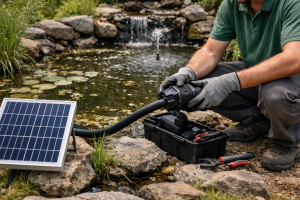
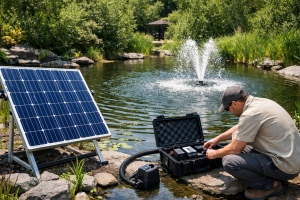
- Solar-Powered Pumps: Systems are now available that run directly from DC power generated by solar panels. High-efficiency brushless DC (BLDC) motors are perfect for this, as they are inherently DC-powered.
- Hybrid AC/DC Systems: For 24-hour reliability, hybrid controllers are the most advanced solution. These controllers intelligently manage power from two sources:
- DC Input (Solar): During the day, the pump runs entirely on solar power. An MPPT (Maximum Power Point Tracking) controller ensures the pump gets the maximum possible energy from the panels, even in varied light conditions.
- AC Input (Grid/Generator): When sunlight is insufficient (on cloudy days or at night), the controller automatically switches to the AC grid as a power source. This ensures your pool remains filtered 24/7 without any manual intervention.
This hybrid approach provides the best of both worlds: maximum free energy from solar with the reliability of the grid as a backup.
The Brains of the Operation: Smart Automation
Automation systems are the central nervous system of the modern pool.
They coordinate all equipment for optimal performance and efficiency.
- Intelligent Scheduling: A smart controller does more than a simple timer. It can run the variable-speed pump at different speeds throughout the day based on need—a low speed for overnight filtration, a medium speed during peak sun for solar heating, and a high speed for cleaning cycles.
- System-Wide Coordination: Smart systems integrate the pump, heater, chlorinator, and lighting. For example, it ensures the pump is running at the required flow rate before turning on the heater, preventing damage and maximizing efficiency.
- Remote Control and Monitoring: Control and monitor every aspect of your pool from a smartphone app. Adjust schedules, check water temperature, and receive alerts about potential issues, like a filter that needs cleaning, from anywhere in the world.
By combining a high-efficiency variable-speed pump, a hybrid solar power system, and smart automation, you create a virtually self-sufficient and highly optimized pool.
This isn't just about saving money; it's about investing in a more sustainable, reliable, and convenient way to enjoy your pool for years to come.
Conclusion
Running a pool pump 24/7 can be costly with old tech, but modern variable-speed pumps and solar solutions make it affordable and efficient, drastically cutting energy bills.
Frequently Asked Questions
Is it cheaper to run a pool pump at night?
Yes, if your utility has Time-of-Use rates.
Running the pump during off-peak hours, typically overnight, can reduce electricity costs by 30-50% compared to peak daytime hours.
How many hours a day should a pool pump run?
For a single-speed pump, 8-12 hours is typical.
A variable-speed pump can run 12-24 hours at a very low, energy-saving speed for better filtration and lower costs.
Do variable-speed pool pumps really save money?
Yes, absolutely.
They can reduce pump-related electricity costs by up to 90%, allowing the pump to pay for its higher initial cost within 1-2 years through significant energy savings.
How much does it cost to run a 1 hp pool pump for 24 hours?
A 1 HP single-speed pump (~1,200W) costs about $4.70 per day, or $141 per month at average rates.
A 1 HP variable-speed pump at low speed would cost under $30 per month.
Can I use a smaller pump to save money?
Yes, but it must be correctly sized.
A smaller, high-efficiency pump is often better than an oversized one.
Proper sizing reduces energy use and system strain, saving money.
How much power does a pool pump use per hour?
A single-speed pump uses 1.5 to 2.5 kWh per hour.
A variable-speed pump at low speed can use as little as 0.2 to 0.4 kWh per hour.
Does a dirty pool filter use more electricity?
Yes.
A clogged filter increases system pressure, forcing the pump to work harder and use significantly more electricity to maintain water flow.
Regular cleaning is crucial for efficiency.
What is the most efficient type of pool pump?
Variable-speed pumps are by far the most efficient.
Their permanent magnet motors and ability to adjust speed allow them to perform tasks using 50-90% less energy than single-speed models.