Struggling to find a pump that delivers the intense pressure you need?
Choosing the wrong one means weak performance and wasted money, a common frustration for many projects.
The best high-pressure pump depends entirely on your application's needs, power source, and water conditions. Engine-driven pumps offer portability, electric pumps provide stationary reliability, and solar pumps deliver eco-friendly, off-grid solutions. The key is matching the pump type to your specific requirements for flow, head, and durability.
Selecting the right high-pressure pump can feel overwhelming.
You face a huge market with various types, power sources, and technical specifications.
This guide simplifies the process.
We will break down the essential factors, compare the top technologies with clear data, and empower you to choose the perfect pump.
Let's find the solution that provides the power and reliability your project demands.
Engine-Driven vs. Electric High-Pressure Pumps
Need a high-pressure pump but unsure about the power source?
Choosing between gas engines and electric motors can impact your project's portability, cost, and convenience, causing decision paralysis.
Engine-driven pumps are best for portable, off-grid applications like firefighting or remote agriculture, offering powerful performance anywhere. Electric pumps excel in stationary roles with reliable power access, such as irrigation systems or industrial processes, providing consistent and lower-maintenance operation.
To make the best choice, you must understand the fundamental trade-offs between engine-driven and electric models.
This decision goes beyond simple power availability.
It influences operational costs, maintenance schedules, and the overall flexibility of your water system.
Let's dive deeper into the specific characteristics of each to determine which is superior for your situation.
Engine-Driven High-Pressure Pumps
Engine-driven pumps are the champions of portability and power in remote locations.
They are typically powered by gasoline or diesel engines, freeing you from the constraints of the electrical grid.
This makes them indispensable for applications like mobile pressure washing, wildland firefighting, and agricultural use in large, unelectrified fields.
Brands like Gorman-Rupp and AMT are well-regarded in this category for their reliability.
For example, a portable fire pump kit using a 5HP Honda gas engine can deliver high-pressure water instantly, which is critical in emergencies.
The primary advantage is their ability to operate anywhere, providing robust performance with high flow rates and pressure.
However, this freedom comes with downsides.
Engines require regular maintenance, including oil changes and fuel refills.
They also produce noise and exhaust fumes, making them less suitable for residential or indoor use.
Fuel costs can also be a significant long-term operational expense compared to electricity.
Electric High-Pressure Pumps
Electric high-pressure pumps are the workhorses for stationary applications where a reliable power source is available.
They are found in everything from commercial car washes and carpet cleaning extractors to large-scale irrigation systems and boiler feed applications.
An electric pump offers a "plug-and-play" convenience that engine-driven models can't match.
They are significantly quieter, produce zero emissions at the point of use, and generally require less maintenance.
The operational cost is often lower, as electricity is typically cheaper than gasoline or diesel per hour of operation.
For example, a high-pressure low-volume electric pump used in the carpet cleaning industry can run consistently at 200-300 PSI with minimal oversight.
Their main limitation is their dependency on a power outlet.
This makes them unsuitable for mobile or remote jobs unless you have access to a generator, which negates some of their benefits.
The power cord itself can also limit range and mobility.
Data-Driven Comparison
| Feature | Engine-Driven Pumps | Electric Pumps |
|---|---|---|
| Best Use Case | Mobile, off-grid, emergency | Stationary, reliable power |
| Portability | High (fully self-contained) | Low (tethered to power source) |
| Upfront Cost | Generally higher | Generally lower for similar performance |
| Operational Cost | High (fuel consumption) | Lower (electricity cost) |
| Maintenance | Higher (oil, fuel, engine service) | Lower (fewer moving parts) |
| Noise & Emissions | High | Very Low / Zero |
| Example PSI Range | 80 - 155 PSI (common models) | 200 - 700+ PSI (application-specific) |
Ultimately, the choice is clear.
If you need to move your operation or work far from a power grid, an engine-driven pump is your only logical choice.
If your work is stationary and you have access to electricity, an electric pump offers a more cost-effective, quieter, and lower-maintenance solution.
Understanding Pump Types: Centrifugal vs. Diaphragm vs. Plunger
Your pressure is too low, but you don't know why.
Using the wrong pump mechanism for your fluid type or pressure needs leads to inefficiency, premature wear, and costly failures.
Centrifugal pumps are best for moving large volumes of clean water at moderate to high pressure. Diaphragm pumps excel at handling abrasive or viscous fluids at lower flows. Plunger pumps are the top choice for generating extremely high pressures, like in pressure washers.
The internal mechanics of a pump determine its performance characteristics.
A centrifugal pump works very differently from a positive displacement pump like a diaphragm or plunger model.
Understanding these differences is crucial for matching the pump to the job.
Using a centrifugal pump for a task requiring the high pressure of a plunger pump will result in disappointment.
Let's explore how each type works and where it shines.
Centrifugal Pumps
Centrifugal pumps are the most common type of pump used today.
They use a spinning impeller to create centrifugal force, which pushes fluid outward and through the pump outlet.
This design is simple, reliable, and highly efficient for moving large volumes of water.
High-pressure versions, often called multi-stage centrifugal pumps, use multiple impellers in a series to build pressure incrementally.
A two-stage centrifugal pump, for instance, can achieve heads up to 400 feet with flow rates up to 140 GPM.
Vertical multistage pumps are even more powerful, making them ideal for booster applications in high-rise buildings or large-scale water treatment facilities.
- Advantages: High flow rates, smooth and non-pulsating flow, simple design, and relatively low cost.
- Limitations: Performance is highly sensitive to changes in pressure (head). They are not self-priming and are less effective with highly viscous fluids or air. They are also sensitive to abrasive solids.
Diaphragm Pumps
Diaphragm pumps are a type of positive displacement pump.
They use a flexible membrane (diaphragm) that moves back and forth, creating a temporary chamber to draw in and then expel fluid.
This mechanism makes them excellent for handling a wide range of fluids, including those with suspended solids, abrasives, or high viscosity.
They are also self-priming and can run dry for short periods without damage.
While they are often associated with lower pressures, specialized high-pressure models exist for applications like chemical spraying or transfer where fluid compatibility is key.
- Advantages: Can handle abrasive and viscous fluids, can run dry, self-priming, and offer good chemical resistance.
- Limitations: Typically provide lower flow rates than centrifugal pumps and produce a pulsating flow that may require a pulsation dampener for some applications.
Plunger Pumps
Plunger pumps, also known as triplex or piston pumps, are another type of positive displacement pump designed for one primary purpose: creating very high pressure.
They use a crankshaft to move one or more plungers (pistons) back and forth, forcing water through a check valve at extremely high pressures.
A triplex plunger pump, for example, can be flanged directly to an electric motor and is ideal for all pressure cleaning and washing applications.
These pumps often feature durable components like forged brass manifolds and solid ceramic plungers to withstand the intense forces.
They are the go-to choice for pressure washers, reverse osmosis systems, and other tasks demanding pressures well over 1000 PSI.
- Advantages: Can generate extremely high pressures, provide a constant flow rate regardless of pressure, and are highly efficient.
- Limitations: More complex design with more moving parts, higher initial cost, and intolerant of running dry or handling abrasive solids without proper filtration.
| Pump Type | Mechanism | Best For | Pressure Range | Flow Rate | Handles Solids? |
|---|---|---|---|---|---|
| Centrifugal | Spinning Impeller | High-volume water transfer | Moderate to High | High | No (poorly) |
| Diaphragm | Flexible Diaphragm | Abrasive/Viscous Fluids | Low to Moderate | Low to Moderate | Yes |
| Plunger | Reciprocating Plungers | Very High Pressure | Very High | Low to Moderate | No (requires filtration) |
The Rise of Solar High-Pressure Pumps
You need high-pressure water in a remote area, but running power lines or constantly refueling a generator is expensive and impractical.
This lack of accessible power leaves valuable land unirrigated and livestock thirsty.
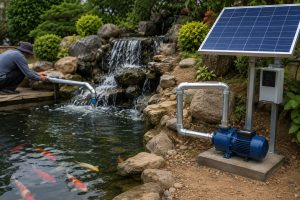
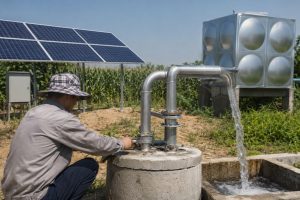
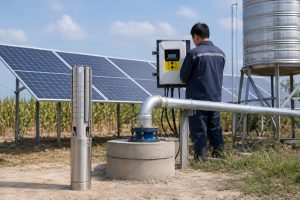
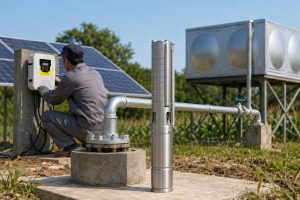
Solar high-pressure pumps provide a powerful, self-sufficient solution for off-grid water needs. By harnessing free energy from the sun, they deliver reliable water pressure for irrigation, livestock, and domestic use without fuel costs or grid dependency, offering over 90% energy efficiency.
The global shift towards sustainable and independent solutions has put solar water pumps in the spotlight.
Once considered a niche product, they are now essential infrastructure in regions like Africa, Australia, and the Americas.
Their ability to operate entirely off-grid makes them a game-changer for agriculture and rural communities.
They are not just an alternative; they represent a more intelligent, cost-effective, and environmentally friendly way to manage water resources.
Let's examine the components and benefits that make this technology so compelling.
Why Go Solar?
The business case for solar pumps is built on long-term economic and operational advantages.
While the initial investment might be comparable to or higher than a conventional system, the savings are substantial over the pump's lifespan.
- Zero Fuel Costs: The sun provides the energy for free. This eliminates the recurring and often volatile expense of diesel or gasoline, which can account for a significant portion of a farm's operating budget.
- Low Maintenance: Solar pump systems have very few moving parts. The core components—solar panels, a controller, and a brushless motor—are incredibly reliable and require minimal upkeep compared to combustion engines.
- Energy Independence: Solar pumps free you from reliance on an unstable power grid or volatile fuel supply chains. You have a consistent water supply as long as the sun is shining.
- Environmental Benefits: These systems produce zero carbon emissions, reduce noise pollution, and eliminate the risk of soil and water contamination from fuel spills.
Core Components of a Solar Pumping System
A modern solar pumping system is more than just a pump connected to a panel.
It's an integrated system designed for maximum efficiency.
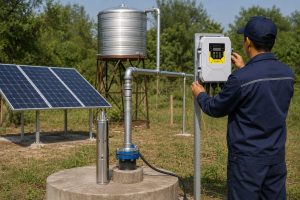
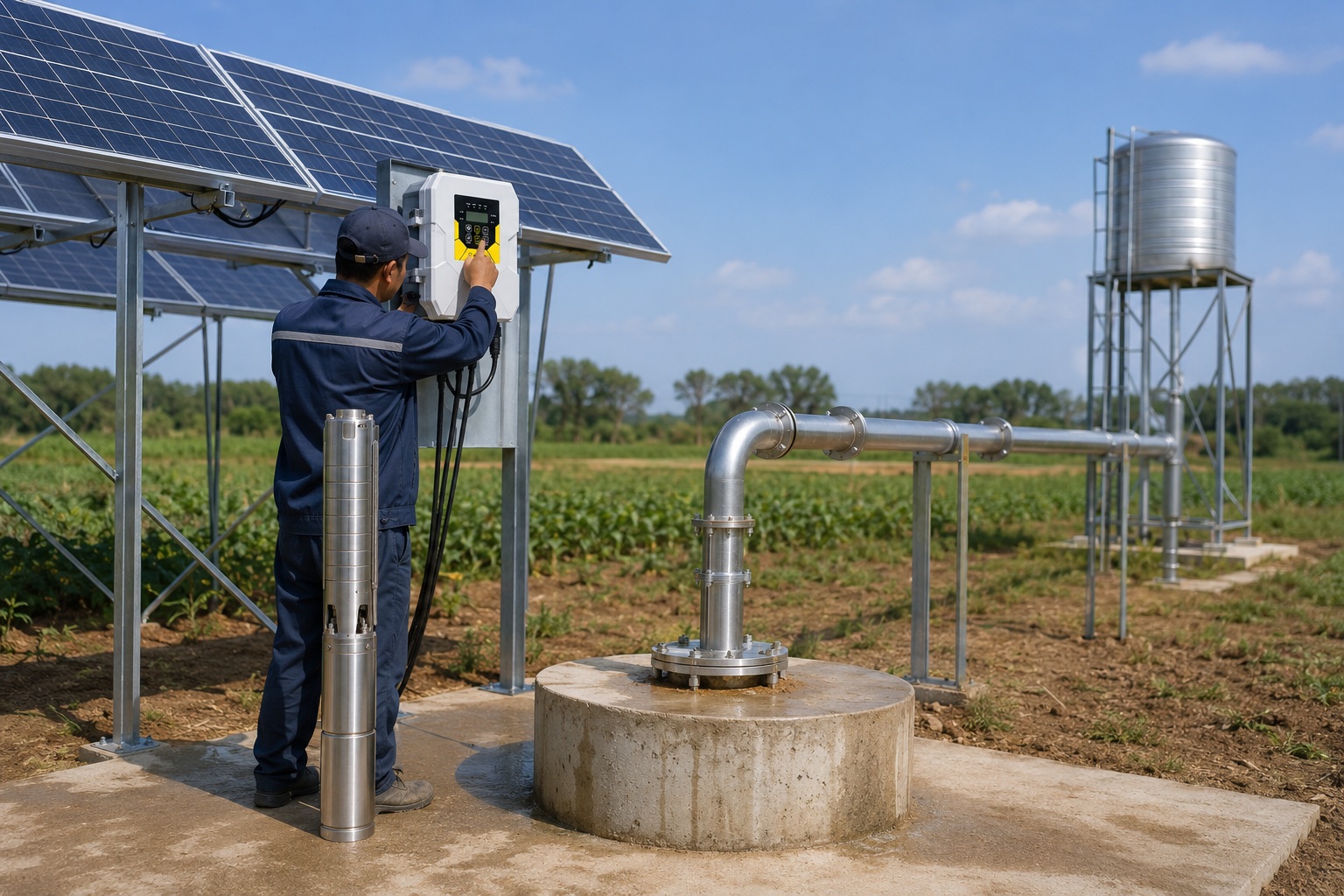
- Solar Panels (PV Array): These capture sunlight and convert it into direct current (DC) electricity. The size of the array is matched to the pump's power requirements and the local solar irradiance levels.
- Pump Controller: This is the brain of the system. It often includes Maximum Power Point Tracking (MPPT) technology, which optimizes the output from the solar panels to match the pump's needs, boosting efficiency by up to 30%. It also provides protections against running dry, overheating, and voltage fluctuations.
- Solar Water Pump: This is the heart of the operation. It's typically a submersible or surface pump fitted with a highly efficient motor designed specifically for solar power.
Return on Investment (ROI)
The financial argument is compelling.
Consider a small farm using a diesel pump for 4 hours a day.
The fuel costs alone can add up to thousands of dollars per year.
A solar pump system, after its initial purchase, has nearly zero running costs.
The payback period for a solar pump system can be as short as 1 to 2 years when replacing a diesel generator.
Over a 10-year period, the total cost of ownership for a solar pump can be 50-70% lower than that of a diesel pump.
This is not just a purchase; it's a long-term investment in sustainability and profitability.
Choosing the Right Solar Pump: Screw vs. Impeller
You've decided on solar, but now you face another choice: screw or impeller pump?
Picking the wrong type for your well depth and water quality can lead to low output, frequent clogs, or premature failure.
For deep wells with low flow needs and sandy water, a solar screw pump is superior due to its sand resistance and high head capability. For higher flow rates in less deep wells, a solar impeller pump (plastic or stainless steel) is the better, more efficient choice.
Within the world of solar pumps, the pump-end mechanism is what truly defines its application.
The three most competitive designs—the screw pump, the plastic impeller pump, and the stainless steel impeller pump—each serve a distinct purpose.
All are driven by the same ultra-efficient motor technology, but their internal design dictates whether they are best for a deep domestic well, a large farm, or a corrosive water environment.
Understanding this portfolio is key to meeting diverse customer needs.
Solar Screw Pump: The Deep Well Specialist
The solar screw pump is a type of progressing cavity pump.
It uses a single helical stainless steel rotor spinning inside a rubber stator.
This action creates sealed cavities that move water upward, generating very high pressure (head) even at low flow rates.
- Key Characteristics: Low Flow, High Head. It's designed to lift water from extreme depths where centrifugal pumps would struggle.
- Best Applications: Domestic water supply for homes in remote areas, livestock drinking troughs fed by deep wells, and small-scale drip irrigation. It is extremely popular in arid regions of Africa and Latin America.
- Core Advantage: Its design makes it highly resistant to sand and silt, with some models handling up to 5% sand content without significant wear. This durability in harsh water conditions is its primary selling point.
- Limitations: The flow rate is inherently limited, making it unsuitable for applications requiring large volumes of water, such as flood irrigation for large farms.
Solar Plastic Impeller Pump: The High-Flow Workhorse
This is a multi-stage centrifugal pump equipped with impellers made from high-strength, wear-resistant engineering plastic.
Multiple impellers are stacked in series to achieve the desired pressure and flow.
- Key Characteristics: High Flow, Medium Head. It's designed to move a lot of water efficiently.
- Best Applications: Farm irrigation, pasture water management, filling reservoirs, and residential water supply from moderately deep wells. It is widely adopted across Africa and the Americas for its excellent performance-to-cost ratio.
- Core Advantage: It delivers a significantly higher water output compared to a screw pump. The engineered plastic is surprisingly resistant to abrasion from fine sand. It is also lightweight and more economical than its stainless steel counterpart.
- Limitations: Plastic impellers are not ideal for very deep wells where high pressures can cause wear over time. They also lack the corrosion resistance needed for acidic or highly alkaline water.
Solar Stainless Steel Impeller Pump: The Premium Durability Option
This model is structurally similar to the plastic impeller pump but uses SS304 stainless steel for the impellers, diffuser, and pump body.
This material upgrade makes it a premium, robust solution.
- Key Characteristics: High Flow, Medium-to-High Head, and Superior Corrosion Resistance.
- Best Applications: Water supply in areas with acidic or alkaline water, coastal regions with brackish water, and high-end residential or commercial properties where longevity and reliability are paramount. It's a key product for markets like Australia and parts of the Americas with challenging water chemistry.
- Core Advantage: Exceptional resistance to corrosion and abrasion, ensuring a very long service life even in aggressive water environments. It offers the highest reliability in the solar pump portfolio.
- Limitations: The use of stainless steel makes it the most expensive and heaviest option, targeting a more niche, high-end market segment that prioritizes long-term durability over initial cost.
| Feature | Solar Screw Pump | Solar Plastic Impeller Pump | Solar Stainless Steel Impeller Pump |
|---|---|---|---|
| Primary Use | Deep wells, home water | Farm irrigation, high volume | Corrosive water, premium use |
| Flow Rate | Low | High | High |
| Head (Pressure) | Very High | Medium | Medium to High |
| Sand Resistance | Excellent | Good (fine sand) | Very Good |
| Corrosion Res. | Good | Poor | Excellent |
| Cost | Moderate | Low | High |
| Ideal Market | Africa, Latin America | Africa, Americas | Australia, Americas (niche) |
The Powerhouse Behind the Pump: BLDC Motors
You want an efficient solar pump, but many systems underperform, requiring more panels and cost.
The problem often isn't the pump itself, but an inefficient motor that wastes precious solar energy.
High-efficiency Brushless DC (BLDC) permanent magnet motors are the core of modern solar pumps, achieving over 90% efficiency. This technology dramatically reduces energy waste, meaning you need fewer solar panels, lowering the system's total cost and improving performance.
The true competitive advantage of a top-tier solar water pump system lies in its motor.
An efficient pump end is useless if the motor driving it wastes a large percentage of the incoming solar power.
This is where Brushless DC (BLDC) permanent magnet synchronous motor technology creates a massive leap in performance.
It is the universal engine that powers all three pump types—screw, plastic impeller, and stainless steel impeller—and is the single biggest factor in the system's overall efficiency and market competitiveness.
What Makes BLDC Motors Superior?
Unlike traditional brushed motors that rely on physical contact (brushes) to transfer power, BLDC motors use an electronic controller.
This design eliminates the friction and energy loss associated with brushes.
The use of powerful permanent magnets, typically neodymium iron boron (NdFeB), in the rotor further enhances performance.
- Unmatched Efficiency: BLDC motors consistently achieve electrical-to-mechanical energy conversion efficiencies exceeding 90%. In contrast, standard DC or AC motors often operate in the 60-75% efficiency range. This 15-30% improvement is monumental.
- Higher Power Density: These motors generate more power and torque relative to their size. A modern BLDC motor can be up to 47% smaller and 39% lighter than a conventional motor with the same power output.
- Longer Lifespan & No Maintenance: The absence of brushes to wear out means the motor has a significantly longer operational lifespan and is virtually maintenance-free.
The Market Value of High Efficiency
The technical advantages of a BLDC motor translate directly into tangible benefits for both distributors and end-users.
It's not just about a percentage point on a spec sheet; it's about real-world cost and performance.
Reduced System Cost
A 90%+ efficient motor requires less power to do the same amount of work.
This means the entire system can run on a smaller, less expensive solar panel array.
For example, a system that would need 1000 watts of solar panels with a 70% efficient motor might only need 770 watts with a 92% efficient BLDC motor.
This directly reduces the largest single cost component of a solar pumping system.
Improved Performance
With higher torque, especially at low speeds, BLDC motors can start pumping earlier in the morning and continue later in the afternoon during low-light conditions.
This extends the daily pumping duration and increases the total volume of water delivered.
The compact and lightweight design also simplifies transportation and installation, a crucial factor for remote projects.
The motor's efficiency is the strategic core that elevates the entire pump system from a simple product to a highly competitive, energy-saving solution.
Ensuring 24/7 Water Supply: AC/DC Hybrid Systems
Solar pumps are great, but what happens on cloudy days or at night?
The fear of having no water when the sun isn't out is a major barrier for many potential users who need a constant supply.
AC/DC hybrid controllers solve this problem by automatically switching between power sources. They prioritize free solar (DC) power when available, but seamlessly switch to grid or generator (AC) power at night or on cloudy days, guaranteeing a reliable 24/7 water supply.
While solar power offers incredible autonomy, its one inherent limitation is its intermittency.
For critical applications like household water supply or intensive livestock operations, a water shortage is not an option.
This is where intelligent hybrid technology comes in, bridging the gap between solar independence and round-the-clock reliability.
An advanced AC/DC hybrid controller transforms a standard solar pump into a worry-free, all-weather water solution.
How Hybrid Controllers Work
A hybrid controller is designed with two separate power inputs: one for DC power from the solar panels and one for AC power from the grid or a backup generator.
The controller's internal logic is programmed to manage these sources intelligently for maximum efficiency and reliability.
- Solar Priority Mode: During the day, if the solar panels are producing enough power, the controller will use 100% solar energy to run the pump. The AC input remains on standby.
- Hybrid Assist Mode: On days with intermittent clouds, when solar power dips below what the pump requires, the controller doesn't just shut off. Instead, it draws only the additional power needed from the AC source to make up the difference. This maximizes the use of free solar energy while ensuring the pump runs at a stable speed.
- AC Takeover Mode: When there is no solar input, such as at night or during heavy, prolonged overcast weather, the controller automatically switches over completely to the AC power source. The pump continues to run without any interruption or manual intervention.
The Ultimate Benefit: Worry-Free Water
This automated functionality provides the best of both worlds.
You get the massive cost savings and environmental benefits of solar power without ever having to compromise on the availability of water.
It eliminates "range anxiety" for water pump users.
There's no need to manually switch on a generator or worry about a tank running dry overnight.
The system handles everything automatically.
For a homeowner, this means the taps will always work.
For a farmer, it means livestock will never go thirsty, and irrigation can be scheduled for optimal times, day or night.
This technology makes solar pumping a viable and superior primary water solution for nearly any application, removing the final barrier to adoption for users who demand 100% uptime.
It ensures you have water whenever you need it, powered by the most economical source available at that moment.
Conclusion
The "best" high-pressure pump is not a single model but a complete system tailored to your needs.
It combines the right pump type with an efficient motor and intelligent controls for optimal performance.
Frequently Asked Questions
What determines the pressure of a water pump?
A pump's pressure, or head, is primarily determined by its design, specifically the impeller diameter and speed for centrifugal pumps or the displacement mechanism for positive displacement pumps.
How many PSI is a high pressure water pump?
High pressure is relative, but it generally starts around 100 PSI for fire pumps and can exceed 3000 PSI for industrial pressure washers and cleaning applications.
Can you use a normal pump for high pressure?
No, standard water pumps are not built to withstand the forces of high pressure. Using one for this purpose can cause catastrophic failure and is extremely dangerous.
What is the difference between a high pressure and high volume pump?
A high-pressure pump is designed to move fluid against significant resistance (high head), while a high-volume pump is designed to move a large quantity of fluid with less resistance (high flow).
How do I increase my water pump pressure?
You can increase pressure by using a multi-stage pump, increasing the motor speed (with a VFD), or replacing the current pump with a model specifically designed for higher pressure.
What type of pump is best for high head?
For very high head applications, positive displacement pumps like screw or plunger pumps, and multi-stage centrifugal pumps are the most effective and efficient choices.