Struggling to get water where you need it?
Choosing the wrong pump leads to wasted money and a system that fails.
Understanding pump power is the first step to a reliable water solution.
A 3 horsepower (HP) pump can lift water to impressive heights, often exceeding 150 meters (nearly 500 feet).
However, the final lift height, known as 'head', depends heavily on the specific pump design and the volume of water you need to move.
More flow usually means less lift.
You might think a 3 HP pump is a 3 HP pump, but that's only part of the story.
The real-world performance depends on a delicate balance of factors, including the pump’s internal design, the power source driving it, and the specifics of your installation.
Simply looking at the horsepower rating is like judging a car by its engine size alone, without considering its transmission or tires.
To truly answer "how high?", we need to look deeper into the mechanics of moving water.
This guide will break down the essential concepts of head, flow, pump types, and power systems so you can make an informed choice.
We'll turn confusing technical specs into clear, actionable knowledge.
Understanding Pump Performance: Head, Flow, and Horsepower****
Are you overwhelmed by technical jargon like head, flow, and PSI?
This confusion can lead to buying a pump that is either too weak or unnecessarily powerful, costing you time and money.
Let’s demystify these terms to ensure your water system works perfectly.
Horsepower (HP) measures the motor's power, while head is the maximum vertical distance it can lift water.
Flow rate, measured in gallons or liters per minute, is the volume of water moved.
A 3 HP pump’s performance is a trade-off between how high it can lift water (head) and how much water it moves (flow).
What is Total Dynamic Head (TDH)?
Total Dynamic Head is the most critical number for sizing any pump.
It represents the total work the pump must do.
It’s not just the vertical lift.
TDH is calculated by adding three components:
-
Static Head: This is the simple vertical distance from the surface of the water source (like the water level in a well) to the highest point where the water will be discharged. For a 3 HP pump, this is the primary number it needs to overcome.
-
Friction Loss: Water moving through pipes creates friction, which is like extra height the pump must push against. Longer pipes, narrower pipes, and fittings like elbows and valves all increase friction loss. A 3 HP pump pushing high flow rates through a small pipe can lose over 30% of its pressure to friction.
-
Pressure Head: If you need the water to be delivered under pressure (e.g., for a sprinkler system requiring 40 PSI), you must convert that pressure into an equivalent height. Every 1 PSI of pressure is equal to 2.31 feet of head.
The formula is: TDH = Static Head + Friction Loss + Pressure Head.
The Inverse Relationship Between Head and Flow
No pump can deliver its maximum head and maximum flow at the same time.
This is the most important trade-off in pump selection.
A pump's performance is shown on a "pump curve," which clearly illustrates this inverse relationship.
As you demand a higher flow rate, the maximum height the pump can achieve decreases.
For a typical 3 HP submersible pump, this relationship might look like this:
| Desired Flow Rate (Gallons per Minute) | Achievable Head (Feet) | Potential Application |
|---|---|---|
| 15 GPM | 450 ft (137 m) | Deep well domestic water |
| 30 GPM | 350 ft (107 m) | Livestock watering / Tank filling |
| 50 GPM | 220 ft (67 m) | Small-scale irrigation |
This shows that if your well is 400 feet deep, the pump can't deliver 50 GPM, but it can comfortably supply 15 GPM.
Horsepower as a Measure of Work
Horsepower is a unit of power that quantifies the rate at which work is done.
A 3 HP motor provides the raw energy, but the pump's hydraulic design (its impellers or screw) is what translates that energy into moving water.
A 3 HP motor provides approximately 2,238 watts of power.
An efficient pump system with a high-efficiency motor might deliver 85% of this power to the water, while a less efficient system might only deliver 60%.
This difference in efficiency is huge.
A 3 HP pump with 85% efficiency can lift the same amount of water about 40% higher than one with only 60% efficiency, using the exact same amount of power.
That is why the motor and pump end must be considered together.
Pump Type Matters: Centrifugal vs. Screw Pumps****
Did you assume that any 3 HP pump would work for your deep well?
This common misconception is a primary cause of system failure and poor water output.
Choosing the right pump design is just as important as choosing the right horsepower.
A 3 HP multi-stage centrifugal pump is engineered for high flow rates at moderate depths.
In contrast, a 3 HP screw pump (or progressing cavity pump) is a specialist, designed to produce very high pressure to lift water from extreme depths, but with a lower flow rate.
The Centrifugal Pump: The High-Flow Workhorse
Centrifugal pumps are the most common type of pump.
They use a series of spinning impellers to generate pressure and move water.
Each impeller and diffuser stage adds more pressure, increasing the total head the pump can achieve.
A 3 HP centrifugal pump is a powerful and versatile machine, perfect for applications that require moving a lot of water.
-
Plastic Impeller Models: These pumps use impellers made from engineered polymers. They offer an excellent balance of performance and cost. Their lightweight nature can improve motor efficiency, and they show surprisingly high resistance to wear from fine sand, making them ideal for farm irrigation and general home use in many regions. They are a cost-effective choice for wells up to 100 meters deep.
-
Stainless Steel Impeller Models: For more demanding conditions, stainless steel impellers are the premium choice. They offer superior durability and are essential for water with corrosive properties (acidic or alkaline pH). A 3 HP model with SS304 impellers can provide reliable service for decades, making it a sound investment for high-end homes or applications with challenging water chemistry, justifying its higher initial cost of 20-30%.
The Screw Pump: The High-Head Specialist
A screw pump operates on a completely different principle called positive displacement.
It uses a single helical rotor (a screw) that rotates inside a rubber stator.
This action creates sealed cavities of water that are pushed up the pump, generating very high pressure.
This design is incredibly effective at overcoming high static head.
A 3 HP screw pump may only produce 20 GPM, but it can push that water up from a well that is 180 meters (590 feet) deep.
A centrifugal pump of the same horsepower would produce zero water at that depth.
Furthermore, screw pumps are highly resistant to sandy or silty water, as the rubber stator can flex to allow particles to pass without causing significant damage.
Performance Comparison: 3 HP Pump Types
Choosing between pump types requires a clear understanding of your priorities: is it the volume of water (flow) or the depth of the well (head)?
Let's compare hypothetical 3 HP models to make the choice clear.
| 3 HP Pump Type | Max Head | Max Flow | Efficiency Zone | Primary Application | Sand Handling |
|---|---|---|---|---|---|
| Centrifugal (Plastic) | 360 ft (110 m) | 60 GPM | 30-50 GPM | Farm Irrigation | Good |
| Centrifugal (SS304) | 400 ft (122 m) | 55 GPM | 25-45 GPM | Home & Ranch Supply | Fair |
| Screw Pump | 590 ft (180 m) | 22 GPM | 10-20 GPM | Deep Well Domestic | Excellent |
This table shows that for a 500-foot well, the screw pump is the only viable option.
For a 300-foot well where you need to irrigate a field, the centrifugal pump is the clear winner.
The Power Source: Why Solar Pumps are Different****
Are you worried about the inconsistent output of a solar-powered system?
This fear often prevents people from embracing a free and sustainable energy source.
Understanding how to build a robust solar pump system eliminates this uncertainty completely.
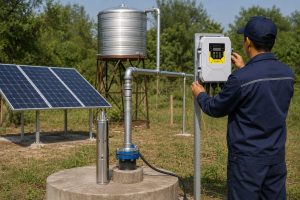
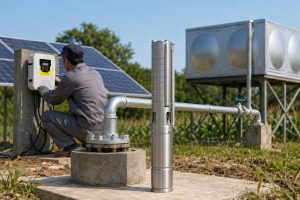
A 3 HP solar pump's performance is directly tied to the sun's intensity.
Its maximum lift is rated for peak sunlight.
To achieve consistent high lift, the system depends critically on a high-efficiency motor and a properly sized solar array to perform reliably even on cloudy days.
The Core of Efficiency: The BLDC Motor
The single greatest advancement in solar pumping is the brushless DC (BLDC) permanent magnet motor.
This is the engine that makes modern solar water systems so effective.
Traditional AC motors have an efficiency of around 70-75%.
BLDC motors, by contrast, regularly exceed 90% efficiency.
This 15-20% improvement is massive.
It means that for every 1000 watts of solar energy captured, a BLDC motor delivers an extra 150-200 watts of mechanical power to the pump compared to an older AC system.
This high efficiency allows a 3 HP BLDC motor to be significantly smaller and lighter (up to 40% lighter) than its AC equivalent.
This reduces installation complexity and, most importantly, lowers the number of solar panels required to run the pump effectively, saving up to 25% on initial system cost.
Sizing Your Solar Array Correctly
Powering a 3 HP pump requires a substantial solar array.
A 3 HP motor consumes approximately 2238 watts (1 HP = 746 Watts).
However, you cannot simply buy 2300 watts of solar panels.
Solar panel ratings are based on ideal lab conditions.
In the real world, factors like cloud cover, high temperatures, time of day, and dust on the panels will reduce output.
A professional rule of thumb is to oversize the solar array by a factor of 1.3 to 1.5.
- Pump Power: 3 HP = 2238 Watts
- Required Solar Array: 2238 Watts * 1.4 = 3133 Watts
Therefore, a robust system for a 3 HP pump would require at least 3200 watts of solar panels.
This could be achieved with nine 375-watt panels.
This oversizing ensures the pump receives enough power to run effectively during the majority of daylight hours, not just at solar noon on a perfectly clear day.
24/7 Reliability with AC/DC Hybrid Systems
What if you need water at night or on a string of rainy days?
This is where solar-only systems can fall short.
The solution is an AC/DC hybrid controller.
This intelligent device can accept power from two sources simultaneously: DC power from the solar panels and AC power from the electrical grid or a generator.
The controller's built-in logic always prioritizes solar power.
It will use 100% solar energy whenever it is sufficient.
If sunlight fades, the hybrid function can blend AC power with the available DC power to maintain pump speed and pressure.
If the solar input drops to zero at night, it automatically switches over to the AC source.
This creates a seamless, uninterruptible water supply, providing the cost savings of solar with the 24/7 reliability of the grid.
Calculating Your Real-World Lift Height
Did you buy a pump based on its advertised max head, only to be disappointed?
This happens when you don't account for the unique demands of your system.
Let's walk through the exact steps to avoid this costly error.
To determine how high a 3 HP pump will lift water in your specific situation, you must calculate your project's Total Dynamic Head (TDH).
This involves adding the vertical lift to the friction losses from your pipes and the pressure you need at the outlet.
Step 1: Measure Your Static Head
This is the foundational measurement for your entire system.
Static head is the total vertical elevation change the water has to make, from its source to its destination.
-
For a well: Measure the distance from the ground surface down to the static water level (the level the water sits at when the pump is off). Then, add the vertical height from the ground surface up to the inlet of your storage tank. For example, if your static water level is 200 feet deep and your tank is on a 20-foot tower, your static head is 220 feet.
-
For a pond or stream: Measure the vertical height from the surface of the pond up to the discharge point.
This number is non-negotiable.
The pump must overcome this gravitational force before it can move any water.
Step 2: Calculate Friction Loss
Friction is the hidden performance killer in a pumping system.
As water flows through pipes and fittings, it rubs against the inner surfaces, losing energy.
This lost energy must be compensated for by the pump, appearing as additional head.
Friction loss depends on three things:
- Flow Rate: Higher flow rates create exponentially more friction. Doubling the flow can quadruple the friction loss.
- Pipe Diameter: A wider pipe has much less friction for the same flow rate. Using a 2-inch pipe instead of a 1.5-inch pipe can reduce friction loss by over 50%.
- Pipe Length and Fittings: The longer the pipe, the more friction. Every 90-degree elbow adds friction equivalent to several feet of straight pipe.
Here is a simplified friction loss table for standard PVC pipe:
| Flow Rate | Friction Loss per 100 ft (1.5" Pipe) | Friction Loss per 100 ft (2" Pipe) |
|---|---|---|
| 20 GPM | 4.8 ft | 1.5 ft |
| 40 GPM | 17.2 ft | 5.4 ft |
| 60 GPM | 36.1 ft | 11.6 ft |
If you need to pump 40 GPM through 300 feet of 2-inch pipe, your friction loss is (5.4 ft / 100 ft) * 300 ft = 16.2 feet.
Step 3: Read the Pump Curve
Once you have your Total Dynamic Head (Static Head + Friction Loss), you can finally consult the pump's performance curve.
A pump curve is a graph provided by the manufacturer for a specific pump model.
The vertical axis shows the head, and the horizontal axis shows the flow rate.
- Find your calculated TDH on the vertical axis.
- Move horizontally across the graph until you intersect the line representing the 3 HP pump.
- From that intersection point, drop vertically down to the horizontal axis.
The number on the horizontal axis is the real-world flow rate your 3 HP pump will deliver for your specific system.
This process removes all guesswork and ensures the pump you choose will meet your expectations.
Conclusion
A 3 HP pump's lift is defined by its design (head vs. flow), not just power.
Calculating your Total Dynamic Head is essential for selecting the right pump and achieving reliable performance.
FAQs
How do you calculate the horsepower of a water pump?
You don't calculate the pump's horsepower; you choose it.
You calculate the Total Dynamic Head (TDH) and required flow rate, then use a pump curve to find a horsepower that meets those needs.
What is the difference between HP and head of a pump?
HP is the power input from the motor.
Head is the performance output, specifically the maximum vertical distance the pump can lift water, measured in feet or meters.
How far can a 3 HP submersible pump push water horizontally?
Horizontal distance is about overcoming friction, not head.
A general rule is 1 foot of head can push water 10-20 feet horizontally, so a pump with 300 feet of head could push water over a mile.
Can a 3hp pump be used for a 500 feet deep well?
Yes, a 3 HP screw pump is specifically designed for such high-head, low-flow applications.
A standard 3 HP centrifugal pump would not work at this depth.
How many solar panels for a 3hp pump?
To run a 3 HP (≈2.3 kW) pump reliably, you should use a solar array of at least 3.2 kW.
This is typically eight or nine high-quality 375W+ solar panels.
Does a 3 HP pump use a lot of electricity?
A 3 HP motor uses about 2.2 kilowatts of power per hour.
When powered by a solar system, this energy is free, eliminating high electricity bills associated with grid-powered pumps.
What size pipe for 3hp submersible pump?
Pipe size depends on flow rate.
For the flow rates of a typical 3 HP pump (20-60 GPM), a pipe diameter of 1.5 to 2.5 inches is recommended to minimize friction loss.
Is 3hp enough for irrigation?
Absolutely.
A 3 HP centrifugal pump can provide 50+ GPM, which is more than enough to run several sprinkler zones or a small-scale drip irrigation system for multiple acres.