Struggling to keep your large pond water clear?
An undersized pump can lead to stagnant, unhealthy water.
Finding the right size is crucial for a thriving aquatic environment.
For a 10,000-litre pond, you need a pump with a flow rate between 5,000 and 10,000 litres per hour (LPH). This ensures the entire pond volume circulates through the filter at least once every one to two hours, maintaining optimal water quality and clarity.
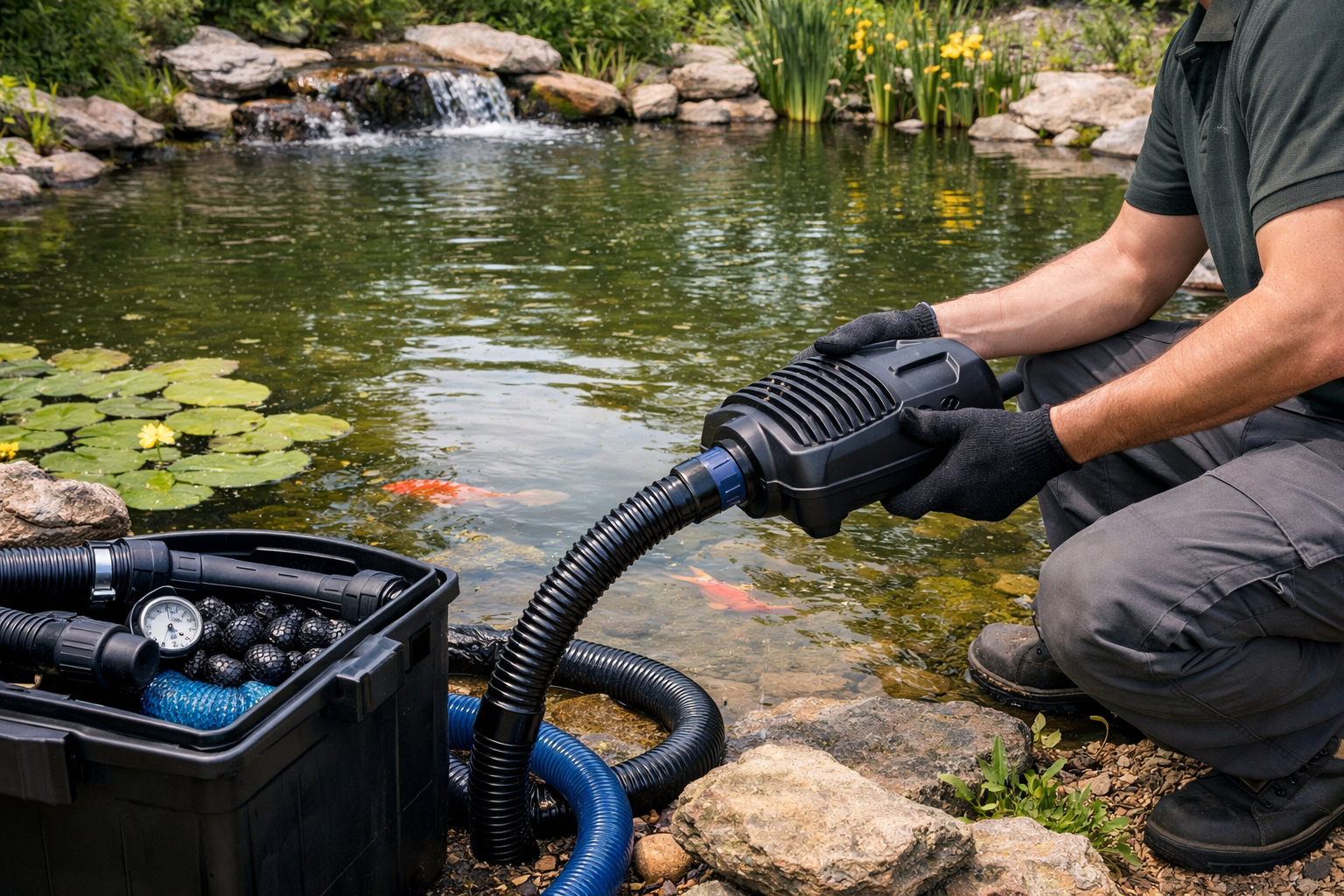
Choosing the right pump size is the first step toward a healthy pond.
It’s like selecting the engine for a car; it must be powerful enough for the job.
But size isn't the only factor.
The type of pump, its energy source, and its features are equally important for long-term efficiency and reliability.
This guide will not only help you calculate the perfect size but also introduce you to advanced, energy-efficient options that can save you money and support a sustainable ecosystem.
Let’s explore how to make the best choice for your beautiful 10,000-litre water feature.
How to calculate pond pump size
Calculating your pond's needs seems complex.
Many pond owners guess the pump size, leading to poor circulation or high energy bills.
This results in cloudy water and stressed fish.
To calculate the right pump size, first determine your pond's volume. A general rule is to choose a pump with a flow rate equal to at least half your pond's volume. For a 10,000-litre pond, this means a minimum flow rate of 5,000 litres per hour (LPH).
Understanding the key factors in pump selection empowers you to create a perfectly balanced pond ecosystem.
It’s not just about a single number.
You need to consider several variables to ensure your pump and filter work together harmoniously.
This approach prevents issues like turbulent water flow that can disturb fish or stagnant areas where harmful bacteria can grow.
Let's break down the essential elements for a precise calculation.
Key Calculation Factors
A successful pond relies on more than just a pump.
It requires a system where every component is matched.
Here are the critical factors to consider:
-
Pond Volume (Capacity): This is the foundation of your calculation.
If you don't know the volume, you can calculate it.
Use the formula: Length (m) x Width (m) x Average Depth (m) x 1000 = Volume in Litres.
An accurate volume measurement is the most critical first step. -
Flow Rate: This measures how much water a pump moves in a set time, usually in litres per hour (LPH).
For most ponds, the goal is to circulate the entire water volume every two hours.
This means the flow rate should be 50% of the total pond volume.
For our 10,000-litre pond, that's a 5,000 LPH pump. -
Head Height: This is the vertical distance from the pump's outlet to the highest point the water needs to reach.
This could be the top of a waterfall or the outlet of a filter.
Every meter of head height reduces the pump's actual flow rate.
Pump manufacturers provide a chart showing flow rate at different head heights.
Always check this to ensure the pump will perform effectively in your specific setup.
A pump rated at 5,000 LPH at zero head height might only produce 3,000 LPH at a 1-meter head height. -
Tubing Diameter and Length: The diameter and length of the hose connecting your pump to the filter or waterfall also affect flow.
A narrow or very long tube will create more friction, reducing the flow rate.
It's best to use the widest diameter tubing recommended for your pump and keep the length as short as possible.
| Factor | Description | Impact on Pump Choice |
|---|---|---|
| Pond Volume | The total amount of water in your pond. | The primary determinant of the required flow rate. |
| Flow Rate | Litres Per Hour (LPH) the pump can move. | Should be at least 50% of the pond's total volume. |
| Head Height | Vertical distance water is lifted. | Significantly reduces the effective flow rate. |
| Tubing | Diameter and length of the hose. | Narrow or long tubing creates friction, reducing flow. |
What size pump do I need for a koi pond?
Koi ponds have unique challenges.
Koi are large, produce significant waste, and require highly oxygenated, clean water to thrive.
Using a standard pond pump often isn't enough.
For a koi pond, you should circulate the entire water volume at least once every hour. Therefore, a 10,000-litre koi pond requires a pump with a flow rate of at least 10,000 LPH. This aggressive circulation is essential for waste removal and oxygenation.
The health of your koi is directly linked to water quality.
Unlike a simple decorative pond, a koi pond is a delicate ecosystem that supports large, valuable fish.
The pump is the heart of this system, driving the life-support functions of filtration and aeration.
A higher turnover rate ensures that ammonia and other toxins from fish waste are quickly sent to the biological filter before they can harm your fish.
This is non-negotiable for serious koi keepers.
Beyond just the flow rate, the type of pump you choose becomes even more critical.
You need a pump that is reliable, efficient, and capable of handling the demands of a high-flow system 24/7.
Specialized Pumps for Demanding Environments
When standard solutions aren't enough, you need to look at specialized pump technology.
For demanding applications like deep wells or regions with specific water challenges, different pump types are engineered to perform optimally.
These principles can also be applied to large, demanding pond systems.
Let's explore three popular types of specialized solar-powered pumps.
1. Solar Screw Pumps: The High-Head Specialist
This pump design is ideal for situations requiring high lift but lower flow volume.
It uses a stainless steel screw (rotor) inside a rubber stator.
As the screw turns, it creates sealed cavities of water that are pushed upward.
- Operating Principle: Positive displacement, pushing water instead of flinging it.
- Best For: Deep ponds or high waterfalls where pressure is more important than volume. It is highly resistant to sand and grit, which is beneficial for ponds in dusty areas or with a sand substrate.
- Performance: Achieves a very high head but delivers a lower flow rate compared to centrifugal pumps. Efficiency can exceed 85% in ideal conditions.
2. Solar Plastic Impeller Pumps: The High-Flow Workhorse
This is a multi-stage centrifugal pump.
It uses a series of durable, wear-resistant plastic impellers to move large volumes of water.
It's an economical and lightweight solution for high-flow needs.
- Operating Principle: Centrifugal force, with each impeller stage adding pressure.
- Best For: Large ponds needing high circulation, powering streams, and general farm or ranch water supply. Its resistance to fine sand makes it a versatile choice.
- Performance: Delivers a very high flow rate at medium head. It offers an excellent balance of performance and cost, with an efficiency of around 88%.
3. Solar Stainless Steel Impeller Pumps: The Premium Durability Option
This pump is built for the toughest conditions.
It features an SS304 stainless steel impeller and pump body.
This design is made to resist corrosion and abrasion over a long service life.
- Operating Principle: Centrifugal force, similar to the plastic impeller model but with superior materials.
- Best For: Ponds with corrosive water (e.g., acidic or alkaline conditions), high-end residential water features, or any application where reliability is the top priority.
- Performance: Offers high flow rates at medium-to-high head. It boasts the highest durability and a service life that can be 50-70% longer than plastic alternatives in harsh conditions.
Choosing an energy-efficient pond pump
Traditional pond pumps can be energy hogs.
Running a powerful pump 24/7 often leads to surprisingly high electricity bills.
This ongoing cost can make pond ownership more expensive than anticipated.
Modern solar-powered pumps, driven by high-efficiency BLDC motors, are an excellent energy-efficient solution. These systems operate independently of the grid, have zero running costs from electricity, and are environmentally friendly. They offer a sustainable choice for any pond owner.
The core of any great pump is its motor.
An inefficient motor wastes electricity, converting it into heat instead of water-moving power.
This is where advanced motor technology truly makes a difference.
The shift towards Brushless DC (BLDC) permanent magnet motors in the pump industry represents a major leap in efficiency and reliability.
A high-efficiency motor not only reduces your carbon footprint but also significantly lowers the lifetime cost of owning your pond. It's a smart investment that pays for itself over time.
The Power of the BLDC Permanent Magnet Motor
The BLDC permanent magnet motor is the core technology powering the next generation of pumps.
It is the key to their superior performance and efficiency.
All three specialized pumps discussed previously—screw, plastic impeller, and stainless steel impeller—are driven by this advanced motor.
Technical Advantages
- Exceptional Efficiency: These motors consistently achieve efficiencies exceeding 90%.
This is a dramatic improvement over traditional AC motors, which often operate at 50-70% efficiency.
This means more water is moved for every watt of power consumed. - Powerful and Compact: The motor's rotor is made from high-strength 40SH neodymium iron boron magnets.
This allows for a design that is both powerful and compact.
Compared to traditional motors, a BLDC motor can be up to 47% smaller and 39% lighter for the same power output. - High Torque: They provide strong starting torque, which is essential for overcoming the initial resistance in deep well or high-head applications.
- Long, Maintenance-Free Life: The brushless design means there are no brushes to wear out and replace.
This results in a motor that is virtually maintenance-free and has a much longer operational lifespan.
The Role of Intelligent Control
To maximize the benefits of a solar pump, an intelligent controller is essential.
A Maximum Power Point Tracking (MPPT) controller constantly analyzes the output from the solar panels and adjusts the electrical load to extract the most power possible.
- MPPT Efficiency: An MPPT controller can boost the power harvested from solar panels by up to 30% compared to simpler controllers.
- Hybrid Functionality: Advanced controllers offer AC/DC hybrid capability.
They prioritize solar power when available.
When sunlight is insufficient, they can automatically switch to or blend in AC grid power or a generator.
This ensures a reliable, 24/7 water supply without interruption, giving you the best of both worlds.
This combination of a high-efficiency BLDC motor and an intelligent MPPT controller forms a complete system.
It ensures that every bit of available solar energy is used to power your pond, providing a reliable and cost-effective water solution.
Conclusion
For a 10,000-litre pond, select a pump with a 5,000-10,000 LPH flow rate.
Consider advanced, energy-efficient solar options with BLDC motors for a sustainable and cost-effective solution.
Frequently Asked Questions (FAQs)
Q: Can a pond pump be too big?
A: Yes, a pump that is too powerful can create excessive turbulence. This can stress fish and may overwhelm your filtration system's capacity, leading to inefficient cleaning and potential overflows.
Q: Should you run a pond pump 24/7?
A: Yes, it is highly recommended to run your pond pump 24/7. Continuous circulation is essential for maintaining oxygen levels and filtering waste, which keeps the water healthy for fish and plants.
Q: How do you calculate the flow rate of a pond pump?
A: The flow rate, rated in litres per hour (LPH), is listed by the manufacturer. You must also consider the head height, as this will reduce the actual flow rate in your specific setup.
Q: How many watts does a 10,000-litre pond pump use?
A: Wattage varies greatly by pump type and efficiency. A traditional pump might use 100-200 watts, while a modern high-efficiency or solar BLDC pump could use significantly less for the same output.
Q: What is the best type of pond pump?
A: The best type depends on your needs. Submersible pumps are common for small to medium ponds. For large or koi ponds, external pumps or specialized high-efficiency solar pumps are often a better choice.
Q: How long should a good pond pump last?
A: A high-quality, well-maintained pond pump can last anywhere from 5 to 10 years. Pumps with durable materials like stainless steel and brushless motors typically have a longer lifespan.
Q: Do I need a filter for my pond or just a pump?
A: A pump circulates water, but a filter cleans it. For a healthy pond with fish, you almost always need both a pump and a filter working together to maintain water quality.
Q: Can I use a sump pump in a pond?
A: It is not recommended. Sump pumps are designed for intermittent use in dirty water and are not built for continuous operation or fish safety, often lacking proper intake shields.