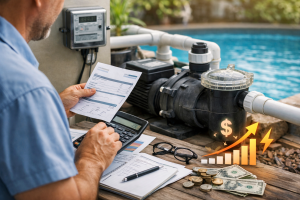
Running a pool pump with grid electricity is expensive.
Your energy bills climb higher every summer, making pool ownership a financial drain.
The best solar panels for a pool pump are those that match your pump's energy needs and your location's peak sun hours.
Typically, you'll need a system of 1.5-2.5 kW, which translates to 4-7 standard solar panels, to efficiently power a standard pool pump.
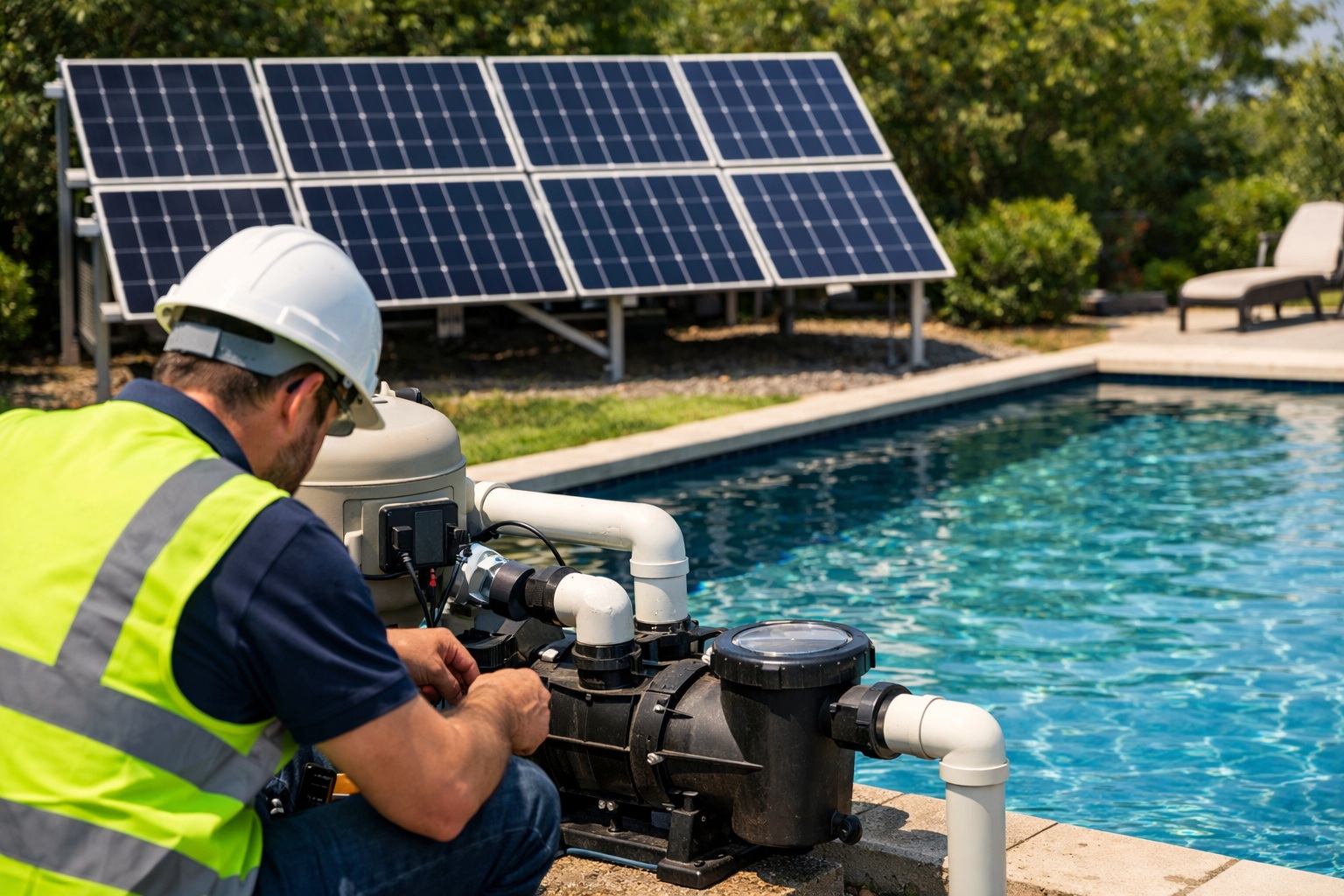
Choosing the right solar solution for your pool pump feels complicated.
You might wonder if you need a separate system or if you can use your home's existing panels.
This guide breaks down everything you need to know.
We will help you make a smart, cost-effective decision.
You can enjoy your pool without worrying about high electricity bills ever again.
How Do You Power a Pool Pump with Solar?
Struggling with the high cost of running your pool pump?
Grid electricity prices of 30-50 cents per kWh can make pool maintenance a significant expense.
You have two primary options: use a dedicated 'off-grid' DC pump with its own panels, or power your existing AC pump with a larger, grid-connected home solar system.
The best choice depends on your specific situation, budget, and local regulations.
Choosing the right method is the most important first step.
Each approach has unique benefits and drawbacks that can impact your costs, efficiency, and installation process.
Let's explore these two options in more detail to determine which one is the perfect fit for your pool.
Option 1: Dedicated Off-Grid System
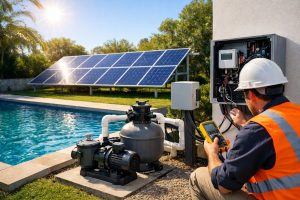
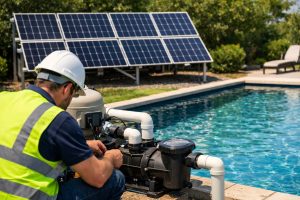
A dedicated system uses a special DC (Direct Current) pool pump.
This pump connects directly to a small set of 4 to 6 solar panels.
It operates completely independently from the electrical grid.
When the sun shines, the panels generate electricity, and the pump runs.
This creates a simple and self-sufficient system for your pool's circulation.
Many homeowners find this appealing because it completely eliminates the pump's running costs from their utility bill.
Furthermore, because these panels are not connected to the grid, you often don't need permission from your utility company to install them.
This can be a huge advantage in areas with strict regulations on grid-connected solar capacity.
However, this approach requires you to purchase a new DC pool pump, which is an added initial cost.
Another consideration is energy waste.
If the panels produce more power than the pump needs, that excess energy is lost.
It cannot be used by other appliances in your home.
The system's performance is also entirely dependent on immediate sunlight.
On cloudy days, the pump may not run long enough unless you oversize the solar array.
Option 2: Integrated Grid-Connected System
This is the most common and efficient method.
You install a standard solar panel system on your home (typically 6kW or larger).
This system powers your entire house, including your existing AC (Alternating Current) pool pump.
You simply set your pump's timer to run during peak sunlight hours, usually from 10 am to 3 pm.
The main advantage is efficiency.
All the solar energy your panels produce is used effectively.
If your pool pump isn't running, the power is used by other appliances like your air conditioner or refrigerator.
If you still have excess power, it gets exported to the grid, earning you a feed-in tariff credit on your bill.
This method requires no changes to your existing pool pump or plumbing.
The primary downside is that on very overcast days, your pump might draw some power from the grid, incurring a small cost.
You also need sufficient roof space for a larger solar array.
This system is subject to your local utility's rules about grid-connected solar, which can sometimes limit the total size you can install.
| Feature | Dedicated Off-Grid System | Integrated Grid-Connected System |
|---|---|---|
| Pump Type | Requires a new DC pool pump. | Uses your existing AC pool pump. |
| Grid Connection | No connection; independent. | Fully connected to the grid. |
| Energy Use | Only powers the pump; excess energy is wasted. | Powers entire home; excess is used or exported. |
| Installation | Simpler wiring but requires a new pump. | More complex system but uses existing pump. |
| Utility Approval | Usually not required. | Required; subject to grid limitations. |
| Initial Cost | Cost of panels plus a new ~€500-€900 DC pump. | Cost of a full home solar system. |
| Cloudy Day Power | Pump runs slower or stops. | System can draw from the grid to supplement. |
| Best For | Small systems, strict grid rules, or limited roof space. | Most homeowners seeking maximum efficiency and savings. |
How Many Solar Panels Are Needed to Run a Pool Pump?
Unsure how many panels you'll actually need?
Estimating wrong could leave your pump underpowered or mean you overspend on your system.
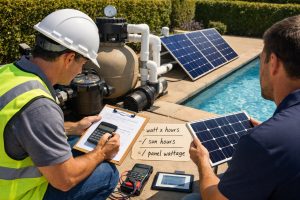
A typical 1.5 HP pool pump requires about 1.85 kW of solar power.
Using standard 370-watt panels, you would need to install 5 solar panels to run your pump effectively, accounting for natural efficiency losses.
Calculating the right number of panels is a straightforward process based on simple math.
It ensures your investment is sized correctly from the start.
Following a few simple steps, you can determine the exact requirements for your specific pump and location, guaranteeing a reliable and efficient solar-powered pool.
Step 1: Calculate Your Pump's Energy Use
First, you need to know how much energy your pump consumes.
This information is usually on the pump's label, often listed in horsepower (HP).
You must convert HP to watts to calculate energy usage.
The conversion is simple: 1 HP equals 745.7 watts.
So, a common 1.5 HP pump uses approximately 1,119 watts (1.5 HP x 745.7).
Next, determine how many hours per day your pump runs.
Let's assume it runs for 8 hours.
To find the total daily energy consumption in watt-hours, multiply the wattage by the hours.
Daily Energy = 1,119 watts × 8 hours = 8,952 watt-hours (Wh)
This is equal to about 8.95 kilowatt-hours (kWh) per day.
This number is the foundation for all further calculations.
Step 2: Find Your Location's Peak Sun Hours
"Peak sun hours" is a critical metric for sizing any solar system.
It does not mean the number of daylight hours.
Instead, it refers to the average number of hours per day when the sun's intensity is at its peak (1,000 watts per square meter).
This value changes based on your geographical location and the time of year.
For example, a sunny location like Arizona might get over 6 peak sun hours daily.
A location in the northern United States or Europe might only get 4 peak sun hours.
You can find this data from online solar resources or government meteorological websites.
Knowing your local peak sun hours is essential for calculating how much energy a solar panel can realistically generate each day.
Using an incorrect value can lead to a system that is either too small and ineffective or too large and expensive.
Step 3: Account for System Inefficiencies
No solar system is 100% efficient.
Energy is always lost during the conversion process from sunlight to usable electricity.
Several factors contribute to these losses.
These include the wiring, the inverter's efficiency, dirt or dust on the panels, and heat.
As panels get hotter, their performance slightly decreases.
Industry standard is to add a buffer of about 15-25% to your calculated energy needs to compensate for these real-world losses.
This ensures your system will still meet your pump's power requirements, even on very hot days or when the panels are not perfectly clean.
For our example, let's use a 25% buffer.
Adjusted Energy Need = 8.95 kWh × 1.25 = 11.19 kWh
This new total is the amount of energy your solar panels must generate daily.
Step 4: Calculate the Number of Panels
Now you can determine the final number of panels.
First, calculate the required solar system size in kilowatts (kW).
Divide your adjusted daily energy need by your location's peak sun hours.
Let's assume your location gets 5 peak sun hours.
System Size (kW) = 11.19 kWh ÷ 5 hours = 2.24 kW
This means you need a solar array with a total capacity of 2.24 kW.
The last step is to divide this system size by the wattage of a single solar panel.
Modern solar panels typically range from 350 to 450 watts.
Let's use a 400-watt (0.4 kW) panel for this calculation.
Number of Panels = 2.24 kW ÷ 0.4 kW/panel = 5.6 panels
Since you cannot install a fraction of a panel, you must round up to the next whole number.
In this case, you would need to install 6 solar panels to reliably power your 1.5 HP pool pump.
What Type of Pump Motor is Best for Solar?
Is your current pump motor ready for solar?
Using an inefficient motor can waste the valuable solar energy you generate, increasing the number of panels you need.
A Brushless DC (BLDC) permanent magnet motor is the most efficient option for solar applications.
These motors convert over 90% of electrical energy into mechanical power, significantly reducing the overall solar panel and operating costs compared to standard AC motors.
The motor is the heart of your solar pump system.
Its efficiency directly determines the overall performance and cost-effectiveness of your investment.
Understanding why a BLDC motor is superior will help you appreciate the long-term value it provides, from lower installation costs to decades of maintenance-free operation.
High-Efficiency BLDC Motors
The core of a modern solar water pump is its motor.
The most advanced systems use a Brushless DC (BLDC) permanent magnet motor.
These motors are engineered for maximum efficiency.
They often achieve efficiency ratings of over 90%.
This is a significant improvement compared to traditional AC motors, which can have efficiencies as low as 60-70%.
The high efficiency comes from the motor's design.
It uses powerful permanent magnets (like neodymium iron boron) and eliminates friction-causing brushes.
This means more of the solar electricity is converted directly into the work of pumping water.
A more efficient motor requires less power to do the same job.
This directly translates to needing fewer solar panels, which lowers the entire system's initial cost by up to 25%.
The compact design also makes them lighter and easier to install.
Matching Pump Types to Your Needs
The motor drives the pump, but different pump mechanisms are suited for different jobs.
For solar applications, there are three main types, each powered by the same efficient BLDC motor.
- Solar Screw Pump: This pump is ideal for deep wells where you need to lift water from great depths. It provides lower flow but very high pressure, or "head." It is also highly resistant to sand and sediment.
- Solar Plastic Impeller Pump: This is a great all-around choice for farm irrigation or filling large tanks. It is a multi-stage centrifugal pump that delivers high flow rates at a medium head. Its plastic impellers are durable against fine sand and make the pump lightweight and affordable.
- Solar Stainless Steel Impeller Pump: For water that is corrosive or has a high mineral content, this is the premium option. The stainless steel components resist corrosion and ensure a very long service life, making it perfect for challenging water conditions or high-end applications.
The Role of an Intelligent Controller
A solar pump system isn't just panels and a pump.
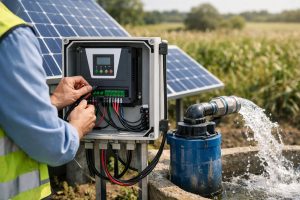
It includes a crucial third component: the MPPT controller.
MPPT stands for Maximum Power Point Tracking.
This smart device acts as the brain of the system.
It constantly adjusts the electrical load to ensure the solar panels are operating at their peak efficiency, regardless of changing sunlight conditions.
An MPPT controller can boost the system's output by up to 30% compared to a system without one.
This means you get more water pumped for every hour of sunlight.
Some advanced controllers also offer hybrid functionality.
They can be connected to both solar panels and an AC power source (like the grid or a generator) simultaneously.
The controller will prioritize using free solar energy.
If the sunlight fades, it automatically supplements with or switches to AC power.
This ensures you have a reliable water supply 24/7, which is critical for livestock or essential home use.
Can Solar Panels Also Heat My Pool?
Want to both power your pump and heat your water with solar?
Many people wonder if the same system can do both jobs, but this is a common point of confusion.
No, the solar photovoltaic (PV) panels that generate electricity for your pump cannot also heat your pool water.
Heating requires a completely different technology called a solar thermal collector, which absorbs heat, not light.
Understanding the difference between these two distinct solar technologies is key.
While both use the sun's energy, they serve entirely different purposes and cannot be combined into a single panel.
Let's clarify how each system works and what's required for a complete solar-powered and solar-heated pool.
Solar Photovoltaic (PV) for Electricity
Solar panels used to power a pool pump are photovoltaic, or PV, panels.
Their job is to convert sunlight directly into electricity.
These are the same panels you would install on your roof to power your entire home.
They are made of silicon cells that create an electric current when exposed to photons from the sun.
This electricity then runs the pump's motor.
While these panels do get hot in the sun, that heat is an unwanted byproduct.
In fact, excessive heat slightly reduces their efficiency in producing electricity.
They are not designed in any way to transfer that heat to water.
Solar Thermal Collectors for Heat
A solar pool heater is a much simpler and different technology.
It is a "solar thermal" system.
These systems consist of a series of tubes, often made of black plastic or rubber, inside a collector panel.
Your pool pump circulates pool water through these small tubes.
The black material is designed to absorb as much of the sun's heat as possible.
This heat is transferred directly to the water flowing inside.
The warmed water is then returned to the pool, gradually raising its temperature.
These systems are highly effective and can be one of the most cost-effective uses of solar energy.
They are much cheaper to install than a PV system of the same physical size.
Sizing a Solar Heating System
Sizing a solar thermal system is different from sizing a PV system.
It is based on the surface area of your pool, not the pump's wattage.
A general rule of thumb is that the total surface area of your solar thermal collectors should be between 50% and 100% of your pool's surface area.
For example, a 16-by-32-foot pool has a surface area of 512 square feet.
You would need between 256 and 512 square feet of solar collectors to heat it effectively.
Factors like your climate, desired pool temperature, and whether you use a pool cover will influence the final size.
Using a pool cover is highly recommended.
It dramatically reduces heat loss from evaporation overnight, which means your solar heater has to do less work each day.
This can reduce the required collector size by as much as 40%.
Conclusion
Powering your pool pump with solar is a smart investment.
It cuts your electricity costs and reduces your environmental impact.
Whether through a dedicated or integrated system, the savings are significant.
FAQs
How long do solar pool pumps last?
A high-quality solar pool pump system can last for decades.
The solar panels are typically warrantied for 25 years, and a brushless DC motor can operate for over 10 years without maintenance.
Can a solar pool pump run at night?
No, a standard solar pump only runs when there is sunlight.
For nighttime operation, you would need a system with battery storage or a hybrid controller connected to the grid.
Do solar panels need direct sunlight to power a pool pump?
Yes, they need direct sunlight for full power.
The pump will run slower on overcast or cloudy days and will not run at all if there is not enough light.
Is it worth getting a solar cover for my pool?
Absolutely.
A solar cover is one of an essential part of the swimming pool.
It reduces water evaporation, chemical use, and heat loss, saving you money and complementing a solar heating system perfectly.
Can you run a variable speed pump on solar?
Yes, variable speed pumps are excellent for solar.
They can adjust their speed to match the available solar power, running slower in low light and faster in full sun, maximizing efficiency.
What maintenance does a solar pool pump require?
Solar pump systems require very little maintenance.
You should keep the solar panels clean and check the pump's strainer basket regularly, just like with a conventional pump. The motor itself is typically maintenance-free.