Struggling with high electricity bills or unreliable water in off-grid areas?
A solar pump offers a powerful solution, but the initial investment can seem complex.
A complete 4 HP solar water pump kit, including the pump, motor, controller, and solar panels, typically costs between $3,500 and $6,000.
This price varies significantly based on well depth, required flow rate, component quality, and system features like AC/DC hybrid capability.
This initial cost seems high, but understanding the components and long-term savings reveals its true value.
A 4 HP pump is a significant investment designed for demanding applications like large-scale irrigation or deep well water supply for entire communities.
Breaking down the price helps you see why quality components are essential for a reliable, long-lasting system that eliminates future operational costs.
Let's explore the factors that determine the final price tag.
Why Do Solar Pump Prices Vary So Much?
Confused by the huge price differences between a $500 pump and a $5,000 system?
You're not alone.
The quality of core components dictates cost, performance, and longevity.
A 4 HP solar water pump system's price is a comprehensive sum of its essential parts.
The pump itself, the high-efficiency motor, the intelligent controller, and the required number of solar panels all contribute to the final cost.
The quality of these components is the primary reason for price variation.
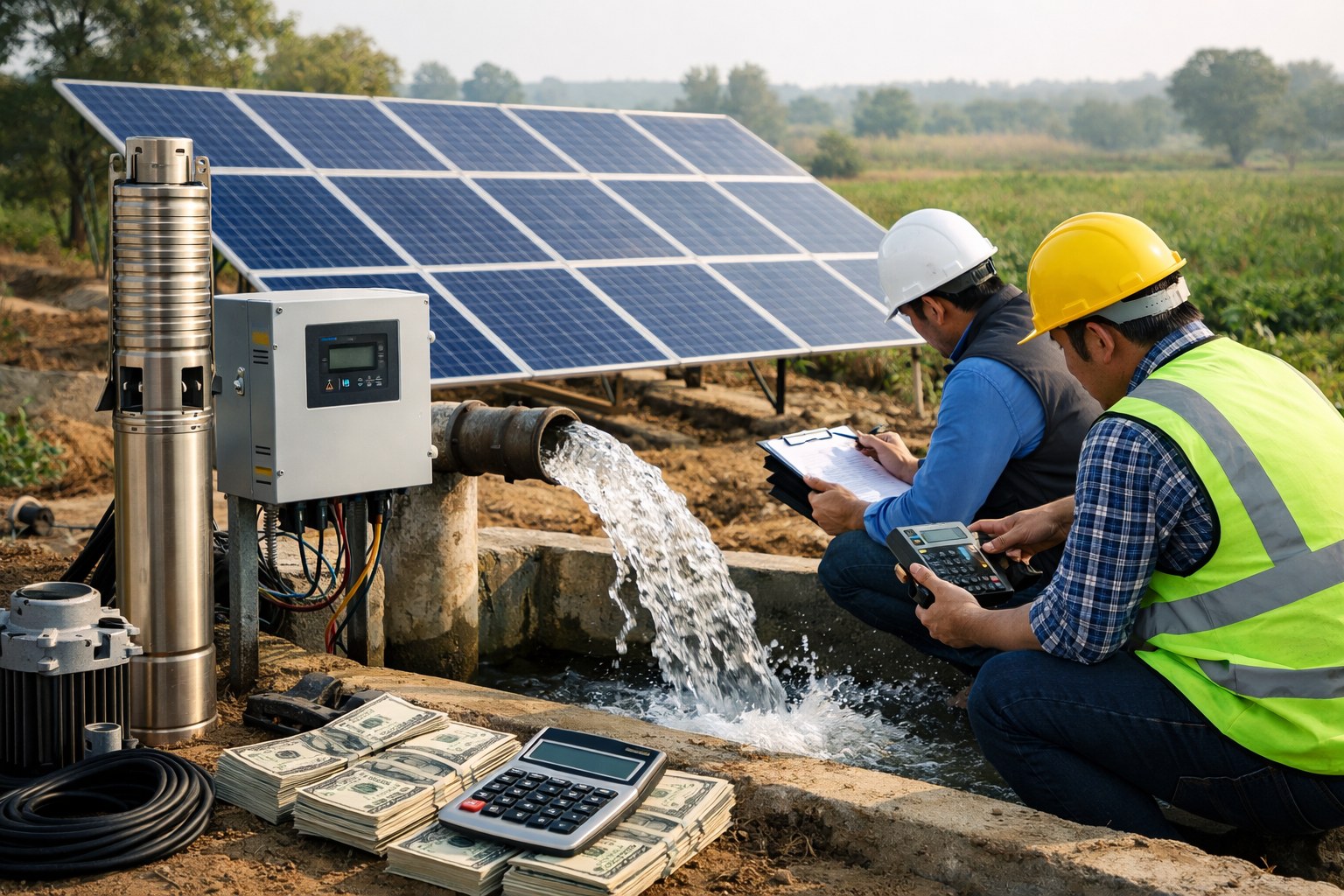
The initial cost may seem high, especially when compared to cheap online listings.
However, a professional-grade system is engineered for durability and efficiency, often lasting over a decade with minimal maintenance.
This contrasts sharply with low-cost "trash pumps" that use inferior materials, such as brushed motors and plastic parts, leading to failure within 6 to 12 months.
Investing more upfront in a system with a high-efficiency brushless motor and robust construction means you avoid the recurring costs of replacement and the frustration of system downtime.
Let’s dive deeper into the specific components.
Core Component Quality
The heart of the system's cost and reliability lies in its internal components.
A high-quality 4 HP solar pump utilizes a Brushless DC (BLDC) permanent magnet motor, which can have an efficiency of over 90%.
These motors use powerful rare-earth magnets (like Neodymium Iron Boron) and are significantly more compact and lightweight than traditional motors.
This high efficiency means you need fewer solar panels to achieve the same water output, reducing the overall system cost by 15-20%.
In contrast, cheaper pumps use brushed motors.
The brushes are designed to wear down like a pencil nib, and once they're gone, the entire motor is useless and must be replaced.
The Pump End and Materials
The pump end mechanism is another critical factor.
- Stainless Steel Impeller Pumps: These are ideal for high flow rates and offer superior resistance to corrosion. Though they have a higher initial cost, their long service life in demanding water conditions provides excellent long-term value.
- Plastic Impeller Pumps: These offer a great balance of high flow and wear resistance against fine sand. They are a more economical choice for agricultural irrigation where water quality is not corrosive.
- Screw Pumps: Designed for high head and low flow, these are perfect for deep wells. Their sand-resistant design ensures reliability in challenging environments.
A 4 HP pump designed for a deep well (e.g., over 600 feet) will naturally cost more than one designed for a shallow well due to its more robust construction.
The Role of the Controller
Finally, the controller adds to the cost but also to the system's intelligence and efficiency.
A standard MPPT (Maximum Power Point Tracking) controller maximizes the power drawn from the solar panels, increasing water output by up to 30% compared to systems without one.
More advanced AC/DC hybrid controllers allow the pump to be powered by the grid or a generator when sunlight is insufficient.
This dual-power capability adds to the upfront cost but ensures a 24/7 water supply, making it a valuable feature for critical applications.
| Component | Professional-Grade System | Low-Cost System | Impact on Performance & Cost |
|---|---|---|---|
| Motor | Brushless DC (BLDC) >90% Efficiency | Brushed Motor <60% Efficiency | Higher efficiency reduces panel needs; longer lifespan (10+ years vs. <1 year). |
| Pump End | Stainless Steel or High-Grade Plastic | Low-Grade Plastic | Better resistance to corrosion and wear; suitable for deeper wells and higher pressures. |
| Controller | MPPT and/or AC/DC Hybrid | Basic On/Off Switch | Maximizes solar energy use by up to 30%; provides backup power options. |
| Warranty | Comprehensive 2-3 Year Warranty | Limited or "Fake" Warranty | Protects investment and ensures manufacturer support. |
What Types of 4 HP Solar Pumps Are Available?
Choosing a pump is not a one-size-fits-all decision.
The right choice depends on your specific needs for water volume (flow) and pumping height (head).
For a 4 HP system, you will typically choose between a centrifugal pump for high flow or a screw pump for high head.
Each type is designed for different applications, from large-scale farm irrigation to supplying water from extremely deep wells where pressure is paramount.
Understanding the distinction between these pump types is crucial for optimizing your water system.
A 4 HP centrifugal pump uses multi-stage impellers (either stainless steel or high-grade plastic) to move large volumes of water, making it perfect for irrigating fields or filling large reservoirs quickly.
It excels in applications where flow rate is more critical than extreme depth.
Conversely, a 4 HP screw (or progressing cavity) pump uses a helical rotor inside a rubber stator.
This mechanism acts like a screw, pushing slugs of water upward under immense pressure.
This design makes it the undisputed champion for deep-well applications, capable of lifting water from depths that centrifugal pumps cannot reach, albeit at a lower flow rate.
Let's break down the ideal use cases for each.
Centrifugal Pumps: For High Volume Needs
A 4 HP centrifugal solar pump is the workhorse of modern agriculture and large-scale water supply.
Its design is optimized for moving massive amounts of water at low to medium heads.
- Stainless Steel Impeller: This is the premium option. Its key advantage is superior corrosion resistance, making it essential for regions with acidic or alkaline water. It offers the longest service life and highest reliability, perfect for high-end residential water systems, commercial operations, and areas with known water quality issues. While it carries a higher price tag, its durability justifies the investment.
- Plastic Impeller: This model provides a cost-effective alternative without sacrificing performance in the right conditions. The engineered plastic is highly resistant to abrasion from sand and silt, which can quickly wear down metal components. This makes it an excellent choice for farm irrigation or livestock watering in areas with sandy wells. It is lightweight and more economical, providing a great return on investment for high-flow applications.
A 4 HP centrifugal pump can deliver flow rates exceeding 100, 200, or even 400 gallons per minute (GPM), depending on the total dynamic head.
This makes it ideal for flood irrigation, center-pivot systems, or rapidly filling large storage tanks.
Screw Pumps: For Extreme Depth
When your well is exceptionally deep (e.g., 600 to 1,100 feet), a 4 HP screw pump is often the only viable solution.
The centrifugal design loses efficiency dramatically at such depths, but the screw pump's positive displacement mechanism maintains consistent pressure.
Its primary characteristics are:
- High Head, Low Flow: It is engineered to push water from extreme depths but will deliver a lower GPM compared to a centrifugal pump of the same horsepower.
- Excellent Sand Resistance: The screw design can handle water with a higher concentration of sand and sediment without clogging or significant wear, a common failure point for other pump types in harsh well conditions.
- Applications: These pumps are vital for domestic water supply from deep aquifers, livestock watering in arid regions, and remote homes where drilling deep is the only option to reach water.
The choice rests on a simple trade-off: do you need more volume (gallons per minute) or more pressure to overcome depth (head)?
| Pump Type | Primary Advantage | Best Application | Flow Rate | Head (Depth) |
|---|---|---|---|---|
| Centrifugal (Stainless Steel) | Corrosion Resistance, Durability | High-end homes, corrosive water | High | Medium to High |
| Centrifugal (Plastic Impeller) | Wear Resistance, Cost-Effective | Farm irrigation, sandy wells | Very High | Medium |
| Screw (Progressing Cavity) | Extreme Depth Capability | Deep domestic wells (>600 ft) | Low | Very High |
How Does Well Depth Affect the 4 HP Pump Cost?
Your well's depth is the single most important factor determining the final cost of a 4 HP solar pump system.
Deeper wells require more power, more materials, and more robust equipment.
A 4 HP pump is already a powerful unit, typically reserved for wells deeper than 300 feet or for high-volume needs.
As the depth increases, the price of the system rises accordingly to handle the added physical and mechanical stress.
The cost escalates with depth for several clear reasons.
First, a pump engineered for a 1,000-foot well must be built to withstand immense water pressure, requiring a stronger, more durable pump body and motor housing.
Second, the system needs more solar panels to generate the extra energy required to lift water from such a great distance.
Third, the supporting a-gories—such as the heavy-duty drop pipe and the thicker gauge copper wiring needed to prevent power loss over long distances—add significantly to the total material cost.
Let's examine how these costs stack up as you go deeper.
Cost Breakdown by Well Depth
A 4 HP solar pump system is generally considered for wells in the "deep well" category.
The prices below are estimates for a complete kit, including the pump, motor, controller, and solar panels, but excluding panel mounting and installation labor.
- Deep Wells (300-600 feet): For wells in this range, you can expect the cost of a 4 HP system to be between $3,500 and $5,500. This system would be configured for either high flow rates at moderate depth or medium flow at greater depth. The number of solar panels required is substantial, typically ranging from 8 to 12 high-wattage panels.
- Very Deep Wells (600-1,100 feet): Once you venture past 600 feet, the engineering requirements become much more demanding. The cost for a 4 HP system capable of operating at these depths can increase to between $6,000 and $10,500 or more. This price jump reflects the need for a specialized high-head pump (likely a screw pump), more solar panels (potentially 12 to 16+ panels), and heavier-duty wiring and piping.
Installation Considerations for Deep Wells
Beyond the equipment cost, installing a pump in a very deep well is a more complex and expensive task.
For any well deeper than 400 feet, a professional installation team with a boom truck is typically required.
Here's why:
- Immense Weight: The combined weight of the pump, hundreds of feet of water-filled pipe, and heavy copper wiring can easily exceed several hundred pounds. Attempting to lower this by hand is not only impractical but extremely dangerous. A boom truck provides the necessary lifting power and control to lower the assembly safely.
- Specialized Equipment: Professionals use specialized clamps, safety lines, and reels to manage the pipe and wire, preventing catastrophic drops that could damage the pump or the well casing.
- Labor Costs: Hiring a team with a boom truck can add $1,000 to $3,000 or more to the total project cost, depending on your location and the well depth.
While a DIY installation is feasible for shallower wells, trying to save money on a deep well installation can lead to costly mistakes.
Protecting your significant investment in a 4 HP pump system by hiring professionals is a wise decision.
What's Included in a 4 HP Solar Pump Kit?
When you see a price for a "solar pump kit," it's crucial to understand exactly what you are getting.
A seemingly low price might hide the absence of essential components.
A complete, ready-to-install 4 HP solar water pump kit should provide everything you need to get water flowing, minus the solar panel mounting structure.
This ensures you have a fully compatible system engineered to work together seamlessly.
A truly comprehensive kit removes the guesswork from sourcing individual parts.
The manufacturer has already matched the pump's power requirements to the solar array's output and specified a controller that can handle the electrical load.
This bundling not only simplifies the purchasing process but also prevents compatibility issues that can plague a system built from mismatched components.
A typical 4 HP kit provides a direct-to-consumer value by eliminating a-gory markups from distributors and installers, passing those savings directly to you.
Let's look at the standard inclusions and the necessary extras.
Standard Kit Components
A professional-grade 4 HP kit is designed to be a near-complete solution.
Here is what you should expect to find included in the price:
- The Pump and Motor Unit: This is the core of the system. For a 4 HP model, it will be a robust submersible unit, either a centrifugal or screw pump, with an integrated high-efficiency brushless DC motor.
- Solar Panels: The kit should include the correct number and wattage of solar panels to fully power the 4 HP pump under average sunlight conditions. This could be anywhere from 8 to 16 panels, depending on their efficiency. High-efficiency bifacial panels, which capture light from both sides, are becoming more common in premium kits.
- The Solar Pump Controller: This is the brain of the operation. It will be an MPPT controller to maximize power from the panels. Premium kits may offer an AC/DC hybrid controller for 24/7 operation using grid or generator power as a backup.
- Essential Accessories:
- Solar Wiring: The MC4 extension cables needed to connect the solar panels to the controller.
- Splice Kit: A waterproof heat-shrink kit to connect the pump's motor cable to the main drop wire going down the well.
- Hose Barb Connectors: Fittings to connect the drop pipe to the pump outlet.
What Is Typically Not Included?
While kits are comprehensive, a few key items are almost always sold separately due to site-specific variations.
- Solar Panel Mounting: This is the most significant exclusion. The type of mount needed depends entirely on your installation site. Options range from simple roof mounts to ground-mounted pole top mounts. The cost can vary from $400 to $2,000+ depending on the size of the solar array and the complexity of the mount.
- Well Pipe (Drop Pipe): The pipe that goes down the well to carry the water is not included. Its length is determined by your well depth, and the material (e.g., poly pipe, PVC) may depend on local codes and preferences.
- Submersible Drop Cable: The main electrical cable running from the pump up to the surface. The required length and gauge depend on the well depth and pump's power draw. A 4 HP pump at depth requires a very thick, and therefore expensive, copper cable.
- Pitless Adapter: A fitting used in cold climates to route the pipe underground below the frost line, preventing it from freezing in winter.
When comparing prices, always verify the exact contents of the kit to ensure you are making an accurate, apples-to-apples comparison.
Conclusion
The cost of a 4 HP solar pump system is a long-term investment in water independence, with prices reflecting the quality, depth rating, and included components of the chosen package.
FAQs
How many solar panels are needed to run a 4 HP pump?
A 4 HP pump typically requires between 2,500 and 3,500 watts of solar power.
This translates to roughly 8 to 12 solar panels of 300-400 watts each.
Can a 4 HP solar pump run at night?
Not on solar power alone.
To run at night, you need a system with an AC/DC hybrid controller connected to the grid or a generator, or a battery bank.
How long do solar water pumps last?
A high-quality solar water pump with a brushless motor can last 10 to 20 years.
Cheaper pumps with brushed motors may only last 6 to 12 months.
What is the maintenance on a solar water pump?
Solar pump systems are very low maintenance.
The primary tasks are to periodically clean the solar panels and check the wiring connections, with no ongoing fuel or electricity costs.
Can solar pumps be used in cloudy weather?
Yes, solar pumps can operate on cloudy days, but their performance (flow rate) will be reduced.
An MPPT controller helps maximize output in low-light conditions.
What is the difference between a DC and an AC/DC solar pump?
A DC pump runs only on solar power or batteries.
An AC/DC hybrid pump can automatically switch between solar power and an AC source like the grid or a generator.
Is a 4 HP pump overkill for a home?
For a single home, a 4 HP pump is usually excessive unless the well is extremely deep (over 600 feet).
Smaller 1-2 HP pumps are often sufficient.
How deep can a 4 HP pump push water?
A 4 HP solar pump, particularly a screw pump model, can push water from depths of over 1,000 feet, making it suitable for very deep well applications.