Struggling with water management on a massive scale?
Ordinary pumps can't handle extreme flooding or protect entire cities.
Discover the engineering marvels that move rivers of water in seconds.
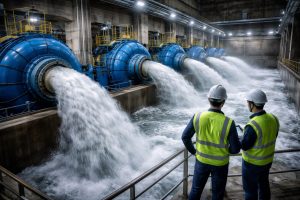
**The world's largest water pumps are mega-pumps like those at the IJmuiden Pumping Station in the Netherlands.
These giants, with impellers four meters in diameter, can move 50,000 liters of water every second.
They are essential for protecting low-lying regions from
catastrophic flooding.**
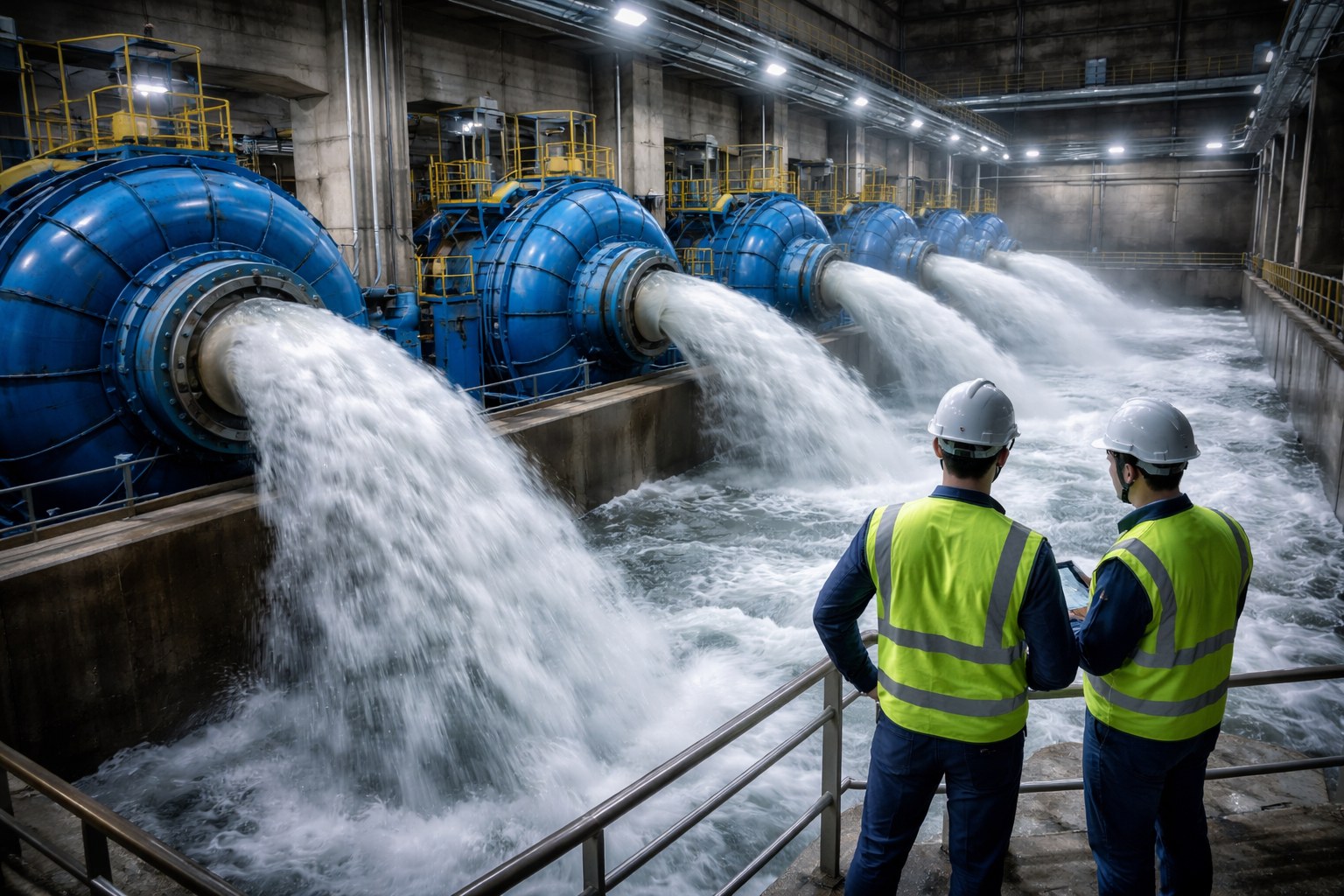
The scale of these mega-pumps is truly astonishing.
They represent the peak of hydraulic engineering, capable of shifting volumes of water equivalent to draining an Olympic swimming pool in under a minute.
But the technology that powers these titans is not locked away in top-secret facilities.
The same fundamental principles are scaled down and refined to solve water challenges everywhere, from large farms to individual homes in remote areas.
This article will explore these mega-pumps and then connect their incredible power to the efficient, practical solutions available for today’s water needs, particularly in regions relying on sustainable energy.
We will see how advanced motor technology and intelligent design are making reliable water access a reality for everyone.
Pumping Titans: The Largest Water Pumps in the World
Facing the threat of rising sea levels and extreme weather?
Protecting cities requires moving water on an unimaginable scale.
These engineering giants are the frontline defense for millions of people worldwide.
The titans of water movement are colossal pumping stations designed to drain swimming pools in seconds and hold back storm surges.
From the Netherlands to New Orleans, these mega-pumps are indispensable for the survival of the world's most vulnerable regions, especially in a changing climate.
These mega-pumps are more than just large machines.
They are integrated systems of civil engineering, advanced hydraulics, and powerful motors.
Each project is custom-designed to address a specific, life-threatening challenge.
Some prevent coastal flooding during hurricanes, while others manage inland river levels to protect agricultural land.
These systems operate on a scale that dwarfs anything in commercial or industrial use.
For example, the power required to drive a single one of these pumps can exceed 5,000 horsepower, equivalent to the combined power of over 30 high-performance sports cars.
The water they move is measured not in liters per minute, but in cubic meters per second (m³/s), where one cubic meter is 1,000 liters.
Let's examine some of the most powerful pumping stations on the planet to understand their function and staggering capabilities.
Their success demonstrates how targeted engineering can conquer even the most daunting water management problems.
The Engineering Behind the Giants
Mega-pumps rely on a few core designs, primarily axial flow and centrifugal pumps, but scaled up to an enormous size.
- Axial Flow Pumps: These are ideal for high-volume, low-pressure applications.
They function like a propeller in a tube, moving vast quantities of water with a relatively low lift.
This design is perfect for draining large, low-lying areas into an adjacent sea or river, where the height difference is minimal.
The pumps at many large drainage stations are of this type. - Centrifugal Pumps: These use a spinning impeller to throw water outwards by centrifugal force, converting rotational energy into hydrodynamic energy.
They are better suited for applications requiring higher pressure or "head," such as lifting water over tall flood barriers. - Power Source: The motors driving these pumps are massive.
They can be electric motors with power ratings in the megawatts or enormous diesel engines, often chosen for their reliability during power outages caused by storms.
The efficiency of these power systems is critical, as operating costs can be substantial.
The true marvel is how these components are integrated into a cohesive defense system.
This includes massive floodgates, extensive canal networks, and sophisticated control centers that monitor water levels and weather forecasts in real-time to activate the pumps precisely when needed.
IJmuiden Pumping Station (Netherlands) – Europe’s Giant Flood Control Pump
Is your region constantly threatened by water?
The Netherlands, largely below sea level, faces this daily.
They built a system so powerful it holds a world record for flood control.
Gemaal IJmuiden is one of the world's most powerful flood control facilities.
Its six enormous pumps, including two "super pumps" that can each move 50,000 liters per second, protect the western Netherlands by pumping excess water from canals into the North Sea.
The IJmuiden pumping station is a masterpiece of water management, critical to the survival of the Netherlands.
A significant portion of the country lies below sea level, making it exceptionally vulnerable to flooding from both the sea and overflowing rivers.
The station's primary role is to maintain safe water levels in the North Sea Canal, which is a vital waterway for Amsterdam and the surrounding regions.
Why Such a Huge Pump System is Needed
The Netherlands has a long history of battling the water.
Without active water management, large parts of the country would be uninhabitable.
The IJmuiden station pumps approximately 1 billion cubic meters of water into the sea each year.
This prevents the intricate network of canals and polders (reclaimed land) from overflowing due to heavy rainfall and river discharge.
The two largest pumps at the station are particularly noteworthy.
Each one has specifications that are difficult to comprehend.
- Flow Rate: 50 m³/s (50,000 liters per second) per pump.
- Impeller Diameter: 4 meters.
- Weight: Approximately 120 tons per pump unit.
- Height: Equivalent to a three-story building.
These pumps are so powerful that they earned a Guinness World Record.
They are driven by highly efficient permanent-magnet motors paired with variable-speed drives.
This advanced technology allows the operators to precisely adjust the pumping rate to match the exact amount of water that needs to be removed.
This not only improves efficiency but also reduces operational noise and wear on the equipment.
If these pumps were to be switched off during a period of heavy rain, water levels would quickly rise, threatening homes, infrastructure, and vast areas of valuable farmland across the western Netherlands.
Comparing Pumping Capacity
| To put the station's capacity into perspective, consider these figures: | Pump Station | Combined Flow Rate (m³/s) | Olympic Pools Drained Per Minute |
|---|---|---|---|
| IJmuiden (all pumps) | ~280 | ~6.7 | |
| IJmuiden (one super pump) | 50 | ~1.2 |
This immense power ensures that even during severe weather events, the water management system can cope with the influx and keep the country safe and dry.
The station stands as a testament to Dutch engineering and their ongoing commitment to water security.
West Closure Complex (New Orleans, USA) – World’s Largest Drainage Pump Station
Can a city survive a hurricane's storm surge?
After Hurricane Katrina, New Orleans needed an unprecedented solution.
They built the world's largest drainage pump station to protect its people.
The West Closure Complex (WCC) is the largest drainage pumping station globally.
It features 11 massive pumps capable of moving over 560 cubic meters of water per second (560,000 liters/sec), which is enough to empty two Olympic swimming pools in under a minute.
The construction of the West Closure Complex was a direct response to the devastating flooding caused by Hurricane Katrina in 2005.
This engineering marvel, a project costing over $1 billion, is a cornerstone of the post-Katrina hurricane and storm damage risk reduction system.
It is designed to protect the West Bank area of New Orleans from storm surges coming from the Gulf of Mexico via connecting waterways.
How it Works and Why it Matters
The WCC is a multi-layered defense system.
It includes a massive navigable floodgate that closes during a storm to block the surge.
However, closing the gate creates a new problem: trapping rainwater that falls inside the protected area.
This is where the pumps become critical.
The 11 mega-pumps are tasked with lifting this accumulated stormwater up and over the closed flood barrier, discharging it safely into the wetlands beyond.
Without these pumps, the city's West Bank would experience severe "back-end" flooding from rainfall, even with the levees holding strong against the ocean surge.
Each of the 11 vertical pumps is driven by a 5,400-horsepower diesel engine, ensuring they can operate independently of the electrical grid, which is likely to fail during a major hurricane.
The station's combined capacity is astounding.
- Total Flow Rate: Approximately 20,000 cubic feet per second (around 566 m³/s).
- Equivalent: Roughly 150,000 gallons per second.
The entire complex is built to withstand extreme conditions, including 100-year storm forces, high winds, and even collisions from stray barges.
It serves as a vital safety net that has already proven its worth in subsequent hurricanes, keeping communities dry and saving lives.
It powerfully illustrates the necessity of proactive, large-scale engineering in an era of increasing climate-related risks.
The WCC is not just a pump station; it is a symbol of resilience and a critical piece of infrastructure ensuring the future of New Orleans.
MOSE Project (Venice, Italy) – Giant Gates that “Pump Out” the Sea
How do you protect a sinking city built on water?
Venice faces constant flooding from high tides.
The MOSE Project is an ingenious solution that uses air to hold back the sea.
The MOSE Project is a system of 78 mobile floodgates that rise from the seabed to seal off the Venetian Lagoon from the Adriatic Sea.
While not traditional pumps, they use giant compressors to pump air into the gates, making them buoyant and creating a barrier.
Venice's flooding challenge, known as "acqua alta" (high water), is unique.
Periodic high tides, driven by wind and astronomical cycles, inundate the historic city, flooding St.
Mark's Square and damaging ancient buildings.
The MOSE Project is one of the largest civil engineering undertakings in history, designed to protect Venice from these damaging tides.
Protecting a City of Canals
The system consists of rows of hollow steel gates installed at the three inlets to the Venetian Lagoon.
Normally, these gates are filled with water and rest in housings on the seabed, completely invisible.
When a dangerously high tide is forecast (typically over 1.3 meters), the protection sequence begins.
- Air Injection: Huge compressors pump compressed air into the hollow gates.
- Water Expulsion: The air forces the water out of the gates, making them buoyant.
- Barrier Formation: The buoyant gates pivot on their hinges and rise above the sea's surface, forming a continuous barrier that temporarily separates the lagoon from the Adriatic Sea.
- Protection: With the inlets sealed, the high tide is held back, and the water level within the lagoon remains stable, keeping Venice dry.
- Lowering: After the tide recedes, the air is released, the gates fill with water again, and they sink back into their housings.
Think of it as a reverse pumping mechanism.
Instead of pumping water away, it pumps air to raise a barrier.
This massive system is designed to protect Venice from tides up to 3 meters high, far exceeding the devastating 1.94-meter flood of 1966.
It has become a critical tool for preserving the city's priceless cultural heritage.
Without MOSE, rising sea levels and more frequent storm surges would threaten to make large parts of Venice uninhabitable, turning its iconic squares and alleyways into permanent waterways.
Marina Barrage (Singapore) – Urban Flood Control and Water Supply
Can a dam in a city center provide clean water and flood protection?
Singapore's Marina Barrage does both.
Beneath its green park lies a powerful pumping station ready for monsoon season.
Marina Barrage contains seven powerful pumps, each capable of moving 40 cubic meters of water per second.
Together, they can discharge 280,000 liters every second from the reservoir into the sea, protecting Singapore's low-lying financial district from flooding during heavy rain.
Marina Barrage is a brilliant example of multi-purpose urban infrastructure.
Completed in 2008, it is a dam built across the Marina Channel, creating Singapore's first reservoir in the heart of the city.
It serves three main functions: water supply, flood control, and as a lifestyle and recreation venue.
A 3-in-1 Project
On a normal day, the barrage's nine crest gates remain closed, separating the freshwater of Marina Reservoir from the seawater.
This creates a stable source of freshwater for the city-state, which has historically been reliant on imported water.
The rooftop of the barrage building is a green park, popular for picnics and kite flying, offering stunning views of the city skyline.
However, its most crucial role becomes apparent during heavy monsoon rains.
- Flood Control Mechanism: During periods of heavy rainfall at low tide, the barrage's nine crest gates are opened to release excess stormwater into the sea by gravity.
- Pumping Power: If heavy rain coincides with high tide, the gates cannot be opened without letting seawater in.
This is when the seven giant pumps kick in.
Each pump is driven by a 1.6 MW motor, with a combined power equivalent to over 13,000 horsepower.
They pump the excess water from the reservoir directly into the ocean.
Before Marina Barrage, low-lying areas of Singapore like Chinatown and Orchard Road were prone to flash floods.
The barrage's pumping system now acts as a massive safety valve for the city's drainage network.
It can quickly evacuate huge volumes of stormwater, preventing overflows in rivers and canals and protecting the city’s valuable financial district and residential areas from costly flood damage.
The Pump House, a distinct building at the barrage, houses all seven of these massive pumps, ready to operate at a moment's notice.
From Mega-Pumps to Modern Solutions: How Do They Compare?
Need reliable water access without a billion-dollar budget?
The tech powering city-saving pumps is now available for your farm or home.
High-efficiency motors make sustainable water solutions a reality.
The same principles of moving water efficiently apply at every scale.
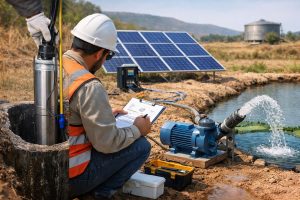
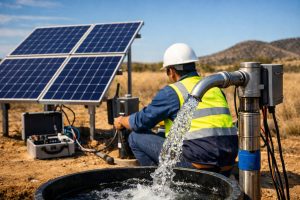
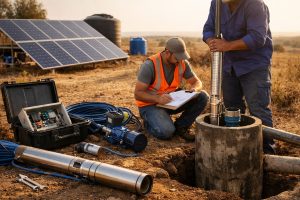
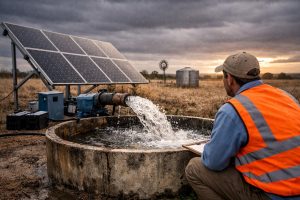
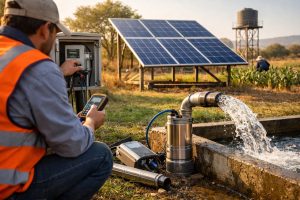
Advanced, high-efficiency brushless DC motors and intelligent controllers, similar to those in mega-projects but miniaturized, now power a range of solar pumps for agriculture, livestock, and domestic use, offering sustainable off-grid solutions.
The scale of mega-pumps is breathtaking, but their core purpose—moving water reliably and efficiently—is a universal need.
Thankfully, you don't need a city-sized budget to achieve this.
Modern solar water pumps leverage the same focus on efficiency and durability to provide solutions for a wide range of applications, especially in off-grid areas across Africa, the Americas, Australia, and Asia.
The innovation lies in the heart of the system: the motor.
The Power of High-Efficiency Motors
The true breakthrough in modern pumping is the adoption of Brushless DC (BLDC) permanent magnet motors.
These are the core technology driving a new generation of solar pumps.
- Exceptional Efficiency: BLDC motors achieve efficiencies of over 90%.
This is a significant improvement over traditional AC or brushed DC motors.
This high efficiency means that more of the sun's energy captured by the solar panels is converted into useful work—pumping water. - Reduced Costs: Higher motor efficiency directly translates to lower system costs.
Fewer solar panels are needed to achieve the desired water flow, reducing the initial investment by a significant margin. - Compact and Lightweight: These motors are remarkably compact and light for their power output.
A typical BLDC motor can be up to 47% smaller and 39% lighter than a conventional motor with the same power.
This simplifies transportation and installation, a crucial advantage in remote areas. - Durability and Reliability: With no brushes to wear out, BLDC motors are virtually maintenance-free and have a very long service life.
This reliability is essential for applications like livestock watering or community water supply, where downtime is not an option.
A Portfolio for Diverse Needs
| This advanced motor technology is integrated into a versatile product portfolio designed to meet specific water challenges, mirroring how mega-pumps are tailored to their environments. | Pump Type | Key Feature | Ideal Application | Performance |
|---|---|---|---|---|
| Solar Screw Pump | High Head, Sand Resistance | Deep wells, domestic water, livestock watering. | Low Flow | |
| Solar Plastic Impeller Pump | High Flow, Wear Resistance | Farm irrigation, pasture water supply, gardens. | Medium Head | |
| Solar SS Impeller Pump | Corrosion Resistance, Durability | Corrosive water, high-end homes, coastal ranches. | Medium-High Head |
This strategic portfolio allows distributors and end-users to select the perfect pump for their specific conditions—whether it's lifting water from a 200-meter deep well in Latin America or irrigating a farm in Africa.
Combined with intelligent MPPT (Maximum Power Point Tracking) controllers that optimize the solar energy input, these systems provide a robust, cost-effective, and environmentally friendly water solution.
For added resilience, hybrid AC/DC controllers allow the system to automatically switch to grid power or a generator during cloudy days or at night, ensuring a continuous, 24/7 water supply.
Conclusion
Mega-pumps show our ability to control water on a vast scale.
But true innovation lies in making efficient, reliable water solutions accessible to all, from farms to remote homes.
FAQs
What type of pump can lift water 500 feet?
A high-head pump, such as a multi-stage centrifugal or a screw pump, is needed to lift water 500 feet. The pump's horsepower and design must overcome this significant vertical distance.
What are the 3 main types of pumps?
The three main types of pumps are positive displacement pumps (like screw pumps), centrifugal pumps (which use an impeller), and axial-flow pumps (which act like a propeller in a pipe).
What pump has the highest flow rate?
Axial-flow pumps typically have the highest flow rates. They are designed to move very large volumes of water at low pressure, making them ideal for large-scale drainage and flood control.
Which is better, a centrifugal pump or a submersible pump?
It depends on the application. Submersible pumps are excellent for deep wells as they push water up. Centrifugal pumps are often used at the surface for boosting pressure or transferring water.
What are large pumps called?
Extremely large pumps used for municipal or major civil engineering projects, like flood control or water transport, are often referred to as mega-pumps or large-capacity pumps.
How much water can the largest pump move?
The largest pumps, like the "super pumps" at the IJmuiden station in the Netherlands, can each move 50,000 liters of water per second, or 50 cubic meters per second.
Why do some pumps use diesel engines instead of electric motors?
Pumps for critical flood defense often use diesel engines as a power source. This ensures they can operate reliably during a storm even if the main electrical grid fails.
Can solar pumps work on cloudy days?
Yes, but with reduced output. To ensure 24/7 operation, modern systems use smart hybrid controllers that can automatically switch to an AC power source or generator when solar energy is insufficient.