Worried that cloudy skies mean no water?
Your solar water pump system is more resilient than you think.
It is designed to deliver water even without direct sunlight.
**Yes, solar water pumps absolutely work on cloudy days.
Photovoltaic (PV) panels generate power from both direct and indirect sunlight.
While output is reduced, a modern system can still pump a significant amount of water, often 25-50% of its peak sunny-day capacity, ensuring you are never left dry.**
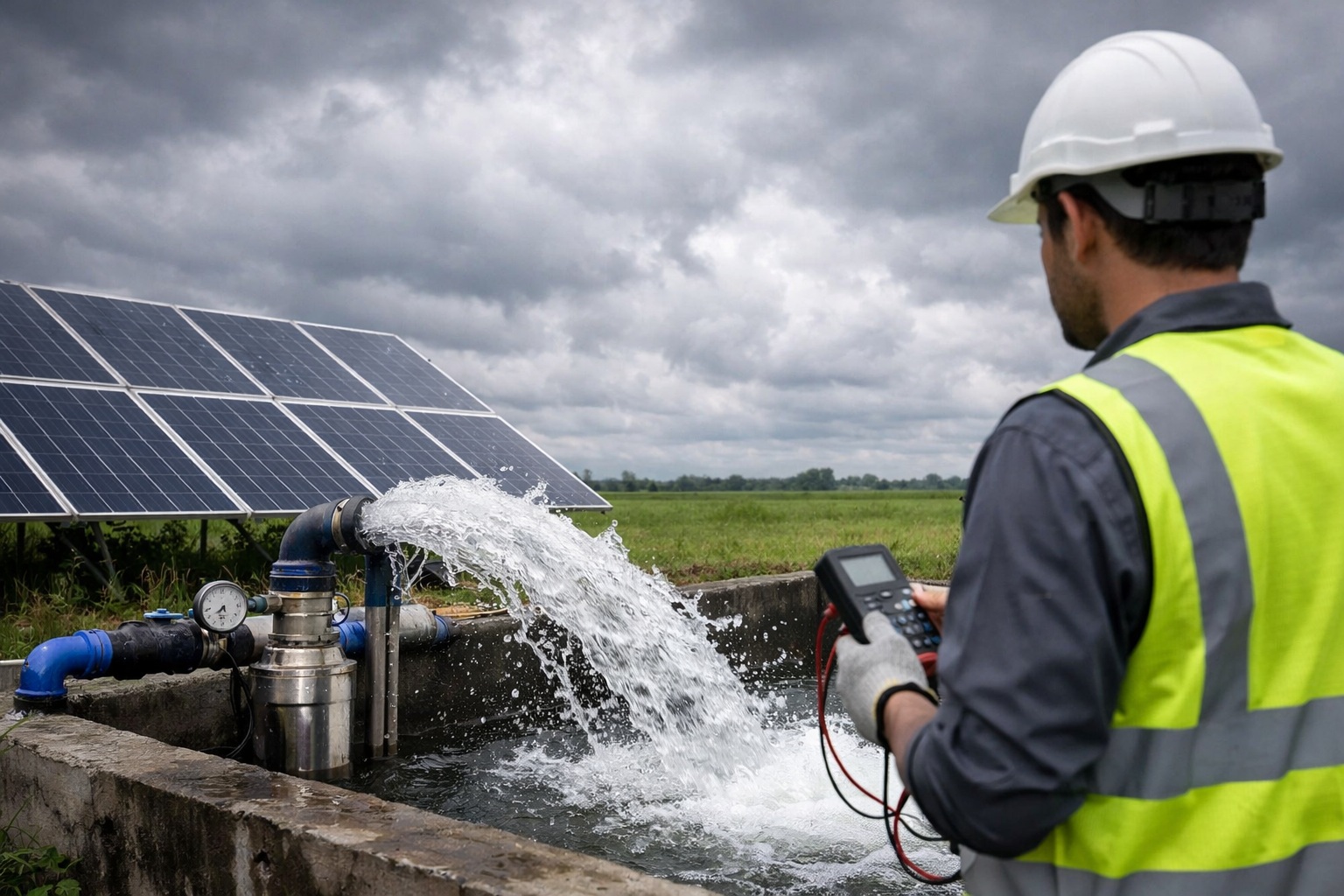
Getting access to water shouldn't depend on perfect weather.
Many people believe the myth that a single cloud can shut down a solar pump, leaving them without water when they need it most.
This can be a major concern for farmers, ranchers, and homeowners in off-grid locations who rely on a consistent water supply for their livelihoods and daily needs.
The truth is, solar pumping technology has advanced significantly.
Modern systems are engineered for reliability in a wide range of weather conditions, not just perfect sunshine.
This article will break down exactly how these systems continue to function when it's overcast, explore the different strategies and pump technologies available to guarantee water flow, and show you how to build a water system that provides true water security, 24/7.
We will explore the different types of pumps, the core motor technology driving them, and the smart control systems that make all-weather operation possible.
Will A Solar Pumps Still Run When It Is Cloudy Outside | Q&A With The Solar Water Pump Experts
Stressing that a few clouds will halt your water supply?
This is a common fear for those considering a switch to solar-powered water solutions.
**This is a myth.
High-quality solar pumps are designed to operate efficiently even on overcast or rainy days.
They use ambient light to continue pumping, albeit at a reduced flow rate.
You can expect your pump to deliver roughly 25% to 50% of its normal sunny-day output, depending on the cloud density.**
Let's dive deeper into how you can ensure a reliable water supply, regardless of the weather.
The key to water security isn't just about the pump itself, but about a well-designed system.
There are three primary strategies to ensure you have water whenever you need it.
1. Store Water, Not Just Power
The most effective and recommended strategy is to invest in water storage.
By pumping water into a large tank or cistern on sunny days, you create a buffer.
We advise storing a 3 to 5-day supply of water.
This approach is simple and highly reliable.
It means that during a stretch of several overcast days, you can simply use the water you've already collected.
This method avoids the complexities and maintenance costs associated with batteries and is perfect for applications requiring large volumes, like agriculture.
You use the sun's peak energy to build a reserve, then rely on gravity or a small pressure pump to distribute it.
This turns your entire system into a more passive and fail-safe operation.
2. Integrate a Battery Backup System
The second approach is to store electricity in batteries.
On sunny days, excess solar energy that isn't used for pumping can be stored in a deep-cycle battery bank.
When clouds roll in or at night, the pump's controller automatically draws power from the batteries to continue operating.
This provides on-demand water access at any time.
However, it's important to understand the limitations.
Batteries have a finite capacity and wear out over time, typically needing replacement every 5-10 years.
Once drained, they require several hours of good sunlight to recharge fully.
This option is often best for lower-volume domestic water applications where on-demand pressure is preferred over bulk storage.
3. Utilize a Hybrid AC/DC Power Input
The third and most versatile strategy is to use a hybrid system.
Most modern, high-quality solar pump controllers include an input for AC power from the grid or a generator.
Some advanced controllers can even blend power sources.
They will use all available solar power first and then supplement it with just enough AC power to meet the demand.
When solar is unavailable (at night or during heavy, prolonged storms), the controller can automatically switch over entirely to the AC source.
This AC/DC hybrid functionality offers the ultimate peace of mind, guaranteeing water 24/7/365.
It is an ideal solution for critical applications where water supply cannot be interrupted, combining the cost savings of solar with the reliability of a conventional power source.
What happens to solar panels when it’s cloudy or raining?
Think that clouds and rain make solar panels useless?
Many people incorrectly assume that without direct, bright sunlight, their investment in solar technology will yield no return.
**Solar panels still generate a significant amount of electricity on cloudy and rainy days.
PV cells can utilize both direct and indirect (diffused) sunlight.
Rain even helps by washing away dust and grime, which can improve panel efficiency by 3-5% over time.**
The performance of a solar panel is not an all-or-nothing affair.
It's a spectrum.
Let's break down how environmental conditions really affect your power generation.
Panel Performance in Different Weather
A solar panel's output is measured in watts, and its performance is rated under Standard Test Conditions (STC), which include bright sunlight.
However, real-world conditions vary.
-
Partly Cloudy: On a day with scattered clouds, panel output will fluctuate.
A high-quality MPPT (Maximum Power Point Tracking) controller is crucial here, as it constantly adjusts the pump's electrical load to extract the maximum possible power as the sunlight changes.
You might see output drop to 50-70% of peak during these moments. -
Overcast/Cloudy: On a fully overcast day, panels receive only diffused light.
The output will be lower, typically in the range of 10% to 30% of the panel's rated capacity.
For a 1,000-watt solar array, this still means 100 to 300 watts of usable power—often more than enough to run a solar pump at a reduced speed. -
Rain: Rain has a minimal negative impact on light levels beyond the effect of the clouds causing it.
In fact, the rain provides a free cleaning service.
Dust, pollen, and bird droppings can accumulate on panels, reducing their efficiency.
A good rainstorm can wash this debris away, restoring the panel to its peak operating potential.
The Importance of System Design
Knowing that panel output will decrease in cloudy weather is why proper system design is paramount.
An experienced engineer or supplier will not size your system based on perfect sunny conditions.
They will use a solar "irradiance map" for your specific location, which shows the average daily sunlight hours for each month of the year, including cloudy weather.
The system, especially the number of solar panels, will be designed to provide enough water to meet your daily average need even during the cloudiest months of the year, not just on the sunniest days.
This ensures that over the course of a day, even a cloudy one, you will pump enough water to fill your storage tank or meet your needs.
Pros and Cons of Solar Water Pumps
Considering a solar water pump but worried about the trade-offs?
It's easy to get stuck weighing the high initial cost against the promise of long-term savings and energy independence.
**The biggest pro is the elimination of ongoing energy costs and a massive reduction in maintenance.
The main perceived con, performance on cloudy days, is largely a myth with modern systems.
The upfront investment is paid back quickly through fuel and electricity savings, often within 1-3 years.**
Let's break down the real pros and cons to give you a clear, balanced picture for making your decision.
We will move beyond marketing claims to look at the practical realities of owning and operating a solar water pumping system.
Pro: Dramatically Lower Operating Costs
This is the most significant advantage.
Once your system is installed, the fuel is free.
The sun provides the energy.
This contrasts sharply with traditional pumping methods.
-
Grid Power: Electricity costs are constantly rising.
A solar pump frees you from unpredictable utility bills. -
Generators: Fossil fuel prices are volatile and have seen massive inflation.
Beyond the cost of diesel or gasoline, you also have the labor and travel time required to refuel the generator, which can be a major issue in remote locations.
A solar pump begins paying for itself from day one.
For agricultural or ranching operations, these savings can add up to thousands of dollars per year, dramatically improving your bottom line.
The return on investment (ROI) is often surprisingly fast.
| Pump Type | Upfront Cost | 5-Year Fuel/Grid Cost | 5-Year Maintenance | Total 5-Year Cost |
|---|---|---|---|---|
| Solar Pump | High | $0 | Low | High |
| Generator Pump | Medium | Very High | Medium | Very High |
| Grid Pump | Low | High | Low | High |
Note: Costs are relative and will vary based on system size, location, and local energy prices.
Con: Higher Upfront Investment
The initial purchase price of a complete solar water pumping system (pump, controller, solar panels) is typically higher than that of a conventional AC pump or a small generator.
This can be a barrier for some.
However, it's crucial to view this as a capital investment, not just an expense.
Many businesses find that financing options or government incentives for renewable energy can make this initial cost much more manageable.
When you calculate the total cost of ownership over 5 or 10 years, the solar pump almost always proves to be the most economical choice.
The system is designed to last for decades, with solar panels often warrantied for 25 years, meaning your free water continues long after the system has paid for itself.
Pro: Superior Reliability and Less Maintenance
Solar pumping systems are remarkably simple and robust from a mechanical standpoint.
-
Brushless Motors: High-quality solar pumps use brushless DC (BLDC) motors.
With no brushes to wear out, these motors are virtually maintenance-free and have service lives that are 30-40% longer than traditional AC motors or brushed DC motors. -
No External Fuel: You will never have a situation where your livestock are thirsty because you ran out of fuel or couldn't get to the gas station.
The system runs automatically every single day. -
Fewer Moving Parts: Compared to windmills, which have complex mechanical linkages, or generators with their internal combustion engines, a solar pump system is solid-state and far less prone to breakdowns.
The main maintenance is simply wiping down the solar panels a few times a year.
This reliability reduces labor, eliminates emergency repair trips, and provides peace of mind.
Choosing the Right Solar Pump for Your Needs
Don't know which solar pump fits your requirements?
With options from low-flow screw pumps to high-flow centrifugal models, choosing the wrong one can lead to poor performance and wasted investment.
**The key is to match the pump type to your specific water well conditions and application.
For deep wells and domestic use, choose a screw pump.
For farm irrigation, a plastic impeller pump is best.
For corrosive water, a stainless steel impeller is essential.**
The heart of any great solar water system is a pump that is perfectly suited to the job.
Understanding the fundamental differences in pump design is critical for distributors and end-users alike to ensure long-term satisfaction and performance.
Each type is engineered for a different balance of flow, pressure (head), and durability.
Let's explore the three main types of solar deep well pumps and the core technology that powers them.
1. The Deep Well Specialist: Solar Screw Pump
This type of pump is a positive displacement pump.
It uses a single helical rotor (the screw) that turns inside a flexible rubber stator.
This action creates sealed cavities that move water up the pipe.
-
Best For: High head, low flow applications.
This means it's excellent at pushing water up from very deep wells (up to 300 meters or more).
Its low flow rate makes it ideal for filling a storage tank for domestic water use or for watering livestock. -
Key Advantage: Incredible sand resistance.
The flexible stator can pass small solids and sand without being damaged, making it highly durable in wells that are not perfectly clean.
Its efficiency remains high even when pumping against extreme pressure. -
Market: Perfect for regions with deep water tables, such as parts of Africa, Latin America, and arid areas of Australia.
2. The High-Volume Workhorse: Solar Plastic Impeller Pump
This is a multi-stage centrifugal pump.
It uses a series of impellers and diffusers stacked on top of each other.
Each stage adds a little bit of pressure, and the design of the impellers allows for moving a large volume of water.
-
Best For: High flow, medium head applications.
This pump is the ideal choice for irrigation, moving large amounts of water to fields, or quickly filling large surface tanks and ponds. -
Key Advantage: High-volume output at an economical price.
The use of engineered wear-resistant plastic (like Noryl) for the impellers makes the pump lightweight and cost-effective while still offering good resistance to fine sand.
Its efficiency peaks when moving large quantities of water against moderate back-pressure. -
Market: Widely used for agriculture and general farm use in regions like the Americas and Africa.
3. The Premium Durability Option: Solar Stainless Steel Impeller Pump
This pump is structurally similar to the plastic impeller model but built with superior materials.
The impellers, diffusers, and pump body are all constructed from SS304 or even SS316 stainless steel.
-
Best For: High flow, high durability applications, especially in corrosive water.
This is the pump of choice for water with low pH (acidic) or high pH (alkaline), high salinity, or other chemical properties that would degrade lesser materials. -
Key Advantage: Maximum corrosion resistance and longevity.
While the upfront cost is higher, this pump offers the longest possible service life in harsh water conditions, ensuring reliability for high-end homes, critical mission applications, or in regions with known water quality issues like the alkaline soils in parts of Australia. -
Core Technology: The BLDC Motor: All three of these modern pump types are powered by a high-efficiency Brushless DC (BLDC) permanent magnet motor.
These motors achieve efficiencies of over 90%, compared to 60-70% for older motor types.
This means they convert more of the sun's energy into water movement, reducing the number of solar panels needed by up to 30%, which lowers system cost and simplifies installation.
They are also maintenance-free and have an exceptionally long lifespan.
Conclusion
A cloudy day does not mean a dry day.
With proper system design—incorporating water storage, batteries, or hybrid power—and the right pump technology, solar energy provides a truly reliable and cost-effective water solution.
FAQ
What is the best type of solar water pump?
There is no single "best" type. The best pump depends on your well depth, required water volume, and water quality.
How many solar panels do I need for a water pump?
This depends on the pump's power rating and your location's average daily sunlight. A professional sizing calculation is recommended for accuracy.
Can a solar water pump run at night?
Yes, if the system includes a battery bank to store energy or a hybrid controller connected to an AC power source.
How long do solar water pumps last?
A high-quality brushless pump can last over 10 years, while solar panels are often warrantied for 25 years of production.
Do solar pumps require a lot of maintenance?
No. The primary maintenance is to periodically clean the solar panels. The brushless motor itself is virtually maintenance-free.
Can a solar pump fill a pressure tank?
Yes, a solar pump can be connected to a standard pressure tank. A pressure switch is used to turn the pump on and off.