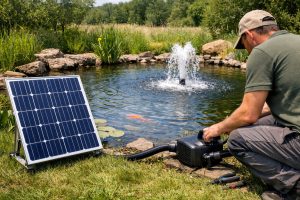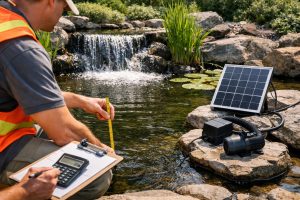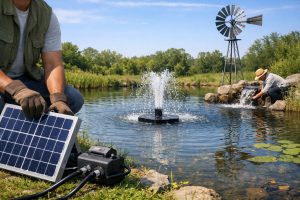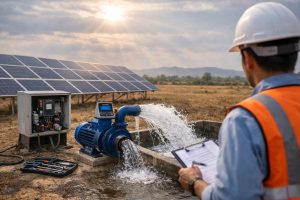
Struggling with high electricity bills or no grid access for your pond?
Imagine a vibrant, healthy water feature running silently and efficiently, powered entirely by the sun.
Yes, solar-powered pumps are an excellent solution for ponds and various other water needs.
They offer reliable, cost-effective, and environmentally friendly water circulation without relying on the power grid, making them perfect for remote locations and reducing energy expenses.
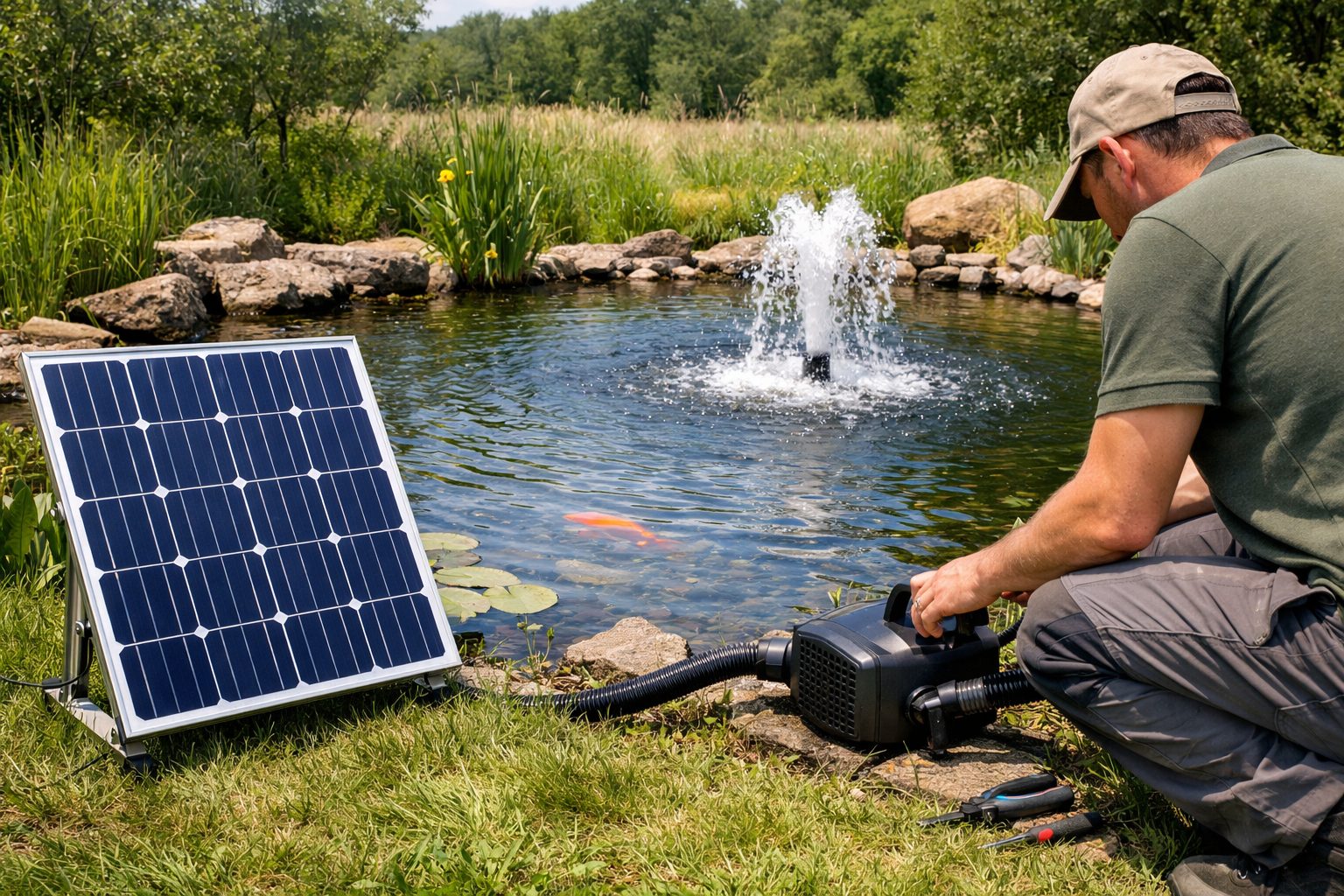
While many associate solar pumps with small garden fountains, the technology is far more robust and versatile.
The core principles that power a simple pond aerator are scaled up in advanced systems capable of drawing water from incredible depths for agriculture, livestock, and homes.
To truly understand their value, we need to look beyond the pond and dive into the powerful technology that makes these systems work.
Let's explore the different types of high-performance solar pumps that showcase just how capable this technology has become.
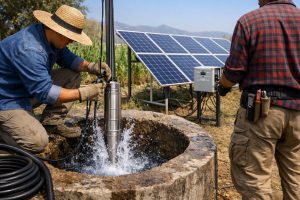
What About Pumping from Deep Water Sources? Explore the Solar Screw Pump.
Need to lift water from a deep well to supply your property?
Traditional pumps often struggle with high lift (head), consume excessive power, and can fail when dealing with sandy water.
Solar screw pumps solve this by excelling in high-head, low-flow situations.
Their unique design is perfect for drawing water from deep wells, and their incredible resistance to sand makes them highly reliable in challenging water conditions.
Solar screw pumps, also known as progressive cavity pumps, are true workhorses for deep-well applications.
They don't use impellers like many common pumps.
Instead, they feature a single helix-shaped stainless steel rotor (the "screw") that turns inside a double helix rubber stator.
This motion creates sealed cavities of water that are progressively pushed upwards.
The process is more about gentle, consistent displacement than high-speed centrifugal force.
This mechanical action allows the pump to build immense pressure.
It can effectively push a column of water from depths where other pumps would fail.
This makes them an indispensable tool in arid or geographically challenging regions.
Their performance is especially crucial in off-grid areas across Africa and Latin America.
How a Screw Pump Delivers Under Pressure
The core advantage is its ability to generate very high head.
This means it can lift water from wells that are hundreds of feet deep.
Another significant benefit is its remarkable sand resistance.
The rubber stator and steel screw can handle abrasive particles far better than the tight tolerances of a high-speed impeller.
Water sources with more than 50 grams of sand per cubic meter can quickly destroy other pumps, but a screw pump often handles it without issue.
Application and Performance Sweet Spot
These pumps are not designed for high-volume jobs like flood irrigation.
Their strength lies in providing consistent, reliable water for specific needs.
- Domestic Water Supply: Providing household water for homes far from municipal lines.
- Livestock Drinking Water: Ensuring remote troughs are always full for cattle, sheep, and other animals.
- Small-Scale Irrigation: Perfect for drip irrigation systems that require pressure but not massive flow rates.
| Feature | Solar Screw Pump |
|---|---|
| Best For | High Head, Low Flow |
| Sand Resistance | Excellent (Rated up to 2-3 times higher than centrifugal pumps) |
| Primary Mechanism | Progressive Cavity (Rotor/Stator) |
| Ideal Applications | Deep Domestic Wells, Livestock Watering |
| Key Limitation | Limited Flow Rate |
While their flow is limited, their efficiency in deep lift applications is unmatched, providing a lifeline where water is scarce and deep.
Need Higher Volume for Your Farm or Garden? Consider the Solar Plastic Impeller Pump.
Facing the challenge of irrigating a large farm or pasture without grid power?
You need a pump that can move a lot of water without costing a fortune or breaking down.
Solar plastic impeller pumps are the high-flow solution.
These multi-stage centrifugal pumps are engineered to deliver high volumes of water efficiently, offering an excellent, wear-resistant, and economical choice for farm irrigation and pasture water supply.
When the goal is moving a significant amount of water rather than lifting it from extreme depths, the centrifugal pump is the answer.
This type of solar pump uses a series of impellers that spin at high speed.
Water enters the center of the first impeller and is thrown outward by centrifugal force.
It then moves to the next stage, where another impeller adds more pressure and velocity.
This multi-stage process allows the pump to achieve a balance of good flow and moderate head.
The key innovation in these models is the use of high-strength, engineered plastic for the impellers.
This is not the cheap plastic you might imagine.
It's a durable, wear-resistant polymer designed specifically for this task.
This material choice makes the pump lightweight and more affordable to produce.
More importantly, it offers excellent resistance to fine sand and suspended solids.
Unlike metal impellers that can be eroded by abrasion, the polymer material often has more "give" and resilience, extending its life in moderately sandy water.
Where High Flow Makes a Difference
The primary advantage is the sheer volume of water it can move.
This makes it the go-to choice for applications where "gallons per minute" is the most critical metric.
It's widely adopted for agricultural and residential uses across Africa and the Americas.
These pumps are a cornerstone of food security and land management in off-grid areas.
Key Strengths and Use Cases
These pumps shine where water volume is paramount for success.
- Farm Irrigation: Powering sprinklers or flood irrigation systems for crops.
- Pasture Water Supply: Quickly filling large stock tanks and reservoirs for livestock.
- Large Home Gardens: Providing ample water for extensive residential landscaping.
| Attribute | Solar Plastic Impeller Pump |
|---|---|
| Performance Profile | High Flow, Medium Head |
| Material Advantage | Excellent resistance to fine sand; Lightweight |
| Cost | Highly economical and cost-effective |
| Main Applications | Farm Irrigation, High-Volume Water Transfer |
| Primary Limitation | Less suitable for very deep wells or corrosive water |
While not designed for the most corrosive environments, their combination of high output, wear resistance, and affordability makes them a popular and practical choice for the majority of surface and moderate-depth water pumping needs.
What if My Water is Corrosive? The Solar Stainless Steel Impeller Pump Is the Premium Choice.
Is your water source acidic, alkaline, or salty?
Standard pumps can corrode, fail prematurely, and even contaminate your water, leading to costly replacements and potential health hazards.
Solar stainless steel impeller pumps are built for this challenge.
Constructed with premium SS304 stainless steel, these pumps offer superior corrosion resistance and longevity, ensuring a clean, reliable water supply even in the harshest water conditions.
This pump operates on the same multi-stage centrifugal principle as its plastic impeller counterpart.
It delivers high flow rates and can be configured for medium-to-high head applications.
The crucial difference lies in its construction materials.
The impellers, diffusers, pump body, and inlet/outlet are all made from SS304 stainless steel.
This material is a grade of stainless steel known for its excellent resistance to a wide range of corrosive agents.
It contains approximately 18% chromium and 8% nickel, which form a passive, protective layer on the surface that prevents rust and degradation.
This robust construction makes it the default choice for environments that would quickly destroy lesser pumps.
These environments are more common than one might think.
Regions with alkaline soil, such as parts of Australia, or areas with industrial or agricultural runoff that affects pH can render a water source corrosive.
Coastal regions may deal with saltwater intrusion, which is highly corrosive to standard cast iron or plastic components.
Unmatched Durability and Reliability
The primary advantage is its exceptional service life in aggressive water.
While the initial investment is higher, the total cost of ownership is often lower because the pump resists degradation and requires fewer replacements.
This reliability is paramount not only for cost savings but also for peace of mind.
For high-end homes, ranches, or critical infrastructure, knowing the water pump won't fail due to corrosion is invaluable.
Ideal Markets and Applications
This model targets a more niche but critical segment of the market.
- Corrosive Water Conditions: Pumping from wells with low pH (acidic) or high pH (alkaline) water.
- Coastal and Saline Environments: Applications where saltwater spray or brackish water is a concern.
- High-End Installations: Used for premium homes, exclusive ranches, and commercial properties that demand the highest reliability and water purity.
| Characteristic | Stainless Steel Impeller Pump |
|---|---|
| Key Feature | Superior Corrosion Resistance |
| Performance | High Flow, Medium-to-High Head |
| Construction | SS304 Stainless Steel Body and Impellers |
| Target User | Those with acidic/alkaline water, high-end applications |
| Trade-Off | Higher initial cost and weight |
For users in challenging water environments or for those who simply demand the best, the stainless steel impeller pump provides a level of durability and long-term performance that other materials cannot match.
What Powers These Pumps So Efficiently? The BLDC Permanent Magnet Motor.
Ever wonder how a solar pump can work so effectively with just a few panels?
The secret isn't just the pump; it's the motor driving it.
Inefficient motors waste precious solar energy.
The core of modern solar pumps is the high-efficiency BLDC motor.
This brushless DC permanent magnet motor achieves over 90% efficiency, converting more solar power directly into water flow and dramatically reducing the number of solar panels needed.
The motor is the heart of any solar pumping system.
A Brushless DC (BLDC) permanent magnet motor represents a major leap in technology over older brushed motors.
In a traditional DC motor, "brushes" make physical contact to deliver power, creating friction, heat, wear, and energy loss.
A BLDC motor eliminates these brushes.
Instead, an electronic controller precisely energizes the motor's stationary coils (the stator), creating a rotating magnetic field that pulls the permanent magnet rotor around.
This design is inherently more efficient, with top-tier motors exceeding 90% electrical-to-mechanical conversion efficiency.
This is a stark contrast to older motor types, which might operate at 60-70% efficiency.
The rotor itself is made from high-strength permanent magnets, typically Neodymium Iron Boron (NdFeB), a powerful rare-earth material.
This creates a strong, consistent magnetic field without needing any electrical power to sustain it, further boosting efficiency.
Technical and Market Advantages
The benefits of using a BLDC motor are transformative for a solar water pump system.
The efficiency gains are the most significant advantage.
A 90%+ efficient motor means that for every 100 watts of solar power generated, over 90 watts are used to turn the pump.
This directly translates to needing fewer solar panels to do the same amount of work, which can reduce the total system cost by 20-30%.
It also means the pump will start earlier in the day and run later in the evening.
Compact Power and Long-Term Value
BLDC motors deliver more power and torque in a smaller package.
Advanced designs can be up to 47% smaller and 39% lighter than conventional motors of the same power output.
This makes installation easier and cheaper, as the unit is less cumbersome to handle and requires less structural support.
Finally, with no brushes to wear out, these motors are virtually maintenance-free.
Their operational lifespan is typically limited only by the bearings, which can last for tens of thousands of hours.
This "install and forget" reliability is a massive selling point for users in remote locations.
When paired with an intelligent MPPT (Maximum Power Point Tracking) controller, the system continuously optimizes the load on the solar panels to extract every last watt of available energy, ensuring maximum water output throughout the day under changing sun conditions.
What About Pumping on Cloudy Days or at Night? The AC/DC Hybrid Solution.
Solar power is fantastic, but what happens when the sun doesn't shine?
Relying solely on solar means no water on cloudy days or at night, which can be a critical issue for households and farms.
Hybrid AC/DC solar pump systems solve this problem completely.
These systems automatically switch between solar power and a backup AC source like the grid or a generator, guaranteeing you have a reliable, 24/7 water supply regardless of the weather.
The true genius of a modern solar water pumping system lies in its intelligent controller.
An AC/DC hybrid controller elevates a solar pump from a daytime-only device to a round-the-clock water solution.
This technology is designed with dual power inputs, allowing you to connect both your solar panel array and an AC power source simultaneously.
The AC source can be your utility grid connection or a backup generator.
The controller's internal logic is programmed to prioritize solar power above all else.
When the sun is shining brightly, the system runs 100% on free energy from the photovoltaic panels.
The controller constantly monitors the solar input.
As clouds pass over or as dusk approaches, the solar power begins to decrease.
Instead of shutting down, the hybrid controller automatically starts to blend in AC power to make up for the shortfall.
This hybrid function maximizes the use of available solar energy at all times.
It only draws the exact amount of AC power needed to maintain the pump's performance.
Seamless and Automatic Operation
This entire process is seamless and fully automatic.
The user doesn't have to flip any switches or monitor the weather.
The system intelligently manages its power sources to ensure the pump never stops when water is needed.
When solar input drops to zero, such as at night or during heavy, prolonged storms, the controller will switch over entirely to the AC source.
Once the sun returns, it automatically reverts to prioritizing solar power.
The Ultimate in Water Security
This hybrid capability provides the best of both worlds.
You get the cost savings and environmental benefits of solar power without sacrificing the reliability of a traditional grid-tied pump.
It removes all "range anxiety" associated with solar a system.
This makes it an ideal solution for a huge range of applications.
- Critical Household Water: Ensures a home never loses its water supply.
- Commercial Agriculture: Guarantees irrigation schedules can be met without interruption.
- Livestock Operations: Prevents a situation where animals are left without drinking water.
This technology represents the pinnacle of energy pragmatism, offering a worry-free water supply that is both sustainable and absolutely dependable.
Conclusion
Solar pump technology, powered by efficient BLDC motors and smart hybrid controllers, offers a robust, reliable, and cost-effective water solution for nearly any aplication, far beyond just small ponds.
FAQs
1. How long do solar pond pumps last?
A quality solar pump system, particularly the motor, can last over 10 years. The solar panels themselves often carry a 25-year performance warranty.
2. Can a solar pump run 24/7?
Yes, with a hybrid AC/DC controller connected to the grid or a generator, the system automatically switches power sources to ensure uninterrupted, 24/7 operation.
3. Do solar pumps work on cloudy days?
Yes, they continue to operate on cloudy days, though at reduced flow. Hybrid systems can supplement with AC power to maintain full performance if needed.
4. How deep can a solar pump pull water from?
Solar screw pumps are designed for deep wells and can effectively lift water from depths exceeding 500 feet (150 meters) or more, depending on the model.
5. How many solar panels do I need for a water pump?
This depends on the pump's power rating and your daily water needs. Highly efficient BLDC motors reduce the number of panels required, often by 20-30%.
6. Are solar water pumps difficult to install?
No, modern systems are designed for straightforward installation. The motors are lighter, and the controllers are often plug-and-play, simplifying the setup process significantly.
7. Can solar pumps handle sandy or dirty water?
Yes, specific models are designed for this. Solar screw pumps and pumps with durable plastic impellers offer excellent resistance to sand and abrasive materials.