Tired of your pool pump driving up your energy bill?
You know solar is the future, but question if the technology is reliable enough for your pool's daily needs.
Yes, solar pool pumps are worth it for many homeowners, especially in sunny climates.
They significantly cut electricity costs, offering a return on investment in as little as 3-5 years.
Modern pumps with high-efficiency motors provide reliable, long-term performance with minimal environmental impact.
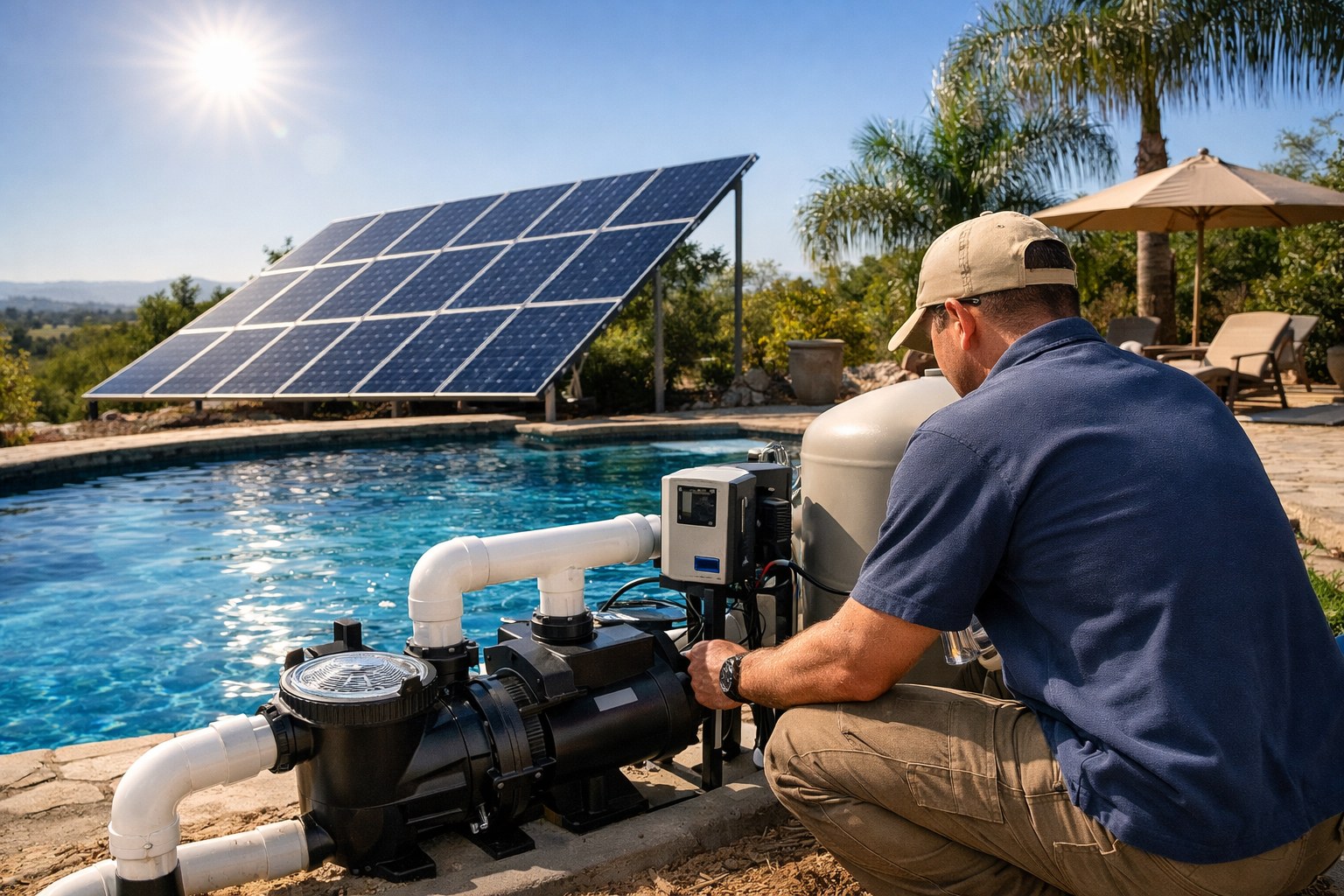
Investing in solar for your pool seems like a smart move.
It promises free energy from the sun and a smaller carbon footprint.
But you've likely heard mixed reviews.
Some users rave about the savings, while others complain about inconsistent performance and equipment failures.
This leaves you wondering what the real story is.
To make an informed decision, it's crucial to understand both the impressive financial benefits and the potential technical challenges.
Let's dive into the numbers and the technology to see if a solar pool pump is the right choice for you.
What's the Real Payback on a Solar Pool Pump?
Worried about the high upfront cost of solar technology?
You want to save money on electricity, but the initial investment feels like a significant financial risk.
A solar pool pump system can pay for itself in 3 to 7 years.
Your annual savings depend on electricity rates, daily pump runtime, and local sun exposure.
After the payback period, you enjoy free pool circulation, drastically reducing your home's energy consumption.
The financial return is often the deciding factor for homeowners considering a solar pool pump.
To understand the potential savings, you need a clear breakdown of the costs versus the benefits over time.
A standard 1-horsepower AC pool pump can be one of the most energy-hungry appliances in your home, often second only to your air conditioner.
Let's explore a detailed cost analysis to see how quickly your investment can turn into real, tangible savings.
Initial Investment Breakdown
The total cost involves more than just the pump itself.
A complete system requires solar panels, a controller, and various installation materials.
A typical DIY setup might include:
- Two 400-watt PV panels: ~$450
- 500-watt DC Pool Pump: ~$350
- MPPT Controller & Cabling: ~$150
- Mounting Hardware & Plumbing: ~$100
This brings a sample initial investment to around $1,050.
Professional installation will add to this cost, but tax credits and rebates in your area can reduce it by 30% or more.
Calculating Your Energy Savings
To see the payback, we compare the cost of running your old AC pump to the $0 daily operational cost of a solar pump.
Let's assume you have a 1 hp (750-watt) AC pump.
| Cost Component | Old AC Pump Calculation | New Solar Pump |
|---|---|---|
| Daily Power Use | 0.75 kW x 8 hours/day = 6 kWh | 0 kWh (from grid) |
| Daily Cost | 6 kWh x $0.16/kWh = $0.96 | $0 |
| Annual Cost | $0.96/day x 365 days = $350.40 | $0 |
With an annual savings of over $350, the payback period for a $1,050 system is approximately 3 years.
($1,050 Initial Investment / $350 Annual Savings = 3 Years).
If you live in an area with higher electricity rates, like California or Hawaii, your payback period could be even shorter.
Long-Term Value
The story gets better after the initial payback.
A high-quality DC brushless motor, the core of a modern solar pump, is rated for 20,000 to 30,000 hours of use.
This is 6 to 10 times longer than the typical 2,000 to 5,000-hour lifespan of a brushed AC motor.
After your system pays for itself, you'll continue to save hundreds of dollars a year.
Even if you need to replace the pump after 8-10 years, you still own the solar panels, which have a performance warranty of 25 years.
This makes your next pump purchase a much smaller investment with an even faster ROI.
What Are the Common Problems with Solar Pool Pumps?
Afraid of your new solar pump failing prematurely?
You've seen negative reviews online mentioning pumps that stop working after just a few months, turning your investment into a headache.
The most common issues are inconsistent performance on cloudy days and motor burnout from frequent on/off cycling.
These problems often stem from basic controllers that can't manage power fluctuations smoothly.
Poor documentation and a lack of technical support for cheaper, imported models also cause significant frustration.
While the savings are attractive, the potential downsides are what give many homeowners pause.
The dream of "free" pool circulation can quickly turn into a nightmare if the equipment is unreliable.
Many of the widely available, low-cost solar pumps are imported directly, and the quality control can be inconsistent.
Understanding these specific problems is key to choosing a system that will last.
Let's break down the technical glitches and support issues that you need to be aware of.
The "Cycling Glitch"
The most significant technical flaw in many basic solar pumps is how they handle variable sunlight.
When a cloud passes overhead, the voltage from the solar panels drops.
A primitive controller will simply shut the pump off.
When the sun returns seconds later, it abruptly turns back on.
This rapid on-off cycling can happen dozens of times on a partly cloudy afternoon.
This process, known as "hard starting," puts immense stress on the DC motor and its electronic components.
It's a primary reason for the premature failures reported in many online reviews.
A quality system needs a smarter controller to prevent this damaging behavior.
Weak Performance with Pool Features
Solar pumps are designed for one primary job: filtration.
Their performance is directly tied to the intensity of the sun.
This creates several limitations:
- Spa Jets: You won't get the strong, invigorating flow needed for spa jets, as the pump's speed will vary.
- Water Features: Waterfalls and bubblers will operate inconsistently. Their flow will weaken or stop altogether as clouds pass by.
- Pool Heaters: Most gas and electric heat pumps require a specific, consistent flow rate to operate safely. The variable output of a solar-direct pump often fails to meet this requirement, causing the heater to shut down.
No Nighttime Operation
This is an obvious but important limitation.
Without a battery storage system, solar-direct pumps cannot run at night.
This means you can't filter your pool after a late-night party or run your spa features after dark.
While filtration is most effective during the day when the sun is promoting algae growth, some owners prefer the flexibility of nighttime operation.
A hybrid system is the only way to solve this Goin solar-only.
The Core Technology: What Makes a Solar Pump Reliable?
Confused by the technical jargon like BLDC and MPPT?
You just want a pump that works reliably without needing an engineering degree to understand why.
A reliable solar pump is powered by a high-efficiency Brushless DC (BLDC) motor.
This motor is paired with an intelligent MPPT (Maximum Power Point Tracking) controller.
Together, they maximize energy use from the panels and ensure the motor runs smoothly and efficiently, extending its lifespan.
Not all solar pumps are created equal.
The difference between a pump that fails in six months and one that lasts for a decade lies in the quality of its core components: the motor and the controller.
These two parts work together as the brain and heart of the system.
Understanding their function is the best way to identify a high-quality product.
Let's explore what makes this technology so effective and why it's the new standard for off-grid water pumping.
The Brushless DC (BLDC) Permanent Magnet Motor
This is the key to efficiency and durability.
Unlike old AC motors that use brushes that wear out, BLDC motors use permanent magnets.
This design has several major advantages:
- High Efficiency: BLDC motors convert over 90% of electrical energy into mechanical power. Traditional AC motors often operate at 60-70% efficiency. This means you need fewer solar panels to get the same pumping power.
- Long Lifespan: With no brushes to wear down, the motor's life is vastly extended, often exceeding 20,000 hours. This translates to years of maintenance-free operation.
- High Torque: They provide strong power even at low speeds, which is perfect for starting the pump under load.
The Intelligent MPPT Controller
This is the brain of the operation.
An MPPT controller constantly monitors the voltage and current from the solar panels.
It adjusts the electrical load to extract the maximum amount of power possible at any given moment.
More importantly, a good MPPT controller provides crucial protection and "soft start" capabilities.
Instead of abruptly shutting off in low light, it will gradually reduce the motor's speed.
This prevents the damaging on-off cycling and dramatically increases the motor's longevity. It's the solution to the "cycling glitch."
Selecting the Right Pump Mechanism
The motor powers the pump, but the pump mechanism itself is designed for a specific task.
While pool pumps are a type of centrifugal pump, understanding the variety in solar pumping helps illustrate the technology's versatility.
For example, in deep well applications:
- Screw Pumps are used for low flow and high lift, perfect for deep wells.
- Centrifugal Impeller Pumps are used for high flow and medium lift, ideal for irrigation.
Different impeller materials, like durable plastic or corrosion-resistant stainless steel, are chosen based on water quality.
This same principle applies to pool pumps, where the pump-end must be designed to handle pool chemicals and provide the right flow for filtration.
Can a Hybrid System Be the Best of Both Worlds?
Don't want to choose between saving money and having a fully functional pool?
You love the idea of solar savings but can't accept the limitations of weather-dependent performance and no nighttime use.
Yes, an AC/DC hybrid solar pump controller offers a complete solution.
It automatically uses solar power when available, but seamlessly switches to AC grid power during cloudy weather or at night.
This gives you 24/7 reliability while still maximizing your energy savings from the sun.
The standard solar-direct pump presents a compromise: you save money, but you sacrifice performance consistency.
For many pool owners, especially those with spas, heaters, or a desire to run their pump at any time, this trade-off isn't acceptable.
Fortunately, technology has advanced beyond this "either-or" scenario.
A hybrid system is designed to eliminate the compromises, providing a robust solution that delivers both cost savings and uncompromising performance.
How AC/DC Hybrid Controllers Work
A hybrid controller is the ultimate smart device for your pump.
It has inputs for both your solar panels (DC power) and your home's electrical grid (AC power).
The controller's logic is programmed to prioritize solar energy.
- Full Sun: The system runs 100% on free solar power. The grid is not used.
- Partial Clouds: The controller uses its MPPT function to draw as much power as possible from the panels. It then supplements the rest with a small amount of AC power to maintain a consistent pump speed.
- No Sun / Nighttime: When there is no solar input, the controller automatically and seamlessly switches over to 100% AC power.
The Main Advantages of a Hybrid System
This approach effectively solves all the major drawbacks of a solar-direct system.
- Guaranteed Circulation: Your pool gets the filtration it needs, every single day, regardless of the weather. This keeps your water clean and safe and prevents algae growth during long stretches of cloudy weather.
- Full Feature Functionality: You can run your spa jets, waterfalls, and pool heater at full power whenever you want. The controller ensures the pump provides the steady flow rate required.
- 24/7 Operation: Need to filter the pool overnight? Want to enjoy a warm spa on a rainy evening? A hybrid system gives you the freedom and flexibility of a traditional pump.
Is a Hybrid System Still a Good Investment?
Even though a hybrid system will use some grid power, it is still an excellent investment.
During peak sun hours—when electricity rates are often highest—your pump will be running for free.
You still offset the vast majority of your pool's energy consumption with solar.
You get the peace of mind that comes with complete reliability, making it the most practical and powerful solution for the modern pool owner.
Conclusion
A solar pool pump is a fantastic investment, offering significant energy savings and a long lifespan—if you choose the right technology.
A system with a BLDC motor and a smart hybrid controller eliminates all major drawbacks.
FAQs
How long do solar pool pumps last?
A quality solar pool pump with a brushless motor can last for 8-10 years or more, with the solar panels themselves lasting over 25 years. This is significantly longer than typical AC pumps.
Can a solar pump run a pool cleaner?
Yes, most modern solar pool pumps produce enough flow to operate suction-side or pressure-side automatic pool cleaners, as long as there is adequate sunlight.
Do I need batteries for a solar pool pump?
No, batteries are not necessary. Most systems are "solar-direct," or for better performance, use an AC/DC hybrid controller that switches to grid power when the sun isn't out.
How many solar panels does a pool pump need?
Typically, a residential solar pool pump requires two to four solar panels, depending on the size of the pump and your geographic location. A 1 HP pump usually pairs well with about 800-1200 watts of panels.
Can a solar pool pump save me money?
Absolutely. By eliminating the electricity cost for pool circulation, a solar pump can save you hundreds of dollars per year, paying for itself in just a few years.
Do solar pool pumps work on cloudy days?
They will run at a reduced speed on cloudy days. A system with a hybrid AC/DC controller is recommended to ensure full circulation regardless of the weather by supplementing with grid power.
Are solar pool pumps noisy?
No, they are incredibly quiet. Because they use a brushless DC motor, they are often whisper-quiet compared to the loud hum of a traditional single-speed AC pump.
Can I install a solar pool pump myself?
Yes, many solar pool pump kits are designed for DIY installation. However, it requires basic plumbing and electrical skills. If you are not comfortable, hiring a professional is recommended.