Are you tired of high electricity bills from your pool pump?
This energy-hungry appliance silently drains your budget, especially during the sunniest months when you use your pool the most.
Yes, you can absolutely run your pool pump on solar power. The best method involves using a dedicated solar DC pool pump or integrating a variable speed AC/DC pump with a larger home solar system. This significantly reduces or even eliminates your pool's electricity costs.
Running a pool pump can be one of the biggest energy expenses for a homeowner, often second only to air conditioning.
It's a constant, daily cost that adds up significantly over a year.
But what if you could harness the same sun that makes you want to use the pool to power it for free?
With the global shift towards sustainable energy, solar technology has become more efficient and affordable than ever.
This has opened up new possibilities for homeowners to cut costs and reduce their carbon footprint.
Powering your pool pump with solar is no longer a complex or niche idea; it's a practical and intelligent investment.
This article will explore the different ways you can make this switch, breaking down the technology, the benefits, and the best options to suit your needs.
We'll look at dedicated off-grid systems, grid-tied solutions, and the advanced pump technology that makes it all possible, ensuring you have all the information to make a smart decision.
How Do Solar Pool Pumps Work?
Concerned about the complexity of solar pumps?
You might think switching to solar requires a complicated and expensive setup, making you hesitant to explore this cost-saving solution.
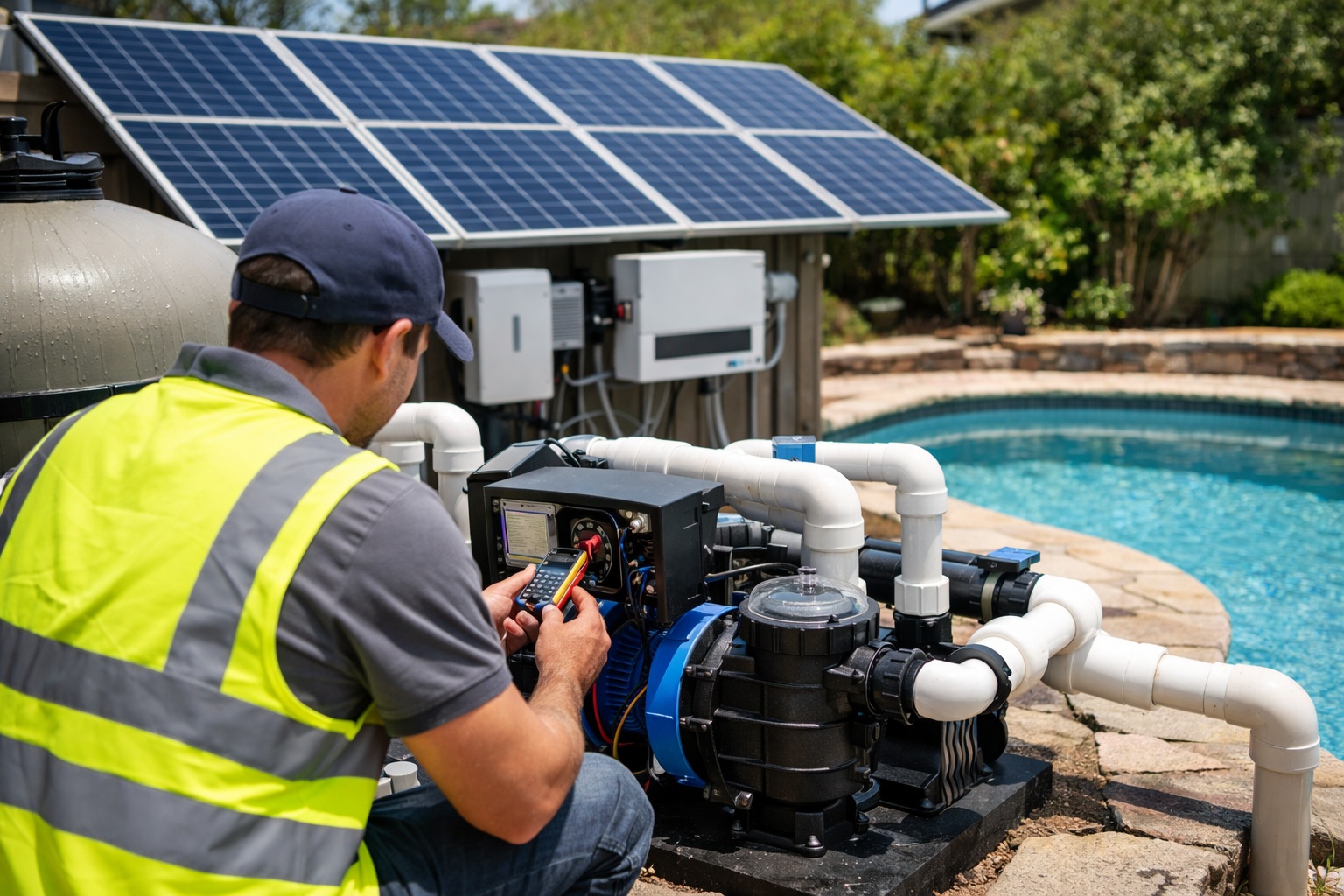
A solar pool pump system is surprisingly simple. It consists of solar panels, a controller, and a special DC or AC/DC pump. The panels generate DC power, and the controller manages this power to run the pump efficiently, circulating your pool water for free whenever the sun shines.
Breaking Down the System
A solar-powered pool pump operates on a straightforward principle: converting sunlight directly into the energy needed to circulate water.
Unlike traditional pumps that draw power from the grid, these systems create their own mini power plant dedicated to your pool.
Let's look at the core components.
1. Solar Panels
These are the heart of the system.
Usually, a set of 2 to 6 panels is sufficient for a standard residential pool.
They capture sunlight and convert it into Direct Current (DC) electricity.
The number of panels required depends on your pool's size, the pump's power, and your geographic location's average sun exposure.
2. The Controller
This is the brain of the operation.
The DC power from the panels flows into an intelligent controller, often using Maximum Power Point Tracking (MPPT) technology.
An MPPT controller optimizes the electrical output from the panels, ensuring the pump receives the maximum possible power throughout the day, even as sunlight intensity changes.
This technology can boost efficiency by up to 30% compared to systems without it.
The controller also provides important safety features, such as run-dry protection, overheating protection, and voltage regulation.
3. The Pump Motor
This is where modern technology truly shines.
Solar pool pumps use highly efficient Brushless DC (BLDC) permanent magnet motors.
These motors are a significant upgrade from the cheap, inefficient AC motors in older pumps.
A BLDC motor can be over 90% efficient, converting almost all the electricity it receives into pumping power.
This high efficiency means you need fewer solar panels to achieve the same water flow, reducing the system's overall cost and footprint.
AC/DC Hybrid: The Best of Both Worlds
While a fully DC system is great for off-grid operation, what happens on cloudy days or if you want to run the pump at night?
This is where hybrid AC/DC systems come in.
Manufacturers have developed advanced controllers that can accept both DC power from solar panels and AC power from the grid.
These hybrid systems are designed for ultimate reliability.
The controller automatically prioritizes solar power.
When an abundance of sunlight is available, the pump runs entirely on free solar energy.
If clouds roll in and solar power drops, the controller can supplement with AC power from the grid to maintain consistent water flow.
When there's no sunlight, it seamlessly switches over to full AC power.
This ensures your pool stays clean 24/7 without you having to do anything, all while maximizing your use of free solar energy.
What are The Benefits of a Solar Pool Pump?
Wondering if the investment is truly worth it?
The upfront cost of a solar pump system can seem high, making you question if the long-term benefits will justify the initial expense.
The benefits are huge. You'll see an immediate and drastic reduction in your electricity bill, a 30% Federal Tax Credit on the purchase, and increased property value. Plus, you’ll be independent from the grid and future utility rate hikes, ensuring predictable costs for years.
Installing a solar pool pump is more than just an eco-friendly choice; it's a smart financial decision with multiple layers of benefits that pay dividends for years.
Let's explore these advantages in more detail.
Immediate and Long-Term Financial Savings
The most compelling benefit is the dramatic reduction in your energy costs.
A typical single-speed 1 HP pool pump running 8 hours a day can add over $550 to your annual electricity bill.
With a solar pump, this cost is a thing of the past.
The system pays for itself over its lifetime purely through energy savings.
But the savings go deeper.
You are also hedging against the future.
Utility electricity rates are not static; they historically increase over time.
By generating your own power, you lock in your pool running costs for the 25+ year lifespan of the solar panels, protecting your budget from unpredictable rate hikes.
Tax Credits and Financial Incentives
To encourage the adoption of renewable energy, governments offer significant financial incentives.
In the United States, you can claim a 30% Federal Solar Tax Credit on the total cost of the system, including installation.
On a $5,000 system, that’s an immediate $1,500 back in your pocket, bringing the net cost down to $3,500.
Many states, like Florida, also offer exemptions from sales tax and property tax assessments for solar energy equipment.
This means you won't pay extra tax at the time of purchase, and your property taxes won't increase even though the system adds value to your home.
Energy Independence and Reliability
A solar pool pump operates independently of the utility grid.
This offers a major advantage, especially in areas prone to power outages from storms.
After a storm, when the grid might be down for days, your solar pump will start working as soon as the sun comes out.
This keeps your pool water circulating and clean, preventing it from turning into a green, stagnant pond that could require expensive chemical treatments to fix later.
This self-sufficiency provides peace of mind and ensures your pool remains a healthy and usable asset, no matter what.
The technology is also incredibly reliable.
BLDC motors are brushless, meaning there are no parts to wear out, leading to a much longer service life and virtually no maintenance compared to traditional pump motors.
When is a Solar Pool Pump a Good Idea?
Is a dedicated solar pump right for everyone?
You might worry that a solar-only system won't be powerful enough for your pool's needs, especially if you have extra features or live in a cloudy area.
A dedicated DC solar pump is an excellent idea for off-grid properties, locations with high electricity rates, or when network rules limit your grid-tied solar capacity. It's also perfect for simple pools where the main goal is basic circulation and filtration during daylight hours.
While variable speed pumps connected to a whole-home solar system are often the most efficient overall solution, there are specific scenarios where a dedicated, off-grid solar pool pump is the superior choice.
Understanding these situations helps you determine the best path forward for your unique needs.
1. You Face Grid Connection Limitations
Many utility networks impose limits on the size of a grid-tied solar system you can install.
For example, you might be capped at a 5kW system.
If that's not enough to power your home and your energy-hungry pool pump, you have a problem.
A dedicated solar pump system solves this perfectly.
Because its panels are not connected to the grid, they do not count toward your grid-tied capacity limit.
This allows you to install a separate set of panels just for your pool, effectively bypassing the utility's restrictions and achieving a higher level of energy independence.
2. Roof Space is Limited
What if you don't have enough suitable, sunny roof space for a large solar array to power both your home and pool?
A dedicated system offers flexibility in panel placement.
The panels for your pump don't have to be on your house.
You can mount them on a ground structure near the pool equipment, on top of a pergola, or on a shed roof.
This frees up your prime roof space for a home solar system while still allowing you to eliminate your pool's running costs.
3. You Live in an Off-Grid or Remote Area
For properties without a grid connection, a solar pool pump is a game-changer.
On an off-grid homestead, every watt of power is precious.
Running a pool pump off your main battery bank would require a much larger and more expensive solar and battery system.
By giving the pool pump its own dedicated power source, you offload a massive electrical demand from your main system.
This allows for a smaller, more economical battery bank and reduces the runtime needed for any backup generator, saving fuel and maintenance costs.
4. You Have Extremely High Electricity Rates
In places like California, Hawaii, or many Caribbean islands, electricity rates can be extraordinarily high.
In these markets, the payback period for a solar pool pump is much shorter, and the return on investment is significantly higher.
When you're paying 40, 50 cents, or more per kilowatt-hour, eliminating the 6-12 kWh a day your pool pump uses results in massive and immediate savings, making the investment an obvious financial win.
An AC/DC hybrid model is particularly useful here, ensuring the pool stays clean while guaranteeing that you only buy expensive grid power when absolutely necessary.
Understanding The Core Technology: Solar Pump Types
Feeling overwhelmed by the different pump options?
With terms like "screw," "impeller," and "centrifugal," it's hard to know which pump is right for your specific water needs and budget.
The choice depends on your needs. For very deep wells with low flow needs, a screw pump is ideal. For high-flow applications like farm irrigation, a plastic impeller pump is economical. For corrosive water, a stainless steel impeller pump offers the best durability.
While we have focused on pool pumps, the same solar technology powers a wide range of water pumps for various applications.
Understanding the different pump end types is crucial for importers and distributors looking to serve diverse markets, from residential pools to deep-well irrigation.
All these pumps are driven by the same core technology: a high-efficiency Brushless DC (BLDC) permanent magnet motor.
The difference lies in the "wet end"—the part that actually moves the water.
1. Solar Screw Pump: Low Flow, High Head
This type of pump uses a a stainless steel rotor (the screw) that turns inside a rubber stator.
This action creates sealed cavities that move water upward through compression.
It’s often called a progressive cavity pump.
- Best For: Deep wells where water needs to be lifted a great distance (high head).
- Applications: Domestic water supply in remote homes, livestock watering troughs, and drip irrigation for small gardens.
- Advantages: Excellent for its ability to handle sandy or silty water without damage. It maintains consistent pressure and flow even when lifting water from over 100 meters deep.
- Limitations: It delivers a relatively low volume of water (low flow), so it's not suitable for applications requiring large amounts of water quickly, like flood irrigation.
2. Solar Plastic Impeller Pump: High Flow, General Use
This is a multi-stage centrifugal pump.
It uses a series of stacked impellers made from durable, wear-resistant engineering plastics.
As the impellers spin, they use centrifugal force to push water outward and upward through each stage, increasing pressure and flow.
- Best For: Applications that need a high volume of water at a medium head.
- Applications: Farm irrigation, filling reservoirs, pasture water supply, and larger home water systems. It's also the basis for many high-performance solar pool pumps.
- Advantages: It delivers a high flow rate, making it very efficient for moving large quantities of water. It is lightweight, cost-effective, and has good resistance to fine sand.
- Limitations: Plastic impellers may not be suitable for highly corrosive water or extreme deep-well conditions where pressure is immense.
3. Solar Stainless Steel Impeller Pump: Premium Quality, Corrosion Resistance
This pump is functionally similar to the plastic impeller model but is built for maximum durability.
The impellers, diffusers, and pump body are all constructed from high-grade stainless steel (like SS304 or SS316).
| Feature | Plastic Impeller Pump | Stainless Steel Impeller Pump |
|---|---|---|
| Material | Engineering Plastic | SS304/SS316 Stainless Steel |
| Best Use | General farm & home use | Corrosive or alkaline water |
| Durability | Good | Excellent |
| Cost | Economical | Premium |
| Weight | Lightweight | Heavier |
- Best For: High-flow applications in harsh water conditions.
- Applications: Pumping water with acidic or alkaline properties, supplying water in coastal areas with saltwater intrusion risk, and for high-end homes or commercial operations where maximum reliability and lifespan are required.
- Advantages: Exceptional corrosion resistance and durability. It can operate for many years in aggressive water that would quickly degrade other pumps.
- Limitations: It comes with a higher initial cost and is heavier than its plastic counterpart, reflecting its premium construction.
The Power Behind the Pump: High-Efficiency BLDC Motors
Does the motor type really make a difference?
You might assume all electric motors are basically the same, but the technology inside your solar pump is the single biggest factor determining its performance and your long-term savings.
Yes, it makes a huge difference. High-efficiency Brushless DC (BLDC) permanent magnet motors are over 90% efficient, compared to 40-60% for standard AC motors. This means you need fewer solar panels, reducing system cost, and the motor lasts longer with no maintenance.
The wet end of the pump decides how it moves water, but the motor is what determines how efficiently it does so.
The revolution in solar pumping is thanks almost entirely to the widespread adoption of Brushless DC (BLDC) permanent magnet motors.
They represent a massive leap forward in efficiency and reliability compared to traditional motors.
What is a BLDC Permanent Magnet Motor?
Unlike old-fashioned brushed motors that use physical carbon brushes to conduct electricity, BLDC motors use an electronic controller.
This eliminates friction and parts that wear out, making them virtually maintenance-free.
The "permanent magnet" part is also key.
The rotor is built with powerful rare-earth magnets (like Neodymium Iron Boron).
This creates a strong magnetic field without needing to use any electricity, unlike traditional AC induction motors.
This design results in several major advantages.
Technical Advantages Lead to Market Value
1. Unmatched Efficiency
A typical AC motor in an old pool pump might be 40-60% efficient, meaning almost half the electricity is wasted as heat and noise.
A BLDC motor, by contrast, is often over 90% efficient.
This efficiency is crucial for a solar-powered system.
It means the motor can produce strong pumping power from less electricity.
In practical terms, a system with a BLDC motor might require 30-40% fewer solar panels to achieve the same water flow as a less efficient motor.
This directly translates to a lower upfront cost for the end-user and a smaller, easier-to-install system.
2. High Torque and Compact Design
BLDC motors produce high torque even at low speeds.
This allows the pump to start easily in the morning sun and handle difficult pumping situations without stalling.
They are also significantly smaller and lighter.
A BLDC motor can be up to 47% smaller and 39% lighter than a traditional motor of equivalent power output.
For distributors, this means lower shipping and storage costs.
For installers, it means the pumps are easier to handle and install, reducing labor time.
3. Long Service Life and Reliability
The absence of brushes to wear out gives BLDC motors an exceptionally long operational lifespan.
Combined with an intelligent controller that protects against overheating, voltage spikes, and running dry, these systems are built for "set it and forget it" reliability.
This is a powerful selling point, as customers want a solution, not another piece of equipment that needs constant attention.
This core technology is the engine that drives the entire product portfolio, making solar pumps not just an environmental choice, but a financially superior one.
Conclusion
Switching your pool pump to solar is a smart, practical investment that eliminates a major household expense and provides energy independence for decades.
FAQs
How many solar panels do I need for a pool pump?
Typically, you'll need 2 to 6 solar panels. The exact number depends on your pool size, pump HP, and local climate, but a professional can calculate the precise requirement for you.
Can a solar pool pump run at night?
A standard DC solar pump cannot run at night without a battery bank, which adds cost and complexity. Hybrid AC/DC pumps solve this by automatically switching to grid power when the sun goes down.
Do solar pool pumps work on cloudy days?
Yes, but at a reduced speed. The pump's flow rate is proportional to the amount of sunlight. An AC/DC hybrid model can supplement with grid power on very overcast days to maintain flow.
How long do solar pool pumps last?
The solar panels are warrantied for 25 years. The brushless DC motors are highly durable with long lifespans due to having fewer wearing parts, often lasting much longer than traditional pump motors.
Will a solar pump work with my pool heater?
It depends. Most solar, gas, or heat pump heaters require a specific, consistent flow rate to work properly. A variable-flow solar pump may not always meet this requirement, so a variable-speed AC pump or hybrid pump is often a better choice.
What maintenance do solar pool pumps require?
The system requires very little maintenance. The pump's brushless motor is virtually maintenance-free, and the solar panels only need occasional cleaning to ensure they are free of debris.
Is it better to get a solar pool pump or a variable speed pump?
For most grid-tied homes, pairing a variable speed pump with a whole-home solar system is most efficient. However, a dedicated solar pump is superior for off-grid homes or if you face grid-connection limits.
How much does a solar pool pump cost?
A complete kit with panels, controller, and pump can range from $1,500 to $5,000+, depending on the power. However, the 30% federal tax credit significantly reduces this net cost.