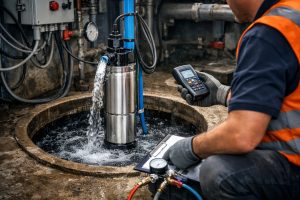
Struggling with high energy bills and unreliable power for your water pump?
You need a better way to secure your water supply without breaking the bank.
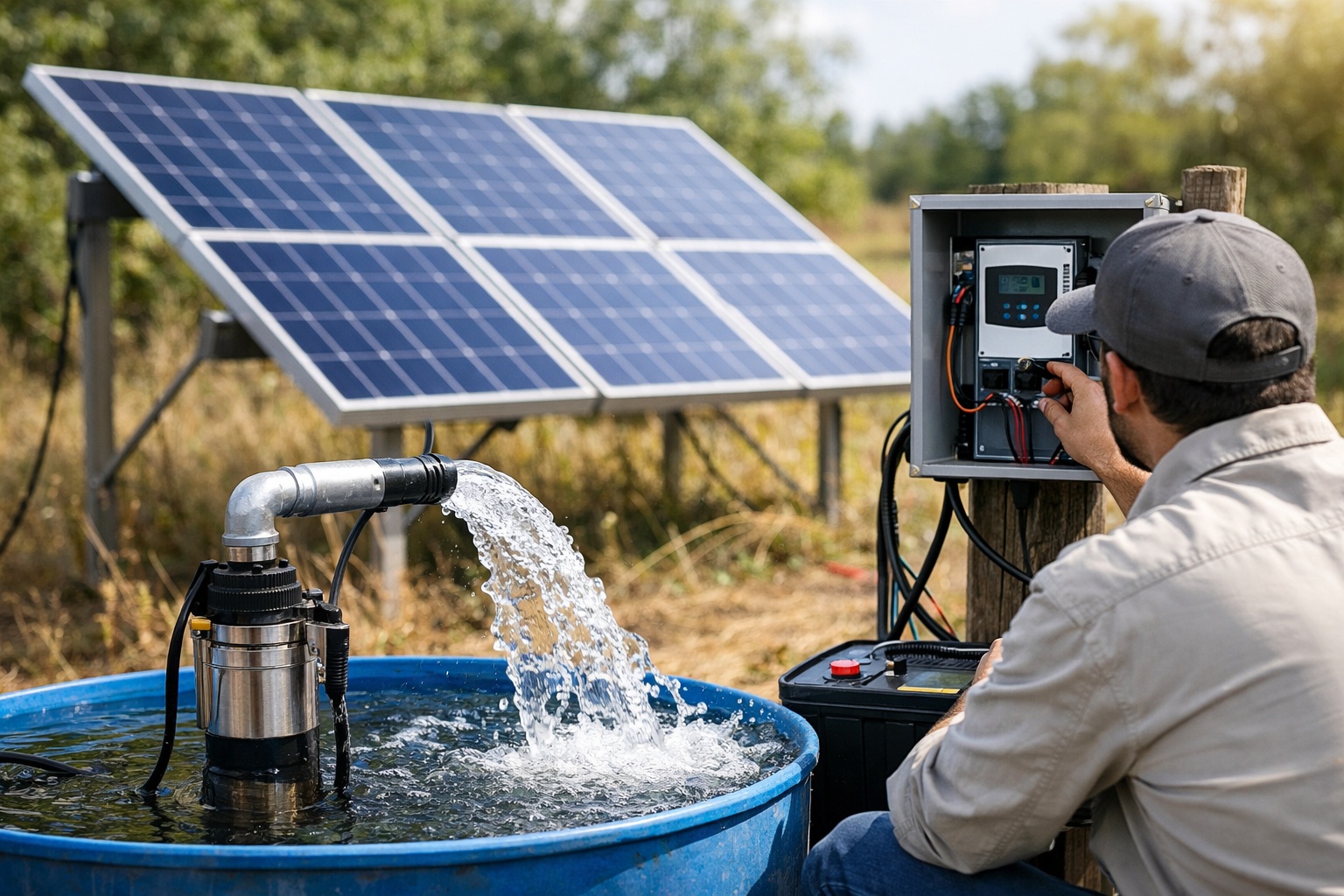
No, you cannot safely or efficiently run a water pump straight from a solar panel for long-term use.
Direct connection can damage the pump's motor due to inconsistent power from the sun.
A solar pump controller is essential to regulate voltage and maximize efficiency, protecting your investment.
Running a water pump seems like it should be simple.
You connect a power source, and water flows.
The idea of connecting a solar panel directly to a pump is tempting for its simplicity.
However, the reality is far more complex.
The sun's intensity changes throughout the day, causing a solar panel's power output to fluctuate wildly.
This unstable power is the enemy of a pump motor.
It can lead to stalling, overheating, and ultimately, a burned-out motor, wasting both time and money.
To truly unlock the power of solar for water pumping, a more intelligent approach is required.
This involves understanding the critical components that make a solar water system reliable and efficient.
It also means choosing the right type of pump for your specific water needs.
Let's explore why a controller is non-negotiable and how to build a solar pumping system that lasts.
Why a Direct Connection is a Bad Idea
You have a solar panel and a pump.
Why complicate things with extra electronics?
This thinking often leads to costly mistakes and a failed system.
A direct connection provides unregulated power to your pump.
This causes the pump to struggle during low-light conditions, like early mornings or cloudy days.
This repeated stress drastically shortens the motor's lifespan, leading to premature failure and replacement costs.
The science behind this failure is straightforward.
A pump motor requires a specific amount of electrical current (amps) to start up successfully.
This is known as the "inrush current."
In the early morning, late afternoon, or on an overcast day, a solar panel might produce enough voltage to try to start the pump, but not enough current.
The pump will attempt to turn on, fail, and then try again and again.
This start-stop cycling generates excessive heat in the motor windings.
Over time, this heat breaks down the motor's insulation, causing a short circuit and permanent damage.
Low-quality brushed motors, often found in cheap pump kits, are especially vulnerable and can fail within a year under these conditions.
Even high-quality brushless motors are not designed for such erratic power delivery.
The lack of a "soft start" mechanism means the pump experiences maximum mechanical torque instantly, which can damage gears and bearings.
Without a controller, you have no protection and no optimization, leaving your entire water supply at the mercy of the weather.
The Role of the Motor
The heart of any pump is its motor.
Most modern solar pumps use a Brushless DC (BLDC) permanent magnet motor.
These motors are highly efficient, often exceeding 90% efficiency.
This means more of the sun's energy is converted into water flow.
The rotor inside these motors is typically made of powerful neodymium iron boron magnets.
This advanced design delivers high torque in a compact package.
A BLDC motor can be up to 47% smaller and 39% lighter than a traditional AC motor of the same power.
This high efficiency is crucial.
It reduces the number of solar panels needed to run the system, lowering the initial investment by 15-25%.
It also simplifies installation and reduces the physical footprint of the solar array.
However, this efficiency is only realized when the motor receives clean, stable power.
This is a task the solar panel alone cannot perform.
A controller is necessary to manage the power and protect this vital component.
| Motor Type | Efficiency | Key Feature | Best For |
|---|---|---|---|
| Brushed DC Motor | 50-60% | Simple design, low cost | Short-term, non-critical tasks |
| AC Induction Motor | 75-85% | Reliable with grid power | Existing grid-tied systems |
| BLDC Permanent Magnet | >90% | High efficiency, long life | Dedicated solar pumping systems |
The Smart Solution: Using a Solar Pump Controller
Your pump is a long-term investment.
Protecting it from damage while maximizing its output is the smartest financial decision.
This is where a controller becomes essential.
A solar pump controller acts as the brain of your system.
It regulates the fluctuating power from solar panels, providing a stable supply to the pump motor.
This ensures the pump starts smoothly, runs efficiently, and is protected from both low-power and high-power damage.
A quality controller does more than just switch the power on and off.
It uses sophisticated technology to optimize the entire system.
The most important feature is Maximum Power Point Tracking (MPPT).
An MPPT controller constantly monitors the voltage and current from the solar panels.
It adjusts the electrical load to find the "maximum power point"—the perfect balance of voltage and current that extracts the most possible energy from the panels at any given moment.
This technology can boost system efficiency by up to 30%, especially in low-light conditions.
This means your pump starts earlier in the morning, runs longer into the afternoon, and performs better on cloudy days.
It translates directly to more water pumped per day using the same number of solar panels.
Controllers also provide critical protective functions.
A "soft start" feature gradually ramps up power to the motor, eliminating the mechanical shock of an abrupt start.
This reduces wear on the pump's internal components and extends its life.
They also include sensors for low-well shutoff, which prevents the pump from running dry and burning out.
Tank overflow sensors can also be connected to automatically stop the pump when a storage tank is full, preventing water waste and unnecessary pump operation.
The controller is not an optional extra; it is the key to a reliable, efficient, and long-lasting solar water pumping system.
Adjusting for Performance
Modern controllers offer more than just protection; they provide control.
A key feature is the ability to adjust the motor speed.
By turning a simple dial, you can increase or decrease the pump's operating speed.
Why is this important?
It allows you to perfectly match the pump's output to your well's recharge rate or your daily water needs.
If you only need a small amount of water, you can slow the pump down.
This reduces wear and tear and consumes less power.
If your well has a slow recovery rate, you can lower the pump speed to prevent it from drawing the water level down too far.
This fine-tuning capability ensures the system operates in perfect balance, maximizing both water output and the longevity of the well and pump.
Hybrid Power Options
What happens on cloudy days or when you need water at night?
Solar power is fantastic, but it's dependent on the sun.
This is why advanced systems offer hybrid power solutions.
Many modern controllers, often called AC/DC controllers, are designed with dual power inputs.
You can connect both your solar panels and an AC power source (like the grid or a generator) to the controller simultaneously.
The controller's internal logic is smart.
It will always prioritize using the free energy from the solar panels.
If solar power is insufficient, the controller can automatically blend in AC power to maintain pump operation.
When the sun goes down completely, it will seamlessly switch over to the AC source.
This ensures you have a reliable, 24/7 water supply without having to manually switch power sources.
It provides the cost savings of solar with the dependability of the grid, offering the best of both worlds.
Choosing the Right Solar Pump for Your Needs
There is no one-size-fits-all solar pump.
The best pump for your neighbor might be the wrong choice for you.
Your decision depends on your unique water needs.
To choose the right pump, you must consider your water source's depth (head) and the amount of water you need per day (flow rate).
Different pump designs excel in different scenarios.
A screw pump is ideal for deep wells, while an impeller pump is better for higher flow rates.
Understanding your requirements is the first step.
The "total dynamic head" is the total vertical distance you need to lift the water, plus any pressure requirements and friction loss in the pipes.
The "flow rate" is how much water you need, usually measured in gallons per minute (GPM) or cubic meters per hour.
With these two factors, you can select a pump type that is optimized for your application, whether it's for household use, livestock watering, or large-scale irrigation.
Let's break down the three most common types of solar deep well pumps.
Each is powered by the same high-efficiency BLDC motor but uses a different mechanical design to move water.
This product portfolio approach allows distributors to meet a wide range of customer demands.
Low Flow, High Head: The Solar Screw Pump
For very deep wells where pressure is paramount, the screw pump is the champion.
This type of pump is a "positive displacement" pump.
It uses a single helical stainless steel screw (the rotor) that turns inside a rubber stator.
This action creates sealed cavities that move water up through the pump.
It's like an Archimedes' screw, pushing the water column upward with each rotation.
This design is incredibly effective at generating high pressure.
It can lift water from extreme depths while maintaining steady output.
This makes it ideal for:
- Domestic water supply for homes with deep wells.
- Livestock drinking water in remote pastures.
- Small-scale drip irrigation that requires consistent pressure.
Another major advantage is its resistance to sand.
The rubber stator can handle abrasive particles better than the tight tolerances of a centrifugal pump, making it durable in less-than-perfect water conditions.
This resilience makes it a popular choice in regions across Africa and Latin America where well quality can be variable.
The trade-off for this high-head capability is a lower flow rate.
It's not designed for applications that require moving massive volumes of water quickly.
| Feature | Specification | Advantage |
|---|---|---|
| Pump Type | Progressing Cavity (Screw) | Handles high pressure and deep wells. |
| Best Application | Deep wells, domestic use | Can lift water from several hundred feet. |
| Sand Resistance | High | Rubber stator resists abrasive wear. |
| Flow Rate | Low | Not suitable for high-volume irrigation. |
High Flow, Medium Head: The Solar Plastic Impeller Pump
When you need to move a lot of water for irrigation or filling large tanks, a centrifugal pump is the answer.
This model uses a stack of impellers—think of them as spinning discs with curved vanes.
As the impellers spin at high speed, they throw water outwards using centrifugal force, creating pressure that pushes water up the pipe.
In this specific design, the impellers are made from a durable, wear-resistant engineering plastic.
This material choice has two key benefits.
First, it offers excellent resistance to fine sand, which can quickly erode softer materials.
Second, it is lightweight and economical, which reduces the overall cost and weight of the pump.
This makes it perfect for:
- Farm irrigation for crops and fields.
- Pasture water supply for large herds.
- Filling ponds or large residential tanks.
This pump is a workhorse, widely used in agriculture across the Americas and Africa.
It delivers a high flow rate at a medium head, making it extremely versatile for many common applications.
Its main limitation is in highly corrosive water or extremely deep wells, where a more robust material might be necessary.
Premium Quality, High Corrosion Resistance: The Solar Stainless Steel Impeller Pump
In some regions, the water itself is the biggest challenge.
Water that is acidic, alkaline, or has high salinity can quickly corrode standard pump components.
For these harsh environments, a premium solution is required.
This pump is also a multi-stage centrifugal pump, but it utilizes impellers made from SS304 stainless steel.
The pump body and other key wet components are also made from stainless steel.
This construction provides superior resistance to corrosion and ensures a very long service life, even in aggressive water conditions.
This pump is the top choice for:
- Acidic or alkaline water found in certain geological areas.
- Alkaline soil regions like those in parts of Australia and the Americas.
- High-end homes and ranches where reliability and water quality are top priorities.
While this pump offers the highest durability and reliability, it comes at a higher cost.
The materials and manufacturing are more expensive, placing it in a premium category.
It targets a niche but important market segment where other pumps would quickly fail.
For distributors, offering this option demonstrates a commitment to quality and the ability to solve even the most challenging water problems.
Conclusion
Directly connecting a pump to a solar panel is a recipe for failure.
A smart system, built around a high-efficiency motor and an intelligent MPPT controller with hybrid capabilities, is the only path to a reliable and cost-effective water solution.
Frequently Asked Questions
How deep can a solar pump work?
Solar pumps can work at various depths. Screw pumps excel at high-head applications, lifting water from over 500 feet, while impeller pumps are for shallower depths.
How many solar panels do I need to run a well pump?
This depends on the pump's horsepower (HP) and daily runtime. For example, a 1HP pump typically requires about 1000-1200 watts of solar panels for effective operation.
Can an inverter run a well pump?
Yes, an inverter can run a standard AC well pump using solar panels and batteries. However, a dedicated DC solar pump is often more efficient overall.
Are solar well pumps any good?
Yes, modern solar well pumps are very reliable and cost-effective. They offer energy independence and have low operating costs, with lifespans often exceeding 10 years.
What is the best solar well pump?
The "best" pump depends on your needs. For deep wells, choose a screw pump. For high flow in shallow wells, an impeller pump is better.
How much does a solar well pump cost?
Costs vary widely by size and type, from a few hundred to several thousand dollars. A complete system includes the pump, controller, and solar panels.
Can you run a well pump on batteries?
Yes, a solar system can charge a battery bank, which can then power the pump at night or during cloudy weather for a 24/7 water supply.
What size pump do I need for a 500-foot well?
For a 500-foot well, you'll need a high-head pump, typically a solar screw pump. The exact model depends on the required flow rate at that depth.