Struggling with high electricity bills from your pool pump? You're looking for a cost-effective, eco-friendly solution but don't know where to start with solar.
To determine the number of solar panels for your pool pump, first, calculate the pump’s daily energy use (wattage × hours). Next, divide this by your location's peak sun hours. Finally, divide that result by the wattage of a single solar panel to find the required panel count.
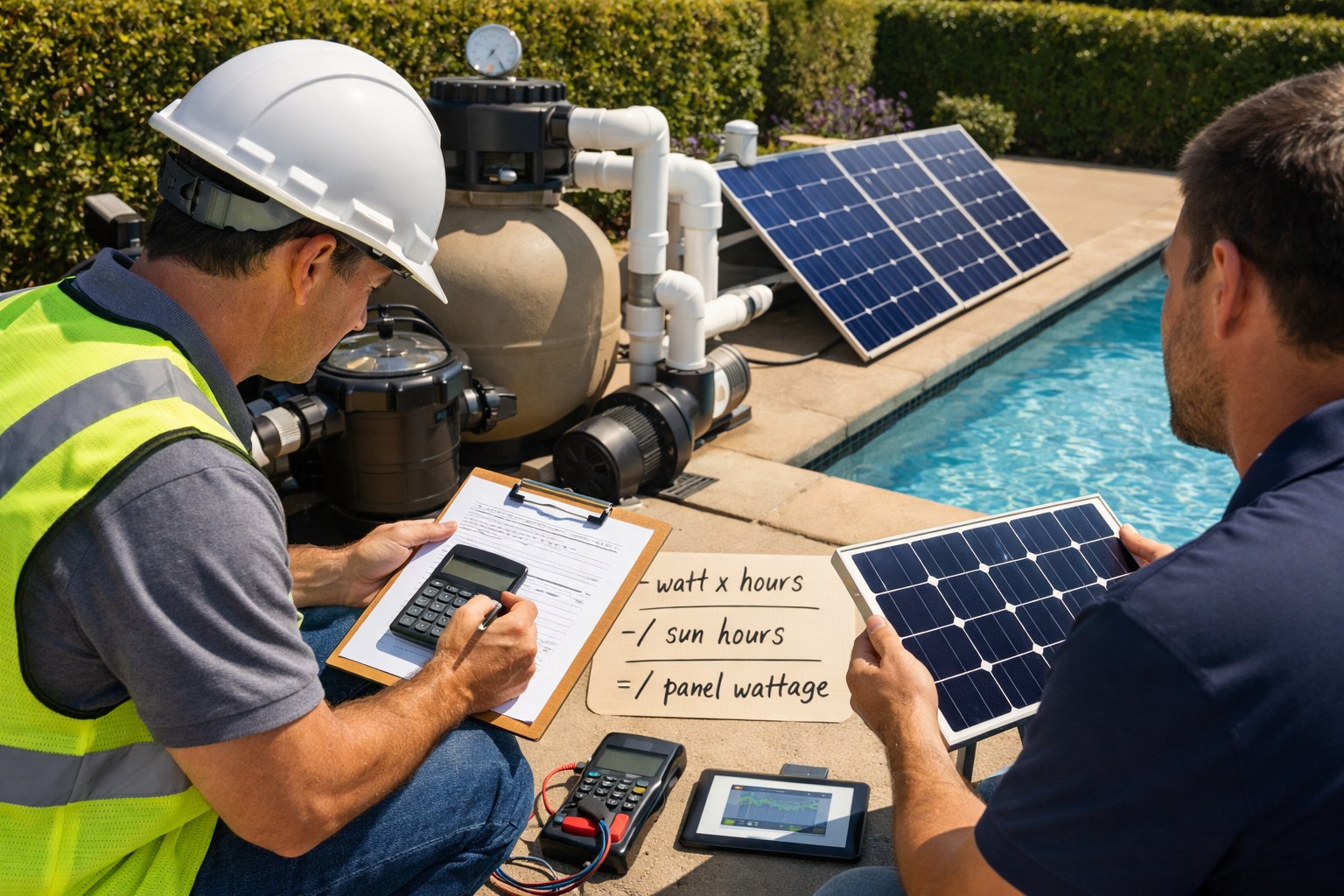
This guide will walk you through the exact steps to size your solar system accurately. We'll break down everything from pump wattage and peak sun hours to system inefficiencies, ensuring you make an informed decision for your pool. Let's dive in.
First, Let's Calculate Your Pump’s Energy Needs
Calculating your pool pump's electricity consumption is the first step toward energy independence. Understanding the technical requirements is key to making a smart investment in solar power.
The core formula is simple: convert your pump’s horsepower to watts, then multiply by its daily run time. For example, a 1.5 HP pump (1,119 watts) running for 8 hours uses 8,952 watt-hours (8.95 kWh) daily. This figure is your starting point.
Understanding Your Pump's Wattage
The power of a pool pump is measured in horsepower (HP).
To get the watts, you need to use a conversion factor.
One horsepower is equal to 745.7 watts.
So, the formula is:
Pump Wattage = Horsepower (HP) × 745.7
Let's look at a common example.
If you have a 2-horsepower pump, the calculation would be:
2 HP × 745.7 = 1,491.4 watts
Most residential pool pumps range from 0.75 HP to 3 HP.
Here is a table to help you quickly find your pump's wattage.
| Pump Horsepower (HP) | Approximate Wattage (Watts) |
|---|---|
| 0.75 HP | 560 watts |
| 1.0 HP | 746 watts |
| 1.5 HP | 1,119 watts |
| 2.0 HP | 1,491 watts |
| 2.5 HP | 1,864 watts |
| 3.0 HP | 2,237 watts |
Calculating Daily Energy Consumption
Once you know the wattage, you need to find out how much energy the pump uses each day.
To do this, multiply the pump's wattage by how many hours it runs per day.
Daily Energy Consumption (Watt-hours) = Pump Wattage × Daily Operating Hours
Pool pumps usually run for 6 to 8 hours a day.
The exact time depends on the pool's size and how quickly the water needs to be filtered.
Let's continue with our 2 HP pump example, assuming it runs for 8 hours a day.
1,491.4 watts × 8 hours = 11,931.2 watt-hours (Wh)
Because this number is large, it's often converted to kilowatt-hours (kWh).
To do this, divide by 1,000.
11,931.2 Wh / 1,000 = 11.93 kWh per day.
This final number is what you'll use to figure out how many solar panels you need.
Next, Find Your Area's Peak Sun Hours
Your location's sunlight exposure dramatically affects your solar system's output. Peak sun hours are not just the number of daylight hours; they represent the hours of maximum solar intensity.
Peak sun hours are the equivalent number of hours when solar irradiance is at its peak—1,000 watts per square meter. For instance, a location with 5 peak sun hours receives the energy equivalent of 5 hours of full, direct sunlight, even if the sun is out for 12 hours.
Why Peak Sun Hours Matter
Solar panels don't work at their maximum capacity all day.
Their output is lower in the morning and evening.
It's also affected by clouds and the angle of the sun.
The "peak sun hour" is a standard unit used to average out this daily variation.
It simplifies the calculation of how much energy a solar panel can produce in a typical day.
A location with more peak sun hours will generate more energy from the same solar panel compared to a location with fewer peak sun hours.
This directly impacts the number of panels required.
If you live in a sunny area like Arizona, you'll need fewer panels than someone in a less sunny state like Vermont to power the same pump.
Finding Peak Sun Hours for Your Location
Different regions receive different amounts of solar energy.
National renewable energy labs, like the NREL in the United States, provide detailed data on this.
The table below shows the average daily peak sun hours for various U.S. states.
You can use this data as a reliable estimate for your calculations.
For our ongoing example, let's assume our 2 HP pool pump is in Los Angeles, California.
According to the data, Los Angeles gets around 6 peak sun hours per day.
| State | Average Peak Sun Hours | State | Average Peak Sun Hours |
|---|---|---|---|
| Arizona | 5.25 - 5.75+ | Nevada | 4.25 - 5.75+ |
| California | 4.0 - 5.75+ | New Mexico | 5.0 - 5.75+ |
| Florida | 4.75 - 5.5 | Texas | 4.5 - 5.75+ |
| Colorado | 4.0 - 5.5 | New York | 4.0 - 4.25 |
| Illinois | 4.0 - 4.5 | Washington | < 4.0 - 4.5 |
| Pennsylvania | < 4.0 - 4.25 | Michigan | < 4.0 - 4.25 |
This data is crucial for the next step: sizing your solar system.
Now, Let's Size Your Solar System
Once you know your energy needs and peak sun hours, sizing the solar system is a straightforward calculation. This step determines the total power output your solar array needs to have.
To size your solar system, divide your pump's daily energy consumption (in kWh) by your area's peak sun hours. For our example, a pump using 11.93 kWh per day in a location with 6 peak sun hours requires a 1.99 kW solar system (11.93 kWh / 6 hours).
Calculating the Basic System Size
The formula to determine the required size of your solar system is:
Solar System Size (kW) = Daily Energy Consumption (kWh) / Peak Sun Hours
Using the numbers from our ongoing example:
Our 2 HP pump uses 11.93 kWh per day.
Our location in Los Angeles has 6 peak sun hours.
System Size = 11.93 kWh / 6 hours = 1.99 kW
This means you need a solar panel system that can produce 1.99 kilowatts of power during peak conditions to meet your pump's daily energy needs.
However, this is just the ideal size under perfect conditions.
In the real world, systems are not 100% efficient.
Accounting for System Losses
Solar systems experience energy losses for several reasons.
These include:
- Weather: Cloudy or rainy days reduce panel output.
- Panel Orientation and Tilt: Panels not facing true south or at the optimal angle will be less efficient.
- Shading: Trees or buildings can cast shadows on the panels.
- Temperature: High temperatures can slightly reduce a panel's efficiency.
- Dirt and Debris: Dust, leaves, or snow on the panels can block sunlight.
- Inverter Efficiency: The inverter, which converts DC power from the panels to AC power for the pump, is not 100% efficient.
To ensure your system produces enough power even with these losses, it's standard practice to add a buffer.
A common buffer is about 14-25%. Let's use an average of 20% for a conservative estimate.
Adjusted System Size = Basic System Size × 1.20
For our example:
Adjusted System Size = 1.99 kW × 1.20 = 2.39 kW
This adjusted size of 2.39 kW is a more realistic target.
It ensures your pump will run reliably even on days that aren't perfectly sunny.
Finally, How Many Panels Do You Need?
With the adjusted system size determined, the final step is to calculate the precise number of solar panels you'll need. This depends on the wattage of the individual panels you choose.
Divide your adjusted solar system size (in watts) by the wattage of a single solar panel. For a 2.39 kW (2,390 watts) system using 300-watt panels, you would need 8 panels (2,390 / 300 = 7.96). Since you can't buy a fraction of a panel, you round up.
Choosing Your Solar Panel Wattage
Solar panels are not all created equal.
They come in various wattages, which reflects their power output capacity.
Common residential solar panel wattages range from 250 to 450 watts.
- Lower Wattage Panels (e.g., 300W): These are often more budget-friendly per panel but require more panels (and more roof space) to achieve the same total system size.
- Higher Wattage Panels (e.g., 400W): These are more efficient and require less space, but typically have a higher cost per panel.
The choice depends on your budget, available installation area, and desired efficiency.
For our calculation, we will use a common and cost-effective 300-watt panel.
The Final Calculation
The formula is:
Number of Panels = Adjusted System Size (in watts) / Wattage of One Panel
First, convert your adjusted system size from kilowatts (kW) to watts (W).
2.39 kW × 1,000 = 2,390 watts
Now, divide by the panel wattage:
Number of Panels = 2,390 watts / 300 watts per panel = 7.96 panels
You cannot install 0.96 of a panel.
Therefore, you must always round up to the next whole number.
In this case, you would need 8 solar panels to reliably power your 2 HP pool pump in Los Angeles.
Here's how the number of panels changes with different panel wattages:
| Panel Wattage | Calculation | Number of Panels Needed |
|---|---|---|
| 250 W | 2,390 W / 250 W | 10 (9.56 rounded up) |
| 300 W | 2,390 W / 300 W | 8 (7.96 rounded up) |
| 350 W | 2,390 W / 350 W | 7 (6.82 rounded up) |
| 400 W | 2,390 W / 400 W | 6 (5.97 rounded up) |
Using higher-wattage panels means fewer panels are needed.
This can be a significant advantage if you have limited roof space.
Solar Heating vs. Solar Power: What’s the Difference?
It's common to hear about "solar for pools," but this can mean two very different things. Understanding the distinction between solar pool heating and solar photovoltaic (PV) systems is crucial for your project.
Solar pool heaters (thermal systems) use the sun's heat to directly warm your pool water. In contrast, solar photovoltaic (PV) panels convert sunlight into electricity to power your pool pump and other equipment. One heats, the other powers.
Solar Pool Heating (Thermal)
Solar thermal systems work like a garden hose left out in the sun.
Their primary job is to raise the temperature of your pool water.
- How They Work: Pool water is pumped through a series of black tubes, called collectors, which are typically installed on a roof. The sun heats the collectors, and this heat is transferred to the water flowing through them. The warmed water is then returned to the pool.
- Sizing: Sizing for a thermal system is based on the pool's surface area, not its volume. The general rule of thumb is to have a collector area that is 50% to 100% of the pool's surface area. A larger collector area provides more heat.
- Result: These systems can raise a pool's temperature by 10-15°F (5-8°C), extending your swimming season without the high cost of a gas or electric heater.
They do not generate any electricity.
Solar Photovoltaic (PV) for Pool Pumps
Solar PV systems are what this article is about.
Their purpose is to create electricity.
- How They Work: PV panels are made of silicon cells that convert photons from sunlight directly into DC (direct current) electricity. This electricity can then power your pool pump, either directly or through an inverter that changes it to AC (alternating current).
- Sizing: As we've detailed, sizing for a PV system is based on the electrical load—in this case, the energy consumption (kWh) of your pool pump.
- Result: A properly sized PV system can reduce or eliminate the electricity cost of running your pool pump, which is often one of the largest energy consumers in a home after HVAC systems.
Key Differences Summarized
| Feature | Solar Pool Heating (Thermal) | Solar for Pump (Photovoltaic) |
|---|---|---|
| Primary Goal | To heat pool water | To generate electricity for the pump |
| Technology | Heat-absorbing collectors (tubes) | Silicon-based cells |
| Output | Warm water | Electricity (DC) |
| Sizing Method | Based on pool surface area (sq. ft.) | Based on pump energy use (kWh) |
| Key Benefit | Extends swimming season, saves on heating costs | Reduces or eliminates pump electricity bills |
You can have both systems installed.
They serve different purposes and together can create a truly energy-efficient and enjoyable pool experience.
The Importance of Motor and Drive Technology
The pump motor is the heart of your system. Its efficiency directly impacts how many solar panels you need. Modern motor technology, especially in the solar pump industry, has evolved to maximize every watt of power.
High-efficiency motors, like Brushless DC (BLDC) permanent magnet motors, can operate at over 90% efficiency. This is a massive improvement over older single-phase AC motors, meaning they require significantly less power—and fewer solar panels—to do the same amount of work.
The Motor Makes the Difference: AC vs. DC
Traditional pool pumps often use single-phase AC motors.
These are reliable but not very efficient.
Many solar-powered pumps, especially deep well pumps that can be adapted for pools, use advanced motor technology.
- Single-Phase AC Motors: These are common in grid-powered equipment. They are less efficient and have a high starting current, which can strain a solar power system. Powering a 1 HP single-phase pump might require up to 2,500 watts of solar panels.
- Three-Phase AC Motors: More efficient than single-phase, these are common in industrial applications. A solar inverter can be used to convert DC power from the panels into three-phase AC power for the motor.
- Brushless DC (BLDC) Permanent Magnet Motors: This is the gold standard for solar pump applications. These motors are incredibly efficient (often >90%), run cooler, and have a longer lifespan. Their high efficiency means they require far fewer solar panels. A 1 HP BLDC pump might only need 1,200 watts of solar panels—a reduction of over 50% compared to an old single-phase motor.
The Role of the Controller (VFD)
The controller, or variable frequency drive (VFD), is the brain of the solar pump system.
It's just as important as the motor.
A modern solar pump controller performs several critical functions:
- MPPT (Maximum Power Point Tracking): The controller constantly adjusts the electrical load to ensure the solar panels are operating at their peak efficiency, maximizing the energy harvested throughout the day. This can boost overall output by up to 30%.
- Soft Start: It gradually ramps up the motor speed, avoiding the massive power surge required for a hard start. This reduces stress on the motor and the solar array.
- AC/DC Hybrid Capability: Advanced controllers can accept both solar (DC) and grid/generator (AC) power input. The system prioritizes free solar energy and automatically switches to or blends in AC power when sunlight is insufficient (e.g., on cloudy days or at night). This ensures a 24/7 water supply without manual intervention.
The Complete System Portfolio
For distributors and installers, understanding the range of available pump types is key to serving diverse market needs.
- Screw Pumps: Ideal for high head, low flow applications. Think deep wells or pumping water to a high elevation point.
- Plastic Impeller Centrifugal Pumps: Offer high flow at medium head. They are a cost-effective solution for farm irrigation or high-volume pool circulation and are resistant to wear from fine sand.
- Stainless Steel Impeller Centrifugal Pumps: The premium option. They provide high flow and are extremely durable, especially in corrosive or aggressive water conditions.
By combining the right pump type with a high-efficiency BLDC motor and an intelligent VFD controller, you create a powerful, reliable, and cost-effective water management solution.
Conclusion
Calculating the right number of solar panels is a manageable process. By following these steps, you can accurately size a system that eliminates your pool pump's electricity costs and supports a sustainable choice.
FAQs
How many solar panels do I need to run a 1 HP pool pump?
A 1 HP pump needs about 4 to 6 panels. This depends on your location's sun hours and the panel wattage you choose.
Can I run a pool pump directly from a solar panel?
Yes, you can, but it is not recommended. Using a solar pump controller provides system protection, maximizes power output (MPPT), and ensures a longer life for the pump.
Do solar panels for a pool pump need batteries?
No, batteries are not usually necessary. The pump runs when the sun is shining, which is also when pools are most often used and require filtration.
What is the difference between solar panels for heating and solar panels for electricity?
Solar heating panels (thermal) circulate water to heat it directly. Solar electric panels (PV) generate electricity to power equipment like your pump.
How do system losses affect the number of solar panels?
System losses from weather, dust, and wiring require you to upsize your array, typically by 15-25%. This ensures consistent performance on less-than-perfect days.
Will a solar-powered pump work on cloudy days?
It will run at a reduced speed. Hybrid systems can automatically switch to grid power on very overcast days to maintain circulation.
How much does it cost to convert a pool pump to solar?
The cost varies widely based on pump size and location. It can range from $2,000 to $5,000, but federal and local incentives can significantly reduce this price.
Can I use solar panels to run my existing AC pool pump?
Yes, by using a solar inverter. The inverter converts the DC electricity from the panels into the AC electricity your existing pump needs to operate.