Struggling with rising electricity bills from your water pump?
You're searching for a sustainable, cost-effective solution but feel overwhelmed by the options.
Yes, you can run a water pump directly from a solar panel, but not by simply wiring them together.
You need a crucial component called a solar pump controller.
This controller acts as the brain, managing the variable power from the panels to run the pump efficiently and safely.
This setup, often called a DC Direct Solar Pump system, is becoming incredibly popular.
It offers a way to achieve energy independence for your water needs.
More and more consumers realize that solar isn't just for whole-home systems.
It is often more efficient when paired directly with a DC appliance like a water pump.
Let's explore how this technology works and why it might be the perfect solution for you.
How Does a Direct Solar Pump System Work?
Your water pump is a major energy user.
Connecting it to solar seems like a brilliant way to cut costs, but how is it actually done?
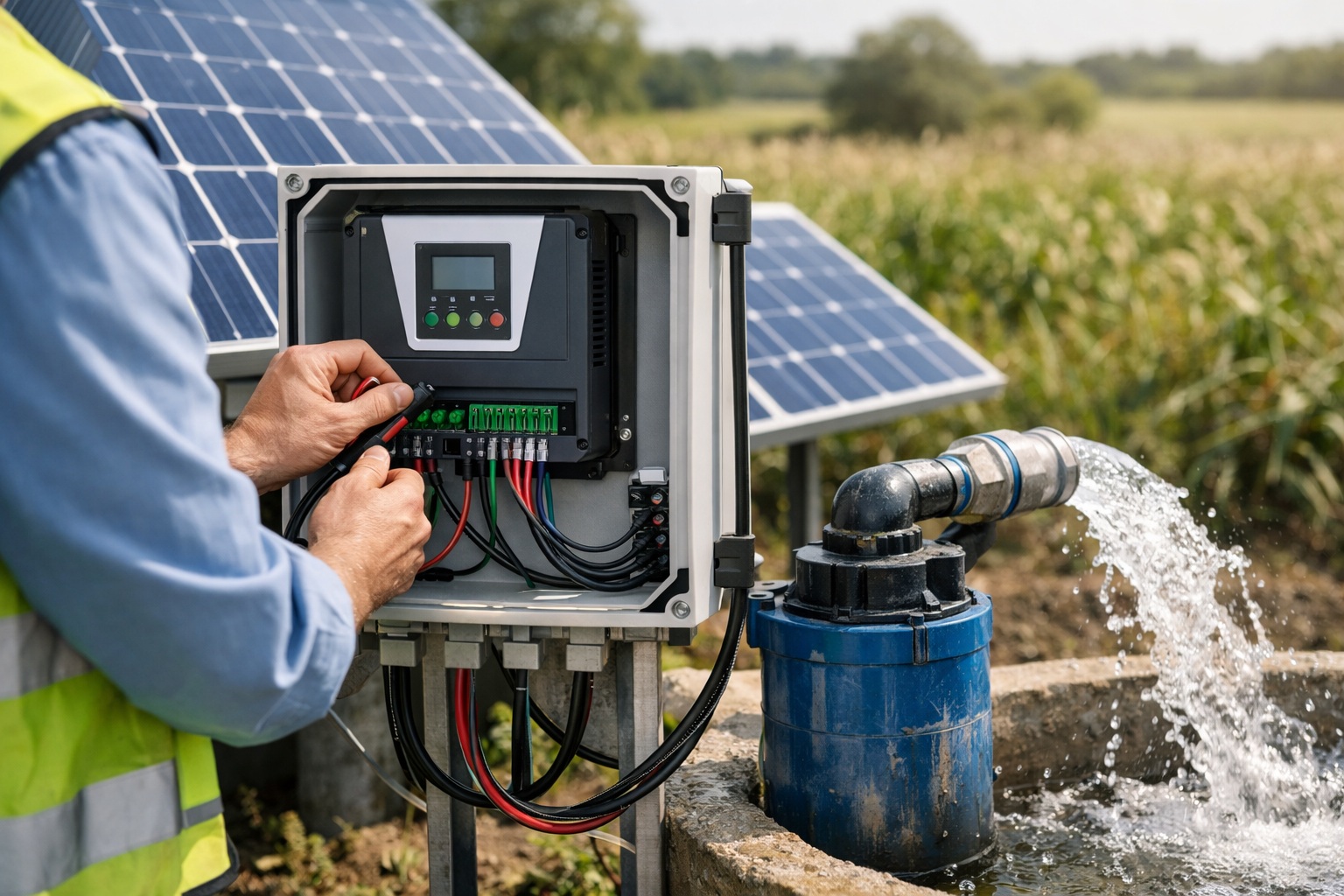
A direct solar pump system connects solar panels to a pump via a specialized controller.
The controller optimizes the sun's power, protects the pump motor, and ensures you get water whenever the sun shines, without needing batteries or an inverter for basic daytime operation.
With a modern solar pump system, the solar panels connect directly to the provided control box.
This control box is the 'brains' of the entire operation.
It harnesses the power collected by the solar panels to efficiently run the pump.
The controller's primary job is to perform Maximum Power Point Tracking (MPPT).
This smart technology constantly adjusts the electrical load to ensure the solar panels operate at their peak efficiency, squeezing every possible watt out of the available sunlight.
This means the pump can start earlier in the morning, run later in the evening, and perform better even on overcast days.
The controller also provides critical protection for the high-efficiency brushless DC (BLDC) motor inside the pump.
Motor Protection and Efficiency
The heart of a modern solar pump is its motor.
These systems use advanced BLDC permanent magnet motors, which boast efficiencies exceeding 90%.
That's a huge leap from traditional AC motors.
The controller protects this vital component from issues like:
- Over-voltage or under-voltage from the panels.
- Over-current and overheating.
- Running dry if the well's water level drops too low (when used with sensors).
This protection drastically extends the lifespan of the pump, ensuring reliable operation for more than 10 years in many cases.
The Components Working Together
Here is how the core parts of the system interact to deliver water.
| Component | Function | Key Benefit |
|---|---|---|
| Solar Panels | Capture sunlight and convert it into DC electricity. | Provides free, renewable energy. |
| MPPT Controller | Manages power, optimizes panel output, protects the motor. | Maximizes water output (up to 30% more) and pump lifespan. |
| BLDC Motor | Converts electrical energy into mechanical energy to drive the pump. | High efficiency (over 90%) means fewer panels are needed. |
| Pump End | The mechanical part that moves the water. | Different types are available for various needs (head, flow). |
This direct DC setup eliminates the need for a large, costly, and inefficient inverter, which is required to convert DC power to AC for a standard pump.
By keeping the entire system on DC power, you minimize energy losses, making the pump more responsive and cost-effective.
What Are the Main Types of Solar Pumps?
Your farm has unique water needs.
You worry that a single solar pump model won't be the right fit for your deep well or large-scale irrigation.
Solar pump portfolios offer specialized models for different needs.
From high-head screw pumps for deep wells to high-flow centrifugal pumps for irrigation, a specific solution exists.
The key is matching the pump type to your specific water depth, required volume, and water quality.
With the growing global demand for sustainable water solutions, a complete and competitive product portfolio has emerged.
This allows distributors to serve diverse markets and end-users to find the perfect fit.
The three most popular types of solar deep well pumps are all driven by high-efficiency BLDC motors, catering to a range of applications from Africa and the Americas to Australia and Asia.
1. The Solar Screw Pump: Master of Depth
This pump is the specialist for deep wells.
It uses a simple but effective design: a stainless steel screw (rotor) rotating within a rubber stator.
This action creates sealed cavities of water that are pushed progressively up the pipe.
- Best For: Low Flow, High Head (pressure).
- Applications: Domestic water supply for homes with very deep wells, livestock drinking water in remote pastures, and small-scale, high-pressure irrigation.
- Key Advantage: Exceptional ability to handle sandy or silty water without rapid wear. Its design is inherently sand-resistant. It can lift water from incredible depths where other pumps struggle.
2. The Solar Plastic Impeller Pump: The All-Rounder
This is a multi-stage centrifugal pump and is often the most cost-effective solution.
It uses a series of wear-resistant plastic impellers to move water.
Each stage adds pressure, allowing it to achieve a balance of good flow rate and moderate head.
- Best For: High Flow, Medium Head.
- Applications: Farm irrigation, pasture water management, and filling residential water tanks.
- Key Advantage: Delivers a high volume of water, making it perfect for irrigation. It's lightweight, economical, and offers excellent resistance to fine sand, making it a versatile workhorse.
3. The Solar Stainless Steel Impeller Pump: The Premium Choice
When water quality is a concern, this pump shines.
Both the pump body and the multi-stage impellers are made from SS304 or even SS316 stainless steel.
This makes it exceptionally durable in challenging conditions.
- Best For: High Flow, Corrosion Resistance.
- Applications: Water supply in areas with acidic or alkaline water, coastal regions with saltwater intrusion concerns, and for high-end homes or ranches demanding maximum reliability and water purity.
- Key Advantage: Superior corrosion resistance ensures a very long service life and protects water quality from contamination by rusty components.
| Pump Type | Primary Use Case | Flow Rate | Head/Pressure | Sand Resistance |
|---|---|---|---|---|
| Screw Pump | Deep Wells & Homes | Low | Very High | Excellent |
| Plastic Impeller | Farms & Irrigation | High | Medium | Good |
| Stainless Steel Impeller | Corrosive Water & High-End | High | Medium-High | Fair |
Understanding these differences is crucial.
Choosing the right pump avoids the frustration of low pressure from a pump not designed for your well's depth, or the premature failure of a pump not built for your water's chemistry.
What Are the Disadvantages of a Solar Water Pump?
You love the idea of free energy from the sun.
But you worry about what happens on cloudy days or when you need to water your crops at night.
The main drawback is their dependence on sunlight.
Solar pumps do not operate at night without an additional power source.
However, this is easily managed by pumping into a storage tank during the day or by using a hybrid power system.
While the benefits of solar pumping are immense, it's important to understand its limitations and how to plan for them.
The technology is fantastic, but it's not magic; it operates within the laws of physics and daily sun cycles.
Thinking through these potential issues beforehand ensures you design a system that is reliable 365 days a year.
The Night-Time Pumping Problem
The most obvious disadvantage is that solar panels need sunlight to generate electricity.
This means a standard, direct-to-panel system will not pump water when it is dark.
If your watering schedule requires irrigation in the early morning or late evening, you might find there isn't enough sunlight to run the pump at full power.
There are two excellent solutions to this:
- Water Storage: This is the most common and cost-effective strategy. Use the pump during peak sunlight hours (e.g., 10 a.m. to 4 p.m.) to fill a large water tank. You can then use gravity to feed water to your crops or home whenever you need it, day or night. It's a simple, reliable, and battery-free solution.
- Hybrid Power Systems: For applications where a tank is not practical, a hybrid controller is the answer. These controllers can accept both DC power from solar panels and AC power from the grid or a generator. The system will automatically prioritize solar power. If the sunlight fades or you need water at night, it seamlessly switches to the AC power source, guaranteeing a 24/7 water supply.
High Upfront Costs
Another factor to consider is the initial investment.
The upfront cost of a complete solar pump kit (pump, controller, and panels) can be higher than a conventional AC pump.
This can be a barrier for some farmers and homeowners.
However, it's crucial to look at the total cost of ownership over the pump's lifespan.
| Cost Factor | Conventional AC Pump | Solar DC Pump |
|---|---|---|
| Upfront Cost | Lower | Higher |
| Fuel/Electricity Costs | Continuous, ongoing expense | Zero |
| Maintenance | Regular servicing needed | Minimal (e.g., clean panels) |
| Lifespan | 5-10 years | 10-20+ years |
| Long-Term Cost | High | Low |
When you factor in the money saved on electricity bills (which often increase over time), the lack of fuel costs for diesel pumps, and the minimal maintenance, the solar pump almost always proves to be the cheaper option in the long run.
The payback period for the initial investment is often just 2-4 years.
After that, you are essentially getting free water for the remaining 10+ years of the pump's life.
Can I Power My Existing AC Pump with Solar?
You already have a good AC water pump.
You'd rather not pull it out of the well, and you're hoping to just add solar panels to save on electricity.
Yes, it's possible to power an existing AC pump with solar, but it's often less efficient and more expensive than a dedicated DC solar pump system.
It requires a special inverter or conversion kit to change the solar DC power to the AC power your pump needs.
We often get this question from customers who want the benefits of solar without the perceived hassle of installing a new pump.
While it is technically feasible, it's important to understand the trade-offs in efficiency and cost.
Powering an AC pump with solar introduces extra components and energy conversion steps that are not present in a native DC system.
The Efficiency Challenge
AC pumps powered by solar are inherently less efficient than DC pumps running on solar.
The reason is simple: energy conversion losses.
- Solar panels produce DC power.
- Your AC pump needs AC power.
- An inverter is required to convert DC to AC. This conversion process is not 100% efficient; you can lose 10-20% of your valuable solar energy as heat in the inverter.
This means you need to buy more solar panels to produce the same amount of water compared to an equivalent DC pump system.
For example, to run a 1HP AC pump, you might need a system that would be powerful enough for a 1.5HP DC pump.
This inefficiency translates directly into higher costs for both the extra panels and the larger inverter required.
The Conversion Kit Option
For those set on using their existing pump, specialized conversion kits are available.
These kits are designed to bridge the gap between solar panels and your AC pump.
The process depends on your pump's wiring.
- 3-Wire Pumps (3+G): Most deep well AC pumps are 3-wire. They have a separate control box on the surface. A solar conversion controller can often integrate with this setup, managing the power flow from the panels to run the pump motor. This would typically require a larger controller and more solar panels than a DC pump of the same horsepower.
- 2-Wire Pumps (2+G): These pumps have their starting components built into the motor down in the well. They are designed for a very specific AC power signature and are generally not compatible with the variable output of a standard solar conversion controller. The best, and often only, option here is to use a battery-based system with a large inverter that can create a stable AC signal, but this adds significant cost and complexity with batteries that have a limited lifespan.
Is It Worth It?
Let's compare the scenarios.
| Scenario | Components Needed | Pros | Cons |
|---|---|---|---|
| New DC Pump System | DC Pump, Controller, Panels | Highest efficiency, fewer panels, long life, simple wiring. | Requires installing a new pump. |
| AC Conversion (3-Wire) | Existing Pump, Conversion Kit, More Panels | Don't have to pull the pump. | Less efficient, higher cost for panels/controller, more complex. |
| AC Conversion (2-Wire) | Existing Pump, Inverter, Batteries, Panels | Don't have to pull the pump. | Least efficient, highest cost, complex, batteries need replacement. |
While you might save on the labor of installing a new pump, that one-time saving is often outweighed by the long-term costs of a less efficient system and the higher price of the conversion equipment.
In most cases, replacing the old AC pump with a new, super-efficient DC pump system is the "no-brainer" choice for long-term savings and reliability.
Conclusion
Connecting solar panels to a water pump is a viable and often superior solution, provided you use the right components and match the system to your specific needs.
FAQs
Can a solar pump run without a battery?
Yes, most solar pump systems are designed to run directly from solar panels during the day without batteries. They use a controller to manage power, and water is often stored in a tank.
How many solar panels are needed to run a water pump?
This depends on the pump's power (HP or kW), the well's depth, and your daily water needs. A small pump might need 2-3 panels, while a large irrigation pump could require 10 or more.
Do solar water pumps work on cloudy days?
Yes, they can work on cloudy days, but at a reduced flow rate. The MPPT controller helps maximize performance by using whatever sunlight is available.
What size solar pump do I need?
Sizing depends on total dynamic head (lift + pressure) and required flow rate (gallons per minute). It's best to use an online calculator or consult a specialist for accurate sizing.
How long do solar water pumps last?
A well-maintained solar pump system can last for many years. The solar panels are often warrantied for 25 years, and the pump motor can last over 10 years.
Can you run a 240v well pump on solar?
Yes, but it requires a large solar array and a powerful solar inverter or a specific AC pump controller to convert DC power from the panels to 240V AC. It's usually less efficient than a native DC pump system.
What is the advantage of a brushless DC motor in a solar pump?
Brushless DC (BLDC) motors are much more efficient (over 90%), reliable, and have a longer lifespan than traditional AC motors. They require less power, meaning you need fewer solar panels.
Do I need a technician to install a solar pump?
Many solar pump kits are designed for DIY installation. They come with detailed manuals and plug-and-play connectors. For deeper or more complex installations, professional help is recommended.