Tired of seeing your electricity bill skyrocket every summer?
Your pool pump is a major energy consumer, but solar power offers a cost-effective, eco-friendly solution to keep your pool sparkling.
Yes, you can absolutely run your pool pump with solar power.
This is one of the most practical applications for solar energy.
It aligns pump usage with peak sunlight hours, significantly cutting your electricity costs and reducing your carbon footprint.
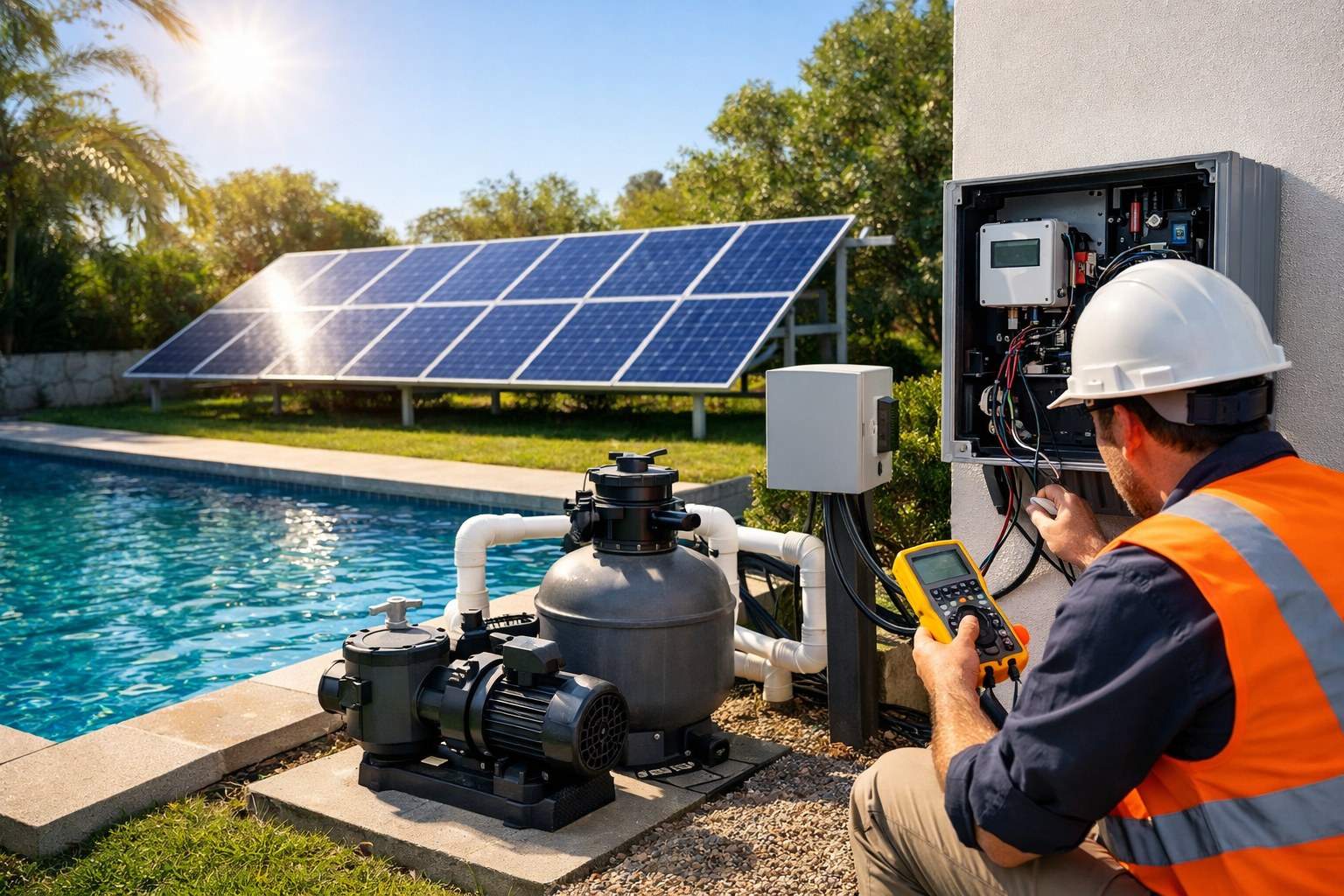
Running a pool pump on solar energy is not just a possibility; it's a smart financial decision.
A typical pool pump can be one of the most energy-intensive appliances in a home, often second only to an air conditioning system.
By harnessing the free, abundant energy from the sun, you can neutralize this major expense.
The technology has advanced significantly, making solar pump solutions more efficient, reliable, and accessible than ever before.
This guide will explore the different methods for powering your pump with solar, help you calculate your specific needs, and explain the core technology that makes it all possible.
Let's dive into how you can make a splash with solar.
How Do I Run My Pool Pump On Solar Power?
Struggling with the high cost of running your pool pump?
The constant hum of the motor is the sound of money draining from your bank account, especially during peak sun hours.
You have two primary options for powering your pool pump with solar.
You can either install a dedicated off-grid system with a DC solar pump or integrate it into a larger grid-tied solar system that powers your entire home.
Both paths lead to significant savings.
Choosing the right method depends on your specific situation, including your current energy setup, roof space, and local utility regulations.
Each approach has distinct advantages and potential drawbacks.
Understanding these differences is key to making an informed decision that maximizes your return on investment and ensures your pool stays clean without hassle.
Let's break down these two options in more detail.
Option 1: The Dedicated Off-Grid System
A dedicated system, also known as an "off-grid" setup, involves connecting a set of solar panels directly to a DC (Direct Current) solar pool pump.
This creates a self-contained circuit for your pool filtration.
The pump operates whenever the sun is shining on the panels, neatly aligning its run time with the time of day your pool needs the most filtration and sanitizing from the sun's UV rays.
This is a straightforward and highly effective solution.
The biggest advantage is complete independence from the electrical grid for your pool pumping needs.
Your energy bill for running the pump drops to zero.
Furthermore, because these panels are not connected to the grid, you often don't need utility permission to install them, and they don't count toward any size limits your utility may impose on grid-tied solar systems.
This can be a huge benefit in areas with restrictive solar policies.
| Feature | Off-Grid Dedicated System |
|---|---|
| Grid Dependence | None. Operates independently. |
| Energy Cost | $0 after initial investment. |
| Utility Permission | Generally not required. |
| Excess Energy | Any excess energy generated is not used. |
| Cloudy Day Performance | Pump may not run or will run at low speed. |
| Initial Cost | Requires purchasing a new DC pump and panels. |
However, there are considerations.
You must replace your existing AC pump with a specialized DC model.
Also, if the solar panels produce more energy than the pump needs, that excess power cannot be used by your home or exported to the grid.
Conversely, on very overcast days, the pump may not run for the required duration without a battery or grid backup option.
Option 2: The Integrated Grid-Tied System
The second option is to power your existing AC pool pump using a standard grid-tied solar system for your whole house.
If you install a sufficiently large solar array (typically 6kW or more), it can generate enough electricity to cover your home's regular consumption as well as the pool pump's needs during the day.
You simply set your pump's timer to run during peak sunlight hours, usually from around 10 AM to 4 PM.
The primary benefit here is efficiency.
Every kilowatt-hour of solar energy your panels produce is put to good use.
If your pump and other appliances don't use all the energy, the surplus is exported to the grid, often earning you a feed-in tariff or credit on your bill.
This method uses your existing pool pump, avoiding the cost and hassle of replacing it.
It's a holistic approach to home energy savings.
| Feature | Grid-Tied Integrated System |
|---|---|
| Grid Dependence | Yes. System is connected to the utility grid. |
| Energy Cost | Pump is powered by "free" solar, reducing grid usage. |
| Utility Permission | Required for system installation. |
| Excess Energy | Used by other appliances or exported to the grid for credit. |
| Cloudy Day Performance | Pump can draw power from the grid to complete its cycle. |
| Initial Cost | Part of a larger, more expensive home solar installation. |
The main drawback is that on cloudy days, your solar production might not be enough to cover both your home and the pump.
In these cases, the pump will automatically draw electricity from the grid, which will appear on your bill.
This approach also requires a significant upfront investment in a whole-home solar system and necessitates getting approval from your local electricity network to connect it to the grid.
How Many Solar Panels to Run a Pool Pump?
Worried about the complexity of sizing a solar system for your pump?
Guessing the wrong number of panels could lead to poor performance or wasted money, a frustrating outcome for any homeowner.
To determine the number of solar panels, you need to calculate your pump's daily energy use and divide it by your area's peak sun hours.
This calculation ensures you generate enough power.
Factoring in a small buffer for efficiency losses gives you the final number.
Sizing a solar array for your pool pump is a straightforward process based on simple math.
It's about matching the energy generation of your solar panels with the energy consumption of your pump.
Over-sizing the system means you've spent more than necessary, while under-sizing it will result in the pump not running long enough to keep your pool clean.
By following a few clear steps, you can confidently determine the ideal number of panels for your specific pump and location.
Step 1: Calculate Your Pump's Energy Consumption
The first step is to figure out how much electricity your pool pump uses.
This figure is the foundation for all subsequent calculations.
You can usually find the pump's power rating in either horsepower (HP) or watts (W) on its specification plate.
If it's in HP, you need to convert it to watts.
- Conversion: 1 Horsepower = 746 Watts
For example, a common 1.5 HP pool pump would have a wattage of:
1.5 HP * 746 W/HP = 1,119 Watts
Next, determine how many hours per day the pump needs to run.
This can vary by season; it might be 8 hours in summer but only 4-5 in winter.
Multiply the wattage by the daily run time to get the total daily energy consumption in watt-hours (Wh).
- Daily Energy Use (Wh) = Pump Wattage (W) × Daily Run Hours (h)
So, for our 1.5 HP pump running for 8 hours:
1,119 W * 8 h = 8,952 Wh or about 8.95 kilowatt-hours (kWh) per day.
Step 2: Determine Your Location's Peak Sun Hours
"Peak sun hours" is a critical metric that describes the intensity of sunlight in a specific location.
It's not just the number of daylight hours.
It's the equivalent number of hours when the sun's intensity is at its peak (1,000 watts per square meter).
Locations closer to the equator with clear skies have more peak sun hours.
This value is crucial because it tells you how much energy a solar panel can realistically generate in your area per day.
You can find this data from renewable energy labs or solar installer resources online.
For example, a sunny location like Arizona might get 6-7 peak sun hours, while a northern state like Vermont might only get 3.5-4.
Let's assume our example is in a location with 5 peak sun hours.
Step 3: Size the Solar System and Panels
Now you can calculate the total solar panel wattage required.
To do this, you first need to account for inevitable energy losses in the system, which can be around 15-25%.
These losses come from wiring, inverter efficiency, dust on the panels, and heat.
It's standard practice to add a buffer of at least 1.15 (a 15% increase) to your daily energy needs.
- Adjusted Daily Energy Need:
8,952 Wh * 1.15 = 10,295 Wh
Next, divide this adjusted energy need by your peak sun hours to find the total solar panel wattage you need.
- Total Solar Wattage = Adjusted Daily Energy Need (Wh) / Peak Sun Hours (h)
10,295 Wh / 5 h = 2,059 Watts
Finally, divide this total wattage by the wattage of the individual solar panels you plan to use.
Panels typically range from 300W to 500W.
If we choose 400W panels:
- Number of Panels = Total Solar Wattage / Single Panel Wattage
2,059 W / 400 W/panel = 5.15 panels
Since you can't buy a fraction of a panel, you would round up.
You would need 6 panels of 400W each.
What Is The Technology Behind Solar Pumps?
Confused by the technical jargon like BLDC, MPPT, and AC/DC hybrid?
Without understanding the core components, you might invest in a system that is inefficient or fails to meet your needs.
The heart of a modern solar pump is a high-efficiency Brushless DC (BLDC) motor, managed by an intelligent controller.
This combination maximizes the use of solar energy, ensures longevity, and provides reliable performance even in changing weather conditions.
The reason solar pumps have become so effective and popular is due to major advancements in motor and control technology.
It’s not just about hooking a panel to a pump anymore.
Modern systems are engineered for maximum efficiency and durability, allowing them to extract as much power as possible from every bit of sunlight.
Understanding these key technological components will give you a deeper appreciation for how these systems work and help you identify a high-quality product.
The Core: High-Efficiency BLDC Motors
At the center of every advanced solar water pump is a Brushless DC (BLDC) permanent magnet motor.
Unlike traditional AC motors or brushed DC motors, BLDC motors are exceptionally efficient, with efficiencies often exceeding 90%.
This is a game-changer for solar applications where every watt of power is precious.
Here’s why they are superior:
- No Brushes: Traditional motors use carbon brushes to transmit power, which wear down over time, create friction, and generate heat—all of which represent energy loss. BLDC motors use electronics to switch the motor's phases, eliminating this physical wear and boosting efficiency by over 25%.
- Permanent Magnets: They use powerful rare-earth magnets (like Neodymium iron boron) in the rotor. This creates a strong magnetic field without consuming electrical energy, unlike AC induction motors that must induce a magnetic field. This design results in higher torque and power density.
- Cooler Operation & Longer Life: With less friction and higher efficiency, BLDC motors run cooler and have a significantly longer lifespan, often rated for 20,000-30,000 hours of operation compared to just 2,000-5,000 hours for brushed motors.
The compact and lightweight design of these motors—often around 40% smaller and lighter than their AC counterparts—also simplifies installation and reduces material costs.
The Brains: Intelligent MPPT Controllers
A solar panel's power output (voltage and current) fluctuates constantly with sunlight intensity.
An MPPT (Maximum Power Point Tracking) controller is the intelligent electronic brain that manages this.
Its job is to continuously adjust the electrical load to find the "maximum power point" of the solar array.
This ensures the motor receives the optimal voltage and current at all times, maximizing the amount of water pumped.
An advanced MPPT controller can boost the water output of a system by up to 30% compared to a system without one.
It also provides critical protection for the motor against conditions like:
- Over-voltage and under-voltage
- Over-current and overload
- Dry running (with a water sensor)
- Phase loss
The Game-Changer: AC/DC Hybrid Capability
A major limitation of purely DC solar pump systems is their reliance on the sun.
On cloudy days or at night, they don't run.
This is where AC/DC hybrid technology comes in.
High-quality solar pump controllers are designed with dual power inputs.
You can connect both the solar panels (DC) and a grid power source or generator (AC) to the controller simultaneously.
The controller's logic is programmed to prioritize solar power.
When the sun is providing enough energy, the pump runs entirely on DC power.
If solar power drops due to a passing cloud, the controller seamlessly blends in just enough AC power to maintain the pump's speed.
When there's no solar input at all (like at night), it automatically switches over to full AC power.
This ensures you have a reliable water supply 24/7 without having to manually switch power sources.
Conclusion
Running your pool pump on solar is an effective way to cut energy costs.
By choosing between a dedicated DC system or an integrated AC setup, you can harness free energy from the sun.
FAQs
Can a solar pump run 24/7?
A standard solar-only pump runs when there is sunlight.
However, systems with AC/DC hybrid controllers can automatically switch to grid or generator power at night or on cloudy days for 24/7 operation.
How do I maintain a solar pool pump?
Maintenance is minimal.
You should keep the solar panels clean from dust and debris.
The brushless DC motors are maintenance-free, as they have no brushes to wear out and replace.
What happens to a solar pool pump on cloudy days?
On cloudy days, the pump will run at a slower speed or may stop if sunlight is insufficient.
AC/DC hybrid systems solve this by automatically supplementing with grid power to maintain performance.
Do I need a battery for my solar pool pump?
A battery is not required.
Most systems are designed to pump water when the sun is shining and store the "energy" as filtered water.
Batteries add significant cost and complexity.
What is the lifespan of a solar pool pump?
A high-quality solar pump with a BLDC motor can last for 20,000 to 30,000 hours of operation.
The solar panels themselves typically come with a 25-year performance warranty.
Can solar panels damage my pool pump?
No, a properly designed system will not damage your pump.
The controller regulates the voltage and current from the panels, protecting the motor from power surges, under-voltage, and other electrical issues.