Struggling to match a solar panel to your water pump?
Choosing the wrong one leads to poor performance, and potentially damages your pump, wasting your investment.
The best solar panel is one whose wattage is 20-30% higher than your pump's power requirement. For instance, a 1000W pump works best with a 1200W-1300W solar array. You must also match the system voltage (e.g., 24V, 48V) to ensure compatibility and optimal efficiency.
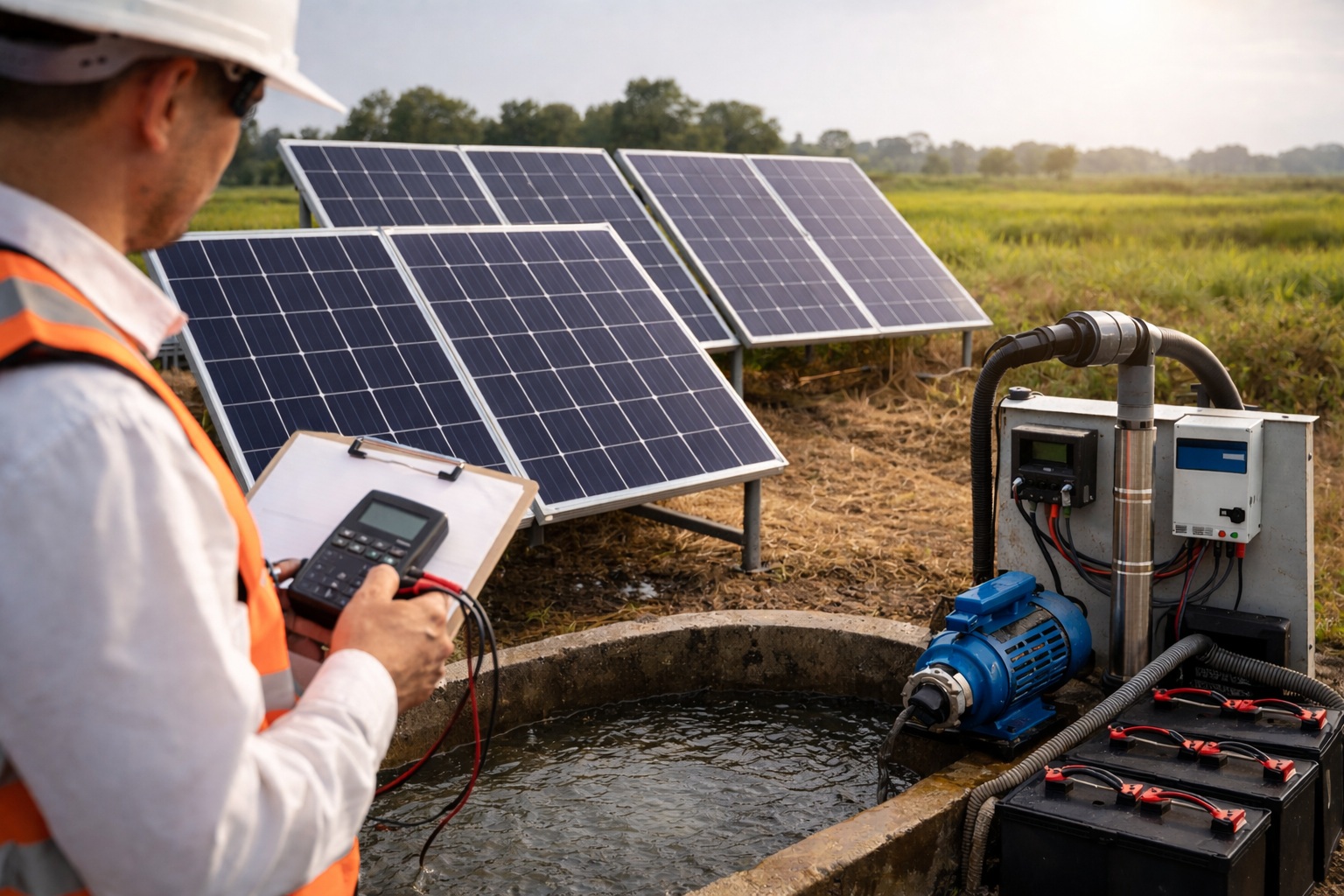
Choosing the right panel is more than just matching watts; it's about building a reliable and efficient system from the ground up.
To truly optimize your setup, you must first understand the heart of the system—the water pump itself.
The type of pump you use fundamentally determines the kind of power it needs.
Let's dive deeper into how your pump's design influences your solar panel selection.
Understanding Your Solar Water Pump First
Buying solar panels without knowing your pump is a huge gamble.
You might underpower it, leading to stalls and burnout, or waste money on an oversized array you don't need.
Before choosing panels, identify your pump type. Screw pumps for deep wells, plastic impeller pumps for high-volume irrigation, and stainless steel pumps for corrosive water each have different power demands. Knowing this first ensures you select a perfectly matched solar array, saving money and boosting performance.
Understanding your specific water pumping needs is the critical first step.
The application dictates the pump technology, and the pump technology dictates the solar panel requirements.
A pump designed for deep well extraction in Africa has a vastly different energy profile than one used for farm irrigation in the Americas.
Let's break down the most common types of solar deep well pumps to see how they directly impact your solar panel choice.
Solar Screw Pump: Powering High Head Applications
The solar screw pump is a workhorse for deep wells.
It uses a stainless steel screw encased in a rubber stator.
This design pushes water upwards through compression, much like a screw turning in a bolt.
This mechanism allows it to achieve very high head, meaning it can lift water from great depths.
However, this design results in a lower flow rate compared to other pump types.
- Typical Applications: Ideal for domestic water supply, providing drinking water for livestock, and small-scale irrigation projects where the water source is deep.
- Geographic Suitability: Highly effective in electricity-scarce regions like Africa and Latin America, where deep wells are common.
- Key Advantage: It handles sandy or silty water exceptionally well, with high resistance to abrasion. It can operate reliably in harsh water conditions where other pumps might fail.
- Limitation: The flow rate is limited, making it unsuitable for large commercial farms that require high volumes of water.
The power demand for screw pumps is tailored to overcoming high pressure.
This means they need a consistent voltage and current to maintain torque, especially during startup.
Your solar panel array must be sized to provide this steady power, even in less-than-perfect sunlight, to prevent the motor from stalling under heavy load.
| Feature | Specification | Impact on Solar Panel Choice |
|---|---|---|
| Pump Type | Progressing Cavity (Screw) | Requires panels that provide stable voltage to maintain torque. |
| Flow Rate | Low | Lower overall energy consumption per day. |
| Head (Lift) | Very High | Needs sufficient wattage to handle high-pressure startups. |
| Sand Resistance | Excellent | Reliable motor operation reduces risk of current spikes. |
Solar Plastic Impeller Pump: High Flow for Agriculture
When you need to move a lot of water, the solar plastic impeller pump is often the best choice.
This is a multi-stage centrifugal pump.
It uses a series of durable, engineered plastic impellers to accelerate water, delivering high flow rates at a medium head.
Its design is optimized for efficiency in high-volume applications.
- Typical Applications: Perfect for farm irrigation, large-scale pasture water supply, managing home gardens, and filling reservoirs.
- Geographic Suitability: Widely used in agricultural regions across Africa and the Americas where high water output is essential.
- Key Advantage: It provides excellent water output for its energy consumption. It also offers great resistance to fine sand, is lightweight, and is generally more economical than all-metal pumps.
- Limitation: It is less durable in highly corrosive water or for very deep wells, where pressure and chemical wear can degrade the plastic components over time.
Because these pumps are designed for high flow, their motors are often larger and require more wattage.
The solar array must be sized to meet this higher power demand, especially during the peak sunlight hours when irrigation is most needed.
An undersized array will cause the pump to run at a lower speed, significantly reducing its flow rate and efficiency.
Solar Stainless Steel Impeller Pump: Durability in Tough Conditions
For the most demanding environments, the solar stainless steel impeller pump offers superior quality and resilience.
This premium model features an SS304 stainless steel impeller and pump body.
This construction is specifically designed to withstand corrosive water conditions.
It delivers high flow rates and can handle medium-to-high head requirements.
- Typical Applications: Essential for areas with acidic or alkaline water tables, such as alkaline soil regions in Australia or parts of the Americas. Also used for high-end homes and ranches demanding long-term reliability.
- Key Advantage: It boasts exceptional corrosion resistance, ensuring a very long service life and high reliability. It can operate for years in water that would destroy lesser pumps.
- Limitation: This durability comes at a price. The pump is heavier and more expensive, targeting niche, high-end markets where water quality is a major concern.
Pumps with stainless steel components are heavier and require more energy to get started and maintain flow.
This translates to a need for a more robust solar panel array.
The initial power draw to overcome inertia is higher, so your solar controller and panels must be able to handle that peak load without faltering.
Sizing Your Solar Panel System
You've picked the right pump.
Now what?
Choosing panels that are too small will leave you with a trickle of water, while oversized panels are a waste of money.
To size your system, calculate the pump's daily energy need (Pump Watts x Run Hours). Divide this by your location's peak sun hours to find the required solar panel wattage. Finally, add a 25% margin to account for cloudy days and system inefficiencies.
Properly sizing your solar array is a crucial step that balances performance with cost.
It’s not just about a single number; it's about understanding the relationship between your pump's power needs, your geographic location, and the reliability you require.
A system designed for daily home use has different requirements than one for critical livestock watering.
Let's break down the key factors and calculations to ensure your system performs flawlessly.
Match the Power Requirements
The first rule of solar pump systems is simple: the solar panels must provide enough power to run the pump effectively.
This power is measured in watts (W).
- Check Pump Wattage: Every pump has a nameplate or manual that specifies its power rating in watts or horsepower (1 HP ≈ 746W). This is your starting point.
- Energy, Not Just Power: A 500W pump running for 6 hours needs 3,000 watt-hours (Wh) of energy. This is the total energy your solar panels must generate in a day.
- The 25% Rule: Always oversize your solar array by at least 25%. If your pump needs 1000W, aim for at least 1250W of solar panels. This buffer accounts for cloudy weather, panel degradation over time, and energy losses in the wiring and controller. This ensures the pump gets full power for maximum performance and longevity.
A pump that consistently receives less power than it needs will operate inefficiently.
It may struggle to start, run at lower speeds, or overheat, significantly shortening its lifespan.
Proper sizing protects your investment.
Consider Your Geographical Location
Where you install your system has a massive impact on its performance.
Solar panels don't produce their rated wattage all day long; they depend on the intensity and duration of sunlight.
This is measured in "Peak Sun Hours."
- Peak Sun Hours: This isn't just the number of daylight hours. It's the equivalent number of hours per day when solar irradiance averages 1,000 W/m². Locations closer to the equator might get 5-6 peak sun hours, while northern regions may only get 3-4.
- Seasonal Changes: Your location's peak sun hours change throughout the year. Size your system based on the season with the least sunlight when you still need water.
- Tilt and Orientation: For maximum output in the Northern Hemisphere, panels should face south. The optimal tilt angle is often equal to your latitude, but can be adjusted seasonally for even better performance. An incorrect orientation can reduce output by 15-20%.
You can find peak sun hour data for your specific location from online solar radiation databases.
Using this data is essential for accurate system sizing and avoids guesswork.
Ensure System Voltage Compatibility
Voltage is the electrical "pressure" in a system.
If the panel voltage doesn't match the pump and controller voltage, the system will not work correctly.
It might not work at all, or it could damage the components.
Most solar pump systems operate at standard voltages like 12V, 24V, 48V, or higher.
Your pump will have a specific voltage rating.
- Series vs. Parallel Connections: You can configure multiple solar panels to achieve the required system voltage.
- Connecting in Series (positive to negative) adds the voltages together but keeps the current the same. Two 12V panels in series create a 24V system.
- Connecting in Parallel (positive to positive, negative to negative) adds the currents together but keeps the voltage the same. Two 12V panels in parallel remain a 12V system but with double the amps.
Your solar pump controller is the bridge between the panels and the pump.
It is rated for a specific voltage input range.
Always ensure your panel array's voltage (Vmp) falls comfortably within the controller's accepted range.
The Core Technology: Why the Motor Matters
You can have the best pump and panels in the world.
But if the motor is inefficient, you're just wasting sunlight and money.
The motor is the true heart of the system. High-efficiency Brushless DC (BLDC) permanent magnet motors convert over 90% of electrical energy into mechanical power. This means you need fewer solar panels, reducing system cost by up to 30% while ensuring reliable performance.
In any solar pumping system, overall efficiency is king.
The component that has the single biggest impact on this is the motor.
It is the engine that drives the entire operation.
An inefficient motor acts like a leak in your energy bucket, forcing you to oversize your solar array just to get the job done.
This is why understanding the motor technology is not just for engineers—it's for anyone looking to build a cost-effective and dependable water solution.
Unlocking Efficiency with BLDC Permanent Magnet Motors
Almost all modern, high-quality solar pumps use a specific type of motor: the Brushless DC (BLDC) permanent magnet motor.
This technology is a game-changer for off-grid applications.
- High Efficiency: Unlike older brushed motors that lose energy to friction and heat, BLDC motors are electronically commutated. This results in efficiencies exceeding 90%. In contrast, a standard AC motor might only be 60-70% efficient.
- Powerful Magnets: They utilize powerful rare-earth magnets, like neodymium iron boron (NdFeB), in their rotors. This creates a strong magnetic field, generating higher torque with less electricity.
- Compact and Lightweight Design: High efficiency means less waste heat and a more compact design. A BLDC motor can be up to 47% smaller and 39% lighter than a traditional motor of the same power output. This simplifies installation, especially for deep well pumps.
- Long, Maintenance-Free Life: With no brushes to wear out, these motors are incredibly reliable and have a long service life, which is critical for installations in remote areas.
The Market Value of an Efficient Motor
The choice of motor technology has direct financial consequences.
A more efficient motor provides a significant competitive advantage.
It translates directly into savings for the end-user and a better product for distributors.
| Motor Benefit | Impact for Distributors | Impact for End Users |
|---|---|---|
| Higher Efficiency | A key selling point; presents a technologically superior product. | Reduces the number of solar panels needed, lowering initial cost. |
| Increased Torque | Pumps can start reliably even in low-light conditions. | More consistent water flow throughout the day. |
| Compact Size | Easier and cheaper to ship and handle inventory. | Simplifies installation and reduces labor costs. |
| Maintenance-Free | Fewer warranty claims and support issues. | Lower lifetime operating costs and greater reliability. |
This high-efficiency motor is the universal driver that elevates the performance of all pump types, whether it's a screw, plastic impeller, or stainless steel model.
When paired with an intelligent MPPT (Maximum Power Point Tracking) controller, the system can squeeze every last watt from the solar panels, maximizing water output from sunrise to sunset.
Considering an AC/DC Hybrid System
What happens when the sun doesn't shine?
For many, a lack of water on cloudy days or at night isn't an option.
An AC/DC hybrid system provides a 24/7 water solution. It prioritizes free solar power when available but can automatically switch to grid power or a generator during low-sunlight periods. This ensures you have a reliable water supply without interruption, maximizing both sustainability and convenience.
While a DC-only solar pump system is beautifully simple, its reliance on direct sunlight is a limitation for critical applications.
You may need to pump water for livestock at night, irrigate before sunrise, or simply ensure your home has water pressure during a week of rainy weather.
This is where hybrid technology provides the ultimate peace of mind.
A modern hybrid controller is designed with dual power inputs.
You can connect both your solar panel array and an AC power source (like the grid or a generator) to the controller simultaneously.
The controller's intelligent logic handles the rest.
- Solar Priority: By default, the system will always use the available solar power first. This is free, clean energy.
- Automatic Hybrid Function: When solar power is insufficient to run the pump at the required speed—for example, on an overcast day—the controller automatically blends in AC power to make up the difference. This maximizes the use of every available watt of solar energy before drawing from the grid.
- Full AC Takeover: When there is no solar input at all, such as at night, the controller seamlessly switches to 100% AC power.
- Uninterrupted Water: The transition is automatic and smooth. From the user's perspective, the water simply keeps flowing, regardless of the weather or time of day.
This approach offers the best of both worlds.
You get the cost savings and environmental benefits of solar power without sacrificing the 24/7 reliability of a traditional grid-tied pump.
It's an ideal solution for homes, farms, and businesses that cannot afford any downtime in their water supply.
Conclusion
Choosing the right solar panel starts with understanding your pump, motor efficiency, and daily water needs.
A properly sized system with a high-efficiency motor ensures you get a reliable, cost-effective water supply powered by the sun.
FAQs
-
How many solar panels are needed for a 1 HP water pump?
A 1 HP pump needs about 1200 watts. You would typically use four 300-watt panels or twelve 100-watt panels, allowing for system inefficiencies. -
Can I run a water pump directly from a solar panel?
Yes, but it's not recommended. A solar charge controller optimizes the power from the panel to the pump, improving performance and protecting the motor from damage. -
What size solar panel do I need to run a pool pump?
A typical pool pump needs 1500-2000W. You would want a solar array of at least 2000-2500W to run it effectively during peak sun hours. -
Do solar water pumps work on cloudy days?
They can work at reduced flow on overcast days. For full performance, you would need a battery bank or an AC/DC hybrid system that can switch to grid power. -
How do you calculate the solar panel size for a water pump?
Multiply the pump’s wattage by its daily run hours to get total watt-hours. Divide this by your area's peak sun hours to find the required panel wattage. -
What is the difference between a monocrystalline and polycrystalline panel for a pump?
Monocrystalline panels are more efficient and perform better in low light, making them ideal for smaller spaces or critical applications. Polycrystalline panels are less expensive but require more surface area. -
How long do solar water pump systems last?
Solar panels typically last 25 years or more. A high-quality BLDC pump and controller can last for over 10 years with minimal maintenance. -
Will a bigger solar panel make my pump work better?
Slightly oversizing your panel array (by 20-30%) is beneficial. However, a grossly oversized array won't significantly improve performance and could damage the controller if its voltage or current limits are exceeded.