Struggling with unreliable grid power for your water needs?
The cost and complexity of sizing a solar system can be overwhelming, leaving your water supply in question.
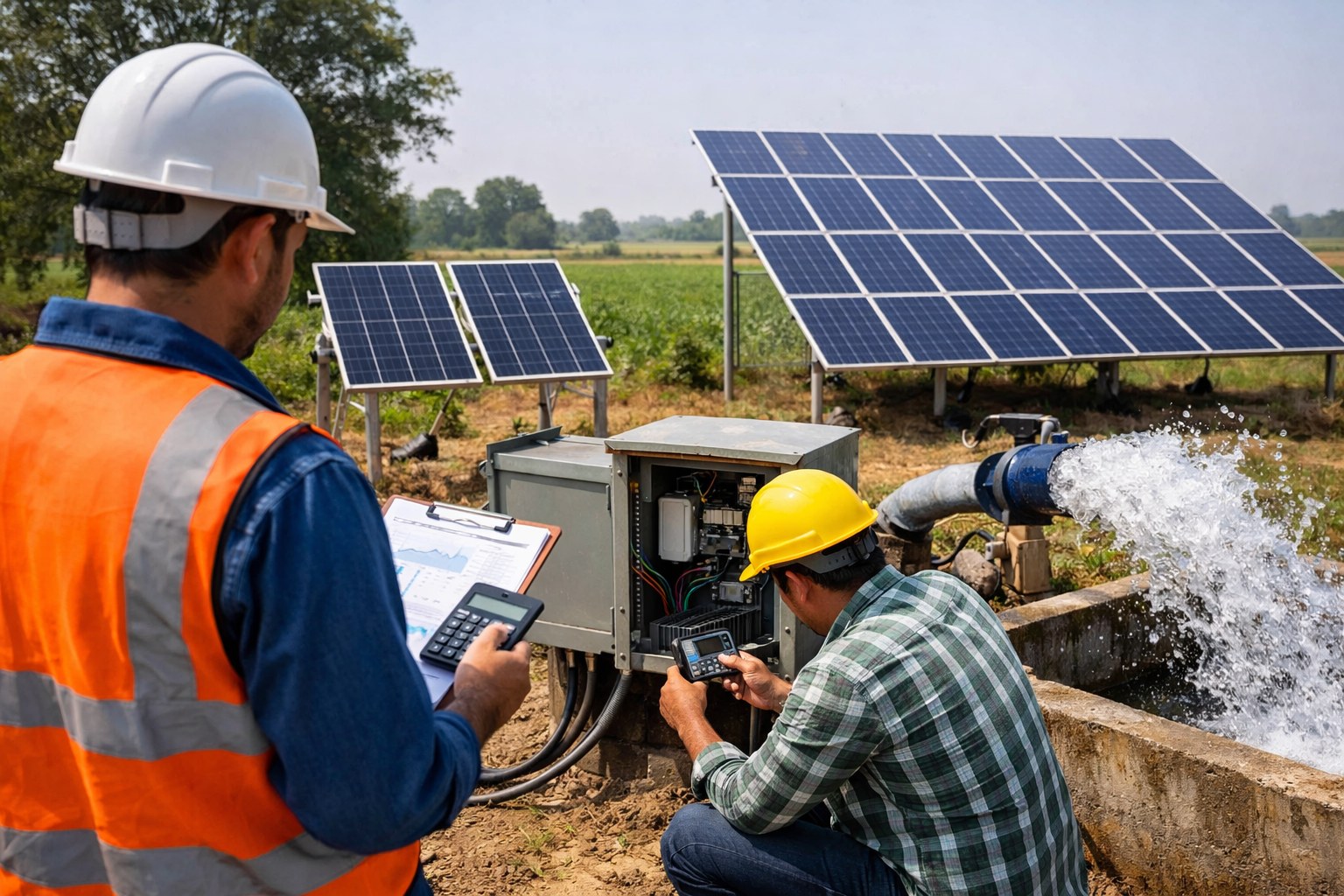
The number of solar panels depends on your pump's horsepower (HP), type (AC vs. DC), daily water volume needs, and your location's peak sun hours. A small 1/2 HP DC pump might need only two 100W panels, while a 5 HP AC pump could require twenty 375W panels or more.
But simply matching panels to a pump isn't the whole story.
The real key to a reliable and cost-effective system is understanding the technology inside the pump and the options available for different water conditions.
To make the best investment, you need to look beyond the panel count and consider the heart of the system.
Let's dive into the details that determine the perfect solar water pumping solution for your specific needs, ensuring you get it right the first time.
First, Let's Calculate Your Basic Power Needs
**Struggling to start your calculation?
The process begins with understanding your pump's daily energy consumption, not just its horsepower.
To accurately determine the number of panels, you must calculate the pump's total daily watt-hours, divide by your area's available peak sun hours, add a buffer for system inefficiencies, and then divide by the wattage of a single solar panel.**
Sizing a solar array isn't just guesswork; it's a straightforward calculation based on energy demand and supply.
By following a clear, step-by-step process, you can move from a simple pump rating to a precise number of panels.
This method removes uncertainty and ensures your system will perform reliably day after day.
It empowers you to design a system that is neither oversized and expensive nor undersized and ineffective.
Let's break down this essential calculation into five simple steps.
Step 1: Find Your Pump's Daily Energy Consumption
The first step is to quantify exactly how much energy your pump uses.
This starts with its power rating, which is usually in horsepower (HP).
To make it useful for solar calculations, you need to convert this to watts.
One horsepower is equivalent to approximately 745.7 watts.
So, for a 2 HP pump, the calculation is:
- Wattage = 2 HP × 745.7 = 1,491.4 watts
Next, determine how many hours the pump needs to run each day to meet your water requirements.
This can range from 4 hours for simple livestock watering to 8 hours for extensive irrigation.
If your 2 HP pump needs to run for 6 hours daily, the total energy consumption is:
- Daily Energy = 1,491.4 watts × 6 hours = 8,948.4 watt-hours (Wh), or about 8.95 kilowatt-hours (kWh).
This 8.95 kWh is the daily energy target your solar panels must produce.
Step 2: Determine Your Location's Peak Sun Hours
Solar panels don't produce their maximum rated power all day.
"Peak Sun Hours" is a metric that represents the number of hours per day when the sun's intensity averages 1,000 watts per square meter.
This value is crucial because it tells you how much energy a solar panel can realistically generate in your specific geographic location.
It varies significantly based on latitude and climate.
For example, a location in Arizona might get over 5.75 peak sun hours, while a location in Maine may only get 4.
You can find this data from national renewable energy lab resources.
| State | Peak Sun Hours | State | Peak Sun Hours |
|---|---|---|---|
| Arizona | 5.25 - 5.75+ | Ohio | < 4 - 4.25 |
| California | 4 - 5.75+ | Texas | 4.5 - 5.75+ |
| Florida | 4.75 - 5.5 | Maine | < 4 - 4.25 |
| Kansas | 4.25 - 5.25 | Washington | < 4 - 4.5 |
Step 3: Size the Required Solar Array
With your daily energy needs and peak sun hours known, you can calculate the minimum required size of your solar array in kilowatts (kW).
The formula is simple:
- Solar Array Size (kW) = Daily Energy Consumption (kWh) ÷ Peak Sun Hours
Using our previous example of an 8.95 kWh daily need in a location with 5 peak sun hours:
- Solar Array Size = 8.95 kWh ÷ 5 hours = 1.79 kW
This means you need a solar array capable of producing at least 1.79 kW of power under standard test conditions.
Step 4: Account for Real-World System Losses
In the real world, solar systems are never 100% efficient.
Energy is lost due to factors like dust on panels, power conversion in the controller, resistance in the wiring, and high temperatures.
These combined losses typically range from 10% to over 20%.
To ensure your system meets demand even in less-than-ideal conditions, it's standard practice to add a safety buffer.
A conservative buffer of 14% is often recommended.
- Adjusted Array Size = 1.79 kW × 1.14 = 2.04 kW
This adjusted size of 2.04 kW is the true power output your solar array needs to deliver.
Step 5: Calculate the Final Number of Panels
The final step is to determine how many individual solar panels are needed to create your adjusted array size.
This depends on the wattage of the panels you choose.
Solar panels commonly range from 100W for smaller systems to 400W or more for larger installations.
Let's assume you are using 375W panels.
- Number of Panels = Adjusted Array Size (in watts) ÷ Panel Wattage
- Number of Panels = 2,040 watts ÷ 375 watts = 5.44 panels
Since you can't install a fraction of a panel, you must always round up to the next whole number.
In this case, you would need 6 solar panels of 375W each to reliably run your 2 HP pump for 6 hours a day.
The Pump Itself: How DC vs. AC Affects Your Panel Count
**Confused about AC versus DC pumps?
The choice directly impacts system efficiency and the number of solar panels you'll need.
A DC pump designed for solar is far more efficient, requiring fewer panels than a standard AC pump adapted for solar.
For example, a 1/2 HP DC pump may run on 200 watts (2 panels), while a 1/2 HP AC pump needs around 800 watts (up to 8 panels) to do the same work.**
The type of pump you choose is one of the most significant factors in your solar system's design and cost.
It’s not just about moving water; it's about how efficiently that work is done using the limited power from your solar panels.
While a traditional AC pump can be retrofitted for solar, it inherently suffers from energy conversion losses.
A system built around a native DC pump is streamlined for solar from the ground up, delivering significant advantages in efficiency and simplicity.
Understanding this difference is crucial for any distributor or end-user aiming for an optimized, cost-effective water solution.
The Advantage of Solar-Native DC Pumps
Pumps specifically designed for solar power utilize a DC (Direct Current) motor.
This is a critical advantage because solar panels naturally produce DC electricity.
The power flows directly from the panels, through an efficiency-optimizing controller, and to the DC pump motor.
This direct pathway minimizes energy losses that occur when converting DC power to AC.
These pumps are built with efficiency as the top priority.
They often use high-efficiency permanent magnet brushless DC (BLDC) motors, which can achieve operational efficiencies exceeding 90%.
Because of this ultra-high efficiency, a DC pump can perform the same amount of work (pumping a certain volume of water to a certain height) with significantly less power.
This means you can achieve your water goals with a smaller, less expensive solar array.
For example, a small DC pump for livestock can often run on as little as 200 watts, requiring just two 100W panels.
Using Classic AC Pumps with Solar
Many existing wells are already equipped with standard AC (Alternating Current) pumps, which are designed to run on grid power.
It is possible to run these pumps on solar, but it requires additional hardware.
The DC power from the solar panels must be converted into AC power to match the pump's motor.
This is done using a specialized solar controller or a large inverter.
The conversion process itself consumes energy, immediately reducing the overall system efficiency by 5-15% compared to a DC system.
Consequently, to power an AC pump, you need a larger solar array to compensate for both the pump's lower inherent efficiency and the energy lost during DC-to-AC conversion.
A 1/2 HP AC pump may require 800 watts or more, while a large 10 HP AC system could need over 10,000 watts (10 kW) of solar panels.
Why Motor Technology is the Deciding Factor
At the heart of pump efficiency is the motor.
The use of Brushless DC (BLDC) permanent magnet motors is a game-changer for the solar pump industry.
Unlike traditional motors, BLDC motors use powerful magnets (like Neodymium iron boron) and an intelligent electronic controller instead of friction-prone brushes.
This design results in several key benefits:
- Extreme Efficiency: With efficiencies often over 90%, very little solar energy is wasted as heat. This directly translates to needing fewer solar panels, reducing the system's upfront cost and physical footprint.
- High Torque: They provide strong power even at low speeds, which is ideal for starting up on a cloudy morning or with limited sunlight.
- Compact & Lightweight: These motors can be up to 47% smaller and 39% lighter than conventional motors of the same power output, simplifying transportation and installation.
- Durability and Low Maintenance: The absence of brushes to wear out means a much longer operational life and virtually zero maintenance, a critical feature for pumps installed in remote, off-grid locations.
For a distributor, offering pumps with advanced BLDC motors provides a clear competitive advantage.
It allows you to sell a more efficient, reliable, and cost-effective system to your customers.
Choosing the Right Pump Type for Your Water Needs
**Think all pumps are the same?
The wrong pump type can lead to poor performance and premature failure, even with enough solar panels.
You must match the pump's design to your specific water conditions.
A solar screw pump excels in deep wells with low flow needs, a plastic impeller pump is ideal for high-volume irrigation with fine sand, and a stainless steel impeller pump is essential for corrosive water.**
Beyond the motor, the pump-end mechanism itself—the part that actually moves the water—is designed for specific applications.
Choosing the right type is just as important as calculating your panel needs.
A system with a perfectly sized solar array will still fail if the pump is mismatched with the well's depth, the required flow rate, or the water's quality.
A versatile product portfolio that includes different pump types allows distributors to solve a wider range of customer problems effectively.
Let's explore the three most popular solar deep well pump designs and where each one performs best.
1. Solar Screw Pump: The Deep Well Specialist
The solar screw pump, also known as a progressing cavity pump, is engineered for one primary purpose: achieving high head (lifting water from great depths).
It uses a single helical stainless steel screw (rotor) that rotates inside a rubber stator.
This action creates sealed cavities that move progressively up the pump, pushing the water column ahead of them.
- Best For: Deep, low-yield wells, domestic water supply, and livestock watering in arid regions. It's an ideal solution for parts of Africa and Latin America where water tables are very deep.
- Key Advantage: Its design makes it exceptionally resistant to sand and sediment, as it can handle abrasive particles without significant wear. It can generate very high pressure to overcome deep static water levels.
- Limitations: This design provides a relatively low flow rate. It is not suitable for applications that demand a large volume of water quickly, such as flood irrigation for large farms.
| Feature | Solar Screw Pump |
|---|---|
| Principle | Progressing Cavity |
| Best Application | Deep wells, domestic use |
| Flow Rate | Low |
| Head (Lift) | Very High |
| Sand Resistance | Excellent |
2. Solar Plastic Impeller Pump: The High-Flow Workhorse
This is a multi-stage centrifugal pump designed to deliver high volumes of water.
It uses a series of stacked impellers, made of durable, engineered plastic, that spin at high speed.
Each stage (impeller and diffuser) adds pressure to the water, pushing it higher while maintaining a strong flow rate.
This design offers a balance of performance and economy.
- Best For: Farm irrigation, filling large storage tanks, pasture water supply, and other applications where high GPM (gallons per minute) is the priority. It's widely used across the Americas and Africa for agriculture.
- Key Advantage: It delivers a much higher flow rate than a screw pump at medium head levels. The materials provide good resistance to fine sand, and the pump is lightweight and more economical than its stainless steel counterpart.
- Limitations: The plastic components may not have the longevity of stainless steel in very deep wells (due to high pressure) or in chemically aggressive water.
3. Solar Stainless Steel Impeller Pump: The Premium Durability Option
This pump operates on the same multi-stage centrifugal principle as the plastic impeller model but is constructed with superior materials.
The entire pump end, including the impellers, diffusers, and pump body, is made from SS304 or higher-grade stainless steel.
This construction makes it the ultimate choice for durability and longevity, especially in harsh environments.
- Best For: Water sources with corrosive properties (acidic or alkaline pH), geothermal wells, high-end residential water systems, and installations in regions with alkaline soil, like parts of Australia.
- Key Advantage: Exceptional resistance to corrosion, rust, and abrasion, ensuring a very long service life and high reliability. It can handle high flow rates and medium-to-high head conditions without degradation.
- Limitations: The use of stainless steel makes this pump heavier and carries a higher upfront cost, positioning it as a premium solution for specialized or demanding applications.
| Pump Type | Best For | Flow Rate | Head | Key Feature |
|---|---|---|---|---|
| Screw Pump | Deep Wells, Homes | Low | High | Sand Resistance |
| Plastic Impeller | Farms, Irrigation | High | Medium | Economical, Wear-Resistant |
| Stainless Steel Impeller | Corrosive Water | High | Medium-High | Corrosion Resistance |
Beyond the Sun: Ensuring Water 24/7
**Worried about cloudy days or needing water at night?
Standard solar pumps only run when the sun is shining.
To ensure a continuous, 24/7 water supply, you need a system with a backup power source.
Modern hybrid AC/DC controllers automatically switch to grid or generator power when sunlight is insufficient, while battery systems store solar energy for on-demand use anytime, day or night.**
For many applications, such as household water supply or critical livestock watering, a "sun-up to sun-down" pumping schedule is not enough.
Water must be available on demand, regardless of the weather or time of day.
This is where advanced system design becomes essential.
The solution isn't always just adding more panels.
Instead, intelligent controllers and energy storage provide the reliability needed for mission-critical water access.
These technologies transform a basic solar pump into a complete, worry-free water security system.
Option 1: The Hybrid AC/DC Controller
The most flexible and robust solution for uninterrupted water is a hybrid AC/DC pumping system.
This system is built around a sophisticated controller designed with two power inputs: one for DC power from the solar panels and another for AC power from the electrical grid or a backup generator.
- How It Works: The intelligent controller continuously monitors the power available from the solar panels.
- Automatic Prioritization: It is programmed to always prioritize solar power. When the sun is shining brightly, the pump runs 100% on free solar energy.
- Hybrid Function: If cloud cover reduces solar input, the controller can blend AC power with the available DC power to maintain the pump's performance, maximizing the use of every bit of solar energy.
- Automatic Switchover: When the sun sets or during extended periods of bad weather, the controller seamlessly and automatically switches over to the AC power source. When the sun returns, it switches back to solar.
This technology provides the best of both worlds: the cost savings and energy independence of solar, combined with the 24/7 reliability of the grid. There is no manual switching required; the system manages itself, ensuring you have water whenever you need it.
Option 2: Battery Backup Systems
For locations that are completely off-grid, a battery bank is the traditional solution for 24-hour power.
This setup uses a charge controller to direct excess solar energy generated during the day into a bank of deep-cycle batteries.
- How It Works: During peak sun hours, the solar array powers the pump and simultaneously charges the batteries.
- Nighttime Operation: At night or on cloudy days, the pump draws stored energy from the batteries to operate. You can take a shower or water livestock in the middle of thenight using power that was captured hours earlier.
- Sizing Considerations: Battery systems require careful sizing. You need enough solar panels to both run the pump and fully recharge the batteries each day. You also need enough battery capacity to cover your water needs for a set number of "days of autonomy" (days without sun).
- Winter Challenges: In climates with short winter days and frequent overcast weather, systems must be significantly oversized. This often means adding 30-50% more panels just to keep the batteries charged, which increases the system's overall cost and complexity.
While effective, battery systems add expense, maintenance (batteries have a limited lifespan of 5-10 years), and another layer of complexity compared to the simplicity of a hybrid AC/DC controller.
Conclusion
Calculating the number of solar panels is a crucial starting point, but true system performance hinges on matching the pump type to your water conditions and choosing a high-efficiency motor to minimize costs and maximize reliability.
FAQs
1. How many solar panels does it take to run a 1 hp pump?
A 1 HP DC pump may need 4-6 panels (~800W), while a 1 HP AC pump could require 8-10 panels (~1500W) due to lower efficiency.
2. Can I run a well pump directly from solar panels?
Yes, you can run a DC well pump directly from solar panels through a controller, which optimizes power and protects the pump motor.
3. How much does a solar powered well pump cost?
Costs vary widely, from a few hundred dollars for a small DIY kit to thousands for a high-capacity, professionally installed deep well system.
4. How many watts does it take to run a well pump?
A small 1/2 HP pump might use 500-800 watts, while a larger 2 HP pump can draw 2000-2500 watts while running.
5. How long will a solar pump last?
A quality solar pump system can last 20+ years. The pump and motor may last 10-15 years, while solar panels are often warrantied for 25 years.
6. Do solar water pumps work on cloudy days?
Yes, they can work at reduced speed on cloudy days. For full power, a hybrid AC/DC system or a battery backup is needed.
7. Can a solar pump fill a tank?
Absolutely. Many systems are designed to pump water to a storage tank during the day, providing a gravity-fed water supply 24/7.