Struggling with unreliable water access in a remote area?
You need a consistent water supply but extending the grid is too expensive, and generators are a constant hassle.
This creates daily uncertainty for your crops and livestock.
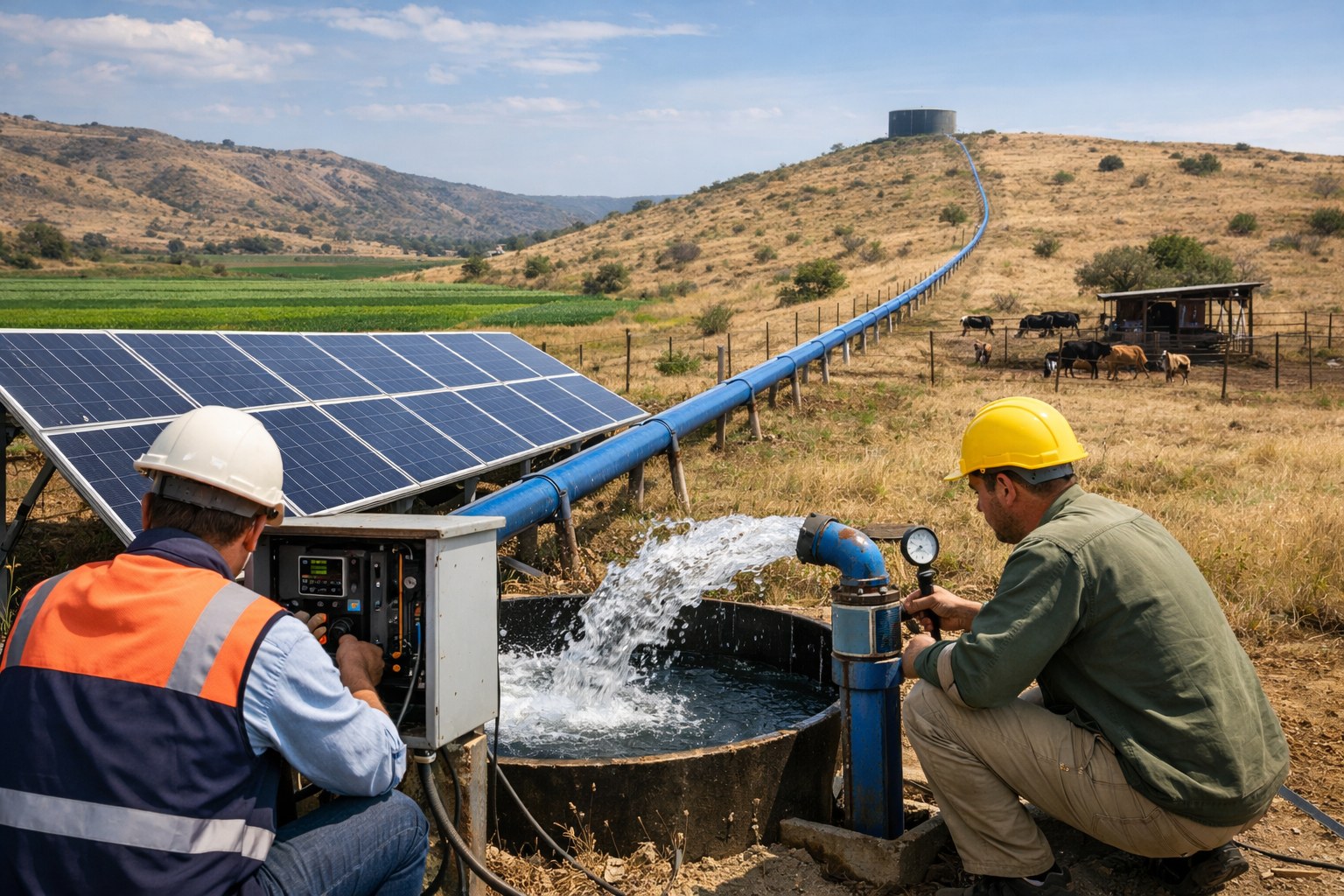
A good solar water pump can push water very far, often over 700 meters horizontally.
This distance depends heavily on the pump's power, the vertical lift (head), and pipe diameter.
A 2 HP pump is a common choice for these long-distance applications.
Understanding how far a solar pump can move water is critical.
It is not just about one number.
It involves a balance between vertical height, horizontal distance, and the volume of water you need.
Getting this calculation wrong can lead to an inefficient system that fails to meet your needs.
This guide will break down all the essential factors.
You will learn how to choose the right pump to deliver water exactly where you need it, ensuring your farm or home has a reliable supply.
How Do I Choose the Right Water Pump?
Choosing a pump feels complicated with so many options.
You worry about picking one that is too weak for your well or too powerful for your needs, wasting money.
This indecision can delay your project and prolong water shortages.
To choose the right pump, first measure your well's depth and calculate your daily water demand.
For wells deeper than 25 feet, you need a submersible pump.
For surface water or shallow wells, a centrifugal pump is better.
Selecting the perfect pump goes beyond just depth.
It requires a deeper look into your specific application, water quality, and long-term goals.
A mismatch can lead to premature pump failure or insufficient water flow, especially during peak demand.
Required Flow Rate And Pressure
Your pump must handle "peak demand."
This is the time of day when you use the most water.
For example, you might be irrigating fields and watering livestock at the same time.
A typical cattle operation might need between 8 to 12 Gallons Per Minute (GPM) just to keep troughs full.
If you use sprinklers for irrigation, constant pressure is key.
Most sprinkler systems require 30 to 50 PSI to distribute water evenly across a field.
Calculating your total required flow rate and pressure ensures you select a pump that never leaves you short on water.
Pump Type: Deep Well VS. Shallow Well
The depth of your water source is the deciding factor.
It determines whether you need a submersible or a surface pump.
-
Deep Well (Submersible Pump): This is the ideal solution for water sources deeper than 25 feet (about 7.6 meters).
The pump is lowered directly into the well.
It pushes water up, making it highly efficient for high vertical lifts.
These pumps are self-priming and operate silently underground. -
Shallow Well (Centrifugal Pump): This pump is best for surface water sources like ponds, rivers, or wells less than 25 feet deep.
It sits above ground and pulls water using suction.
These pumps prioritize high volume over high lift.
They are easier to access for maintenance but need protection from weather.
The choice depends entirely on your water source's characteristics.
Matching the Pump to Water Conditions
The type of water pump an also depends on water quality.
Not all water is the same, and the right pump material can dramatically extend its lifespan.
-
Solar Screw Pump: This pump is perfect for low-flow, high-head applications.
It uses a stainless steel screw to push water.
This design is highly resistant to sand and can operate in harsh water conditions, common in deep wells.
It's ideal for domestic water supply or livestock drinking in areas with deep aquifers. -
Solar Plastic Impeller Pump: This is a multi-stage centrifugal pump designed for high flow and medium head.
Its durable plastic impeller offers excellent resistance to fine sand.
This makes it a great, economical choice for farm irrigation or pasture water supply where water output is the priority.
However, its durability can be limited in highly corrosive water. -
Solar Stainless Steel Impeller Pump: This premium model uses SS304 stainless steel for both the impeller and pump body.
It is specifically designed for corrosive water environments, such as areas with acidic or alkaline water.
This pump offers high corrosion resistance and a very long service life, making it suitable for high-end applications.
| Pump Type | Best For | Flow Rate | Head (Lift) | Key Advantage |
|---|---|---|---|---|
| Screw Pump | Deep wells, sandy water | Low | High | High sand resistance |
| Plastic Impeller | Farm irrigation, high volume | High | Medium | Economical & wear-resistant |
| Stainless Steel Impeller | Corrosive water, premium use | High | Medium-High | High corrosion resistance |
How Much Water Does a Pump Move?
You need a specific amount of water daily.
You worry that a solar pump's output will be inconsistent, especially on cloudy days.
This uncertainty makes it hard to plan your irrigation or ensure livestock have enough water.
A 1 HP submersible pump typically moves 8.8 to 15.4 GPM (2.0 to 3.5 m³/h).
A 1 HP surface pump can move up to 44 GPM (10 m³/h).
Output depends on vertical lift; the higher the lift, the lower the flow rate.
The amount of water a pump delivers is not a single, fixed number.
It is a variable figure influenced by several critical factors.
Understanding these factors will help you accurately predict your daily water yield and size your system correctly.
The interplay between pump design, environmental conditions, and system setup determines the final flow.
Typical Flow Rate
Flow rate is always a trade-off with pressure, or "head."
A pump designed to push water very high will naturally have a lower flow rate than one designed to move large volumes at ground level.
-
Submersible Pumps: These are built for high "lift."
They excel at pushing water up from deep wells, sometimes over 95 meters.
Because so much energy is used for vertical lift, their flow rate is generally lower.
A 1 HP model typically delivers between 2.0 to 3.5 cubic meters per hour. -
Centrifugal (Surface) Pumps: These are built for high "volume."
They operate with very little vertical lift.
This allows them to move a much larger amount of water horizontally.
A 1 HP model can move between 1.6 to 10 cubic meters per hour.
Their strength lies in transferring surface water quickly over distances.
Factors Affecting Water Output
Several dynamic factors influence a solar pump's daily water output.
Getting these right is crucial for a reliable system.
-
Total Dynamic Head (TDH): This is the most important calculation.
It is the sum of the vertical lift (how high you are pushing the water) plus all friction loss from the pipes.
As TDH increases, the flow rate will always decrease.
A pump operating at 40 meters of head will produce significantly more water than the same pump at 95 meters. -
Solar Irradiance: A solar pump's output is directly tied to the sun's intensity.
Peak flow happens during "Peak Sun Hours," usually from 10 AM to 3 PM.
On a bright sunny day, the pump may operate at 100% of its rated capacity.
However, on a cloudy day, the output might drop to 30-50%.
This variability is why sizing the system correctly for your region's climate is essential. -
Outlet Pipe Size: The diameter of your discharge pipe has a huge impact.
Using a pipe that is too small creates high "back pressure" from friction.
For example, if your pump has a 1.25-inch outlet but you connect it to a 0.75-inch hose, you are forcing the motor to work much harder.
This drastically reduces the volume of water that actually reaches your destination.
Always use a pipe diameter that matches or exceeds the pump's outlet size for long distances.
How Many Watts Does a Pump Use?
Worried about the high cost of powering a water pump?
Grid electricity is expensive or unavailable, and generators consume a lot of fuel and require frequent maintenance.
This makes traditional pumping methods unsustainable and costly.
A 1 HP solar pump motor runs very efficiently, typically using 800 to 900 watts.
In contrast, a standard 1 HP AC pump uses 1,100 to 1,400 watts.
The solar pump's DC motor is designed for maximum efficiency with solar panels.
Understanding power usage is fundamental to designing an efficient and cost-effective solar pumping system.
It is not just about the pump's horsepower rating.
The true energy requirement depends on the motor's technology.
This directly impacts the number of solar panels you need and the overall system cost.
Core Power: The BLDC Motor
The engine behind modern solar pumps is the Brushless DC (BLDC) permanent magnet motor.
This is the core technology that makes solar pumping so efficient.
-
High Efficiency: BLDC motors achieve efficiencies exceeding 90%.
This is significantly higher than their AC counterparts.
This means more of the sun's energy is converted directly into water pumping power. -
Advanced Design: The rotor uses high-strength materials like 40SH neodymium iron boron magnets.
This creates powerful torque in a compact size.
A BLDC motor can be up to 47% smaller and 39% lighter than a traditional motor of the same power. -
Market Value: The high efficiency reduces the number of solar panels needed to run the pump.
This lowers the initial investment cost.
The motor's design is maintenance-free and ensures a long service life, reducing operational costs over time.
This advanced motor technology is the key to the entire system's performance and competitiveness.
Power Usage: AC vs. DC Pumps
The difference in power consumption between AC and DC pumps is significant, especially for off-grid applications.
| Feature | 1 HP DC Solar Pump | Traditional 1 HP AC Pump |
|---|---|---|
| Power Source | Direct Solar Panels | Grid Power / Generator |
| Running Watts | 800W – 900W | 1,100W – 1,400W |
| Starting Surge | Soft-start (no surge) | High (3x to 5x running watts) |
| Energy Efficiency | Very High (90%+) | Standard |
| Infrastructure | Panels + Controller | Grid connection or Large Generator |
A DC solar pump is engineered from the ground up for solar power.
It runs directly from the panels without needing an expensive, power-wasting inverter.
The soft-start technology eliminates the massive power surge that AC motors require to get started.
To run a 1 HP AC pump on solar, you would need an oversized power system just to handle the 3,000W–4,000W starting surge.
This makes a dedicated DC solar pump a much more practical and cost-effective solution for off-grid water pumping.
Hybrid AC/DC Systems
For ultimate reliability, an AC/DC hybrid solar pump offers the best of both worlds.
This system provides water 24/7, regardless of the weather.
It has inputs for both solar panels (DC) and grid power or a generator (AC).
The intelligent controller prioritizes solar power automatically.
When sunlight is sufficient, the pump runs entirely on solar energy.
If clouds reduce the solar input, the controller automatically blends in AC power to maintain performance.
When there is no sunlight at all, like at night, it seamlessly switches to the AC power source.
This ensures an uninterrupted water supply for critical applications.
How Far Can a Pump Push Water Vertically?
You have a very deep well.
You're concerned that a solar pump won't have enough power to lift water from the bottom.
This doubt might make you stick with expensive, less reliable traditional pumping methods.
High-quality solar deep well pumps can handle extreme depths.
Many systems are designed for a Total Dynamic Head (TDH) of up to 1,000 feet (over 300 meters).
This capability ensures reliable water from even the deepest aquifers.
Understanding a pump's vertical lift capability is about more than just its maximum depth rating.
It involves calculating the "Total Dynamic Head" (TDH), which is the total pressure the pump must overcome.
This calculation is the foundation for sizing your pump correctly to ensure it delivers the water you need without stalling.
Calculating Total Dynamic Head (TDH)
TDH is the true measure of the workload on your pump.
It is the total equivalent height that water must be lifted.
-
Static Water Level: This is the distance from the ground surface down to the water level in your well before pumping begins.
This is your primary vertical lift. -
Elevation Change: If your storage tank is on a hill or elevated stand, you must add this height to the static water level.
For example, if your tank is 20 feet above the wellhead, you add 20 feet to your TDH. -
Pipe Friction Loss: As water moves through pipes, it creates friction, which is equivalent to adding more vertical lift.
The longer the pipe and the smaller its diameter, the greater the friction loss.
A general rule is that every 100 meters of horizontal pipe adds about 5 to 10 meters of equivalent head. -
Pressure Tank Addition: If you are pumping directly into a pressure tank, you must account for the pressure setting.
You add 2.31 feet of head for every 1 PSI of pressure.
A standard 40 PSI tank adds roughly 92.4 feet (about 28 meters) to your TDH calculation.
The final TDH is the sum of all these factors.
You must choose a pump that can deliver your required flow rate at that specific TDH.
Matching Pump Models to Depth
Different pump models are engineered for different depths and volumes.
A manufacturer's product line is often categorized by its performance characteristics.
-
Standard Submersible Pumps: These are typically 3-inch or 4-inch pumps designed for common well depths, often up to 300 feet (about 91 meters).
They offer a balanced performance of flow and head for most residential and small farm applications. -
High Head "ProD" Models: These are specialized pumps designed for extremely deep wells.
They prioritize head over volume.
A "ProD" (Pro Deep) model might deliver a lower volume of water but can push it from depths of 1,000 feet or more.
These are essential for regions with very deep water tables. -
High Volume "ProV" Models: These pumps are designed for applications that require more water at shallower depths.
A "ProV" (Pro Volume) model offers a higher flow rate but has a lower maximum head.
They are ideal for irrigation or filling large reservoirs from wells that are not exceptionally deep.
By understanding your TDH, you can confidently select the right pump model from a professional product line to perfectly match your well's depth and your water needs.
Conclusion
A solar pump’s ability to move water depends on power, head, and pipe size, not just distance.
Matching the right pump type to your specific needs guarantees an efficient, reliable water supply.
FAQs
What size solar pump do I need?
The size depends on your daily water needs and the Total Dynamic Head (TDH).
Calculate these two factors first to determine the required horsepower and flow rate.
Can a solar pump fill a tank overnight?
No, a standard solar pump only operates when there is sunlight.
For overnight operation, you would need an AC/DC hybrid system or a battery bank.
How do you calculate the size of a solar water pump?
Calculate your required daily water volume (gallons or liters) and your Total Dynamic Head (TDH).
Use these figures to consult a pump performance curve to find a matching model.
How long do solar water pumps last?
A high-quality solar pump system can last for many years.
The BLDC motors are designed for over 10 years of life, and solar panels often last 25 years.
Do solar pumps work on cloudy days?
Yes, they work on cloudy days but at a reduced flow rate.
Output might drop to 30-50% of their peak capacity depending on the cloud cover.
Can a solar pump run without a battery?
Yes, most solar water pumps are designed to run directly from solar panels without batteries.
They pump water whenever the sun is shining.
How many solar panels are needed for a 2 HP water pump?
A 2 HP (1500W) pump typically requires about 1800W to 2000W of solar panels.
This ensures sufficient power even in less-than-ideal sunlight conditions.
What is the maintenance of a solar water pump?
Maintenance is very low.
Periodically clean the solar panels and check electrical connections.
The submersible pump itself is generally maintenance-free.