Struggling with high electricity bills or unreliable water access in off-grid areas?
The solution can seem expensive.
A complete solar borehole pump kit typically costs between $1,600 and $3,500 for most residential or small farm wells.
However, prices can range from $900 for very shallow wells to over $10,000 for deep, high-volume agricultural or industrial applications.
The final cost depends on well depth and required water flow.
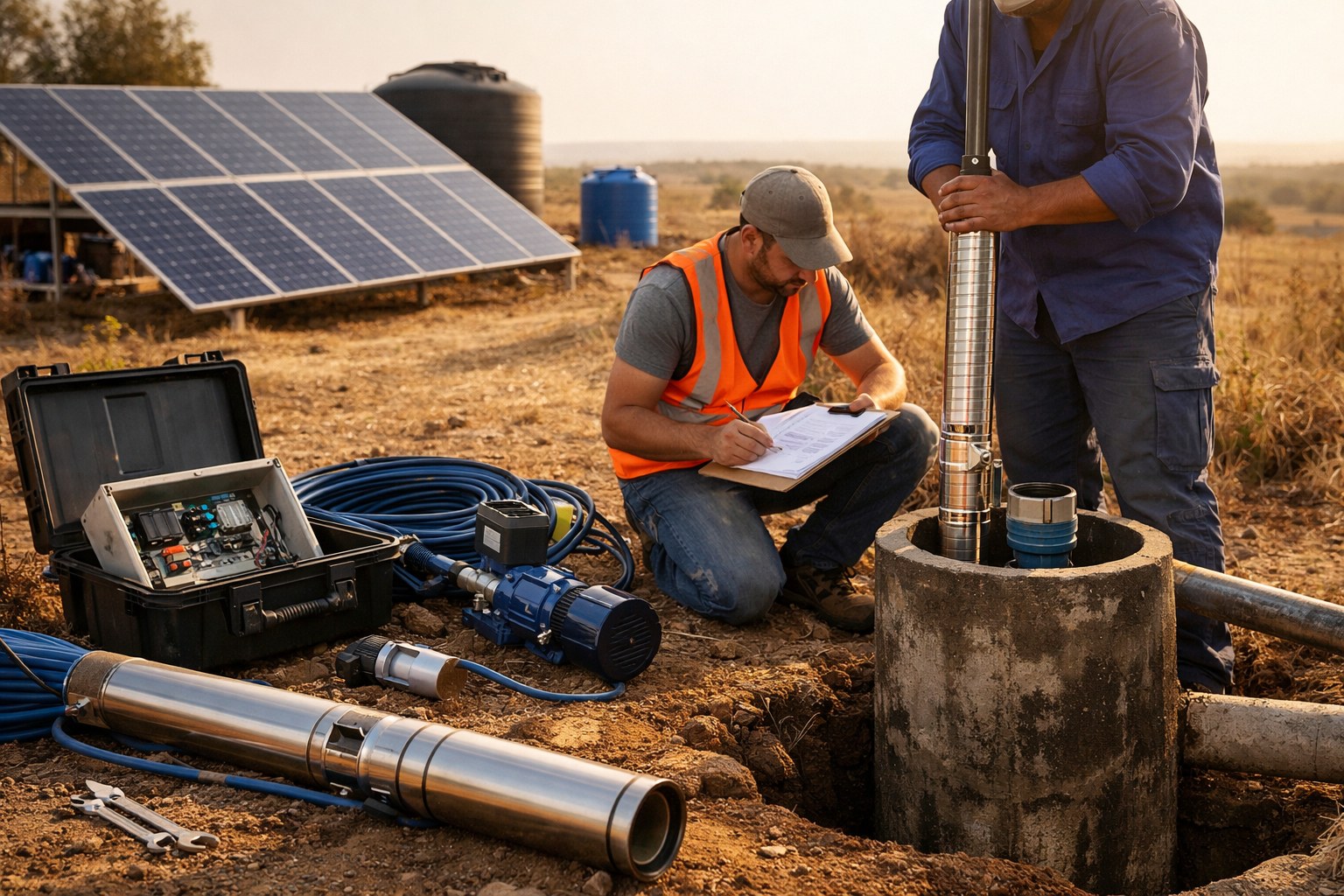
Understanding the cost of a solar borehole pump system requires looking beyond the initial price tag.
It's an investment in long-term water security and operational savings.
This article will break down the key factors that influence the total cost, from the pump itself to the solar panels and installation.
We will explore the different types of pump technologies available.
This will help you make an informed decision that balances performance, durability, and budget for your specific needs.
Let's dive into what truly determines the price of reliable, solar-powered water.
Factors That Influence Solar Borehole Pump Costs
Are you trying to budget for a solar pump but find the price variations confusing?
The well's depth and your daily water needs are the biggest cost drivers.
The primary factors determining the cost of a solar borehole pump system are the well depth (total dynamic head), the required flow rate (gallons per minute), and the size of the solar panel array needed to power the pump.
These three elements dictate the pump's size and specifications.
The cost of a solar pump system is not a single number but a calculation based on specific site requirements.
A deeper well requires a more powerful pump to lift the water, which in turn demands more energy from a larger solar panel array.
Similarly, a higher flow rate for applications like large-scale irrigation requires a more robust pump and more power.
Let's break down these core components to see how they directly impact your final investment.
Well Depth and Total Dynamic Head (TDH)
The deeper you need to pump from, the more power is required.
This is the single most significant factor in pump cost.
The pump must overcome gravity and friction to lift water to the surface.
This total resistance is known as Total Dynamic Head (TDH).
TDH isn't just the depth of your well; it also includes the vertical height the water needs to be pushed above ground to a storage tank, plus any pressure losses from friction in the pipes.
A pump for a 150-foot well will be substantially less expensive than one designed for a 600-foot well, as the latter requires a much stronger motor and more robust internal components.
A more powerful motor requires more watts, which means more solar panels are needed.
This creates a compounding effect on the overall system cost.
| Well Depth (Feet) | Typical System Cost Range |
|---|---|
| 0–150 | $1,600 – $2,000 |
| 150–300 | $2,500 – $3,000 |
| 300–800+ | $3,500 – $10,500+ |
As the table shows, the price escalates significantly with depth.
For extremely deep wells (over 400 feet), you may also need to factor in the cost of specialized installation equipment, like a boom truck, which adds to the project budget.
Flow Rate (Gallons Per Minute - GPM)
Your daily water requirement determines the necessary flow rate.
A system for livestock may need a continuous, slow trickle throughout the day.
In contrast, an irrigation system might require a high volume of water in a short period.
The flow rate, measured in Gallons Per Minute (GPM), dictates the size and type of the pump's "wet end"—the part with the impellers or screw that actually moves the water.
Higher GPM pumps have larger, more complex wet ends and require more powerful motors to drive them.
For example, a 5 GPM pump might suffice for a small household.
However, a commercial farm could require a pump capable of 100 GPM or more.
This difference in capacity leads to a significant price difference, not just for the pump but for the entire power system.
It's a common mistake to oversize a pump, leading to unnecessary upfront costs.
Conversely, undersizing a pump will result in inadequate water supply and potentially cause the motor to overwork and fail prematurely.
Calculating your peak water demand is a critical step in the sizing process.
A quick method for homes is to count one GPM for every major water fixture (taps, showers, etc.).
This ensures you select a pump that meets your needs without overspending.
Solar Panel Array Size
The pump's power demand dictates the number of solar panels you need.
The motor at the heart of the solar pump has a specific wattage rating.
The solar panel array must be large enough to provide this power, even on days with less-than-perfect sunlight.
For example, a small 200-watt pump might only need two 100-watt solar panels.
A larger 800-watt pump would require at least eight 100-watt panels.
Solar panels are typically priced per watt, often ranging from $1.00 to $1.50 per watt.
Therefore, the cost of the solar array can be a substantial portion of the total system price.
A 200-watt array might cost $200-$300.
An 800-watt array could cost between $800 and $1,200.
Don't forget the mounting hardware, which can add another $200 to $2,000 depending on the size and type of mount (pole mount, ground mount, etc.).
The efficiency of the pump's motor plays a crucial role here.
A high-efficiency motor, like a Brushless DC (BLDC) motor with over 90% efficiency, requires fewer solar panels to do the same amount of work as a less efficient motor.
This can lead to significant savings on the overall system cost.
Understanding Different Solar Pump Technologies
Confused by terms like "screw pump" and "centrifugal"?
Each pump type is designed for a specific job: high lift or high flow.
The three most common types of solar borehole pumps are screw pumps, plastic impeller centrifugal pumps, and stainless steel impeller centrifugal pumps.
Each uses a high-efficiency BLDC motor but is engineered for different depths, flow rates, and water conditions, directly affecting their cost and suitability.
Choosing the right solar pump technology is as important as sizing it correctly.
The internal mechanism of the pump determines its performance characteristics.
A pump designed for a deep, sandy well in Africa will be very different from one intended for a shallow, corrosive well in Australia.
Understanding the strengths and weaknesses of each type ensures you invest in a solution that is not only cost-effective but also durable and reliable for your specific environment.
Let's examine how these different technologies work and where they fit best.
Solar Screw (Helical Rotor) Pumps: Low Flow, High Head
This pump is the specialist for deep wells.
It uses a simple, effective design.
A stainless steel screw (the rotor) turns inside a rubber stator.
This action creates sealed cavities that move water upward with each rotation.
This mechanism is excellent at creating high pressure.
This allows the pump to lift water from extreme depths, often exceeding 800 feet.
However, this design limits the volume of water it can move.
Its flow rate is typically lower than that of a centrifugal pump.
The main advantage of a screw pump is its resilience.
It handles sandy or silty water better than impeller pumps, as there are fewer delicate parts to wear out.
This makes it ideal for newly drilled boreholes or areas with challenging water quality.
| Feature | Specification |
|---|---|
| Best Application | Deep wells (300-800+ ft), high sand content |
| Flow Rate | Low (e.g., 2-10 GPM) |
| Head/Lift Capability | Very High |
| Primary Markets | Domestic water, livestock watering in arid regions |
| Main Advantage | High sand resistance, deep lift capability |
| Limitation | Not suitable for high-volume irrigation |
Because of their specialized application for high-lift scenarios, these pumps are a cost-effective solution for providing essential water for homes and livestock where other pumps simply cannot reach.
Solar Plastic Impeller Pumps: High Flow, General Purpose
This is the workhorse for many farms and ranches.
It's a multi-stage centrifugal pump.
Water is drawn in and accelerated by a series of rotating impellers.
Each impeller and diffuser stage adds more pressure, pushing the water higher.
Using engineered plastic for the impellers offers a great balance of performance and cost.
These pumps can deliver high flow rates at shallow to medium depths (up to about 300-400 feet).
They are perfect for applications like farm irrigation, filling large stock tanks, or supplying water to a multi-bathroom home.
The plastic used is highly wear-resistant, especially against fine sand.
This feature gives them a long service life in typical well conditions.
They are also lighter and more economical to produce than their stainless steel counterparts.
This makes them a popular and competitive choice in markets across the Americas and Africa.
Their main limitation is in very deep wells where high pressure can stress the components, or in highly corrosive water that could degrade the materials over time.
For most standard agricultural and residential applications, they represent the best value proposition.
They provide high water output for a moderate investment.
Solar Stainless Steel Impeller Pumps: Premium, Corrosion-Resistant
When durability is non-negotiable, this is the premium choice.
This pump operates on the same centrifugal principle as the plastic impeller model.
However, its key components—the impellers, diffusers, and pump body—are constructed from SS304 or higher-grade stainless steel.
This construction gives it superior resistance to abrasion and corrosion.
It is specifically designed for harsh water environments.
This includes water with acidic or alkaline properties, or high levels of dissolved minerals.
These conditions are often found in certain regions of Australia or the Americas.
While the initial cost is higher than a plastic impeller pump, the investment pays off in longevity.
In a corrosive well, a stainless steel pump can last years longer than a plastic alternative, avoiding costly replacements and downtime.
These pumps are also capable of achieving high flow rates at medium-to-high heads.
They are the preferred option for high-end residential systems, critical commercial operations, and any application where water quality could compromise lesser materials.
They represent a long-term investment in reliability and uninterrupted water supply.
The Core Technology: BLDC Permanent Magnet Motors
Having trouble deciding which pump to buy?
Focus on the motor—it's the engine that drives performance and savings.
All modern, high-quality solar pumps are powered by a Brushless DC (BLDC) permanent magnet synchronous motor.
This core technology is the key to their high efficiency (often over 90%), which reduces the number of solar panels needed and lowers the overall system cost.
The pump's wet end (screw or impellers) gets a lot of attention, but the motor is the true heart of the system.
An efficient motor converts more solar electricity into water-pumping power, wasting very little as heat.
This is the single biggest factor in the system's long-term performance and cost-effectiveness.
Older, cheaper pumps often use brushed motors, which are inefficient and wear out quickly.
The switch to BLDC motor technology revolutionized the solar pumping industry, making it a viable and reliable solution for users worldwide.
Let's break down why this motor technology is so crucial.
High Efficiency and Its Impact on Cost
An efficient motor directly translates to cost savings.
A BLDC motor can be up to 47% smaller and 39% lighter than a traditional AC motor of the same power output.
More importantly, its efficiency rating of over 90% is a massive improvement over brushed DC motors (60-75%) or standard AC motors.
What does this mean for your budget?
A high-efficiency motor requires less input power to achieve the same water output.
This means you can power your pump with a smaller, less expensive solar panel array.
For example, a pump system with a 92% efficient motor might only need 800 watts of solar panels.
A similar system with a 75% efficient motor could require 1000 watts of panels to do the same job.
That 200-watt difference in solar panels could save you hundreds of dollars on the initial purchase.
Over the 25-year lifespan of the solar panels, these energy savings are substantial.
The high-torque design of BLDC motors also means they start up reliably, even in low-light conditions, maximizing your water pumping time each day.
Durability and Maintenance-Free Operation
BLDC motors are designed for a long, service-free life.
The "brushless" design is the key.
In older brushed motors, small carbon blocks (brushes) make physical contact with the rotor to deliver power.
These brushes wear down over time, just like a pencil nib, and eventually, the motor fails.
They are the single most common point of failure.
BLDC motors have no brushes to wear out.
Power is delivered electronically, creating a rotating magnetic field that turns the rotor.
The rotor itself is made of powerful permanent magnets, like neodymium iron boron.
There are no touching parts to wear down, resulting in a motor that is exceptionally reliable and requires no maintenance.
This is a critical feature for a pump installed hundreds of feet down a borehole in a remote location.
The cost and difficulty of pulling a pump for service make motor reliability a top priority.
Investing in a pump with a high-quality BLDC motor ensures peace of mind and protects you from the expense and hassle of premature pump failure.
The Smart Controller and Hybrid Power Options
What happens on a cloudy day or at night?
Without a smart system, your water stops flowing.
Modern solar pump systems include an intelligent MPPT controller that maximizes solar energy use.
Many now also offer AC/DC hybrid capability, allowing the system to automatically switch to grid or generator power when sunlight is insufficient, ensuring a 24/7 water supply.
A solar pump is more than just a pump and a panel.
The controller is the brain of the operation.
It manages the flow of power from the solar panels to the motor, ensuring the pump runs efficiently and is protected from damage.
Early solar pump systems were simple direct connections, which were inefficient and unreliable.
The development of Maximum Power Point Tracking (MPPT) controllers dramatically improved performance.
The latest evolution is the hybrid controller, which addresses the primary limitation of solar power: its intermittency.
This technology makes solar pumping a truly dependable, round-the-clock water solution.
MPPT: Maximizing Every Ray of Sunshine
An MPPT controller is an electronic DC-to-DC converter.
It constantly adjusts the electrical operating point of the solar panels to extract the maximum available power.
Solar panels have a "maximum power point" that varies with sunlight intensity and temperature.
The MPPT controller finds this sweet spot and holds it, boosting efficiency by up to 30% compared to a direct connection.
This efficiency gain means the pump can start earlier in the morning and run later in the evening.
It can even continue to pump at a reduced speed on overcast days.
By squeezing every available watt from your panels, an MPPT controller ensures you get the most water possible from your solar investment.
It also provides crucial protections for the motor, such as safeguards against over-voltage, over-current, and running dry.
This intelligent management extends the life of the entire system.
AC/DC Hybrid: The 24-Hour Water Solution
For applications where a constant water supply is critical, the AC/DC hybrid controller is a game-changer.
This controller has two power inputs: one for the DC power from your solar panels and another for an AC power source, like the utility grid or a backup generator.
The controller's logic is designed to prioritize solar power.
When there is enough sunlight, the system runs 100% on free solar energy.
If clouds roll in and the solar power drops, the controller can blend in just enough AC power to maintain the required pump speed, maximizing the use of any available solar energy.
When the sun goes down or during extended periods of bad weather, the controller automatically switches entirely to the AC source.
This provides a seamless and uninterrupted water supply without any manual intervention.
This hybrid functionality offers the best of both worlds: the cost savings and energy independence of solar, combined with the absolute reliability of grid or generator power.
Conclusion
The cost of a solar borehole pump is a direct investment in reliable, off-grid water.
Prices are shaped by well depth, water needs, and the right technology for your environment.
FAQs
How many solar panels does it take to run a well pump?
Typically, two to eight 100-watt panels are needed for standard residential or farm pumps.
The exact number depends on the pump motor's wattage requirement.
How long do solar water pumps last?
A quality solar borehole pump system can last 10 to 20 years.
The BLDC motors are exceptionally durable, and solar panels are often warrantied for 25 years.
Can a solar pump fill a water tank?
Yes, this is a very common and efficient application.
The pump fills a storage tank during the day, and gravity provides water pressure on demand, day or night.
Do solar pumps work on cloudy days?
Yes, but at a reduced flow rate.
The MPPT controller optimizes the low available light to keep the pump running, though a hybrid system may be needed for full power.
What is the maintenance on a solar pump?
Solar pump systems are nearly maintenance-free.
The brushless motor has no parts to wear out, and solar panels may only need occasional cleaning to remove dust or debris.
Is a solar well pump a good investment?
Yes, for off-grid properties or areas with high electricity costs.
They eliminate monthly power bills and offer a reliable water source with a very low operating cost.
Can I install a solar well pump myself?
Yes, many companies offer DIY kits for shallow wells (under 100-150 feet).
However, deeper wells often require professional installation and specialized equipment for safety.
What is the difference between a solar pump and a normal pump?
The main difference is the motor.
Solar pumps use highly efficient DC motors designed to run on solar power, while normal pumps typically use less efficient AC grid-powered motors.