Struggling with unreliable water access in a remote location?
The cost and hassle of fuel-powered pumps can be overwhelming.
Solar water pumps offer a dependable, cost-effective, and green solution.
To choose a solar pump, first determine your daily water needs and total dynamic head (TDH), which is the total height the water must be lifted.
Then, select a pump type—submersible for deep wells or surface for ponds—and match it with a motor and solar array that meet your requirements.
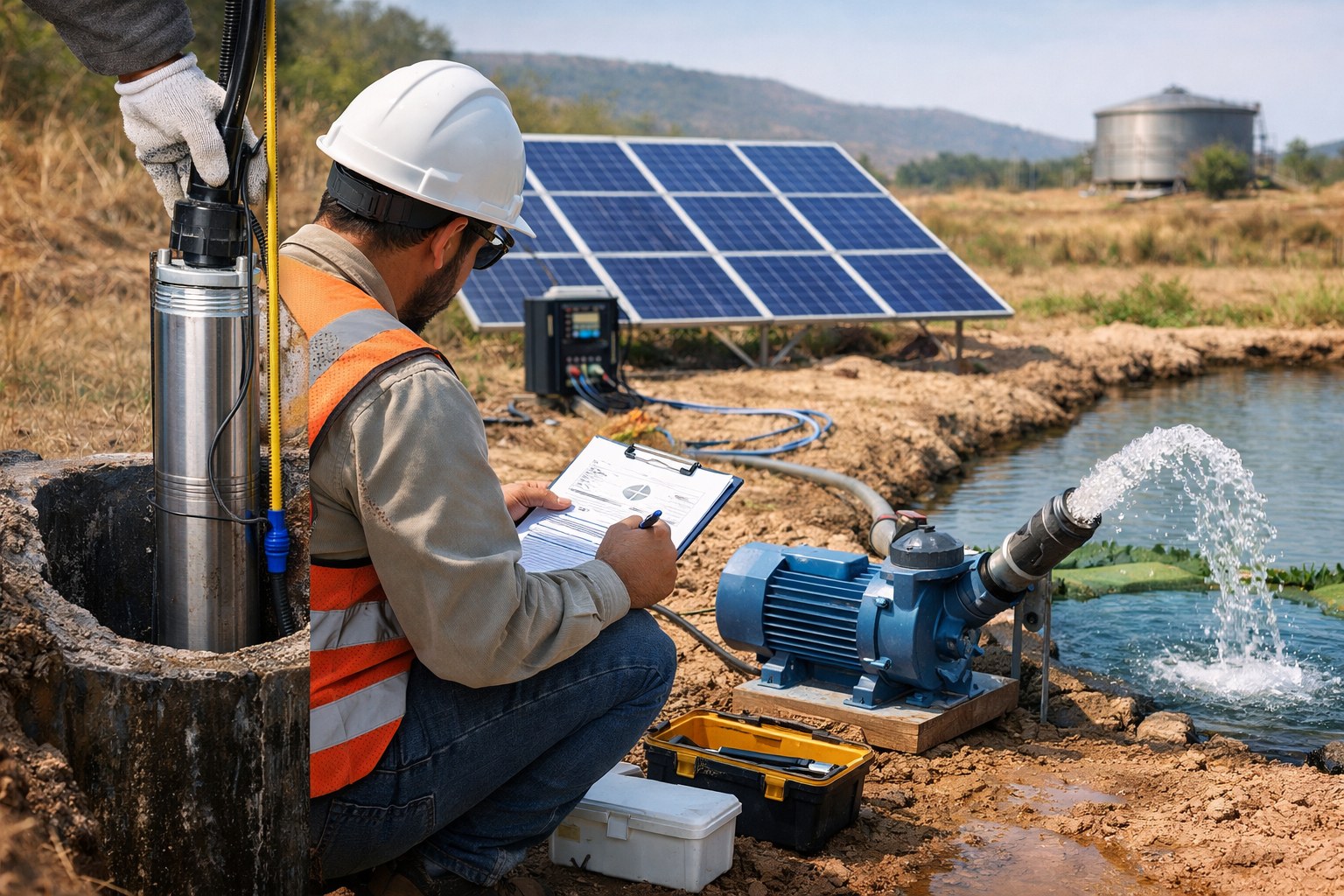
Choosing the right solar water pump can feel complex with so many variables to consider.
However, breaking down the process into clear, manageable steps makes it straightforward.
This guide will walk you through everything from calculating your water needs and understanding pump types to selecting the core motor technology, ensuring you find the perfect system for any remote application.
Let's dive into the specifics to empower your decision.
Why Choose Solar Water Pumps Over Other Options?
Tired of the constant refueling and maintenance of gas-powered pumps?
The noise, fumes, and operational costs add up quickly.
Solar pumps provide silent, clean, and fuel-free operation with minimal upkeep.
Solar water pumps are superior to gas or wind-powered alternatives due to their high reliability, near-zero maintenance, and absence of fuel costs.
While the initial investment might be higher, the long-term savings and operational simplicity deliver a much lower total cost of ownership.
When evaluating water pumping solutions, it's crucial to look beyond the initial purchase price and consider the entire lifecycle of the system.
Factors like ongoing fuel expenses, maintenance frequency, reliability, and environmental impact play a significant role in determining the true value of your investment.
Solar technology consistently emerges as the most practical and economically sound choice for a wide range of applications, especially in off-grid or remote areas where traditional power sources are either unavailable or prohibitively expensive.
Let's explore the direct comparisons in more detail.
Comparing Pumping Technologies
A side-by-side analysis reveals the clear advantages of solar-powered systems.
While options like windmills or fuel-powered generators have their place, they often come with significant drawbacks that solar pumps overcome.
The choice becomes evident when you weigh the pros and cons across key performance indicators.
| Feature | Solar Water Pump | Gas-Powered Pump | Windmill Pump |
|---|---|---|---|
| Fuel Costs | None | High & Volatile | None |
| Maintenance | Low (minimal moving parts) | High (engine servicing) | High (complex mechanics) |
| Reliability | Very High | Dependent on fuel & maintenance | Dependent on wind |
| Installation | Simple & Scalable | Simple | Complex & Specialized |
| Environmental Impact | Zero Emissions | High Noise & Fumes | Low |
| Operating Life | 20+ years | 5-10 years | 20+ years (with costly repairs) |
The Economic and Environmental Case
The economic argument for solar pumps is compelling.
The elimination of fuel costs alone can lead to a return on investment in just two to three years.
For a typical agricultural application requiring daily water pumping, fuel and maintenance for a diesel pump can cost thousands of dollars annually.
A solar system, once installed, has virtually no running costs.
Its modular nature also means you can start with a smaller system and expand it as your needs grow, adding more panels to increase water output.
Environmentally, solar pumps are a clear winner.
They produce no greenhouse gases, reduce noise pollution, and eliminate the risk of soil and water contamination from fuel spills.
This makes them an ideal choice for ecologically sensitive areas, organic farms, and providing clean drinking water for livestock and communities without compromising the surrounding environment.
Their reliability ensures a consistent water supply, which is critical during dry seasons or droughts, enhancing water security and resilience.
Understanding the Core Pump Types for Deep Wells
Do you need to draw water from a deep well?
Choosing the wrong pump can lead to inefficiency, sand damage, or insufficient water flow.
Specialized solar deep well pumps are designed for these demanding conditions.
For deep wells, pump choice depends on your specific needs: screw pumps for high head and low flow, plastic impeller pumps for high flow and wear resistance, and stainless steel impeller pumps for corrosive water and ultimate durability.
Each excels in different scenarios.
The technology behind solar deep well pumps is specifically engineered to handle the challenges of lifting water from significant depths efficiently.
Unlike surface pumps, which are limited to drawing water from shallow sources, these submersible units are built to perform reliably deep underground.
The selection process isn't about finding a single "best" pump, but rather about matching the right pump technology to your well's characteristics and water requirements.
Let's break down the three leading solutions to see which one fits your application.
1. The Solar Screw Pump: The High-Head Specialist
When your well is exceptionally deep but your water volume needs are modest, the solar screw pump is the ideal solution.
This pump operates on a progressive cavity principle, using a stainless steel screw (rotor) that turns within a rubber stator.
This action creates sealed cavities of water that are pushed progressively up to the surface.
This design allows it to generate very high pressure, making it capable of lifting water from depths where other pumps struggle.
- Best For: Deep wells (over 80 meters), low-yield wells, and applications where water pressure is more critical than a high flow rate.
- Key Advantage: Its exceptional ability to handle sandy or silty water without sustaining significant damage. The gentle pumping action and durable materials minimize wear from abrasives.
- Typical Applications: Providing drinking water for homes and livestock, small-scale irrigation for gardens or orchards, and filling storage tanks in remote areas.
2. The Solar Plastic Impeller Pump: The High-Flow Workhorse
For applications demanding a large volume of water, such as farm irrigation or supplying water to large herds of livestock, the plastic impeller pump is the go-to choice.
This multi-stage centrifugal pump uses a series of impellers and diffusers to build pressure and move water.
Modern engineered plastics make the impellers highly durable and resistant to wear from fine sand, offering an excellent balance of performance and cost-effectiveness.
- Best For: Medium- to high-flow applications, wells with moderate depth, and situations requiring significant water output.
- Key Advantage: It delivers a high flow rate at a more accessible price point compared to its stainless steel counterpart. It is also lightweight, simplifying installation.
- Typical Applications: Agricultural irrigation, pasture water supply, community water systems, and filling large ponds or reservoirs.
3. The Solar Stainless Steel Impeller Pump: The Premium Durability Option
In environments where water is corrosive or has a high mineral content, durability is paramount.
The stainless steel impeller pump is the premium solution, built to withstand the harshest conditions.
Constructed with SS304 stainless steel impellers, diffusers, and pump housing, it offers superior resistance to corrosion, rust, and abrasion.
This ensures a long, trouble-free service life even in acidic, alkaline, or saline water sources.
- Best For: Corrosive water environments, applications requiring the highest level of reliability, and supplying potable water where purity is essential.
- Key Advantage: Unmatched longevity and resistance to chemical degradation. It maintains peak performance and water quality over many years, justifying its higher initial cost.
- Typical Applications: Water supply in coastal regions, mining operations, high-end homes or ranches with poor water quality, and agricultural use in areas with alkaline soil.
The Engine of Efficiency: The BLDC Permanent Magnet Motor
Is your pump's motor wasting precious solar energy?
An inefficient motor requires more solar panels, increasing system cost and complexity.
The right motor technology is the key to maximizing every watt of solar power.
All high-performance solar pumps use a Brushless DC (BLDC) permanent magnet motor.
This core technology boasts over 90% efficiency, dramatically reducing the number of solar panels needed, lowering overall system costs, and ensuring reliable, maintenance-free operation for years.
At the heart of every elite solar water pump system lies its motor.
The motor's efficiency directly dictates the overall performance and economic viability of the entire setup.
An inefficient motor acts as a bottleneck, demanding more energy to perform the same amount of work, which translates to a larger, more expensive solar array.
This is why the transition to advanced BLDC technology has been a game-changer in the solar pumping industry, unlocking new levels of performance and affordability.
Why BLDC Technology Dominates
A Brushless DC (BLDC) motor is fundamentally different from older, brushed motor designs.
It eliminates the physical brushes and commutator, which are common points of wear and energy loss.
Instead, it uses an electronic controller to switch the motor's phases, resulting in several significant advantages:
- Unmatched Efficiency: BLDC motors consistently achieve efficiencies exceeding 90%. Traditional AC or brushed DC motors often operate at 60-75% efficiency. This 15-30% efficiency gain means the pump can deliver more water with the same amount of sunlight.
- Exceptional Durability: With no brushes to wear out, BLDC motors are virtually maintenance-free and have a much longer operational lifespan. This is a critical advantage for pumps installed in remote or hard-to-access wells.
- High Power Density: These motors, often using powerful neodymium iron boron magnets, produce high torque in a compact and lightweight package. A modern BLDC motor can be up to 47% smaller and 39% lighter than a traditional motor with the same power output, simplifying transport and installation.
The Market Value of High-Efficiency Motors
The strategic importance of a high-efficiency motor cannot be overstated.
For distributors and installers, it creates a powerful competitive advantage.
A system built around a 90%+ efficient motor requires roughly 25% fewer solar panels than a system with a 70% efficient motor to pump the same volume of water.
This translates directly into a lower upfront cost for the end user, making the entire proposition more attractive.
For the end user, the benefits are clear:
- Lower Initial Cost: Fewer solar panels and potentially smaller mounting structures reduce the total system price.
- Better Performance in Low Light: The high efficiency allows the pump to start earlier in the morning, run later in the evening, and continue operating more effectively on overcast days.
- Long-Term Reliability: The maintenance-free design provides peace of mind and eliminates the future cost and labor associated with servicing or replacing worn-out motor components.
The motor is not just a component; it is the core driver that determines the system's overall efficiency, reliability, and market competitiveness.
How to Calculate Your Solar Pump System Size
Unsure what size pump or how many solar panels you need?
Guesswork can lead to an undersized system that fails to meet your needs or an oversized one that wastes your money.
A few simple calculations will ensure your system is perfectly sized.
To size your system, you must first calculate your Total Dynamic Head (TDH) by adding vertical lift, static height, and pipe friction loss.
Then, determine your required GPM (gallons per minute).
These two figures will allow you to select the correct pump and PV array size.
Properly sizing your solar water pump system is the most critical step in the selection process.
A correctly sized system will operate efficiently, meet your water demands reliably, and provide years of trouble-free service.
The process involves understanding your specific water needs, measuring your site's physical characteristics, and using that information to calculate the necessary pump and solar array specifications.
Follow these steps to ensure you engineer the perfect system for your application.
Step 1: Determine Your Daily Water Requirements
First, estimate the total volume of water you need per day (gallons per day or GPD).
This will vary greatly depending on the application.
Use the table below for common estimates, and remember to account for seasonal variations—you'll likely need more water during hot, dry months.
| Application | Estimated Water Usage |
|---|---|
| Household Use (per person) | 50 GPD |
| Dairy Cows (per head) | 20-30 GPD |
| Cattle & Horses (per head) | 10-15 GPD |
| Young Trees (dry weather) | 15 GPD |
| Poultry (per 100 birds) | 6-12 GPD |
Once you have your total GPD, consider your water source's capacity.
For a well, you need to know its recovery rate to ensure you don't pump it dry.
For a pond or stream, assess its volume and seasonal fluctuations.
Step 2: Calculate the Total Dynamic Head (TDH)
Total Dynamic Head (TDH) is the total equivalent height that water must be lifted, taking into account both vertical distance and friction loss from pipes.
It is the most important factor in choosing a pump.
TDH is the sum of three values:
- Static Lift: The vertical distance from the low water level in your well or pond to the ground level where the solar array is.
- Static Height: The vertical distance from the ground level to the highest point of discharge (e.g., the top of a storage tank).
- Friction Loss: The pressure lost as water moves through pipes and fittings. This depends on pipe diameter, length, and flow rate. Smaller pipes and higher flow rates result in greater friction loss. You can find this value using standard friction loss charts available online.
Formula: TDH = Static Lift + Static Height + Friction Loss
Step 3: Determine the Required Pumping Rate (GPM)
Next, you need to convert your daily water needs (GPD) into the flow rate your pump must achieve during available sunlight hours (gallons per minute or GPM).
First, find the average "peak sun hours" for your location using solar radiation maps (the NREL in the US provides these).
This is typically between 4 and 6 hours for most locations.
Formula: GPM = Total GPD / (Peak Sun Hours x 60)
Example:
- You need 1,200 gallons per day (GPD).
- Your location gets 5 peak sun hours per day.
- Calculation: 1,200 GPD / (5 hours x 60 minutes) = 4 GPM
- Conclusion: You need a pump that can deliver at least 4 GPM at your calculated TDH.
With your required TDH and GPM, you can now consult pump performance charts from manufacturers to find a model that meets your exact specifications.
Finally, the manufacturer's data will specify the required wattage for your solar array.
It is always recommended to add a 25% safety margin to the solar array wattage to account for cloudy conditions, dust on panels, and other real-world inefficiencies.
Future-Proofing Your System: The AC/DC Hybrid Solution
What happens on cloudy days or when you need water at night?
A standard DC-only solar pump will stop working, leaving you without water.
This limitation can be a major problem for critical applications.
An AC/DC hybrid solar pump controller offers the ultimate solution for 24/7 water security.
It intelligently prioritizes free solar power when available but can automatically switch to grid power or a generator during low-sun conditions, ensuring an uninterrupted water supply.
While solar pumps are incredibly reliable during sunny conditions, their dependence on sunlight can be a drawback for users who require a constant, around-the-clock water supply.
To address this, advanced control technology has been developed to create hybrid systems that offer the best of both worlds: the cost-free energy from the sun and the on-demand reliability of conventional AC power.
This ensures you are never left without water, regardless of the weather or time of day.
How the Hybrid Controller Works
The AC/DC hybrid controller is the brain of the system.
It is designed with simultaneous inputs for both DC power from the solar panels and AC power from the grid or a generator.
The controller's sophisticated software constantly monitors the power available from the solar array.
- Priority on Solar: Whenever the sun is shining, the controller will draw 100% of the pump's power requirement from the solar panels. This maximizes your use of free energy and minimizes operational costs.
- Smart Blending: As clouds pass over or as the sun begins to set, the photovoltaic input will decrease. Instead of shutting down, the controller's hybrid function begins to blend AC power with the available DC power, supplementing only what is necessary to maintain the pump's operation. This function ensures maximum utilization of every bit of solar energy produced.
- Automatic Switchover: When there is no solar input at all (e.g., at night or during heavy storms), the system seamlessly and automatically switches over to the AC power source, providing uninterrupted pumping.
- Seamless Return to Solar: The next morning, as soon as the solar panels begin producing sufficient power, the controller automatically switches back to DC input, once again prioritizing solar energy.
This intelligent management of power sources provides true energy independence and water security. It's an ideal solution for residential water supply, critical livestock watering, and irrigation systems where a consistent water flow is non-negotiable. It eliminates the need for large, expensive battery banks, offering a more cost-effective and low-maintenance approach to achieving 24-hour pumping capability.
Conclusion
Choosing the right solar pump involves matching pump type to your water source, motor efficiency to your budget, and system size to your daily needs for a truly sustainable water solution.
FAQs
How deep will a solar water pump work?
A solar submersible pump can work at depths over 200 meters. The actual depth depends on the pump's design, particularly screw pumps which are made for high-head applications.
Can a solar pump work without a battery?
Yes, most solar pumps are designed to run directly off solar panels during the day. Batteries are only needed if you require water pumping at night or during cloudy periods.
How many solar panels do I need to run a water pump?
The number of panels depends on the pump motor's wattage and your location's sun hours. A 1HP (750W) pump typically requires about 900W to 1200W of solar panels.
How long do solar water pumps last?
A well-maintained solar water pump system can last for decades. The solar panels are often warrantied for 20-25 years, and brushless motors can operate for over 10 years without maintenance.
Do solar pumps work on cloudy days?
Yes, they can work on cloudy days but at a reduced flow rate. High-efficiency motors and controllers help maximize performance in low-light conditions, but output will be lower than in full sun.
What maintenance does a solar water pump require?
Maintenance is minimal. It mainly involves wiping the solar panels clean periodically and checking any inline filters. Brushless DC motors are virtually maintenance-free, unlike their gasoline counterparts.