Sizing a pond pump feels complex.
Choosing incorrectly wastes money and leads to poor performance.
This guide simplifies selecting the perfect pump for any water need.
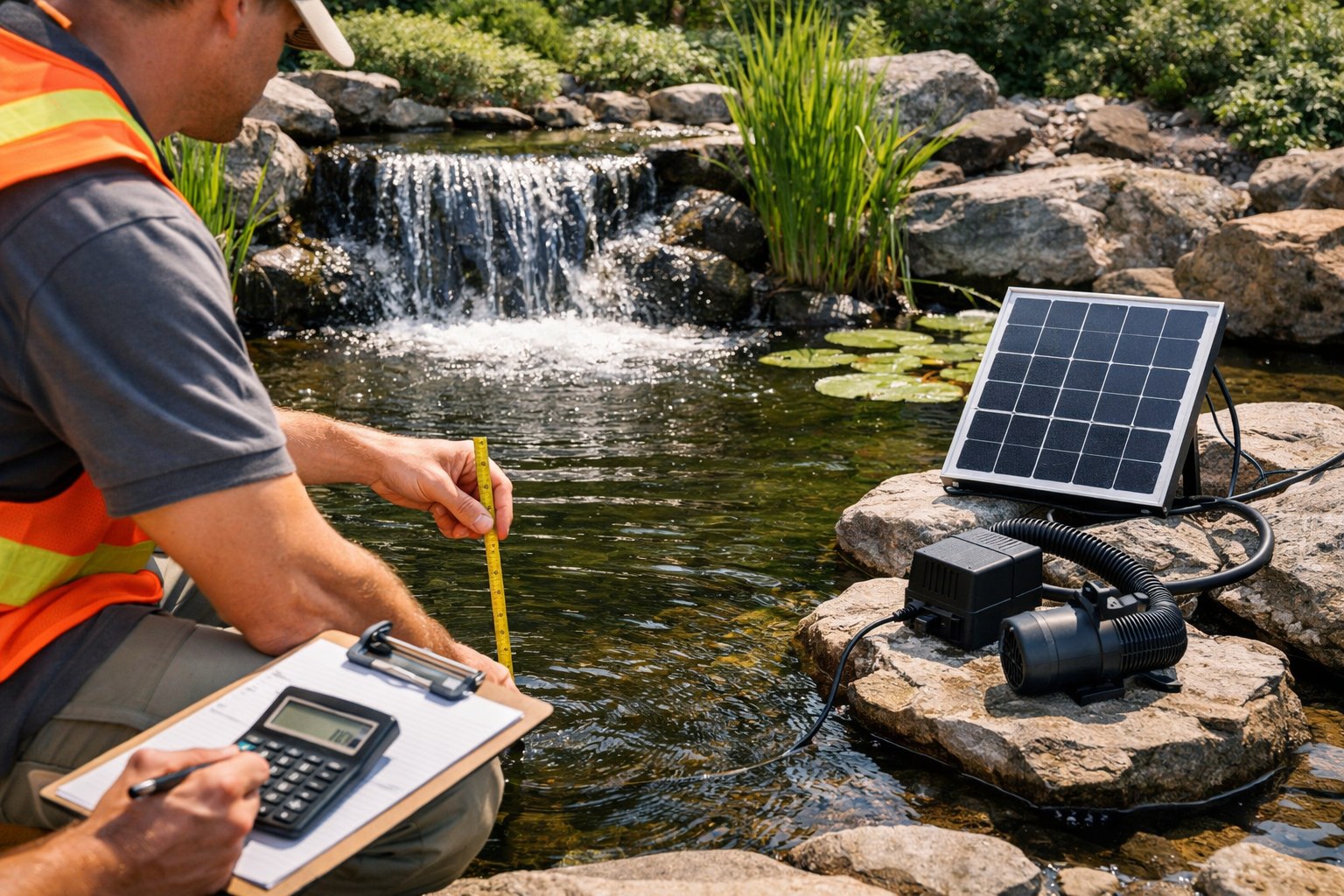
To size a solar pond pump, first calculate your pond's volume (Length x Width x Depth). A good rule of thumb is to circulate the entire volume of water at least once every two hours. For waterfalls, you need about 1,500 GPH for every foot of width.
Choosing the right size is the first step.
However, the true power lies in selecting the right type of pump technology.
Different scenarios, from domestic ponds to large-scale agricultural irrigation, demand different solutions.
Understanding the core components, like the motor and pump mechanism, ensures you invest in a system that is not only correctly sized but also efficient, durable, and perfectly suited to your specific water conditions.
This knowledge transforms a simple purchase into a long-term, cost-effective water management strategy.
Let's explore the advanced pump technologies that meet these diverse needs.
How to Choose the Right Pump by Application
Choosing the wrong pump type leads to poor performance and wasted investment.
Don't settle for a pump that can't handle your specific job.
We'll guide you to the perfect match for maximum efficiency.
Match the pump type to your water needs precisely. For deep wells and high lift (head), a solar screw pump is ideal. For high-volume applications like farm irrigation, a plastic impeller pump excels. For corrosive or acidic water, choose a durable stainless steel impeller pump.
Selecting the right pump goes beyond just flow rate and pond size.
It requires a deeper understanding of the pump's core design and how it interacts with your specific environment.
The demands of lifting water from a 100-meter deep well are vastly different from circulating water in a backyard garden.
Today's solar pump market offers specialized solutions, each engineered for a distinct purpose.
These technologies have become essential in regions like Africa, Australia, and the Americas, where grid independence and sustainability are paramount.
The key is to align the pump’s strengths with your application's challenges, whether it's high head, high flow, or harsh water quality.
Let's break down the three leading solar deep well pump technologies to clarify which one is your best investment.
The Solar Screw Pump: For Low Flow and High Head
Solar screw pumps, also known as progressive cavity pumps, are engineered for a very specific task.
They excel at producing very high pressure, or head.
This design uses a rotating stainless steel screw within a rubber stator.
As the screw turns, it creates sealed cavities of water that are pushed upwards.
This mechanism generates powerful lift but with a lower flow rate compared to other pump types.
Key Applications:
- Deep Well Water Supply: Their primary use is extracting water from very deep wells for domestic use.
- Livestock Drinking Water: Ideal for reliably supplying water to troughs in remote pastures.
- Small-Scale Irrigation: Suitable for drip irrigation systems where high pressure is needed more than high volume.
This technology is particularly transformative in off-grid areas, common in parts of Africa and Latin America, where deep groundwater is the only reliable water source.
| Feature | Specification | Advantage |
|---|---|---|
| Pumping Mechanism | Progressing Cavity (Screw) | Generates very high head pressure. |
| Best For | Deep wells, high lift | Can overcome significant vertical distances. |
| Sand Resistance | Excellent | The design handles sandy or silty water without rapid wear. |
| Flow Rate | Low | Not suitable for applications requiring large water volumes quickly. |
The main advantage is its resilience.
These pumps can operate in harsh water conditions and are highly resistant to sand, a common issue that quickly destroys other pump types.
Their limitation is clear: the low flow rate makes them unsuitable for large-scale farming or applications needing high volumes of water.
The Solar Plastic Impeller Pump: For High Flow and Wear-Resistance
When the priority is moving a large volume of water efficiently, the solar plastic impeller pump is the go-to solution.
This is a type of multi-stage centrifugal pump.
It uses a series of durable, wear-resistant plastic impellers stacked on a single shaft.
As water enters, each impeller stage adds pressure, efficiently pushing a high volume of water at a medium head.
This makes it a workhorse for agriculture and larger domestic systems.
Key Applications:
- Farm Irrigation: Perfect for flood irrigation or supplying water to multiple sprinklers.
- Pasture & Livestock: Can supply large amounts of water needed for large herds or extensive pasture management.
- Community Water Supply: Effective for providing water to small communities or multiple homes from a single well.
This pump is widely adopted in agricultural regions across the Americas and Africa.
Its design provides an excellent balance of performance and cost.
| Feature | Specification | Advantage |
|---|---|---|
| Pumping Mechanism | Multi-stage Centrifugal | Delivers high flow rates efficiently. |
| Best For | Irrigation, high volume needs | Moves large amounts of water quickly. |
| Material | Wear-resistant Plastic Impeller | Excellent resistance to fine sand; economical and lightweight. |
| Limitations | Medium Head, Durability | Not ideal for extremely deep wells or highly corrosive water. |
Its key advantage is the high water output combined with remarkable resistance to fine sand.
The lightweight nature of the plastic components also makes it more economical and easier to install.
However, its durability is a limitation in highly corrosive (acidic or alkaline) water environments or under the extreme pressures of very deep wells, where a more robust material is required.
The Solar Stainless Steel Impeller Pump: For Premium Quality and Corrosion Resistance
For the most demanding water conditions, the solar stainless steel impeller pump offers unmatched durability and reliability.
This premium model uses the same multi-stage centrifugal principle as the plastic version but with a crucial upgrade.
Both the impellers and the pump body are constructed from high-grade SS304 stainless steel.
This material choice makes the pump exceptionally resistant to corrosion, rust, and abrasion.
It is specifically designed for environments where water chemistry would quickly degrade lesser pumps.
Key Applications:
- Corrosive Water Conditions: Ideal for water with high or low pH (acidic or alkaline).
- Coastal and Saline Areas: Provides a long service life where saltwater intrusion is a risk.
- High-End Properties: Used in premium homes, ranches, and resorts where reliability is non-negotiable.
- Specialized Agriculture: Necessary in regions with alkaline soil, such as parts of Australia and the Americas.
This pump targets a more niche, high-end market where longevity and operational security justify a higher initial investment.
| Feature | Specification | Advantage |
|---|---|---|
| Pumping Mechanism | Multi-stage Centrifugal | Delivers high flow and medium-to-high head. |
| Best For | Corrosive water, long-term reliability | Unmatched durability and service life. |
| Material | SS304 Stainless Steel | Superior corrosion and abrasion resistance. |
| Limitations | Cost and Weight | Higher initial price and heavier than plastic models. |
The primary advantage is its robust construction.
The stainless steel components ensure a long service life and consistent performance even in aggressive water.
The tradeoff is a higher cost and increased weight, which can make installation more complex.
This pump represents a long-term investment in water infrastructure security.
The Core Technology: The High-Efficiency Motor
A pump is just a pump without its motor.
You can have the best pump design, but poor motor performance will ruin it.
This is where true efficiency and power come from.
All three advanced solar pump types are powered by a high-efficiency Brushless DC (BLDC) permanent magnet motor. This core technology provides efficiencies exceeding 90%, reduces solar panel requirements, and ensures a long, maintenance-free service life, making it the heart of a competitive system.
The motor is the engine that drives your entire water system.
In solar pumping, motor efficiency is everything.
A more efficient motor converts more of the sun's precious energy into usable water pressure and flow.
This directly impacts the number of solar panels you need, the overall system cost, and its performance on cloudy days.
The standard for high-performance solar pumps is the Brushless DC (BLDC) permanent magnet synchronous motor.
This isn't just a minor feature; it's a fundamental technological advantage.
Unlike older brushed motors, BLDC motors have no physical brushes to wear out, drastically increasing their lifespan and eliminating the need for maintenance.
Let's dive into why this motor technology is a game-changer.
Technical Advantages of the BLDC Permanent Magnet Motor
The innovation behind modern solar pumps lies in the motor's design and materials.
These are not your average electric motors.
They are precision-engineered for maximum output from minimal input.
The core of the motor is its rotor, which is constructed from high-strength permanent magnets, typically 40SH grade Neodymium Iron Boron (NdFeB).
These powerful magnets create a strong magnetic field without requiring electrical energy, which is a major source of loss in other motor types.
Key Technical Gains:
- Exceptional Efficiency: BLDC motor efficiency consistently exceeds 90%. Traditional asynchronous motors often operate at 60-75% efficiency. This 15-30% gain is massive in a solar-powered system.
- High Torque: The permanent magnet design delivers high starting torque, allowing the pump to start easily even in low sunlight conditions and push against high initial pressure.
- Compact and Lightweight: This advanced motor technology results in a much smaller physical footprint. A BLDC motor can be up to 47% smaller and 39% lighter than a traditional AC motor of the same power output, simplifying shipping and installation.
- Intelligent Control: BLDC motors are paired with sophisticated controllers, often featuring Maximum Power Point Tracking (MPPT). This technology constantly adjusts the electrical load to extract the maximum possible power from the solar panels as sunlight conditions change throughout the day. An MPPT controller can boost water output by up to 30% compared to a simple controller.
These technical advantages combine to create a system that is powerful, reliable, and incredibly efficient.
The market value is clear: fewer solar panels are needed to achieve the same water output, reducing the initial system cost and making solar pumping viable for more applications.
Bringing It All Together with Smart Controllers
Your solar panels and pump are powerful.
But without an intelligent controller, you're leaving performance on the table.
This brain of the system is what maximizes your investment.
A smart controller with an MPPT function is essential. It optimizes the power from your solar panels to run the pump efficiently. For 24/7 operation, an AC/DC hybrid controller automatically switches between solar and grid power, ensuring a constant water supply day and night.
The controller is the crucial link between your energy source and your pump.
Its job is to manage the variable power produced by solar panels and deliver it to the motor in the most effective way possible.
A basic controller will simply turn the pump on or off.
An advanced controller, however, transforms the system's reliability and output.
Maximum Power Point Tracking (MPPT) is the most critical feature.
Solar panels have a specific voltage and current combination—the "maximum power point"—at which they produce the most energy.
This point changes constantly with sun intensity and temperature.
An MPPT controller actively tracks this point and adjusts the electrical parameters in real-time.
This ensures that every available watt is harnessed, especially during early mornings, late afternoons, and on cloudy days.
The Power of Hybrid AC/DC Technology
For applications where water is needed 24/7, reliance on sunlight alone is a limitation.
This is where hybrid AC/DC controllers provide the ultimate solution for water security.
These controllers are designed with dual power inputs.
You can connect both your solar panel array and an AC power source (like the grid or a generator) at the same time.
How it Works:
- Solar Priority: By default, the controller will always use the free energy from the solar panels to power the pump.
- Hybrid Function: When photovoltaic power is available but insufficient (e.g., on a very cloudy day), the controller intelligently blends solar power with AC power, maximizing the use of free solar energy before drawing from the grid.
- Automatic Switchover: When there is no solar input at all (e.g., at night), the controller seamlessly and automatically switches to the AC power source.
- Seamless Operation: The switch is automatic. You don't have to do anything. The system ensures you have a reliable water supply around the clock without interruption.
This technology eliminates the main drawback of solar-only systems.
It provides the environmental and cost benefits of solar power during the day, with the absolute reliability of grid power as a backup.
For critical applications like domestic water supply, commercial operations, or intensive livestock farming, this hybrid capability offers complete peace of mind and worry-free water use.
Conclusion
Choosing the right solar pump means matching its technology—screw, plastic, or steel impeller—to your specific water source and needs, while ensuring it is powered by a high-efficiency BLDC motor.
Frequently Asked Questions
Do solar pond pumps work in winter?
Yes, they work in winter, but performance is reduced due to fewer sunlight hours. Models with efficient motors and MPPT controllers perform better in low-light conditions.
Do solar pond pumps work at night?
Standard solar pumps do not work at night. Systems with battery backup or a hybrid AC/DC controller can operate 24/7 by using stored or grid power.
How high can a solar pump lift water?
This depends on the pump type. Solar screw pumps are designed for high lift, capable of pushing water over 100 meters, while centrifugal pumps offer medium head.
What size solar pump do I need for my pond?
Circulate your pond's volume every one to two hours. For a 2,000-gallon pond, you need a pump with a flow rate of at least 1,000-2,000 GPH.
How many solar panels are needed for a water pump?
It depends on the motor's wattage. A small 1/2 HP pump might need 400-800 watts of panels, while larger agricultural pumps require significantly more.
Can I run a well pump on solar power?
Absolutely. Specialized solar well pumps, including screw and submersible centrifugal models, are designed specifically for this purpose and are highly effective in off-grid locations.
What is the difference between a solar pump and a regular pump?
A solar pump uses a DC motor designed for variable power from solar panels. A regular pump typically uses an AC motor that requires a stable grid power source.
What is an AC/DC solar pump?
It's a system with a hybrid controller that can run on DC power from solar panels or AC power from the grid, automatically switching between them for reliability.